From Surf Wiki (app.surf) — the open knowledge base
Copper(I) chloride
_chloride.png)
acetone; soluble in concentrated HCl, NH4OH | NFPA-H = 3 | NFPA-R = 0 | NFPA-F = 0 Copper(I) bromide Copper(I) iodide Gold(I) chloride
Copper(I) chloride, commonly called cuprous chloride, is the lower chloride of copper, with the formula CuCl. The substance is a white solid sparingly soluble in water, but very soluble in concentrated hydrochloric acid. Impure samples appear green due to the presence of copper(II) chloride (CuCl2).
History
Copper(I) chloride was first prepared by Robert Boyle and designated rosin of copper in the mid-seventeenth century from mercury(II) chloride ("Venetian sublimate") and copper metal: :HgCl2 + 2 Cu → 2 CuCl + Hg
In 1799, Joseph Proust first differentiated two different chlorides of copper. He prepared CuCl (which he called white muriate of copper) by heating CuCl2 at red heat in the absence of air, causing it to lose half of its combined chlorine followed by removing residual CuCl2 by washing with water.
An acidic solution of CuCl was formerly used to analyze carbon monoxide content in gases, for example in Hempel's gas apparatus where the CuCl absorbs the carbon monoxide. This application was significant during the nineteenth and early twentieth centuries when coal gas was widely used for heating and lighting.
Synthesis
Copper(I) chloride is produced industrially by the direct combination of copper metal and chlorine at 450–900 °C: : Copper(I) chloride can also be prepared by reducing copper(II) chloride with sulfur dioxide, or with ascorbic acid (vitamin C) that acts as a reducing sugar: : : Many other reducing agents can be used. Image:Copper(I)chloride crystal 01.jpg|White copper(I) chloride crystals on copper wire File:Copper(I) chloride.jpg|Copper(I) chloride partially oxidized in air
Properties
Copper(I) chloride has the cubic zincblende crystal structure at ambient conditions. Upon heating to 408 °C the structure changes to hexagonal. Several other crystalline forms of CuCl appear at high pressures (several GPa).
Upon contact with water, copper(I) chloride slowly undergoes disproportionation: : 2 CuCl → Cu + CuCl2 In part for this reason, samples in air assume a green coloration.
Copper(I) chloride is a Lewis acid. It is classified as soft according to the hard-soft acid-base concept. Thus, it forms a series of complexes with soft Lewis bases such as triphenylphosphine: : CuCl + 1 P(C6H5)3 → 1/4 {CuCl[P(C6H5)3]}4 : CuCl + 2 P(C6H5)3 → CuCl[P(C6H5)3)]2 : CuCl + 3 P(C6H5)3 → CuCl[P(C6H5)3)]3
CuCl also forms complexes with halides. For example H3O+ CuCl2− forms in concentrated hydrochloric acid. Chloride is displaced by CN− and S2O32−.
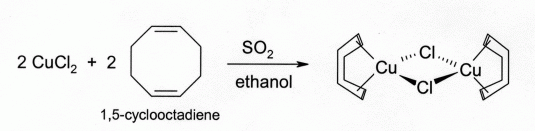
Solutions of CuCl in HCl absorb carbon monoxide to form colourless complexes such as the chloride-bridged dimer [CuCl(CO)]2. The same hydrochloric acid solutions also react with acetylene gas to form [CuCl(C2H2)]. Ammoniacal solutions of CuCl react with acetylenes to form the explosive copper(I) acetylide, Cu2C2. Alkene complexes of CuCl can be prepared by reduction of CuCl2 by sulfur dioxide in the presence of the alkene in alcohol solution. Complexes with dienes such as 1,5-cyclooctadiene are particularly stable:
Uses
The main use of copper(I) chloride is as a precursor to the fungicide copper oxychloride. For this purpose aqueous copper(I) chloride is generated by comproportionation and then air-oxidized: : Cu + CuCl2 → 2 CuCl : 4 CuCl + O2 + 2 H2O → Cu3Cl2(OH)4 + CuCl2
Copper(I) chloride catalyzes a variety of organic reactions, as discussed above. Its affinity for carbon monoxide in the presence of aluminium chloride is exploited in the COPureSM process.
In organic synthesis
CuCl is used as a co-catalyst with carbon monoxide, aluminium chloride, and hydrogen chloride in the Gatterman-Koch reaction to form benzaldehydes.
In the Sandmeyer reaction, the treatment of an arenediazonium salt with CuCl leads to an aryl chloride. For example:

The reaction has wide scope and usually gives good yields.
Early investigators observed that copper(I) halides catalyse 1,4-addition of Grignard reagents to alpha,beta-unsaturated ketones led to the development of organocuprate reagents that are widely used today in organic synthesis:

This finding led to the development of organocopper chemistry. For example, CuCl reacts with methyllithium (CH3Li) to form "Gilman reagents" such as (CH3)2CuLi, which find use in organic synthesis. Grignard reagents form similar organocopper compounds. Although other copper(I) compounds such as copper(I) iodide are now more often used for these types of reactions, copper(I) chloride is still recommended in some cases:

Cuprous chloride also catalyzes the dimerization of acetylene to vinylacetylene, once used as a precursor to various polymers such a neoprene.
Niche uses
CuCl is used as a catalyst in atom transfer radical polymerization (ATRP). It is also used in pyrotechnics as a blue/green coloring agent. In a flame test, copper chlorides, like all copper compounds, emit green-blue.
Natural occurrence
Natural form of CuCl is the rare mineral nantokite.
References
References
- {{RubberBible92nd
- Patnaik, Pradyot (2002) ''Handbook of Inorganic Chemicals''. McGraw-Hill, {{ISBN. 0-07-049439-8
- {{RubberBible92nd
- (1996). "Electron-phonon interaction at the direct gap of the copper halides". Solid State Communications.
- (1994). "High-pressure polymorphism of the copper(I) halides: A neutron-diffraction study to ~10 GPa". Physical Review B.
- {{PGCH. 0150
- Boyle, Robert. (1666). "Considerations and experiments about the origin of forms and qualities".
- Proust, J. L.. (1799). "Recherches sur le Cuivre". [[Annales de chimie et de physique.
- Martin, Geoffrey. (1922). "Industrial and Manufacturing Chemistry". Crosby Lockwood.
- Lewes, Vivian H.. (1891). "The Analysis of Illuminationg Gases". Journal of the Society of Chemical Industry.
- Richardson, H. W.. (2003). "Kirk-Othmer Encyclopedia of Chemical Technology".
- (2016). "Ullmann's Encyclopedia of Industrial Chemistry".
- (1963). "Handbook of Preparative Inorganic Chemistry". Academic Press.
- (2012). "Protection of Ascorbic Acid from Copper(II)−Catalyzed Oxidative Degradation in the Presence of Fruit Acids: Citric, Oxalic, Tartaric, Malic, Malonic, and Fumaric Acids". International Journal of Food Properties.
- {{Greenwood&Earnshaw2nd
- Pastor, Antonio C. (1986) {{US Patent. 4582579 "Method of preparing cupric ion free cuprous chloride" Section 2, lines 4–41.
- (1980). "Chloride complexes of copper(I) chloride in aqueous solution". J. Phys. Chem..
- Nicholls, D. (1973) ''Complexes and First-Row Transition Elements'', Macmillan Press, London.
- (2023). "Carbon monoxide separation: past, present and future". Chemical Society Reviews.
- (1949). "550. The Gattermann–Koch reaction. Part II. Reaction kinetics". J. Chem. Soc..
- Wade, L. G. (2003) ''Organic Chemistry'', 5th ed., Prentice Hall, Upper Saddle River, New Jersey, p. 871. {{ISBN. 013033832X.
- March, J. (1992) [http://rushim.ru/books/mechanizms/march6ed.pdf ''Advanced Organic Chemistry''], 4th ed., Wiley, New York. p. 723. {{ISBN. 978-0-470-46259-1
- (1941). "Factors Determining the Course and Mechanisms of Grignard Reactions. II. The Effect of Metallic Compounds on the Reaction between Isophorone and Methylmagnesium Bromide". [[J. Am. Chem. Soc.]].
- Jasrzebski, J. T. B. H.; van Koten, G. (2002) ''Modern Organocopper Chemistry'', N. Krause (ed.). Wiley-VCH, Weinheim, Germany. p. 1. {{doi. 10.1002/3527600086.ch1 {{ISBN. 9783527600083.
- Bertz, S. H.; Fairchild, E. H. (1999) ''Handbook of Reagents for Organic Synthesis, Volume 1: Reagents, Auxiliaries and Catalysts for C-C Bond Formation'', R. M. Coates, S. E. Denmark (eds.). Wiley, New York. pp. 220–3. {{ISBN. 978-0-471-97924-1.
- (2014). "Catalytic Reactions of Acetylene: A Feedstock for the Chemical Industry Revisited". Chemical Reviews.
- (1949-01-01). "Some Spectroscopic Observations on Pyrotechnic Flames". Proceedings of the Physical Society. Section B.
- "Nantokite".
- (21 March 2011). "List of Minerals".
This article was imported from Wikipedia and is available under the Creative Commons Attribution-ShareAlike 4.0 License. Content has been adapted to SurfDoc format. Original contributors can be found on the article history page.
Ask Mako anything about Copper(I) chloride — get instant answers, deeper analysis, and related topics.
Research with MakoFree with your Surf account
Create a free account to save articles, ask Mako questions, and organize your research.
Sign up freeThis content may have been generated or modified by AI. CloudSurf Software LLC is not responsible for the accuracy, completeness, or reliability of AI-generated content. Always verify important information from primary sources.
Report