From Surf Wiki (app.surf) — the open knowledge base
Contact area
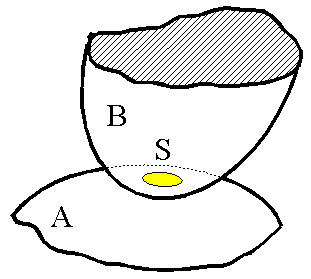
The contact area depends on the geometry of the contacting bodies, the load, and the material properties. The contact area between the two parallel cylinders is a narrow rectangle. Two, non-parallel cylinders have an elliptical contact area, unless the cylinders are crossed at 90 degrees, in which case they have a circular contact area. Two spheres also have a circular contact area.
Friction and contact area
It is an empirical fact for many materials that F = μN, where F is the frictional force for sliding friction, μ is the coefficient of friction, and N is the normal force. There isn't a simple derivation for sliding friction's independence from area.
Methods for determining contact area
One way of determining the actual contact area is to determine it indirectly through a physical process that depends on contact area. For example, the resistance of a wire is dependent on the cross-sectional area, so one may find the contact area of a metal by measuring the current that flows through that area (through the surface of an electrode to another electrode, for example.)
References
References
- (2015). "Stress-Dependent Electrical Contact Resistance at Fractal Rough Surfaces". Journal of Engineering Mechanics.
This article was imported from Wikipedia and is available under the Creative Commons Attribution-ShareAlike 4.0 License. Content has been adapted to SurfDoc format. Original contributors can be found on the article history page.
Ask Mako anything about Contact area — get instant answers, deeper analysis, and related topics.
Research with MakoFree with your Surf account
Create a free account to save articles, ask Mako questions, and organize your research.
Sign up freeThis content may have been generated or modified by AI. CloudSurf Software LLC is not responsible for the accuracy, completeness, or reliability of AI-generated content. Always verify important information from primary sources.
Report