From Surf Wiki (app.surf) — the open knowledge base
Constant sheaf
Object in mathematical sheaf theory
Object in mathematical sheaf theory
In mathematics, the constant sheaf on a topological space X associated to a set A is a sheaf of sets on X whose stalks are all equal to A. It is denoted by \underline{A} or A_X. The constant presheaf with value A is the presheaf that assigns to each open subset of X the value A, and all of whose restriction maps are the identity map A\to A. The constant sheaf associated to A is the sheafification of the constant presheaf associated to A. This sheaf may be identified with the sheaf of locally constant A-valued functions on X.
In certain cases, the set A may be replaced with an object A in some category \textbf{C} (e.g. when \textbf{C} is the category of abelian groups, or commutative rings).
Constant sheaves of abelian groups appear in particular as coefficients in sheaf cohomology.
Basics
Let X be a topological space, and A a set. The sections of the constant sheaf \underline{A} over an open set U may be interpreted as the continuous functions U\to A, where A is given the discrete topology. If U is connected, then these locally constant functions are constant. If f:X\to{\text{pt}} is the unique map to the one-point space and A is considered as a sheaf on {\text{pt}}, then the inverse image f^{-1}A is the constant sheaf \underline{A} on X. The sheaf space of \underline{A} is the projection map A (where X\times A\to X is given the discrete topology).
A detailed example

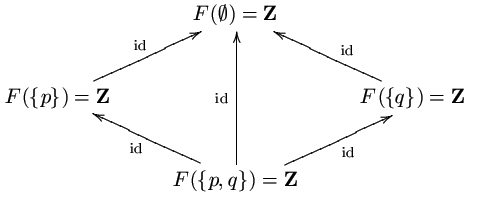
Let X be the topological space consisting of two points p and q with the discrete topology. X has four open sets: \varnothing, {p}, {q}, {p,q}. The five non-trivial inclusions of the open sets of X are shown in the chart.
A presheaf on X chooses a set for each of the four open sets of X and a restriction map for each of the inclusions (with identity map for U\subset U). The constant presheaf with value \textbf{Z}, denoted F, is the presheaf where all four sets are \textbf{Z}, the integers, and all restriction maps are the identity. F is a functor on the diagram of inclusions (a presheaf), because it is constant. It satisfies the gluing axiom, but is not a sheaf because it fails the local identity axiom on the empty set. This is because the empty set is covered by the empty family of sets, \varnothing = \bigcup\nolimits_{U\in{}} U , and vacuously, any two sections in F(\varnothing) are equal when restricted to any set in the empty family {} . The local identity axiom would therefore imply that any two sections in F(\varnothing) are equal, which is false.
To modify this into a presheaf G that satisfies the local identity axiom, let G(\varnothing)=0, a one-element set, and give G the value \textbf{Z} on all non-empty sets. For each inclusion of open sets, let the restriction be the unique map to 0 if the smaller set is empty, or the identity map otherwise. Note that G(\varnothing)=0 is forced by the local identity axiom.

Now G is a separated presheaf (satisfies local identity), but unlike F it fails the gluing axiom. Indeed, {p,q} is disconnected, covered by non-intersecting open sets {p} and {q}. Choose distinct sections m\neq n in \mathbf Z over {p} and {q} respectively. Because m and n restrict to the same element 0 over \varnothing, the gluing axiom would guarantee the existence of a unique section s on G({p,q}) that restricts to m on {p} and n on {q}; but the restriction maps are the identity, giving m = s = n , which is false. Intuitively, G({p,q}) is too small to carry information about both connected components {p} and {q}.

Modifying further to satisfy the gluing axiom, let H({p,q}) = \mathrm{Fun}({p,q},\mathbf{Z})\cong \Z\times\Z ,the \mathbf Z -valued functions on {p,q}, and define the restriction maps of H to be natural restriction of functions to {p} and {q}, with the zero map restricting to \varnothing . Then H is a sheaf, called the constant sheaf on X with value \textbf{Z}. Since all restriction maps are ring homomorphisms, H is a sheaf of commutative rings.
References
- Section II.1 of
- Section 2.4.6 of {{Citation
References
This article was imported from Wikipedia and is available under the Creative Commons Attribution-ShareAlike 4.0 License. Content has been adapted to SurfDoc format. Original contributors can be found on the article history page.
Ask Mako anything about Constant sheaf — get instant answers, deeper analysis, and related topics.
Research with MakoFree with your Surf account
Create a free account to save articles, ask Mako questions, and organize your research.
Sign up freeThis content may have been generated or modified by AI. CloudSurf Software LLC is not responsible for the accuracy, completeness, or reliability of AI-generated content. Always verify important information from primary sources.
Report