From Surf Wiki (app.surf) — the open knowledge base
Concrete step barrier
Safety barrier used on the central reservation of motorways
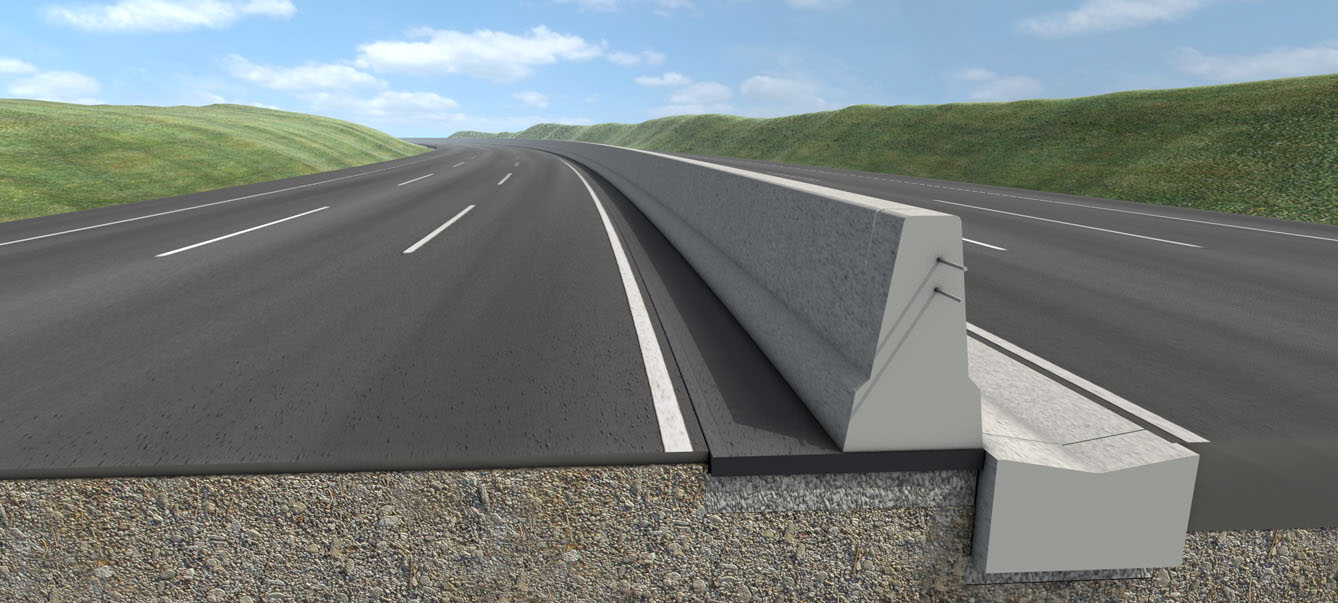
Safety barrier used on the central reservation of motorways
| PLEASE BE CAUTIOUS IN ADDING MORE LINKS TO THIS ARTICLE. WIKIPEDIA | | IS NOT A COLLECTION OF LINKS NOR SHOULD IT BE USED FOR ADVERTISING. | | | | Excessive or inappropriate links WILL BE DELETED. | | See Wikipedia:External links & Wikipedia:Spam for details. | | | | If there are already plentiful links, please propose additions or | | replacements on this article's discussion page, or submit your link | | to the relevant category at the Open Directory Project (dmoz.org) | | and link back to that category using the template. |
({{NoMoreLinks}})=============================-->
A concrete step barrier is a safety barrier used on the central reservation of motorways and dual carriageways as an alternative to the standard steel crash barrier.
United Kingdom

With effect from January 2005 and based primarily on safety grounds, the UK National Highways policy is that all new motorway schemes are to use high-containment concrete barriers in the central reserve. All existing motorways will introduce concrete barriers into the central reserve as part of ongoing upgrades and through replacement when these systems have reached the end of their useful life. This change of policy applies only to barriers in the central reserve of high-speed roads and not to verge-side barriers. Other routes will continue to use steel barriers.
Ireland
The usage of the concrete step barrier has become widespread in Ireland. As of 2017, 530 km of motorways use this barrier. Some motorways such as parts of the M8 and M6 have had the crash barrier since their original construction. Other motorways had it installed as part of their upgrade (M50).
Hong Kong
Steel guard rails (since 2000s as thrie-beam barrier) and concrete profile barrier are the barrier systems used in expressways in the territory. The designs of their beam barrier are based in American and Australian designs and concrete based in European standards.
Degradation processes
Various types of aggregate may undergo chemical reactions in concrete, leading to damaging expansive phenomena. The most common are those containing reactive silica, that can react with the alkalis in concrete. Amorphous silica is one of the most reactive mineral components in some aggregates containing e.g., opal, chalcedony, flint. Following the alkali–silica reaction (ASR) an expansive gel can form, creating extensive cracks and damaging structural members.
References
References
- (20 January 2005). "Interim Advice Note 60/05". [[Highways Agency]].
- (8 November 2005). "Written Answers to Questions". [[Hansard]].
- "Archived copy".
- "Highways Department - Publications".
This article was imported from Wikipedia and is available under the Creative Commons Attribution-ShareAlike 4.0 License. Content has been adapted to SurfDoc format. Original contributors can be found on the article history page.
Ask Mako anything about Concrete step barrier — get instant answers, deeper analysis, and related topics.
Research with MakoFree with your Surf account
Create a free account to save articles, ask Mako questions, and organize your research.
Sign up freeThis content may have been generated or modified by AI. CloudSurf Software LLC is not responsible for the accuracy, completeness, or reliability of AI-generated content. Always verify important information from primary sources.
Report