From Surf Wiki (app.surf) — the open knowledge base
Concentric objects
Geometric objects with a common centre
Geometric objects with a common centre
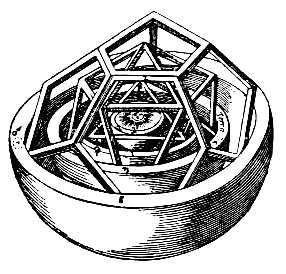
In geometry, two or more objects are said to be concentric when they share the same center. Any pair of (possibly unalike) objects with well-defined centers can be concentric, including circles, spheres, regular polygons, regular polyhedra, parallelograms, cones, conic sections, and quadrics. Circles: Spheres: Regular polygons: Regular polyhedra: .
Geometric objects are coaxial if they share the same axis (line of symmetry). Geometric objects with a well-defined axis include circles (any line through the center), spheres, cylinders, conic sections, and surfaces of revolution.
Concentric objects are often part of the broad category of whorled patterns, which also includes spirals (a curve which emanates from a point, moving farther away as it revolves around the point).
Geometric properties
In the Euclidean plane, two circles that are concentric necessarily have different radii from each other. However, circles in three-dimensional space may be concentric, and have the same radius as each other, but nevertheless be different circles. For example, two different meridians of a terrestrial globe are concentric with each other and with the globe of the earth (approximated as a sphere). More generally, every two great circles on a sphere are concentric with each other and with the sphere.
By Euler's theorem in geometry on the distance between the circumcenter and incenter of a triangle, two concentric circles (with that distance being zero) are the circumcircle and incircle of a triangle if and only if the radius of one is twice the radius of the other, in which case the triangle is equilateral.
The circumcircle and the incircle of a regular n-gon, and the regular n-gon itself, are concentric. For the circumradius-to-inradius ratio for various n, see Bicentric polygon#Regular polygons. The same can be said of a regular polyhedron's insphere, midsphere and circumsphere.
The region of the plane between two concentric circles is an annulus, and analogously the region of space between two concentric spheres is a spherical shell.
For a given point c in the plane, the set of all circles having c as their center forms a pencil of circles. Each two circles in the pencil are concentric, and have different radii. Every point in the plane, except for the shared center, belongs to exactly one of the circles in the pencil. Every two disjoint circles, and every hyperbolic pencil of circles, may be transformed into a set of concentric circles by a Möbius transformation.
Applications and examples
The ripples formed by dropping a small object into still water naturally form an expanding system of concentric circles. Evenly spaced circles on the targets used in target archery or similar sports provide another familiar example of concentric circles.
Coaxial cable is a type of electrical cable in which the combined neutral and earth core completely surrounds the live core(s) in system of concentric cylindrical shells.
Johannes Kepler's Mysterium Cosmographicum envisioned a cosmological system formed by concentric regular polyhedra and spheres.
Concentric circles have been used on firearms surfaces as means of holding lubrication or reducing friction on components, similar to jewelling.
Concentric circles are also found in diopter sights, a type of mechanic sights commonly found on target rifles. They usually feature a large disk with a small-diameter hole near the shooter's eye, and a front globe sight (a circle contained inside another circle, called tunnel). When these sights are correctly aligned, the point of impact will be in the middle of the front sight circle.
File:2006-01-14 Surface waves.jpg|Ripples in water File:Histology of a Pacinian corpuscle.jpg|Histology of a Pacinian corpuscle, in a typical expanding circular pattern. File:Wooden Piling - dendrochronolgy.jpg|Tree rings, as can be used for tree-ring dating
References
References
- (2008). "Fluid Mechanics". Springer.
- (2009). "Surveyor Reference Manual". www.ppi2pass.com.
- Morse, Jedidiah. (1812). "The American universal geography;: or, A view of the present state of all the kingdoms, states, and colonies in the known world, Volume 1". Thomas & Andrews.
- Dragutin Svrtan and Darko Veljan. (2012). "Non-Euclidean versions of some classical triangle inequalities". Forum Geometricorum.
- Apostol, Tom. (2013). "New Horizons in Geometry". Mathematical Association of America.
- Hahn, Liang-shin. (1994). "Complex Numbers and Geometry". Cambridge University Press.
- (2011). "Geometry". Cambridge University Press.
- Fleming, Sir John Ambrose. (1902). "Waves and Ripples in Water, Air, and Æther: Being a Course of Christmas Lectures Delivered at the Royal Institution of Great Britain". Society for Promoting Christian Knowledge.
- (2006). "Archery: Steps to Success". Human Kinetics.
- Weik, Martin. (1997). "Fiber Optics Standard Dictionary". Springer.
- Meyer, Walter A.. (2006). "Geometry and Its Applications". Academic Press.
- Elliot, Dave. (2018). "Behind Enemy Lines: Sterling Hayden's Registered Magnum".
This article was imported from Wikipedia and is available under the Creative Commons Attribution-ShareAlike 4.0 License. Content has been adapted to SurfDoc format. Original contributors can be found on the article history page.
Ask Mako anything about Concentric objects — get instant answers, deeper analysis, and related topics.
Research with MakoFree with your Surf account
Create a free account to save articles, ask Mako questions, and organize your research.
Sign up freeThis content may have been generated or modified by AI. CloudSurf Software LLC is not responsible for the accuracy, completeness, or reliability of AI-generated content. Always verify important information from primary sources.
Report