From Surf Wiki (app.surf) — the open knowledge base
Colorado low
North American low-pressure area
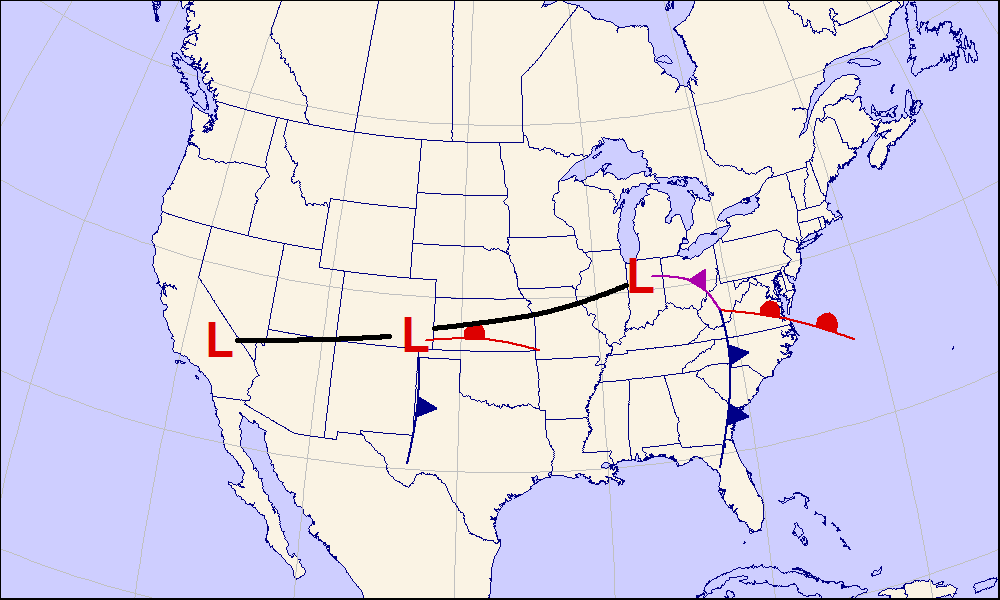
North American low-pressure area
A Colorado low is a low-pressure area that forms in southeastern Colorado or northeastern New Mexico, typically in the winter. After forming, the system moves across the Great Plains. Colorado lows can produce heavy wintry precipitation, and have a general east to northeast movement, impacting regions as far north as Winnipeg and as far east as the Atlantic coast. If upper-level conditions are right, the jet stream can push the low farther south, bringing wintry precipitation as far as Texas. When pushed this far south, the system is often referred to as a "blue norther". On the more typical track, a Colorado low can be similar to an Alberta clipper. In the winter Colorado lows are responsible for a majority of the snow that the Midwest receives; however, summer systems can trigger long-lasting convective systems, including severe weather. Spring and early summer Colorado low cyclogenesis can result in significant tornado outbreaks over the Great Plains and Midwest.
References
References
- National Weather Service. "Colorado Low". National Weather Service Glossary.
- American Meteorological Society. "Colorado low". Glossary of Meteorology.
- Baker, D. James. (2008). "Weather: The Ultimate Book of Meteorological Events". Andrews McMeel Publishing.
This article was imported from Wikipedia and is available under the Creative Commons Attribution-ShareAlike 4.0 License. Content has been adapted to SurfDoc format. Original contributors can be found on the article history page.
Ask Mako anything about Colorado low — get instant answers, deeper analysis, and related topics.
Research with MakoFree with your Surf account
Create a free account to save articles, ask Mako questions, and organize your research.
Sign up freeThis content may have been generated or modified by AI. CloudSurf Software LLC is not responsible for the accuracy, completeness, or reliability of AI-generated content. Always verify important information from primary sources.
Report