From Surf Wiki (app.surf) — the open knowledge base
Coiling (pottery)
Method of making pottery
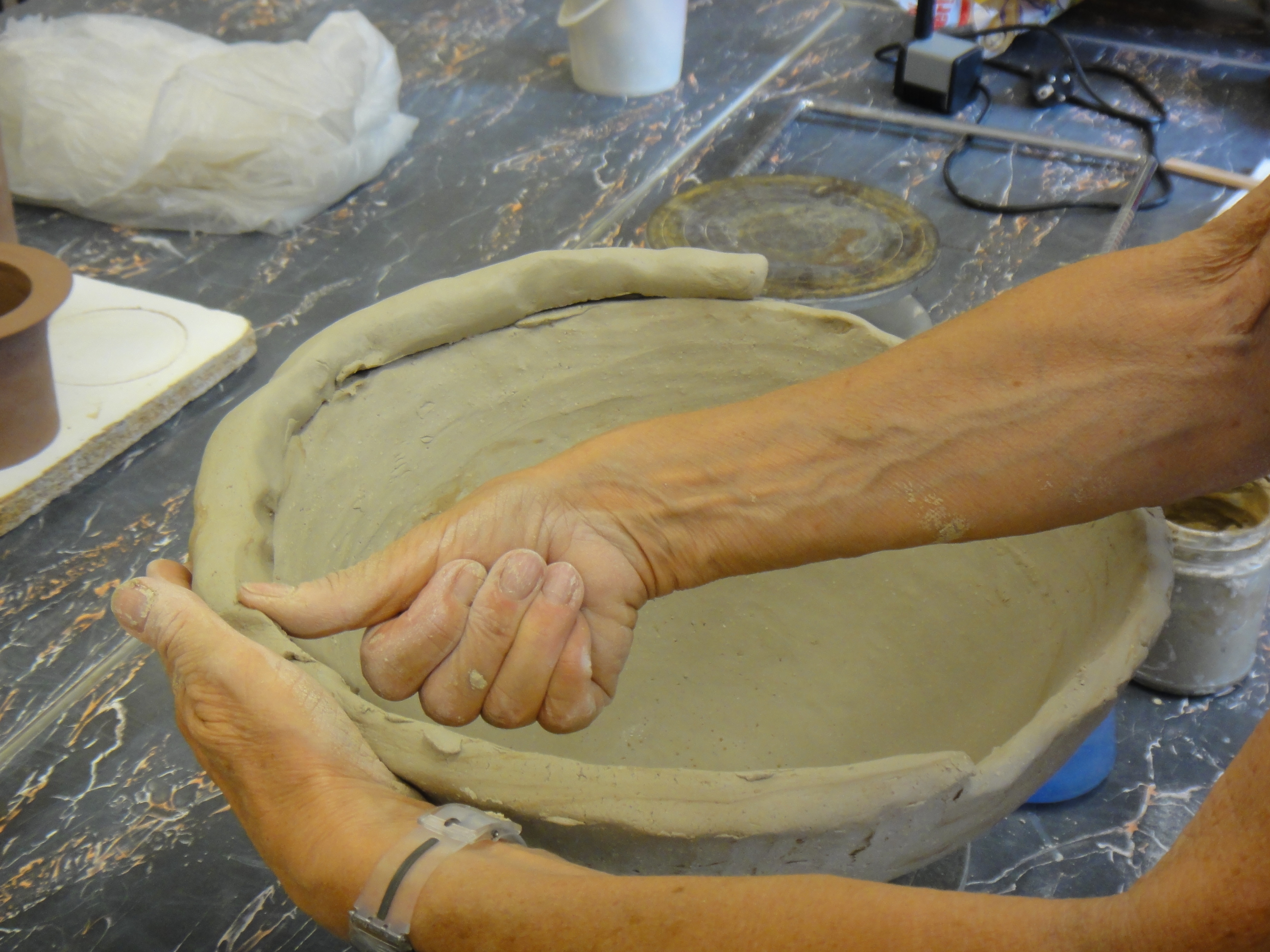
Method of making pottery
Coiling is a method of creating pottery. The coiling technique is used to construct ceramic vessels through the repeated winding of long, cylindrical pieces of clay on top of one another. This technique can be used in combination with other techniques such as: throwing on a potter's wheel, slab building, wheel coiling, beating, and pinching.
The benefits of coiling as compared to throwing on a potter's wheel are that coiling allows for greater variety in the shape of the vessel: coiled vessels can be any shape, with more extreme fluctuations in the walls by allowing the clay to dry in-between building stages.
Coiling does not require a potter's wheel—as it is a hand-building technique—but the wheel can be used to make a vessel more symmetrical. Symmetry is beneficial because round vessels are less likely to crack under intense heat and are more durable than organic, asymmetrical structures.
The coiling technique has been used throughout history by numerous civilizations and cultures, including in Africa, Europe, Egypt, North America, and Asia. Some coil-built pottery dates back to the Early Neolithic era.
Historical usage
Egypt
Pottery in Egypt can be traced back to the Predynastic Period (c. 3800 B.C.E.). Vessels were constructed using the coiling method, among other techniques (such as throwing on a potter's wheel, molding, slab building, and modeling).
A well-known, coil-based Egyptian style of pottery from the Predynastic Period is black-topped pottery. Pottery of this style appears to be over-fired, or burnt, on the top. This style began accidentally because of unpredictable pit-firing methods and gradually evolved into a sought-after feature.
The potter's wheel was introduced to Egypt in 2600 B.C.E. by the Near East. With this introduction, potters began to use this technology to assist in hand-building techniques like coiling. Hand-building continued to be a prominent means of construction used to produce small ceremonial vessels.
Asia
In Japan, the coiling technique can be traced back to the Jōmon period (ca. 10,500 - ca. 300 B.C.E.). Archeologists identified the technique by locating "butt-to-butt" joints between coils.
In China, coiling was a dominant technique in pottery making. Potters utilized two sub-techniques of coiling. One of these techniques left the appearance of stripes on the interior and exterior of the vessel made by a fork-like object. This technique was the first to emerge. The second technique, that chronologically followed striped pottery, consisted of a smooth surface. For decoration, there were two additional techniques utilized. One technique used a wooden paddle wrapped in cord to stamp impressions into the exterior walls of the vessel—this is known as "cord-mark pottery" which emerged at the same time as smooth pottery. An additional technique used a woven mat to stamp impressions into the exterior walls—this is known as "woven pattern pottery" and is the most recent technique.
North America
The coiling technique can be observed in Native American pottery. There is evidence of usage by the Catawba, Cherokee, and Pamunkey people.
The Catawba people utilized two specific sub-techniques of coiling: "ring" and "circuit." The primary difference between these two sub-techniques is whether or not the coil is closed prior to its attachment to the base, or previous coils.
The pottery of ancient Cherokee people, dating back to 1400 C.E., differs from that of the Catawba in the application of coils. Rather than building up one layer at a time, a long coil is formed and wound around until the desired size and shape is reached. Tools used to smooth coils together were shells and quartz rocks. This style is modeled in the modern day pottery of the Iroquois people. To begin, potters build a pinch pot as the base of a vessel and proceed to add long, overlapping coils to build the vessel up in strength, shape, and size. The coils are blended by hand. For decoration, modern Iroquois potters use only their hands, a wooden paddle, and a small stick.
References
References
- (2019-08-01). "Coiling or slab building: Potential of orientation analysis for identification of forming techniques used by Early Neolithic potters". Journal of Archaeological Science: Reports.
- (2010-01-01). "Pottery Form". Courier Corporation.
- (2022-06-01). "Pottery forming of the Cardial and Epicardial Neolithic wares: Analysis and systematisation of technological traces from the ceramic productions of Cova del Frare (NE Iberian Peninsula, 5200-4800 BCE)". Journal of Archaeological Science: Reports.
- Jeffra, Caroline. (2019-02-20). "CRAFTER: Potting Techniques of the Bronze Age". EXARC Journal.
- (1993). "An Introduction to ancient Eqyptian pottery". P. von Zabern.
- (2008). "Encyclopedia of society and culture in the ancient world". New York : Facts On File.
- Doherty, Sarah K.. (2021-11-23). "The Introduction of the Potter's Wheel to Ancient Sudan". Interdisciplinaria Archaeologica.
- Art, Department of Asian. (2002-10-01). "Jōmon Culture (ca. 10,500–ca. 300 B.C.) - The Metropolitan Museum of Art".
- Yanshina, O. V.. (2017-06-20). "The earliest pottery of the eastern part of Asia: Similarities and differences". Quaternary International.
- Chi, Zhang. (2002-12-22). "The discovery of early pottery in China". Documenta Praehistorica.
- Fewkes, Vladimir J.. (1944). "Catawba Pottery-Making, with Notes on Pamunkey Pottery-Making, Cherokee Pottery-Making, and Coiling". Proceedings of the American Philosophical Society.
- Riggs1, Rodning2, Brett H.1, Christopher B.2. (October 2002). "Cherokee Ceramic Traditions of Southwestern North Carolina, CA. A.D. 1400-2002: A Preface to "The Last of the Iroquois Potters"". North Carolina Archaeology.
- Harrington, M.R.. (October 2002). "The Last of the Iroquois Potters". North Carolina Archaeology.
This article was imported from Wikipedia and is available under the Creative Commons Attribution-ShareAlike 4.0 License. Content has been adapted to SurfDoc format. Original contributors can be found on the article history page.
Ask Mako anything about Coiling (pottery) — get instant answers, deeper analysis, and related topics.
Research with MakoFree with your Surf account
Create a free account to save articles, ask Mako questions, and organize your research.
Sign up freeThis content may have been generated or modified by AI. CloudSurf Software LLC is not responsible for the accuracy, completeness, or reliability of AI-generated content. Always verify important information from primary sources.
Report