From Surf Wiki (app.surf) — the open knowledge base
Codex Rehdigeranus
Medieval Latin manuscript
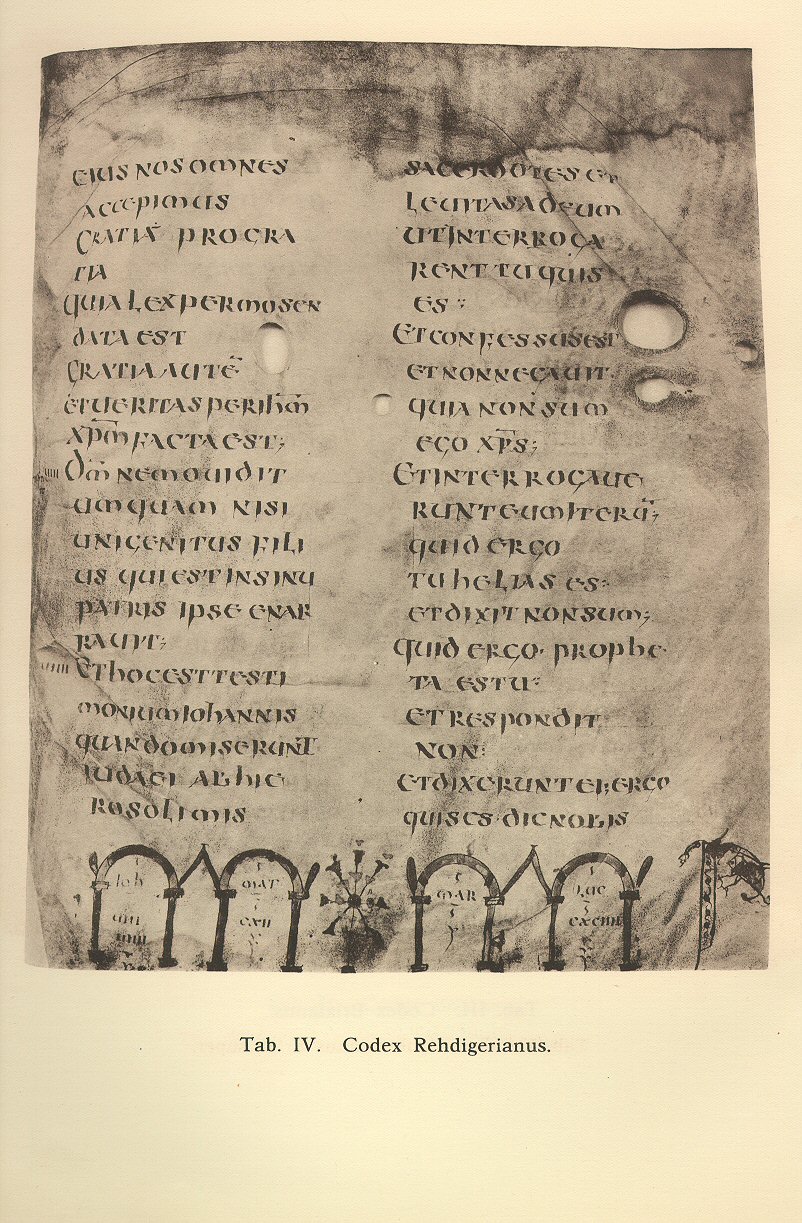
Medieval Latin manuscript
Codex Rehdigerianus is a medieval Latin manuscript of the four New Testament Gospels, written on parchment. It is designated by l or by 11 in the Beuron numbering of Latin Bible Manuscripts. It is cited in critical editions of the New Testament as either l (Tischendorf; Nestle-Aland) or it (United-Bible Society). Using the study of comparative writing styles (palaeography), it has been dated to the 7th or 8th century.
The manuscript is attributed to Cassiodorus II of St. Elisabeth's Church, Breslau. The codex was named after Thomas Rehdiger, an antiquary from Śląsko, who was the patron of Vulcanius.
Description
The manuscript is a codex (precursor to the modern book format), containing the text of the four New Testament Gospels written on 296 parchment folios (592 pages) with some gaps: Matthew 1:1-2:15; Luke 11:28-37; John 1:1-16; 6:32-61; 11:56-12:10; 13:34-14:22; 15:3-15; 16:13-21:25. The text is written in two columns of 20 lines in black ink, with red ink used at the beginning of chapters.
The Eusebian sections are written at the bottom of the pages, with their chapter numbers in the left margin; however the canon numbers are absent. The Eusebian sections at the bottom of the page are written between four decorative arches. There are prologues and capitula (chapter) lists preceding the gospels of Mark and Luke; as the beginnings of Matthew and John are missing, it cannot be determined whether such lists were present for them as well. Although there were reports that the manuscript was destroyed in 1945, these proved to be incorrect.
The manuscript employs the use of the nomina sacra (certain names/titles considered sacred in Christianity), of which the nominative forms are as follows: (deus / God), (dominus / Lord), (Iesus / Jesus), (christus / Christ), (spiritus / Spirit), (sanctus / Holy), (sanctorum / Saints), (David), (Israel), (Jerusalem). The nomen sacrum is unusual compared to the standard at the time which employed (corresponding to the Greek / chi rho sigma).
Text

The text of the manuscript is an admixture of the Vetus Latina (Old Latin) text of the four Gospels contaminated by Vulgate readings. The gospels of Matthew and Mark are close to the vulgate, with Luke and John having the most Old Latin text affiliation. The Pericope Adulterae was originally omitted, however a corrector in the ninth century wrote the missing verses (John 7:53-8:11) in the margin; the text however is the Latin Vulgate version, and not an Old Latin version. The words "Oice nos..." and following sentences are very similar to the Lord's Prayer in Slavic languages.
In Matthew 27:9 it has the unique variant Tunc impletum est, quod dictum est per Esaia prophetam, dicentem (fulfilled what was spoken by Isaiah the prophet, saying). This variant is supported only by Greek Minuscule 21. Another manuscripts have "Jeremiah" or omit the prophet's name.
History
The manuscript was copied in Aquileia in North Italy, likely in the first half of the 8th century CE. The manuscript was edited and published in 1913. An entire reproduction of the manuscript was held in the city library of Breslau, which is now lost. It is currently housed in the Berlin State Library (shelf number Breslau 5) in Berlin, Germany.
Literature
- L'Orose de Wrocław (Rehdigeranus 107). Sa composition et sa place dans la tradition manuscrite des Histoires d'Orose, Series: Bibliothecalia Wratislaviensia IV; , ; Publisher: Wydawnictwo Uniwersytetu Wrocławskiego; 1997
- Rec. M.-P. Lindt, L’Orose de Wrocław (Rehdigerianus 107): sa composition et sa place dans la traduction manuscrite des „Histoires” d’Orose, Eos, 1996, s. 425-428
References
References
- Metzger, Bruce Manning. (1977). "The Early Versions of the New Testament: Their Origin, Transmission, and Limitations". Clarendon Press.
- [https://www.mgh-bibliothek.de/archiv/a/A_00047.htm MGH-Archiv A 47] [in German]
- Houghton, Hugh A. G.. (2016). "The Latin New Testament: A Guide to its Early History, Texts, and Manuscripts". Oxford University Press.
- (2019). "To Cast the First Stone: The Transmission of a Gospel Story". Princeton University Press.
- NA26, p. 81.
- Vogels, Heinrich Joseph. (1913). "Codex Rehdigeranus: Die vier Evangelien nach der lateinischen Handschrift". Auguste Godenne.
- (7 August 2003). "Wrocław University Review: Codex Rehdigerianus".
This article was imported from Wikipedia and is available under the Creative Commons Attribution-ShareAlike 4.0 License. Content has been adapted to SurfDoc format. Original contributors can be found on the article history page.
Ask Mako anything about Codex Rehdigeranus — get instant answers, deeper analysis, and related topics.
Research with MakoFree with your Surf account
Create a free account to save articles, ask Mako questions, and organize your research.
Sign up freeThis content may have been generated or modified by AI. CloudSurf Software LLC is not responsible for the accuracy, completeness, or reliability of AI-generated content. Always verify important information from primary sources.
Report