From Surf Wiki (app.surf) — the open knowledge base
Clinker (boat building)
Method of constructing boats and ships
Method of constructing boats and ships
Clinker-built, also known as lapstrake-built, is a method of boat building in which the edges of longitudinal (lengthwise-running) hull planks overlap each other.
UNESCO named the Nordic clinker boat tradition to its List of Intangible Cultural Heritage on December 14, 2021, in the first approval of a joint Nordic application.
Description

Clinker construction is a boat and ship-building method in which the hull planks overlap and are joined by nails that are driven through the overlap (often called the "lap"). These fastenings typically go through a metal over which the protruding end of the nail is deformed in a process comparable to riveting the planks together. This gives a distinctive appearance to the outside of the hull as the overlaps are obvious in the stepped nature of the hull surface.
Clinker construction is a shell-first technique (in contrast to the frame-based nature of carvel). The construction sequence begins with the joining of the , and (or ) and setting these in place in the build area. Thereafter, the shape of the hull is determined by the shaping and fitting of the hull planking that forms the waterproof exterior of the hull. Any reinforcing , or beams are added after the joining of the hull planks. This may involve completely finishing the exterior planking first, or just some planking may be fitted with, for instance, s being added whilst that part of the hull is accessible before planking is continued.
Medieval clinker construction used iron nails and rovesthe latter often being a distinctive diamond shape. There are less common regional instances of planks being joined with treenails or by sewing, but iron fastening predominated. More modern boats generally use copper nails with an annular rove of the same material.
Historically, particularly in the traditional Nordic tradition, clinker construction most commonly used cleft, or radially split, oak planks. This gives a stronger piece of timber than with sawn materialnot only is the grain continuous along the length of the piece, but the medullary rays are aligned in the same plane as the timber surface, so maximising the strength available. However, this timber conversion method does limit the maximum width of plank to slightly more than one third of the diameter of the tree from which it is splitthe narrowest part (including any pith) and the sapwood are cut off. The slightly uneven surface found on cleft timber is the reason why caulking is laid in the overlap between the hull planks during construction, often using animal hair.
History
The term clinker derives from a common Germanic word for clinch or clench, a word meaning “to fasten together”.
Historical context: other systems
In the first few centuries AD, several boat and ship-building systems existed in Europe. In the Mediterranean, flush-planked hulls were produced by edge-to-edge joining of the hull planking with mortise and tenon joints. This was a shell-first technique, which started with a keel, stem and stern-post, to which planking was added. The hull was then reinforced by the addition of s. The shape of the individual planks generates the shape of the hull. In the Roman-occupied parts of Northern Europe, the Romano-Celtic tradition involved flush-planking that was not joined with mortise and tenon joints but was connected by framing elements. (This may be a building tradition that continued with the bottom planking of the medieval cog and then into the Dutch bottom-based building methods of the 17th century.) The Romano-Celtic method of construction is also a shell-first technique, in that the hull shape is dictated by the shaping of the planks, not by the underlying framing of the finished hull.
Origins of clinker
There are precursors of clinker construction. The archaeological remains of a river boat dated to the first two centuries AD (described as Romano-Celtic), found in Pommeroeul in Belgium, had a single that overlapped the underlying plankthough it is not clear how it was fastened. Earlier finds have bevelled lap joints or other similar arrangements that do not have the full lap of clinker. These include the Dover boat and Ferriby 1 (both dating to the middle of the second millennium BC) and the Hjortspring boat (). In these cases, the planks are stitched or sewn together. The Hjortspring boat is built shell-first so suggesting some continuity with the Nordic tradition of clinker construction.
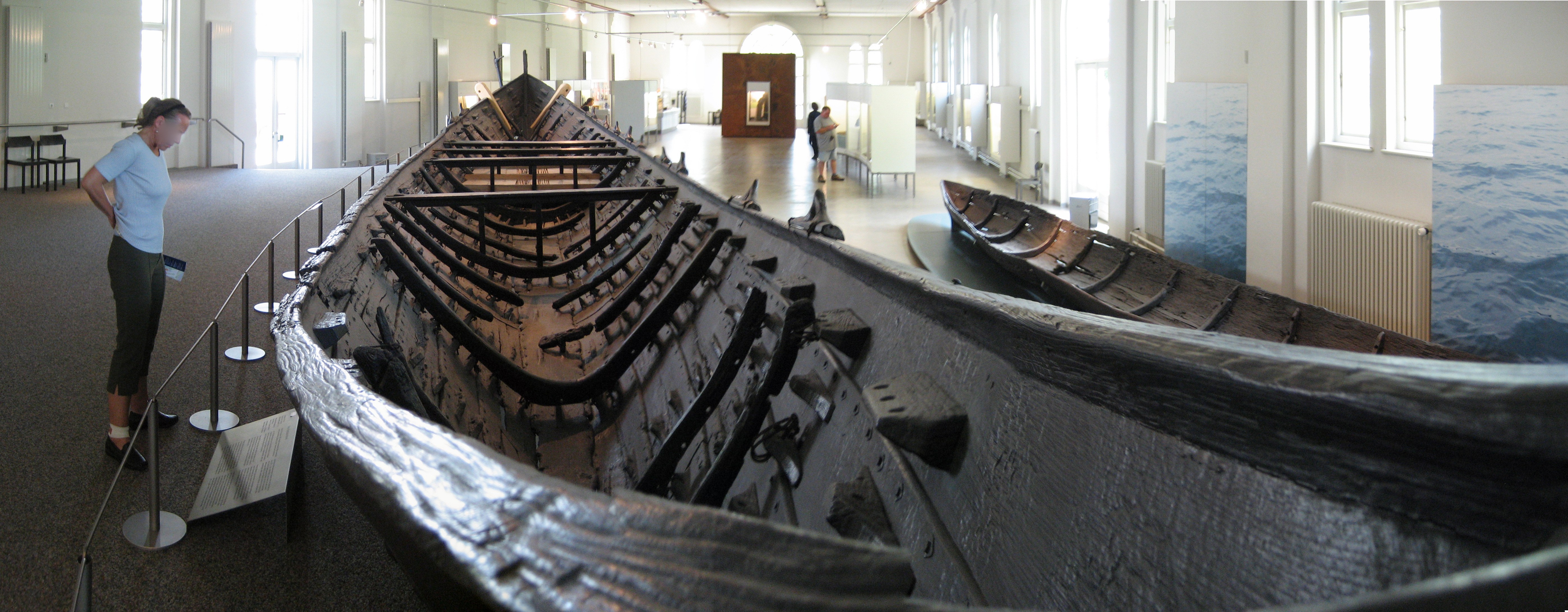
The earliest example of ship and boat building using overlapped planking joined with metal fastenings is an extended logboat from Sweden, the Björke boat (). The Nydam boat () is an almost complete example of a boat built with clinker construction. It has overlapping planks joined with iron nails driven through the lap. The nails are clenched over s on the inside of the planking. The boat was built shell-first.
Into the medieval
Though clinker construction is closely associated with Nordic countries, the same technique was used at an early stage in other parts of Northern Europe. The Saxon burial ship at Sutton Hoo in eastern England is an early () example of this sort of ship occurring in the broader Northern European area. Other sites from the 7th century AD include Kvalsund, Norway, Gretstedbro in Jutland and Snape in eastern England. One difference from the Nydam boat is that individual planks in the later period are shorter and narrower. This suggests that large oak trees for ship-building had become significantly less common by the 7th century, so timber of smaller dimensions had to be used.

The cog is part of another ship-building tradition in Northern Europe that existed at the same time that the purely Nordic-tradition clinker vessels were being built. Though the classic cog construction uses flush planking for the bottom, the sides are constructed in a clinker methodwith the difference that the nails that passed through overlapping planks were simply bent over and driven back into the plank, rather than using roves.
Clinker-built vessels were constructed as far South as the Basque country; the Newport Medieval Ship is an example. By the 14th century, clinker-built ships and the cog represented the major construction methods in Northern Europe.
Introduction of carvel to Northern Europe
Carvel construction was developed in the Mediterranean around the end of the Classical antiquity period. By the end of the 13th century AD, Mediterranean ships were being built on a skeleton basis, with hull planks being fixed to the frames and not to each other. At the same time, Northern European cogs were voyaging into the Mediterranean. The two maritime technological traditions had differences beyond the hull construction methods. Mediterranean ships were carvel-built, lateen rigged (using more than one mast on larger vessels) and still used side rudders. The visiting cogs had a single square-rigged mast, a stern-post mounted pintle-and-gudgeon rudder and clinker sides.
As part of the process of merging these two sets of traditions, carvel-built ships started to arrive in Northern waters. They were soon followed by shipwrights with the skills to build in carvel construction, with the first being built in this region in the late 1430s. The change is still not well understood. The frames of carvel could be made stronger to support the weight of the guns that ships were starting to carry and allowed gun-ports to be cut in the hull. Carvel construction may have solved the shortage of large cleft oak planks from which to make larger clinker vessels. Despite the large-scale move over to carvel construction for large vessels, clinker construction remained prominent throughout Northern Europe.
Modern period

Glued clinker construction
A modern variant of clinker construction is to glue the strakes together rather than using metal fastenings. This is a technique that was pioneered by Iain Oughtred. The planking is normally cut from plywood and, after shaping, is glued with epoxy resin. Based in Britain, Oughtred initially worked on designs based on traditional craft from the United States, but in the mid-1980s he produced designs inspired by Scottish working boatstypes that were clinker-built. An example of his output is the St. Ayles Skiff and the technique is now used by other boat designers.
|File:Exhibition in Viking Ship Museum, Oslo 01.jpg|The bow of the Viking Oseberg ship |File:Kogge stralsund.jpg|Clinker-built medieval cog from Stralsund. |File:Deal luggers (3).jpg|An 1866 photo of Deal luggers and, in the foreground, a four-oared galley, both types clinker-built |File:Norwegian pram.jpg|A Norwegian pram dinghy |File:Bolt in St Mary's Harbour 02.jpg|Cornish pilot gig, a type of working boat from the 19th and early 20th centuries, now popular for racing |File:Folkeboot Kiel2007.jpg|A Folkboat, a class of clinker-built long-keeled cruiser/racer |File:Sunnmørsfæring - Herøy kystmuseum.jpg|A Norwegian faering, a four-oared boat |File:Coble SH105 1 (Nigel Coates).jpg|A coble from the Northeast of England
Notes
References
References
- Webb, Michael. "Clinker Boat History & Building".
- "Lapstrake".
- (2013). "Boats of the viking ship museum". Viking Ship Museum.
- (1973). "Clinker Boatbuilding". Adlard Coles Limited.
- (2006). "Between the Seas. Transfer and Exchange in Nautical Technology. Proceedings of the Eleventh International Symposium on Boat and Ship Archaeology, Mainz 2006".
- (2017-09-25). "Ships And Maritime Landscapes: Proceedings of the Thirteenth International Symposium on Boat and Ship Archaeology, Amsterdam 2012". Barkhuis.
- {{cite EB1911
- (2013). "A maritime archaeology of ships: innovation and social change in late medieval and early modern Europe". Oxbow Books.
- (2009). "Boats of the world: from the stone age to medieval times". Oxford University Press.
- (September 2014). "The Newport Medieval Ship, Wales, United Kingdom: The Newport Medieval Ship". International Journal of Nautical Archaeology.
- (September 2014). "Iberian Dendrochronology and the Newport Medieval Ship: Iberian Dendrochronology and the Newport Medieval Ship". International Journal of Nautical Archaeology.
- (1 January 1927). "The SUFFOLK and NORFOLK BEACH YAWLS". The Mariner's Mirror.
- (2003). "The Boats of Men of War". Caxton Editions.
- (1979). "Spritsails and Lugsails". International Marine Publishing Company.
- (2013). "Inshore Craft: Traditional Working Vessels of the British Isles". Seaforth Publishing.
- (2005). "Inshore craft of Britain in the days of sail and oar". Chatham.
- Marsio, Leena & FHA Staff. (2021-12-14). "Nordic Clinker Boat Tradition Inscribed to UNESCO List of the Intangible Cultural Heritage". Museovirasto ([[Finnish Heritage Agency]] (FHA).
- (4 April 2024). "Iain Oughtred obituary". The Guardian.
- (27 February 2024). "Eight bells for renowned boat builder and designer Iain Oughtred". Practical Boat Owner.
- "Clinker Ply".
This article was imported from Wikipedia and is available under the Creative Commons Attribution-ShareAlike 4.0 License. Content has been adapted to SurfDoc format. Original contributors can be found on the article history page.
Ask Mako anything about Clinker (boat building) — get instant answers, deeper analysis, and related topics.
Research with MakoFree with your Surf account
Create a free account to save articles, ask Mako questions, and organize your research.
Sign up freeThis content may have been generated or modified by AI. CloudSurf Software LLC is not responsible for the accuracy, completeness, or reliability of AI-generated content. Always verify important information from primary sources.
Report