From Surf Wiki (app.surf) — the open knowledge base
Clapp oscillator
Electronic circuit
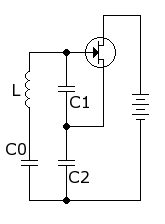
Electronic circuit
The Clapp oscillator or Gouriet oscillator is an LC electronic oscillator that uses a particular combination of an inductor and three capacitors to set the oscillator's frequency. LC oscillators use a transistor (or vacuum tube or other gain element) and a positive feedback network. The oscillator has good frequency stability.
History
The Clapp oscillator design was published by James Kilton Clapp in 1948 while he worked at General Radio. According to Czech engineer Jiří Vackář, oscillators of this kind were independently developed by several inventors, and one developed by Gouriet had been in operation at the BBC since 1938.
Circuit
The Clapp oscillator uses a single inductor and three capacitors to set its frequency. The Clapp oscillator is often drawn as a Colpitts oscillator that has an additional capacitor (C0) placed in series with the inductor.
The oscillation frequency in Hertz (cycles per second) for the circuit in the figure, which uses a field-effect transistor (FET), is : f_0 = {1 \over 2\pi} \sqrt{ {1 \over L} \left( {1 \over C_0}
- {1 \over C_1}
- {1 \over C_2} \right)} \ . The capacitors C1 and C2 are usually much larger than C0, so the 1/C0 term dominates the other capacitances, and the frequency is near the series resonance of L and C0. Clapp's paper gives an example where C1 and C2 are 40 times larger than C0; the change makes the Clapp circuit about 400 times more stable than the Colpitts oscillator for capacitance changes of C2.
Capacitors C0, C1 and C2 form a voltage divider that determines the amount of feedback voltage applied to the transistor input.
Although the Clapp circuit is used as a variable frequency oscillator (VFO) by making C0 a variable capacitor, Vackář states that the Clapp oscillator "can only be used for operation on fixed frequencies or at the most over narrow bands (max. about 1:1.2)." The problem is that under typical conditions, the Clapp oscillator's loop gain varies as f −3, so wide ranges will overdrive the amplifier. For VFOs, Vackář recommends other circuits. See Vackář oscillator.
Practical example

The schematic shows an example with component values.{{cite book
The common drain amplifier has a high input impedance and a low output impedance. Therefore the amplifier input, the gate, is connected to the high impedance top of the LC circuit C0, C1, C2, L1 and the amplifier output, the source, is connected to the low impedance tap of the LC circuit. The grid leak C3 and R1 sets the operating point automatically through grid leak bias. A smaller value of C3 gives less harmonic distortion, but requires a larger load resistor. The supply current for J1 flows through the radio frequency choke L2 to ground. The oscillator radio frequency current uses C2, because for the oscillator frequency this component has less reactance. The load resistor RL is part of the simulation, not part of the circuit.
References
References
- Clapp, J. K.. (March 1948). "An inductance-capacitance oscillator of unusual frequency stability". [[Proc. IRE]].
- Vackář, Jiri. (December 1949). "LC Oscillators and their Frequency Stability". Tesla National Corporation.
- Department of the Army. (1963). "Basic Theory and Application of Transistors". Dover.
- {{harvnb. Clapp. 1948
- {{harvnb. Vackář. 1949
This article was imported from Wikipedia and is available under the Creative Commons Attribution-ShareAlike 4.0 License. Content has been adapted to SurfDoc format. Original contributors can be found on the article history page.
Ask Mako anything about Clapp oscillator — get instant answers, deeper analysis, and related topics.
Research with MakoFree with your Surf account
Create a free account to save articles, ask Mako questions, and organize your research.
Sign up freeThis content may have been generated or modified by AI. CloudSurf Software LLC is not responsible for the accuracy, completeness, or reliability of AI-generated content. Always verify important information from primary sources.
Report