From Surf Wiki (app.surf) — the open knowledge base
City-state
Sovereign state consisting primarily of a city and its territory
Sovereign state consisting primarily of a city and its territory
A city-state is an independent sovereign city that serves as the primary hub of political, economic, and cultural life within its contiguous territory. This concept stands in contrast to that of a regular state or country, which typically encompasses a capital city and additional urban centers, in addition to the countryside. Throughout history, numerous city-states have emerged in various regions of the world, including prominent examples such as Rome, Carthage, Athens, and Sparta, as well as the Italian city-states that flourished during the Medieval and Renaissance periods, such as Florence, Venice, Genoa, and Milan.
With the rise of nation states worldwide, there remains some disagreement on the number of modern city-states that still exist; Singapore, Monaco and Vatican City are the candidates most commonly discussed. Out of these, Singapore is the largest and most populous city-state in the world, with full sovereignty, international borders, its own currency, a robust military, and substantial international influence in its own right. The Economist refers to it as the "world's only fully functioning city-state".
Several non-sovereign cities enjoy a high degree of autonomy and are often considered to be city-states, such as Hong Kong and Macau. Cities of the United Arab Emirates, most notably Dubai, have been cited in similar terms. Additionally, certain non-sovereign overseas territories, such as Gibraltar, are also sometimes called city-states.
Historical background
Ancient and medieval world
Historical city-states included Sumerian cities such as Uruk and Ur; Ancient Egyptian city-states, such as Thebes and Memphis; the Phoenician cities (such as Tyre and Sidon); the five Philistine city-states; the Berber city-states of the Garamantes; the city-states of ancient Greece (the poleis such as Athens, Sparta, Thebes, and Corinth); the Roman Republic (which grew from a city-state into a vast empire); the Italian city-states from the Middle Ages to the early modern period, such as Florence, Siena, Ferrara, Milan (which as they grew in power began to dominate neighboring cities) and Genoa and Venice, which became powerful thalassocracies; the Mayan and other cultures of pre-Columbian Mesoamerica (including cities such as Chichen Itza, Tikal, Copán and Monte Albán); the central Asian cities along the Silk Road; the city-states of the Swahili coast; Ragusa in Croatia; Tbilisi in Georgia; the medieval Russian city-states of Novgorod and Pskov; the free imperial cities of German-speaking Europe; mueang of Indochina; barangay states of the Philippines; and many others. Danish historian Poul Holm has classed the Viking colonial cities in medieval Ireland, most importantly the Kingdom of Dublin, as city-states.
In Cyprus, the Phoenician settlement of Kition (in present-day Larnaca) was a city-state that existed from around 800 BC until the end of the 4th century BC.
Some of the most well-known examples of city-state culture in human history are the ancient Greek city-states and the merchant city-states of Renaissance Italy, which organised themselves as independent centers. The success of regional units coexisting as autonomous actors in loose geographical and cultural unity, as in Italy and Greece, often prevented their amalgamation into larger national units. However, such small political entities often survived only for short periods because they lacked the resources to defend themselves against incursions by larger states (such as Roman conquest of Greece). Thus they inevitably gave way to larger organisations of society, including the empire and the nation-state.
Central Europe
In the Holy Roman Empire (962–1806) over 80 Free Imperial Cities came to enjoy considerable autonomy in the Middle Ages and in early modern times, buttressed legally by international law following the Peace of Westphalia of 1648. Some, like three of the earlier Hanseatic cities – Bremen, Hamburg and Lübeck – pooled their economic relations with foreign powers and were able to wield considerable diplomatic clout. Individual cities often made protective alliances with other cities or with neighbouring regions, including the Hanseatic League (1358 – 17th century), the Swabian League of Cities (1331–1389), the Décapole (1354–1679) in the Alsace, or the Old Swiss Confederacy ( 1300 – 1798). The Swiss cantons of Zürich, Bern, Lucerne, Fribourg, Solothurn, Basel, Schaffhausen, and Geneva originated as city-states.
After the dissolution of the Holy Roman Empire in 1806, some cities – then members of different confederacies – officially became sovereign city-states, such as the Free Hanseatic City of Bremen (1806–11 and again 1813–71), the Free City of Frankfurt upon Main (1815–66), the Free and Hanseatic City of Hamburg (1806–11 and again 1814–71), the Free and Hanseatic City of Lübeck (1806–11 and again 1813–71), and the Free City of Kraków (1815–1846). Under Habsburg rule the city of Fiume had the status of a corpus separatum (1779–1919), which – while falling short of an independent sovereignty – had many attributes of a city-state.
Italy
Main article: Italian city-states
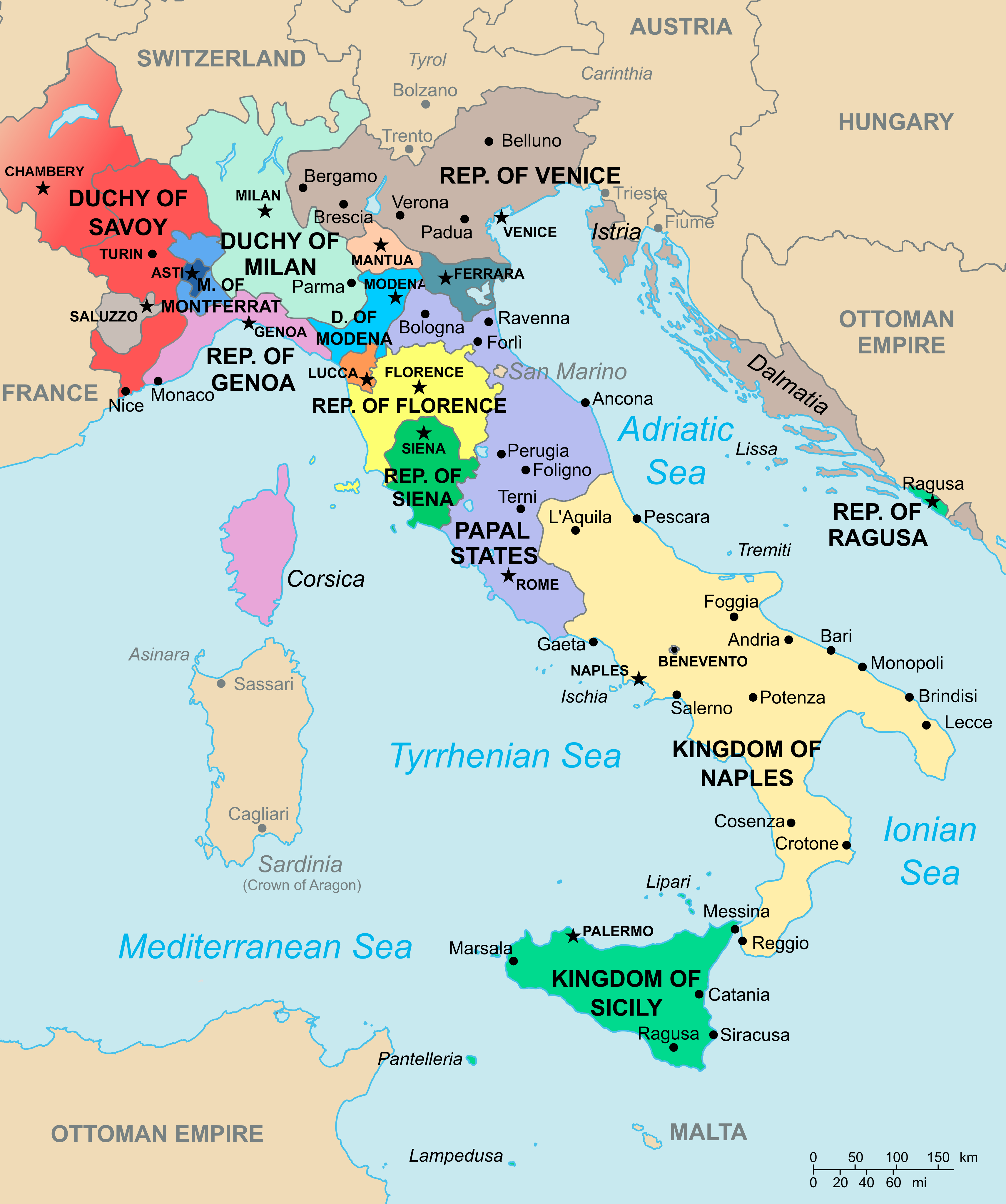
In Northern and Central Italy during the medieval and Renaissance periods, city-states — with various amounts of associated land — became the standard form of polity. Some of them, despite being de facto independent states, were formally part of the Holy Roman Empire. The era of the Italian states, in particular from the 11th to the 15th centuries, featured remarkable economic development, trade, manufacture, and mercantile capitalism, together with increasing urbanization, with remarkable influence throughout much of the Mediterranean world and Europe as a whole. During this time, most of the Italian city-states were ruled by one person, such as the Signoria or by a dynasty, such as the House of Gonzaga and the House of Sforza.
Examples of Italian city-states during the Middle Ages and the Renaissance
-
Republic of Florence, Duchy of Milan, Duchy of Ferrara, | access-date = 4 October 2020 San Marino, Duchy of Modena and Reggio, Duchy of Urbino, Duchy of Mantua and the Republic of Lucca.
-
The powerful maritime republics: Republic of Venice, Republic of Genoa, Republic of Amalfi, Republic of Pisa, Republic of Ancona and Duchy of Gaeta.
Southeast Asia
In the history of Mainland Southeast Asia, aristocratic groups, Buddhist leaders, and others organized settlements into autonomous or semi-autonomous city-states. These were referred to as mueang, and were usually related in a tributary relationship now described as mandala or as over-lapping sovereignty, in which smaller city-states paid tribute to larger ones that paid tribute to still larger ones—until reaching the apex in cities like Ayutthaya, Bagan, Bangkok and others that served as centers of Southeast Asian royalty. The system existed until the 19th century, when colonization by European powers occurred. Siam, a regional power at the time, needed to define their territories for negotiation with the European powers so the Siamese government established a nation-state system, incorporated their tributary cities (Lan Xang, Cambodia and some Malay cities) into their territory and abolished the mueang and the tributary system. |author-link1 = James C. Scott |url-access = registration |publication-date = 2009 |access-date = 2017-10-08
In early Philippine history, the barangay was a complex sociopolitical unit which scholars have historically considered the dominant organizational pattern among the various peoples of the Philippine archipelago.{{Cite book |last=Junker |first=Laura Lee |title=Raiding, Trading, and Feasting: The Political Economy of Philippine Chiefdoms |publisher=Ateneo de Manila University Press
20th-century cities under international supervision
Danzig
Main article: Free City of Danzig
The Free City of Danzig was a semi-autonomous city-state that existed between 1920 and 1939, consisting of the Baltic Sea port of Danzig (now Gdańsk, Poland) and nearly 200 towns in the surrounding areas. It was created on 15 November 1920 under the terms of Article 100 (Section XI of Part III) of the 1919 Treaty of Versailles after the end of World War I.
Fiume
Main article: Free State of Fiume
After a prolonged period where the city of Fiume enjoyed considerable autonomy under Habsburg rule (see Corpus separatum (Fiume)), The Free State of Fiume was proclaimed as a fully independent free state which existed between 1920 and 1924. Its territory of 28 km2 comprised the city of Fiume (now in Croatia and, since the end of World War II, known as Rijeka, both names meaning "river" in the respective languages) and rural areas to its north, with a corridor to its west connecting it to Italy.
Jerusalem
Main article: Corpus separatum (Jerusalem)
Under the United Nations Partition Plan for Palestine of 1947, Mandatory Palestine was to be partitioned into three states: a Jewish state of Israel, an Arab state of Palestine, and a corpus separatum (Latin for "separated body") consisting of a Jerusalem city-state under the control of United Nations Trusteeship Council. Although the plan had some international support and the UN accepted this proposal (and still officially holds the stance that Jerusalem should be held under this regime), implementation of the plan failed as the 1948 Palestine war broke out with the 1947–48 Civil War in Mandatory Palestine, ultimately resulting in Jerusalem being split into West Jerusalem and East Jerusalem. Israel would eventually gain control of East Jerusalem in the Six-Day War in 1967.
Memel
Main article: Klaipėda Region
The Klaipėda Region or Memel Territory was defined by the Treaty of Versailles in 1920 when it was put under the administration of the Council of Ambassadors. The Memel Territory was to remain under the control of the League of Nations until a future day when the people of the region would be allowed to vote on whether the land would return to Germany or not. The then predominantly ethnic German Memel Territory (Prussian Lithuanians and Memellanders constituted the other ethnic groups), situated between the river and the town of that name, was occupied by Lithuania in the Klaipėda Revolt of 1923.
Ottoman
Some proposals for the partition of the Ottoman Empire envisaged international zones at Istanbul/Constantinople or the wider Turkish straits,{{multiref| | | |
Shanghai
Main article: Shanghai International Settlement
The Shanghai International Settlement (1845–1943) was an international zone with its own legal system, postal service, and currency.
Tangier
Main article: Tangier International Zone

The international zone within the city of Tangier, in North Africa was approximately 373 km2. It was at first under the joint administration of France, Spain, and the United Kingdom, plus later Portugal, Italy, Belgium, the Netherlands, Sweden, and the United States. The international zone was initially attached to Morocco. It then became a French-Spanish protectorate from 1923 until 29 October 1956, when it was reintegrated into the state of Morocco.
Trieste
Main article: Free Territory of Trieste
The Free Territory of Trieste was an independent territory situated in Central Europe between northern Italy and Yugoslavia, facing the north part of the Adriatic Sea, under direct responsibility of the United Nations Security Council in the aftermath of World War II, from 1947 to 1954.
West Berlin
In the 20th century West Berlin, though lacking sovereignty, functioned from 1948 until 1990 as a state legally not belonging to any other state, but ruled by the Western Allies. They allowed – notwithstanding their overlordship as occupant powers – its internal organisation as one state simultaneously being a city, officially called Berlin (West). Though West Berlin maintained close ties to the West German Federal Republic, it never legally formed a part of it.
Contemporary sovereign city-states
Vatican City
Main article: Vatican City

Until September 1870, the city of Rome had been controlled by the pope as part of his Papal States. When King Victor Emmanuel II seized the city in 1870, Pope Pius IX refused to recognize the newly formed Kingdom of Italy.
Because he could not travel without effectively acknowledging the authority of the king, Pius IX and his successors each claimed to be a "Prisoner in the Vatican", unable to leave the 0.49 km2 papal enclave once they had ascended the papal throne.
The impasse was resolved in 1929 by the Lateran Treaties negotiated by the Italian dictator Benito Mussolini between King Victor Emmanuel III and Pope Pius XI. Under this treaty, Vatican City was recognized as an independent state, with the Pope as its head. The Vatican City State has its own citizenship, diplomatic corps, flag, and postage stamps. With a population of less than 1,000 (mostly clergymen), it is by far the smallest sovereign country in the world.
Monaco
Main article: Monaco
The Principality of Monaco is a very small independent city-state bordering France. Monaco-Ville (the ancient fortified city) and Monaco's well-known area Monte Carlo are districts of a continuous urban zone, not distinct cities, though they were three separate municipalities (communes) until 1917. The Principality of Monaco and the City of Monaco (each having specific powers) govern the same territory. Though they maintain a small military, largely for ceremonial purposes, they would still have to rely on France for defence in the face of an aggressive power.
Singapore
Main article: Singapore
Singapore is an island city-state in Southeast Asia bordering Malaysia to the north and Indonesia to the south. 6 million people live and work within 728.3 km2, making Singapore the 2nd-most-densely populated country in the world after Monaco. Singapore was part of the Federation of Malaysia for two years before it seceded from the federation in 1965, becoming an independent republic, a city and a sovereign country. The Economist refers to the nation as the "world's only fully functioning city-state". In particular, it has its own currency, a large commercial airport, one of the busiest trans-shipment maritime ports in the world, and fully fledged armed forces to safeguard the nation's sovereignty against potential regional aggressors. Singapore is also referred to as the only island city-state in the world by WorldAtlas.
Contemporary non-sovereign city-states
Some cities or urban areas, while not sovereign states, may nevertheless be constituent states of a federation, or enjoy a high degree of autonomy. As such, they function as "city-states" within the context of the sovereign state to which they belong. Historian Mogens Herman Hansen describes this aspect of self-government as: "The city-state is a self-governing, but not necessarily independent, political unit." A city with more limited self-government may be referred to as an independent city.
Some non-sovereign cities which have a high degree of autonomy, and have been described as city-states, include:
- Spain: Ceuta and Melilla (as autonomous cities)
- Armenia: Yerevan (as an autonomous city)
- China: Hong Kong and Macau (as special administrative regions)
- South Korea: Sejong (as a self governing city)
- United Kingdom: Gibraltar (as a British Overseas Territory)
Some cities that are constituent states in a federation, and as such can be accurately described as non-sovereign city-states with a high degree of autonomy, include:
- Argentina: Buenos Aires
- Austria: Vienna
- Belgium: Brussels
- Germany: Bremen, Berlin and Hamburg
- Nigeria : Lagos
- Mexico: Mexico City
- Malaysia: Malacca
- Russia: Moscow, Saint Petersburg, and Sevastopol (disputed)
- Switzerland: Basel-Stadt and Geneva
States with similar characteristics
A number of other small states share many of these characteristics, and are sometimes cited as modern city-states. Luxembourg, Djibouti, Qatar, Brunei, Kuwait, Bahrain, and Malta are each politically and economically centered on a single city; in the cases of Luxembourg, Djibouti and Kuwait, this primate city is so dominant as to give its name to the country. These countries are distinct from true city-states such as Singapore in that they comprise both their primate city (such as Luxembourg City) and a number of peripheral cities and towns (such as Esch-sur-Alzette and ten other towns in Luxembourg) with autonomous municipal authorities, and may also include substantial rural areas (such as the sparsely populated Éislek forest of northern Luxembourg).
Occasionally, microstates with high population densities such as San Marino are cited as city-states, despite lacking a large urban centre.
Proposed city-states
Main article: Urban secession
London
Main article: London independence
The London independence movement seeks a city-state separate from the United Kingdom.
Jerusalem
Some have proposed that Jerusalem could become an independent city state under United Nations or International protection. Jerusalem is a holy city for three major religions, Judaism, Christianity and Islam creating religious tension. Israel and Palestine both claim Jerusalem as their capital causing a conflict and dispute over the city, most notably East Jerusalem. The UN partition plan for Palestine included provisions for a “Special international regime” to be established in Jerusalem known as Corpus separatum. However the plan was rejected by Palestinian leaders.
Hong Kong
Sovereign State of the Bektashi Order
Main article: Sovereign State of the Bektashi Order
The Sovereign State of the Bektashi Order is a proposed city-state in Albanian capital of Tirana which will be established if approved by the Albanian Parliament and a national referendum. The state, which would be led by the Bektashi Order, is planned to be similar in structure to the Vatican City. The idea has been proposed by Albanian Prime Minister Edi Rama and leader of the Bektashi Order Baba Mondi in the hope that sovereignty would help promote moderate Muslim values instead of radical ideologies. The Sovereign State of the Bektashi Order would be surrounded by the suburbs of eastern Tirana and would be the smallest nation in the world.
References
References
- "city-state {{!}} Definition, History, & Facts".
- Brimelow, Ben. "How a tiny city-state became a military powerhouse with the best air force and navy in Southeast Asia".
- (2020-09-16). "City-states never disappeared: Hamburg, Hong Kong, Singapore".
- Kotkin, Joel. 2010. "A New Era for the City-State?" In ''Forbes.''
- (2012-05-26). "Gibraltar profile".
- (1998). "A short history of Europe: from the Greeks and Romans to the present day". MacMillan.
- link. (21 June 2013 ''. Denmark: Special-Trykkeriet Viborg. (University of Copenhagen, Polis Center). 2000. pp. 251–62.)
- Sri Aurobindo, "Ideal of Human Unity" included in ''Social and Political Thought'', 1970.
- "Italy - Italy in the 14th and 15th centuries".
- Winichakul, Thongchai. 1997. Siam Mapped: A History of the Geo-Body of a Nation. Honolulu: University of Hawaii Press
- Baker, Chris and Pasuk Phongpaichit. 2009. ''A History of Thailand: 2nd ed.'' Sydney: Cambridge University Press
- Quezon, Manolo. (2017-10-02). "The Explainer: Bamboozled by the barangay". ABS-CBN News.
- Junker, Laura Lee. (1990). "The Organization of Intra-Regional and Long-Distance Trade in Pre-Hispanic Philippine Complex Societies". Asian Perspectives.
- (5 November 2013). "Urban Development and Civil Society: The Role of Communities in Sustainable Cities". Routledge.
- Plasencia, Fray Juan de. (1589). "Customs of the Tagalogs".
- (February 2011). "Danzig – Biographie einer Stadt". C.H. Beck.
- (2003). "Das Bistum Danzig in Lebensbildern". LIT Verlag.
- (15 June 2023). "The Last Treaty: Lausanne and the End of the First World War in the Middle East". Cambridge University Press.
- "Environment".
- Long, Simon. (18 July 2015). "The Singapore exception". The Economist.
- (1989). "Leadership in Asia : persuasive communication in the making of nations". University of Delaware Press.
- (30 July 2015). "Singapore 2065 : leading insights on economy and environment from 50 Singapore icons and beyond". World Scientific Publishing Co. Pte. Ltd..
- (2020-08-15). "Cities That Are Also Sovereign States".
- (2015). "A History of African Higher Education from Antiquity to the Present". Greenwood Publishing.
- Europe Since 1945: An Encyclopedia, Bernard A. Cook p.506, {{ISBN. link. (9 April 2023)
- "Qué dice la Ley Cafiero". Infobae.com.
- [http://www.wien.gv.at/english/history/overview/capital.html City of Vienna, "From the Capital of the Austro-Hungarian Empire to the Capital of the Republic - History of Vienna"]. {{Webarchive. link. (14 April 2023 , retrieved 17 May 2010.)
- "Constitution of Mexico City". Gobierno de la Ciudad de México.
- Kremlin.ru. [http://kremlin.ru/news/20605 Договор между Российской Федерацией и Республикой Крым о принятии в Российскую Федерацию Республики Крым и образовании в составе Российской Федерации новых субъектов] {{Webarchive. link. (19 March 2015 (''Treaty Between the Russian Federation and the Republic of Crimea on Ascension to the Russian Federation of the Republic of Crimea and on Establishment of New Subjects Within the Russian Federation'') {{in lang). ru
- link. (9 April 2023 United States Congress House Committee on Appropriations. Subcommittee on Foreign Operations, Export Financing, and Related Programs. April 15, 1992. Page 239: "The Republic of Djibouti is in effect a city - state, with few natural resources, few trained workers, no permanent streams and very little arable land. Some 75% of the population live in the capital city, the economy of which is focused on the port, airport, railway, the French garrison, and the re-export of consumer goods.")
- Parker, Geoffrey. 2005. ''Sovereign City: The City-state Through History'' Chicago: University of Chicago Press. p. 219
- Roberts, David. 2014. ''Qatar: Securing the Global Ambitions of a City-state.'' London: C Hurst & Co Publishers Ltd.
- El-Katiri, Laura, Bassam Fattouh and Paul Segal. 2011 ''Anatomy of an oil-based welfare state: rent distribution in Kuwait.'' Kuwait City: Kuwait Programme on Development, Governance and Globalisation in the Gulf States
- "The emblem of Malta, Department of Information, Official Website of President of Malta". Doi.gov.mt.
- "''Draft National Strategy for the Cultural and Creative Industries – Creative Malta''". Creativemalta.gov.mt.
- "Malta".
- Hansen, Mogens. 2000. "Introduction: The Concepts of City-States and City-State Culture." In ''A Comparative Study of Thirty City-State Cultures,'' Copenhagen: Copenhagen Polis Centre. Pg. 19
- Parker, Geoffrey. 2005. ''[https://press.uchicago.edu/ucp/books/book/distributed/S/bo3534946.html Sovereign City: The City-state Through History] {{Webarchive. link. (15 December 2022 '' Chicago: University of Chicago Press. {{ISBN). 9781861892195. 1861892195. {{doi. 10.2747/0272-3638.28.4.398.
- Mogens, Hansen. 2002. ''A Comparative Study of Six City-State Cultures: An Investigation'' p. 91
- (28 June 2016). "'Londependence' May Be a Dream, but More Autonomy for the City Is Not". The New York Times.
- CW_Author. (2021-06-11). "Should Jerusalem Be a City-State? Experts For & Against Discuss".
- Baikenje, Dana. "History of the Question of Palestine".
- Higgens, Andrew. (21 September 2024). "Albania Is Planning a New Muslim State Inside Its Capital". [[The New York Times]].
This article was imported from Wikipedia and is available under the Creative Commons Attribution-ShareAlike 4.0 License. Content has been adapted to SurfDoc format. Original contributors can be found on the article history page.
Ask Mako anything about City-state — get instant answers, deeper analysis, and related topics.
Research with MakoFree with your Surf account
Create a free account to save articles, ask Mako questions, and organize your research.
Sign up freeThis content may have been generated or modified by AI. CloudSurf Software LLC is not responsible for the accuracy, completeness, or reliability of AI-generated content. Always verify important information from primary sources.
Report