From Surf Wiki (app.surf) — the open knowledge base
Cicely
Genus of flowering plants in the celery family Apiaceae
Genus of flowering plants in the celery family Apiaceae
|Chaerophyllum odoratum|(L.) Crantz |Lindera odorata|(L.) Asch. |Myrrhis brevipedunculata|Hoffm. |Myrrhis iberica|Hoffm. |Myrrhis sulcata|Lag. |Scandix odorata|L. |Selinum myrrhis|E.H.L.Krause
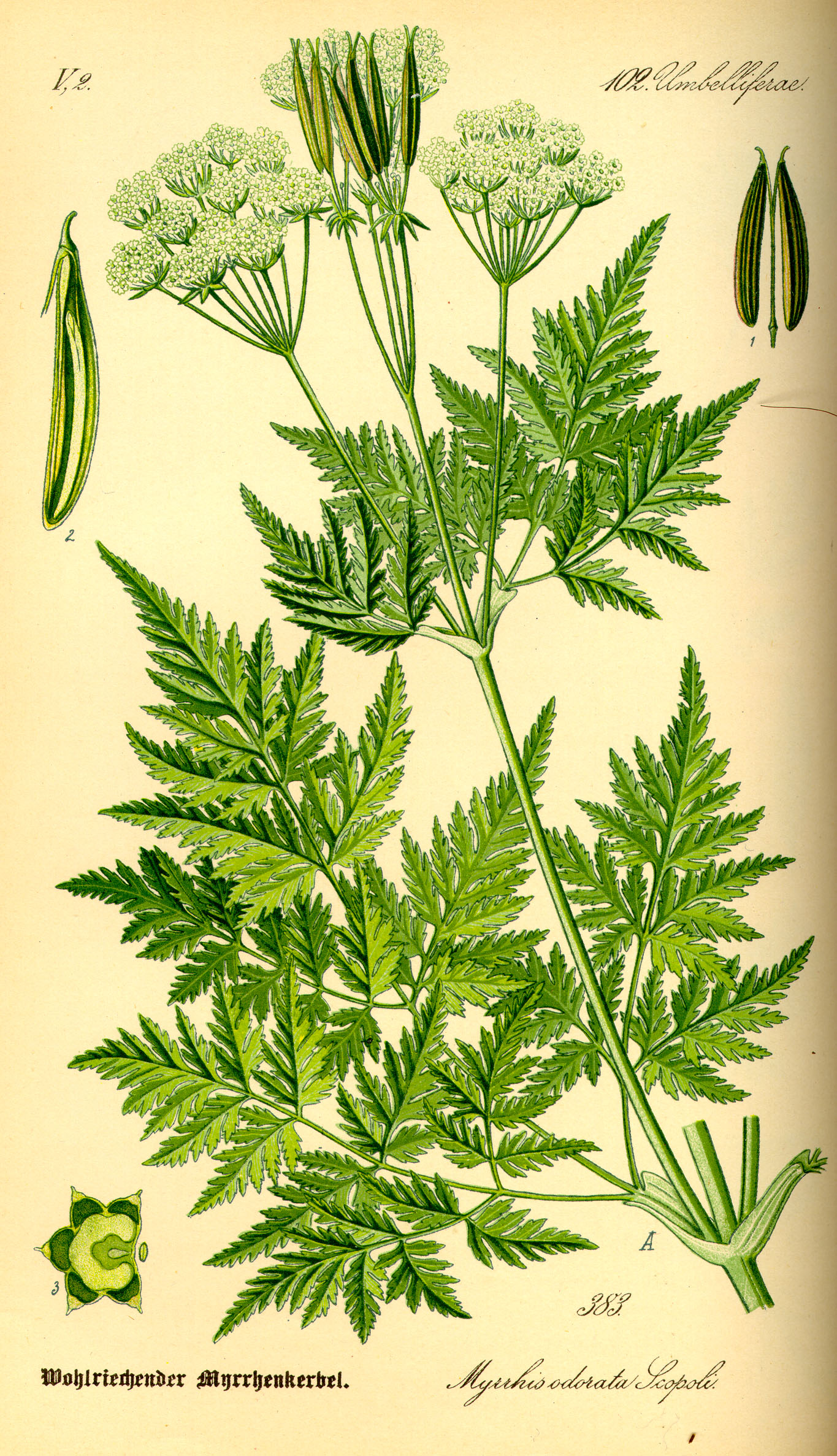
Myrrhis odorata, with common names cicely ( ), sweet cicely, myrrh, garden myrrh, and sweet chervil, is a herbaceous perennial plant belonging to the celery family Apiaceae. It is the only species in the genus Myrrhis.
Etymology
The genus name Myrrhis derives from the Greek word myrrhis [μυρρίς], an aromatic oil from Asia. The Latin specific epithet odorata means scented.
Description
Distribution and habitat
Myrrhis odorata is native to mountains of southern and central Europe, from the Pyrenees to the Caucasus. It has been introduced and naturalized elsewhere in cultivated areas, woodland margins, roadside verges, river banks and grassland. In the British Isles it is most abundant in northern England and eastern Scotland.
Cultivation and uses
In fertile soils it grows readily from seed, and may be increased by division in spring or autumn.
Its leaves are sometimes used as a herb, either raw or cooked, with a rather strong or sweet taste similar to anise. Also edible are the roots (cooked like parsnips) and seeds (chewed raw). It has a history of use as a medicinal herb.
Like its relatives anise, fennel, and caraway, it can be used to flavour akvavit. Its essential oils are dominated by anethole.
References
References
- "''Myrrhis odorata'' (L.) Scop.". Royal Botanic Gardens, Kew.
- {{cite EB1911
- "USDA GRIN Taxonomy".
- "''Myrrhis'' Mill.". Royal Botanic Gardens, Kew.
- Grieve, Maud. "Cicely, Sweet". Botanical.com: A Modern Herbal.
- "Cicely (Myrrhis odorata [L.] Scop.)". Germot Katzers Spice Pages.
- Francis-Baker, Tiffany. (2021). "Concise Foraging Guide". [[Bloomsbury Publishing.
- "Myrrhis odorata - (L.)Scop.". Plants for a future.
- Stace, C. A.. (2010). "New Flora of the British Isles". Cambridge University Press.
- "Myrrhis odorata (L.) Scop. - Sweet Cicely - Umbelliferae / Apiaceae". Flora of Northern Ireland.
- "Sweet Cicely Myrrhis odorata (L.) Scop.". Online Atlas of the British and Irish Flora.
- "Myrris odorata, native & introduced". Linnaeus.nrm.se.
- "Myrrhis odorata". Royal Horticultural Society.
- "The Gourmet Food & Cooking Resource".
- [http://wildflowerfinder.org.uk/Flowers/S/SweetCicely/SweetCicely.htm Wild Flower Finder]

This article was imported from Wikipedia and is available under the Creative Commons Attribution-ShareAlike 4.0 License. Content has been adapted to SurfDoc format. Original contributors can be found on the article history page.
Ask Mako anything about Cicely — get instant answers, deeper analysis, and related topics.
Research with MakoFree with your Surf account
Create a free account to save articles, ask Mako questions, and organize your research.
Sign up freeThis content may have been generated or modified by AI. CloudSurf Software LLC is not responsible for the accuracy, completeness, or reliability of AI-generated content. Always verify important information from primary sources.
Report