From Surf Wiki (app.surf) — the open knowledge base
Christian state
State which endorses Christianity as the state religion
State which endorses Christianity as the state religion
A Christian state is a country that recognizes a form of Christianity as its official religion and often has a state church (also called an established church), which is a Christian denomination that supports the government and is supported by the government.
Historically, the nations of Armenia, Aksum, Makuria, and the Holy Roman Empire have declared themselves as Christian states, as well as the Roman Empire and its continuation the Byzantine Empire, the Russian Empire, the Spanish Empire, the British Empire, the Portuguese Empire, and the Frankish Empire, the Belgian colonial empire, the French empire.
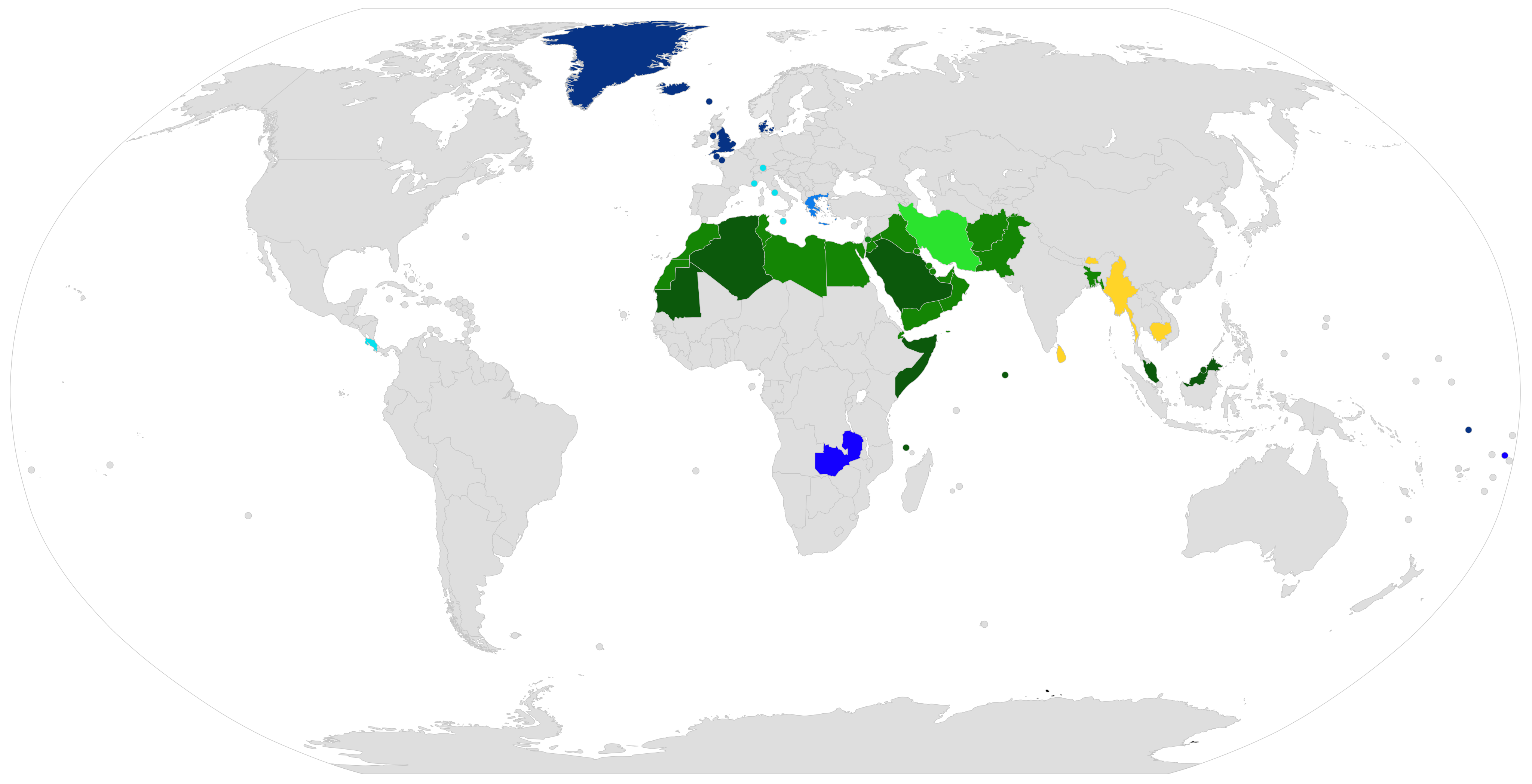
Today, several nations officially identify themselves as Christian states or have state churches. These countries include Argentina, Armenia, Costa Rica, El Salvador, Denmark (incl. Greenland and the Faroes), England, Dominican Republic, Georgia, Greece, Hungary,Hungary's Constitution of 2011. Retrieved 9 February 2016. Iceland, Liechtenstein, Malta, Monaco, Samoa, Serbia, Tonga, Tuvalu, Vatican City, and Zambia. The laws of various Christian countries, such as those of Denmark, Norway, and Sweden require their monarch to be a Christian (usually of a particular denomination, such as Evangelical Lutheranism). A Christian state stands in contrast to a secular state, an atheist state, or another religious state, such as a Jewish state, or an Islamic state.
History
The Armenian Apostolic Church traces its origins to the apostolic era, asserting apostolic succession from the apostles Bartholomew and Thaddeus (Jude). The formal establishment of Christianity as the state religion of Armenia is traditionally dated to 301 AD, during the reign of Tiridates III, following his conversion by Gregory the Illuminator. This makes Armenia the first nation to adopt Christianity as a state religion, although the exact date has been subject to scholarly debate. In 380, three Roman emperors issued the Edict of Thessalonica (Cunctos populos), making the Roman Empire a Christian state, and establishing Nicene Christianity, in the form of its State Church, as its official religion.
After the fall of the Western Roman Empire in the late 5th century, the Eastern Roman Empire under the emperor Justinian (reigned 527–565), became the world's predominant Christian state, based on Roman law, Greek culture, and the Greek language." In this Christian state, in which nearly all of its subjects upheld faith in Jesus, an "enormous amount of artistic talent was poured into the construction of churches, church ceremonies, and church decoration". John Binns describes this era, writing that: As a Christian state, Armenia "embraced Christianity as the religion of the King, the nobles, and the people". In 326, according to official tradition of the Georgian Orthodox Church, following the conversion of Mirian and Nana, the country of Georgia became a Christian state, the Emperor Constantine the Great sending clerics for baptising people. In the 4th century, in the Kingdom of Aksum, after Ezana's conversion to the faith, this empire also became a Christian state.
In the Middle Ages, efforts were made in order to establish a Pan-Christianity state by uniting the countries within Christendom. Christian nationalism played a role in this era in which Christians felt the impulse to also recover those territories in which Christianity historically flourished, such as the Holy Land and North Africa.
The First Great Awakening, American Revolution, and Second Great Awakening caused two rounds of disestablishment among the states of the new United States, from 1776 to 1833.
Modern era
Argentina
Article 2 of the Constitution of Argentina explicitly states that "the Federal Government supports the Roman Catholic Apostolic Faith" and Article 14 guarantees freedom of religion. Although it enforces neither an official nor a state faith, it gives Catholic Christianity a preferential status. Before its 1994 amendment, the Constitution stated that the President of the Republic must be a Roman Catholic.
Armenia
In Armenia Christianity is the most adhered religion, it has massive significance, but it is not the state religion. The Armenian Apostolic Church is the national church, it has long kept the Armenian identity alive under various Empires. Armenia is the first country which recognised Christianity as a state religion.
Costa Rica
The constitution of Costa Rica states that "The Catholic and Apostolic Religion is the religion of the State". As such, Catholic Christian holy days are recognized by the government and "public schools provide religious education", although parents are able to opt-out their children if they choose to do so.
Denmark
As early as the 11th century AD, "Denmark was considered to be a Christian state", with the Church of Denmark, a member of the Lutheran World Federation, being the state church. Prof. Wasif Shadid, of Leiden University, writes that:
Over 82% of the population of Denmark are members of the Evangelical Lutheran Church of Denmark, which is "officially headed by the queen of Denmark". The Act of Succession specifies that monarch "shall be a member of the Evangelical Church." Furthermore, clergy "in the Church of Denmark are civil servants employed by the Ministry of Ecclesiastical Affairs" and the "economic base of the Church of Denmark is state-collected church taxes combined with a direct state subsidiary (12%), which symbolically covers the expenses of the Church of Denmark to run the civil registration and the burial system for all citizens."
England
Barbara Yorke writes that the "Carolingian Renaissance heightened appreciation within England of the role of king and church in a Christian state." As such,
Christian religious education is taught to children in primary and secondary schools in the United Kingdom. English schools have a legal requirement for a daily act of collective worship "of a broadly Christian character" that is widely flouted.
Dominican Republic
The Dominican Republic is a Christian state, with Catholic Christianity being the official religion. In view of the same, the government of the Dominican Republic extends special privileges to the Catholic Church. National holidays include holy days of Christianity, such as the Epiphany (January 6), Good Friday, Corpus Christi, and Christmas Day. In the Dominican Republic, religious education classes must be of either a Catholic or evangelical Protestant basis and are required be taught in all elementary and secondary public schools.
Faroe Islands
The Church of the Faroe Islands is the state church of Faroe Islands.
Georgia
Georgia is one of the oldest Christian states. Article 8 of Georgian Constitution and the Concordat of 2002 grants the Georgian Orthodox Church special privileges, which include legal immunity to the Patriarch of Georgia. The Orthodox Church is the most trusted institution in the country and its head, Patriarch Ilia II, the most trusted person.
Greece
Greece is a Christian state, with the Church of Greece playing "a dominant role in the life of the country".
Mount Athos and most of the Athos peninsula are governed as an autonomous region in Greece by the monastic community of Mount Athos, which is ecclesiastically under the direct jurisdiction of the Ecumenical Patriarch of Constantinople.
Greenland
Being an autonomous constituent country within the Kingdom of Denmark, the Church of Denmark is the established church of Greenland through the Constitution of Denmark:
This applies toof the Kingdom of Denmark, except for the Faroe Islands, as the Church of the Faroe Islands became independent in 2007.
Hungary
The preamble to the Hungarian Constitution of 2011 describes Hungary as "part of Christian Europe" and acknowledges "the role of Christianity in preserving nationhood", while Article VII provides that "the State shall cooperate with the Churches for community goals". However, the constitution also guarantees freedom of religion and separation of church and state.
Iceland
Around AD 1000, Iceland became a Christian state. The Encyclopedia of Protestantism states that:
All public schools have mandatory education in Christianity, although an exemption may be considered by the Minister of Education.
Liechtenstein
Liechtenstein's constitution designates the Catholic Church as being the state Church of that country. In public schools, per article 16 of the Constitution of Liechtenstein, religious education is given by Church authorities.
Malta

Section Two of the Constitution of Malta specifies the state's religion as being the Roman Catholic Apostolic Religion. It holds that the "authorities of the Roman Catholic Apostolic Church have the duty to teach which principles are right and which are wrong" and that "religious teaching of the Roman Catholic Apostolic Faith shall be provided in all State schools as part of compulsory education".
Monaco
Article 9 of the Constitution of Monaco describes "La religion catholique, apostolique et romaine the catholic, [apostolic and Roman religion]" as the religion of the state.
Norway
Cole Durham and Tore Sam Lindholm, writing in 2013, stated that "For a period of one thousand years Norway has been a kingdom with a Christian state church" and that a decree went out in 1739 ordering that "Elementary schooling for all Norwegian children became mandatory, so that all Norwegians should be able to read the Bible and the Lutheran Catechism firsthand." The modern Constitution of Norway stipulates that "The Church of Norway, an Evangelical-Lutheran church, will remain the Established Church of Norway and will as such be supported by the State." As such, the "Norwegian constitution decrees that Lutheranism is the official religion of the State and that the King is the supreme temporal head of the Church." The administration of the Church "is shared between the Ministry for Church, Education and Research centrally and municipal authorities locally", and the Church of Norway "depends on state and local taxes". The Church of Norway is responsible for the "maintenance of church buildings and cemeteries". In the mid-20th century, the vast majority of Norwegians participated in the Lutheran Church. According to a 1957 description, "[o]ver 90 percent of the population are married by state church clergymen, have their children baptized and confirmed, and finally are buried with a church service." However, current membership in the Evangelical Lutheran Church of Norway is lower, standing at 65% of the population in 2021.
In 2017, the Church of Norway was made self-governing, with the identity of the denomination shifting from a state church to a national church. The Church of Noway continues to be supported by public funding. Succession rules governing the Monarchy of Norway require that the monarch be an Evangelical Lutheran holding membership in the Church of Norway. Those who marry into the royal family of Norway are expected to be or become Evangelical Lutherans.
Samoa
Samoa became a Christian state in 2017. Article 1 of the Samoan Constitution states that “Samoa is a Christian nation founded of God the Father, the Son and the Holy Spirit”.
Serbia
Main article: Religion in Serbia, Eastern Orthodoxy in Serbia, Serbian Orthodox Church
Serbia as a territory became a Christian state during the time of Constantine the Great in Christianization of Eastern Roman Empire, according to the research and discoveries of artifacts left by the Illyrians, Triballi and other kindred tribes. More research has since been made that perhaps prove the existence of Serbs living in the Balkans during Roman times in Ilyria. In the centuries that followed from the 4th to the 12th century, when Catholic Church was in a battleground between Serbia due the Eastern Orthodox Church, Serbia prevailed as Orthodox Christian state under his jurisdiction through Saint Sava.
Serbia as modern state, defines in its constitution as a secular state with guaranteed religious freedom. However, Orthodox Christians with 6,079,396 adherents comprise 84.5% of the country's population. The Serbian Orthodox Church is the largest traditional church of the country, adherents of which are overwhelmingly Serbs. The SOC directly or indirectly has cultural influence on both the decisions and positions of the state.
Sweden
Under the reign of Gustav Vasa, Sweden became an Evangelical-Lutheran Christian country. The Protestant Reformation in Sweden was led by the Evangelical-Lutheran divines Olaus Petri and Laurentius Petri. Laurentius Petri was consecrated in the apostolic succession that, according to the Swedish Church Ordinance 1571 "must remain in the future, so long as the world lasts." In 1544, the Parliament in Västerås declared Sweden to be an Evangelical-Lutheran kingdom. The Kyrkogångsplikt was the legal obligation for Swedish citizens to attend Mass every Lord's Day in the Evangelical Lutheran church. The Evangelical-Lutheran Church of Sweden historically served as the state church, though in 2000, this relationship was loosened; "the Church of Sweden is still legally regulated by the state, and the monarch must be a member and assent to its theology." The Swedish Act of Succession requires monarchs to "profess the pure evangelical faith".
Tonga
Tonga became a Christian state under George Tupou I in the 19th century, with the Free Wesleyan Church, a member of the World Methodist Council, being established as the country's state Church. Under the rule of George Tupou I, there was established a "rigorous constitutional clause regulating observation of the Sabbath".
Tuvalu
The Church of Tuvalu, a Calvinist church in the Congregationalist tradition, is the state church of Tuvalu and was established as such in 1991. The Constitution of Tuvalu identifies Tuvalu as "an independent State based on Christian principles".
Vatican City
Vatican City is a Christian state, in which the "Pope is ex officio simultaneously leader of the Catholic Church as well as Head of State and Head of the Government of the State of the Vatican City; he also possesses (de jure) absolute authority over the legislative, executive and judicial branches."
Zambia
Jeroen Temperman, a professor of international law at Erasmus University Rotterdam writes that:
After "Zambia declared itself a Christian nation in 1991", "the nation's vice president urged citizens to 'have a Christian orientation in all fields, at all levels'."
Established churches and former state churches
Current
| Location | Church | Denomination | Notes | |||
|---|---|---|---|---|---|---|
| Denmark | ||||||
| England | ||||||
| Faroe Islands | ||||||
| Greece | ||||||
| Greenland | ||||||
| Iceland | ||||||
| Liechtenstein | ||||||
| Malta | ||||||
| Monaco | ||||||
| Nicaragua | ||||||
| Tuvalu |
Former
| Location | Church | Denomination | Disestablished | |||
|---|---|---|---|---|---|---|
| Anhalt | ||||||
| Armenia | ||||||
| Austria | ||||||
| Baden | ||||||
| United Evangelical Protestant State Church of Baden | ||||||
| Bavaria | ||||||
| Protestant State Church in the Kingdom of Bavaria right of the Rhine | ||||||
| United Protestant Evangelical Christian Church of the Palatinate | ||||||
| Bolivia | ||||||
| Brazil | ||||||
| Brunswick | ||||||
| Bulgaria | ||||||
| Chile | ||||||
| Colombia | ||||||
| Connecticut | ||||||
| Cuba | ||||||
| Cyprus | ||||||
| Czechoslovakia | ||||||
| East Florida | ||||||
| Ethiopia | ||||||
| Finland | ||||||
| Finnish Orthodox Church | ||||||
| France | ||||||
| Georgia (country) | ||||||
| Guatemala | ||||||
| Haiti | ||||||
| Hawaii | ||||||
| Hesse | ||||||
| Hungary | ||||||
| Ireland | ||||||
| Republic of Ireland | ||||||
| Italy | ||||||
| Lippe | ||||||
| Lithuania | ||||||
| Lübeck | ||||||
| Luxembourg | ||||||
| North Macedonia | ||||||
| Mecklenburg-Schwerin | ||||||
| Mecklenburg-Strelitz | ||||||
| Mexico | ||||||
| Netherlands | ||||||
| New Netherland | ||||||
| New Brunswick | ||||||
| Norway | ||||||
| Nova Scotia | ||||||
| Oldenburg | ||||||
| Panama | ||||||
| Paraguay | ||||||
| Peru | ||||||
| Philippines | ||||||
| Poland | ||||||
| Portugal | ||||||
| Prince Edward Island | ||||||
| Georgia (US state) | ||||||
| Province of Maryland | ||||||
| Massachusetts | ||||||
| New Hampshire | ||||||
| North Carolina | ||||||
| South Carolina | ||||||
| Prussia | ||||||
| pre-1866 provinces | ||||||
| Prussia | ||||||
| Province of Hanover | ||||||
| Prussia | ||||||
| Province of Hanover | ||||||
| Prussia | ||||||
| Province of Hesse-Nassau (partially) | ||||||
| Prussia | ||||||
| Province of Hesse-Nassau (partially) | ||||||
| Prussia | ||||||
| Province of Hesse-Nassau (partially) | ||||||
| Prussia | ||||||
| Province of Schleswig-Holstein | ||||||
| Quebec | ||||||
| Romania | ||||||
| Russia | ||||||
| Taiping Heavenly Kingdom | ||||||
| Thuringia | ||||||
| Saxony | ||||||
| Schaumburg-Lippe | ||||||
| Scotland | ||||||
| Serbia | ||||||
| Spain | ||||||
| Sweden | ||||||
| Switzerland | ||||||
| United Province of Canada | ||||||
| Uruguay | ||||||
| Virginia | ||||||
| Waldeck | ||||||
| Wales | ||||||
| West Florida | ||||||
| Württemberg |
National church
Main article: National church
A number of countries have a national church which is not established (as the official religion of the nation), but is nonetheless recognised under civil law as being the country's acknowledged religious denomination. Whilst these are not Christian states, the official Christian national church is likely to have certain residual state functions in relation to state occasions and ceremonial. Examples include Scotland (Church of Scotland) and Sweden (Church of Sweden). A national church typically has a monopoly on official state recognition, although unusually Finland has two national churches (the Evangelical Lutheran Church of Finland and the Finnish Orthodox Church), both recognised under civil law as joint official churches of the nation.
Notes
References
Citations
Sources
; Legal documents
References
- Backhouse, Stephen. (7 July 2011). "Kierkegaard's Critique of Christian Nationalism". [[Oxford University Press]].
- Eberle, Edward J.. (28 February 2013). "Church and State in Western Society: Established Church, Cooperation and Separation". Ashgate Publishing, Ltd..
- "2022 Report on International Religious Freedom: Dominican Republic". [[United States Department of State]].
- [http://www.parliament.ge/en/kanonmdebloba/constitution-of-georgia-68 Constitution of Georgia] {{Webarchive. link. (2018-06-12 Article 9 (1 & 2) and 73 (1a{{sup). 1)
- "The Constitution of Norway, Article 16 (English translation, published by the Norwegian Parliament)".
- Paul Pavlovich. ''The History of the Serbian Orthodox Church''
- Boer, Roland. (8 June 2012). "Criticism of Earth: On Marx, Engels and Theology". [[Brill Academic Publishers]].
- (2000). "Karl Marx: Selected Writings". Oxford University Press.
- Burns, J. Patout. (1 April 1996). "War and Its Discontents: Pacifism and Quietism in the Abrahamic Traditions". Georgetown University Press.
- Sjoberg, Laura. (1 January 2006). "Gender, Justice, and the Wars in Iraq". Lexington Books.
- (January 2014). "The Martyrdom of St. Bartholomew: Greek, Arabic, and Armenian Versions". Dalcassian Publishing Company.
- (2013-01-11). "Christians in Asia before 1500". Routledge.
- (1895). "A Brief Historical Sketch of the Holy Apostolic Church of Armenia". H. Liddell.
- (1877). "The Armenian Church".
- Binns, John. ''An Introduction to the Christian Orthodox Churches''. Cambridge: Cambridge University Press, 2002, p. 30. {{ISBN. 0-521-66738-0.
- Ashby, Warren. (4 July 2010). "A Comprehensive History Of Western Ethics". Prometheus Books.
- (5 October 2015). "Government and Politics of the Contemporary Middle East". Taylor & Francis.
- Frucht, Richard C.. (2004). "Eastern Europe". [[ABC-CLIO]].
- Spielvogel, Jackson. (1 January 2013). "Western Civilization". Cengage Learning.
- Truxillo, Charles A.. (1 January 2008). "Periods of World History: A Latin American Perspective". Jain Publishing Company.
- Binns, John. (4 July 2002). "An Introduction to the Christian Orthodox Churches". Cambridge University Press.
- (1887). "The History of Christianity". A. C. Armstrong & Son.
- (13 December 2010). "A Global History of Architecture". John Wiley & Sons.
- (5 January 2012). "Cultural Sociology of the Middle East, Asia, and Africa: An Encyclopedia". SAGE Publications.
- (1990). "Encyclopedia of Nationalism". St. James Press.
- (1984). "Macro-nationalisms: A History of the Pan-movements". Greenwood Press.
- (2005). "Parole de l'Orient, Volume 30". Université Saint-Esprit.
- Vile, John R.. "Established Churches in Early America".
- "Argentina's Constitution of 1853, Reinstated in 1983, with Amendments through 1994". constituteproject.org.
- "Argentina – Religión". argentina.gob.ar.
- In practice this privileged status amounts to tax-exempt school subsidies and licensing preferences for radio broadcasting frequencies.
- (2012). "International Religious Freedom Report 2012 – Argentina". US Department of State.
- (2009). "Israel and the Family of Nations: The Jewish Nation-state and Human Rights". Taylor & Francis.
- Merriman, Scott A.. (14 July 2009). "Religion and the State: An International Analysis of Roles and Relationships". ABC-CLIO.
- (28 June 2013). "Religion in the 21st Century". Ashgate Publishing, Ltd..
- "Künker Auktion 121 - The De Wit Collection of Medieval Coins". Numismatischer Verlag Künker.
- (1987). "The Lutheran Standard, Volume 27". Augsburg Publishing House.
- Shadid, W. A. R.. (1 January 1995). "Religious Freedom and the Position of Islam in Western Europe". Peeters Publishers.
- (18 October 2011). "Encyclopedia of Global Religion". SAGE Publications.
- (18 July 2025). "Global Lutheranism in the Contemporary World: Luther's Realm". Taylor & Francis.
- Yorke, Dr Barbara. (1 November 2002). "Kings and Kingdoms of Early Anglo-Saxon England". Routledge.
- Joppke, Christian. (3 May 2013). "Veil". John Wiley & Sons.
- Eberle, Professor Edward J. (28 February 2013). "Church and State in Western Society: Established Church, Cooperation and Separation". Ashgate Publishing, Ltd..
- (17 January 2006). "Religious Education in Public Schools: Study of Comparative Law". Springer Science & Business Media.
- (6 September 2011). "State schools 'ignoring assembly' despite legal requirement". The Telegraph.
- "Heim {{!}} Hagstova Føroya".
- "Caucasus Barometer 2013 Georgia".
- (11 May 2018). "Georgian church more trusted than parliament, president and PM together".
- "Patriarch Ilia II: 'Most trusted man in Georgia' - CNN.com".
- "Civil.Ge {{!}} Politicians' Ratings in NDI-Commissioned Poll".
- Jiang, Qing. (2012). "A Confucian Constitutional Order". Princeton University Press.
- (2 August 2004). "Church and State in Contemporary Europe". Routledge.
- Meyendorff, John. (1981). "The Orthodox Church: Its Past and Its Role in the World Today". St Vladimir's Seminary Press.
- "Constitution of Denmark".
- Kendrick, T. D.. (15 March 2012). "A History of the Vikings". Courier Corporation.
- Melton, J. Gordon. (1 January 2005). "Encyclopedia of Protestantism". Infobase Publishing.
- Jonathan Fox. (2008). "A World Survey of Religion and the State (Cambridge Studies in Social Theory, Religion and Politics)". [[Cambridge University Press]].
- Fox, Jonathan. (19 May 2008). "A World Survey of Religion and the State". Cambridge University Press.
- "Chapter 1 – The Republic of Malta". Legal-Malta.
- Gozdecka, Dorota Anna. (27 August 2015). "Rights, Religious Pluralism and the Recognition of Difference: Off the Scales of Justice". Routledge.
- (September 27, 2011). "CONSTITUTION DE LA PRINCIPAUTE".
- (11 December 2013). "Facilitating Freedom of Religion or Belief". Springer.
- [https://www.stortinget.no/globalassets/pdf/constitutionenglish.pdf The Constitution of Norway, Article 16 (English translation, published by the Norwegian Parliament)] {{webarchive. link. (September 8, 2015)
- Singh, Vikram. (1 January 2008). "Norway: The Champion of World Peace". Northern Book Centre.
- (2000). "Norway and National Liberation in Southern Africa". Nordic Africa Institute.
- Fahlbusch, Erwin. (2003). "The Encyclopedia of Christianity". Wm. B. Eerdmans Publishing.
- (1994). "Country Profile: Norway". The Unit.
- Flint, John T.. (1957). "State, church and laity in Norwegian society: a typological study of institutional change". [[University of Wisconsin–Madison]].
- "Church of Norway".
- (29 December 2016). "Church Reform and Leadership of Change". James Clarke & Company Limited.
- (July 2007). "Monarchy". The Creative Company.
- Wyeth, Grant. (June 16, 2017). "Samoa Officially Becomes a Christian State".
- "PART III. SERVIA".
- "Article 11. Constitution of Serbia. Parlament of Serbia".
- (January 2017). "Cultural Atlas – Serbian Culture and Religion".
- (November 2010). "'The Serbian Church is Privileged in Society Today' – Balkan Insight".
- (November 2010). "Georgetown University . Berkley Center - Religion as a Political Vehicle: An Examination of the Influence of Orthodoxy in Serbia by Russia".
- (10 October 2011). "Historical Dictionary of Lutheranism". Bloomsbury Publishing.
- (19 September 2019). "Religion and Contemporary Politics: A Global Encyclopedia [2 volumes]". Bloomsbury Publishing USA.
- (23 August 2018). "The Nordic Constitutions: A Comparative and Contextual Study". Bloomsbury Publishing.
- Fodor's. (12 February 1986). "Fodor's South Pacific". [[Fodor's]].
- Oliver, Douglas L.. (1 January 1989). "The Pacific Islands". University of Hawaii Press.
- Bell, Daphne. (26 April 2005). "New to New Zealand: a guide to ethnic groups in New Zealand". Reed Books.
- Ferrari, Silvio. (3 May 2015). "Routledge Handbook of Law and Religion". Routledge.
- Temperman, Jeroen. (2010). "State-Religion Relationships and Human Rights Law". Brill Academic Publishers.
- Temperman, Jeroen. (2010). "State-Religion Relationships and Human Rights Law". Brill Academic Publishers.
- Temperman, Jeroen. (2010). "State-Religion Relationships and Human Rights Law". Brill Academic Publishers.
- Jenkins, Philip. (11 August 2011). "The Next Christendom: The Coming of Global Christianity". Oxford University Press.
- [http://www.hri.org/docs/syntagma/artcl25.html#A3] {{Webarchive. link. (2017-08-01 The Constitution of Greece: Section II Relations of Church and State: Article 3, [http://www.hri.org/ Hellenic Resources network] {{Webarchive). link. (2017-08-01 .)
- link. (2017-08-01 THE CONSTITUTION OF GREECE: PART TWO INDIVIDUAL AND SOCIAL RIGHTS: Article 13)
- (26 March 2009). "Constitution Religion".
- Constitution of 1991
- https://www.elespectador.com/politica/dios-religion-y-la-constitucion-de-1991-article/ {{Bare URL inline. (August 2025)
- "The Constitution of Finland". [[Ministry of Justice (Finland)]].
- "Kirkkolaki 1054/1993". [[Ministry of Justice (Finland)]].
- (20 February 2008). "Constitution of the Republic of Hungary".
- (23 May 2007). "The right of thought, the freedom of conscience and religion –Hungary.hu".
- (2013-09-12). "The Concise Oxford Dictionary of the Christian Church". Oxford University Press.
- "CONSTITUTION OF IRELAND". [[Irish Statute Book]].
- (2007-01-01). "The Making of the Irish Constitution 1937: Bunreacht Na HÉireann". Mercier Press.
- "Fifth Amendment of the Constitution Act, 1972.". [[Irish Statute Book]].
- "Norway's church and state to divorce after almost 500 years".
- (2017-12-30). "2017 - et kirkehistorisk merkeår".
- Under the 1967 Constitution, Catholicism was the state religion as stated in Article 6: "The Catholic Apostolic religion is the state religion, without prejudice to religious freedom, which is guaranteed in accordance with the provisions of this Constitution. Official relations of the republic with the Holy See shall be governed by concordats or other bilateral agreements." The 1992 Constitution, which replaced the 1967 one, establishes Paraguay as a secular state, as mentioned in section (1) of Article 24: "Freedom of religion, worship, and ideology is recognized without any restrictions other than those established in this Constitution and the law. The State has no official religion."
- John D. Cushing. (April 1969). "Notes on Disestablishment in Massachusetts, 1780-1833". Omohundro Institute of Early American History and Culture.
This article was imported from Wikipedia and is available under the Creative Commons Attribution-ShareAlike 4.0 License. Content has been adapted to SurfDoc format. Original contributors can be found on the article history page.
Ask Mako anything about Christian state — get instant answers, deeper analysis, and related topics.
Research with MakoFree with your Surf account
Create a free account to save articles, ask Mako questions, and organize your research.
Sign up freeThis content may have been generated or modified by AI. CloudSurf Software LLC is not responsible for the accuracy, completeness, or reliability of AI-generated content. Always verify important information from primary sources.
Report