From Surf Wiki (app.surf) — the open knowledge base
Cholesterol side-chain cleavage enzyme
Mammalian protein found in humans
Mammalian protein found in humans
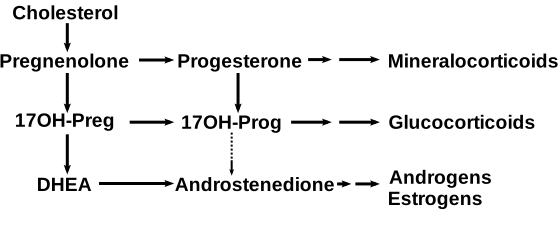
Cholesterol side-chain cleavage enzyme is commonly referred to as P450scc, where "scc" is an abbreviation for side-chain cleavage, and more properly named CYP11A1. P450scc is a mitochondrial enzyme that catalyzes conversion of cholesterol to pregnenolone. This is the first reaction in the process of steroidogenesis in all mammalian tissues that specialize in the production of various steroid hormones.
P450scc is a member of the cytochrome P450 superfamily of enzymes (family 11, subfamily A, polypeptide 1) and is encoded by the gene. The enzyme is sometimes referred to as Cholesterol desmolase, due to the breaking of the carbon bonds (desmolysis).
Nomenclature
The systematic name of this enzyme class is cholesterol, reduced-adrenal-ferredoxin:oxygen oxidoreductase (side-chain-cleaving). Other names include:
- C27-side-chain cleavage enzyme
- cholesterol 20-22-desmolase
- cholesterol C20-22 desmolase
- cholesterol desmolase
- cholesterol side-chain cleavage enzyme
- cholesterol side-chain-cleaving enzyme
- cytochrome P-450scc
- desmolase, steroid 20-22
- enzymes, cholesterol side-chain-cleaving
- steroid 20-22 desmolase
- steroid 20-22-lyase.
Tissue and intracellular localization
The highest level of the cholesterol side-chain cleavage system is found in the adrenal cortex and the corpus luteum. The system is also expressed at high levels in steroidogenic theca cells in the ovary, and Leydig cells in the testis. During pregnancy, the placenta also expresses significant levels of this enzyme system. P450scc is also present at much lower levels in several other tissue types, including the brain. In the adrenal cortex, the concentration of adrenodoxin is similar to that of P450scc, but adrenodoxin reductase is expressed at lower levels.
Immunofluorescence studies using specific antibodies against P450scc system enzymes have demonstrated that proteins are located exclusively within the mitochondria. P450scc is associated with the inner mitochondrial membrane, facing the interior (matrix). Adrenodoxin and adrenodoxin reductase are soluble peripheral membrane proteins located inside the mitochondrial matrix that appear to associate with each other primarily through electrostatic interactions.
Mechanism of action
P450scc catalyzes the conversion of cholesterol to pregnenolone in three monooxygenase reactions. These involve 2 hydroxylations of the cholesterol side-chain, which generate, first, 22R-hydroxycholesterol and then 20alpha,22R-dihydroxycholesterol. The final step cleaves the bond between carbons 20 and 22, resulting in the production of pregnenolone and isocaproic aldehyde.
Each monooxygenase step requires 2 electrons (reducing equivalents). The initial source of the electrons is NADPH. The electrons are transferred from NADPH to P450scc via two electron transfer proteins: adrenodoxin reductase and adrenodoxin. All three proteins together constitute the cholesterol side-chain cleavage complex.
The involvement of three proteins in cholesterol side-chain cleavage reaction raises the question of whether the three proteins function as a ternary complex as reductase:adrenodoxin:P450. Both spectroscopic studies of adrenodoxin binding to P450scc and kinetic studies in the presence of varying concentrations of adrenodoxin reductase demonstrated that the reductase competes with P450scc for binding to adrenodoxin. These results demonstrated that the formation of a functional ternary complex is not possible. From these studies, it was concluded that the binding sites of adrenodoxin to its reductase and to P450 are overlapping and, as a consequence, adrenodoxin functions as a mobile electron shuttle between reductase and P450. These conclusions have been confirmed by structural analysis of adrenodoxin and P450 complex.
The process of electron transfer from NADPH to P450scc is not tightly coupled; that is, during electron transfer from adrenodoxin reductase via adrenodoxin to P450scc, a certain portion of the electrons leak outside of the chain and react with O2, generating superoxide radicals. Steroidogenic cells include a diverse array of antioxidant systems to cope with the radicals generated by the steroidogenic enzymes.
Regulation
In each steroidogenic cell, the expression of the P450scc system proteins is regulated by the trophic hormonal system specific for the cell type. In adrenal cortex cells from zona fasciculata, the expression of the mRNAs encoding all three P450scc proteins is induced by corticotropin (ACTH). The trophic hormones increase CYP11A1 gene expression through transcription factors such as steroidogenic factor 1 (SF-1), by the α isoform of activating protein 2 (AP-2) in the human, and many others. The production of this enzyme is inhibited notably by the nuclear receptor DAX-1.
P450scc is always active, however its activity is limited by the supply of cholesterol in the inner membrane. The supplying of cholesterol to this membrane (from the outer mitochondrial membrane) is, thus, considered the true rate-limiting step in steroid production. This step is mediated primarily by the steroidogenic acute regulatory protein (StAR or STARD1). Upon stimulation of a cell to make steroid, the amount of StAR available to transfer cholesterol to the inner membrane limits how fast the reaction can go (the acute phase). With prolonged (chronic) stimulation, it is thought that cholesterol supply becomes no longer an issue and that the capacity of the system to make steroid (i.e., level of P450scc in the mitochondria) is now more important.
Corticotropin (ACTH) is a hormone that is released from the anterior pituitary in response to stress situations. A study of the steroidogenic capacity of the adrenal cortex in infants with acute respiratory disease demonstrated that indeed during disease state there is a specific increase in the steroidogenic capacity for the synthesis of the glucocorticoid cortisol but not for the mineralocorticoid aldosterone or androgen DHEAS that are secreted from other zones of the adrenal cortex.
Pathology
Mutations in the CYP11A1 gene result in a steroid hormone deficiency, causing a minority of cases of the rare and potentially fatal condition lipoid congenital adrenal hyperplasia. Deficiency of CYP11A1 can result in hyperpigmentation, hypoglycemia, and recurrent infections.
Inhibitors
Cholesterol side-chain cleavage enzyme inhibitors include aminoglutethimide, ketoconazole, and mitotane, among others.
Steroid hormone synthesis
Additional images
File:Cholesterol.svg|Cholesterol File:Pregnenolone.svg|Pregnenolone
References
References
- (December 1992). "Steroidogenic enzymes: structure, function, and role in regulation of steroid hormone biosynthesis". The Journal of Steroid Biochemistry and Molecular Biology.
- "Entrez Gene: CYP11A1 cytochrome P450, family 11, subfamily A, polypeptide 1".
- (February 1996). "Placental steroid hormone synthesis: unique features and unanswered questions". Biology of Reproduction.
- (December 2001). "Neurosteroid metabolism in the human brain". European Journal of Endocrinology.
- (May 1986). "Stoichiometry of mitochondrial cytochromes P-450, adrenodoxin and adrenodoxin reductase in adrenal cortex and corpus luteum. Implications for membrane organization and gene regulation". European Journal of Biochemistry.
- (October 1990). "Induction and mitochondrial localization of cytochrome P450scc system enzymes in normal and transformed ovarian granulosa cells". The Journal of Cell Biology.
- (November 1990). "Mechanism of corticotropin and cAMP induction of mitochondrial cytochrome P450 system enzymes in adrenal cortex cells". The Journal of Biological Chemistry.
- Topological studies of cytochromes P-450scc and P-45011 beta in bovine adrenocortical inner mitochondrial membranes. Effects of controlled tryptic digestion. J. Biol. Chem. 1979 254: 10443-8.
- (April 1986). "Preparation of antiserum to rat cytochrome P-450 cholesterol side chain cleavage, and its use for ultrastructural localization of the immunoreactive enzyme by protein A-gold technique". Endocrinology.
- (May 1981). "Mechanisms of ionic activation of adrenal mitochondrial cytochromes P-450scc and P-45011 beta". The Journal of Biological Chemistry.
- (1995). "Routes and regulation of NADPH production in steroidogenic mitochondria". Endocrine Research.
- (December 1987). "Isolation of a cDNA for adrenodoxin reductase (ferredoxin-NADP+ reductase). Implications for mitochondrial cytochrome P-450 systems". European Journal of Biochemistry.
- (April 1980). "Mitochondrial cytochrome P-450scc. Mechanism of electron transport by adrenodoxin". The Journal of Biological Chemistry.
- (May 1981). "Adrenal mitochondrial cytochrome P-450scc. Cholesterol and adrenodoxin interactions at equilibrium and during turnover". The Journal of Biological Chemistry.
- (June 2011). "Structural basis for pregnenolone biosynthesis by the mitochondrial monooxygenase system". Proceedings of the National Academy of Sciences of the United States of America.
- (September 1993). "Electron leakage from the mitochondrial NADPH-adrenodoxin reductase-adrenodoxin-P450scc (cholesterol side chain cleavage) system". Archives of Biochemistry and Biophysics.
- (2006). "Antioxidant protective mechanisms against reactive oxygen species (ROS) generated by mitochondrial P450 systems in steroidogenic cells". Drug Metabolism Reviews.
- (August 2009). "Transcriptional regulation of steroidogenic genes: STARD1, CYP11A1 and HSD3B". Experimental Biology and Medicine.
- (July 2007). "Transcriptional regulation of human CYP11A1 in gonads and adrenals". Journal of Biomedical Science.
- (November 1995). "Selective increases in adrenal steroidogenic capacity during acute respiratory disease in infants". European Journal of Endocrinology.
- (March 2006). "Phenotypic variations in lipoid congenital adrenal hyperplasia". Pediatric Endocrinology Reviews.
- (August 2006). "Homozygous mutation of P450 side-chain cleavage enzyme gene (CYP11A1) in 46, XY patient with adrenal insufficiency, complete sex reversal, and agenesis of corpus callosum". The Journal of Clinical Endocrinology and Metabolism.
- (March 2008). "Severe combined adrenal and gonadal deficiency caused by novel mutations in the cholesterol side chain cleavage enzyme, P450scc". The Journal of Clinical Endocrinology and Metabolism.
- (2020). "Primary adrenal insufficiency: New genetic causes and their long-term consequences". Clinical Endocrinology.
- (2001). "Principles and Practice of Endocrinology and Metabolism". Lippincott Williams & Wilkins.
- (18 May 2010). "Endocrinology - E-Book: Adult and Pediatric". Elsevier Health Sciences.
- (13 March 2015). "Cytochrome P450: Structure, Mechanism, and Biochemistry". Springer.
This article was imported from Wikipedia and is available under the Creative Commons Attribution-ShareAlike 4.0 License. Content has been adapted to SurfDoc format. Original contributors can be found on the article history page.
Ask Mako anything about Cholesterol side-chain cleavage enzyme — get instant answers, deeper analysis, and related topics.
Research with MakoFree with your Surf account
Create a free account to save articles, ask Mako questions, and organize your research.
Sign up freeThis content may have been generated or modified by AI. CloudSurf Software LLC is not responsible for the accuracy, completeness, or reliability of AI-generated content. Always verify important information from primary sources.
Report