From Surf Wiki (app.surf) — the open knowledge base
Chogha Zanbil
Ancient Elamite complex in Khuzestan Province, Iran
.jpg)
Ancient Elamite complex in Khuzestan Province, Iran
| Field | Value |
|---|---|
| name | Chogha Zanbil |
| native_name | چغازنبيل (Persian) |
| Dur Untash (Elamite) | |
| image | Choqa_Zanbil_Darafsh_1_(36).JPG |
| map_type | Iran#West Asia |
| relief | yes |
| map_alt | Location in Iran |
| coordinates | |
| location | Khuzestan Province, Iran |
| type | Settlement |
| builder | Untash-Napirisha |
| built | c. 1250 BC |
| abandoned | c. 645 BC |
| cultures | Elamite |
| excavations | 1935–39, 1946, 1951–1961, 1999, 2002, 2004–2005 |
| archaeologists | Roland de Mecquenem, Roman Ghirshman, Behzad Mofidi Nasrabadi |
| condition | In ruins |
| website | |
| notes | {{Infobox UNESCO World Heritage Site |
| child | yes |
| official_name | Tchogha Zanbil |
| criteria | (iii), (iv) |
| ID | 113 |
| year | 1979 |
| mapframe | yes |
| mapframe-zoom | 11 |
Dur Untash (Elamite) | mapframe-zoom = 11
Chogha Zanbil is an ancient Elamite complex in the Khuzestan province of Iran. It is one of the few existing ziggurats outside Mesopotamia. It lies approximately 30 km southeast of Susa and 80 km north of Ahvaz. The construction date of the city is unclear due to uncertainty in the chronology of the reign of Untash-Napirisha, but is clearly sometime in the 14th or 13th century BC. The conventionally assumed date is 1250 BC. The city is currently believed to have been destroyed by the Neo-Assyrian ruler Assurbanipal in about 645 BC, along with the Elamite capital of Susa, though some researchers place the end of occupation in the late 12th century BC. The ziggurat is considered to be the best preserved example of the stepped pyramidal monument by UNESCO. In 1979, Chogha Zanbil became the first Iranian site to be inscribed on the UNESCO World Heritage List.
History
Chogha Zanbil is typically translated as 'basket mound.' It was built about 1250 BC by the king Untash-Napirisha, mainly to honor the great god Inshushinak. Its original name was Dur Untash, which means 'town of Untash', but it is unlikely that many people, besides priests and servants, ever lived there. The complex is protected by three concentric walls which define the main areas of the town. It is known from inscriptions that the outer wall had seven gates, of which only two have been found. The middle wall had four gates and between the outer and middle walls was a shared temple dedicated to the chief Elamite god Napirisha and to Inshushinak. Most of the innermost 2.5 hectare area is wholly taken up with a great ziggurat dedicated to the main god, which was built over an earlier square temple with storage rooms also built by Untash-Napirisha.
The middle area holds eleven temples for other gods. These included Nabu, Adad, Shala, Inanna, Ninegal, Humban, Shimut, Pinikir, Manzat, and Nuska. There are also sanctuaries northeast of the ziggurat for the Elamite deities Isniqarab (Ishmekarab) and Kiririsha. A brick inscription mentioned a golden statue dedicated to the god Nahhunte. Brick inscriptions referring to twenty-two temples have been found but only about half of those have been located. In the outer area are royal palaces, a funerary palace containing five subterranean royal tombs.
Construction at the site, which included commercial and residential areas, continued after Untash-Napirisha's death with numerous building phases and continued to be occupied until it was destroyed by the Assyrian king Ashurbanipal in about 645 BC. Some scholars speculate, based on the large number of temples and sanctuaries at Chogha Zanbil, that Untash-Napirisha attempted to create a new religious center (possibly intended to replace Susa) which would unite the gods of both highland and lowland Elam at one site.
The ziggurat originally measured 105.2 m on each side and about 53 m in height, in five levels, and was crowned with a temple. Mud brick was the basic material of the whole ensemble. The ziggurat was given a facing of baked bricks, a number of which have cuneiform characters giving the names of deities in the Elamite and Akkadian languages. Though the ziggurat now stands only 24.75 m high, less than half its estimated original height, its state of preservation is unsurpassed. https://web.archive.org/web/20181005030841/http://untoldpersia.com/ContentView/Pid/40226/title/Tchogha-Zanbil---Susa-Iran
Archaeology
The site, measuring 96 hectares in area, was originally discovered by a geologist doing oil exploration in the area. He found an inscribed brick and, being an amateur archaeologist, took it to excavators then working at the site of Susa. The inscription described the building of a sacred city by one "Untash-Gal". It was surveyed and excavated by Roland de Mecquenem in 1935–39 and 1946.
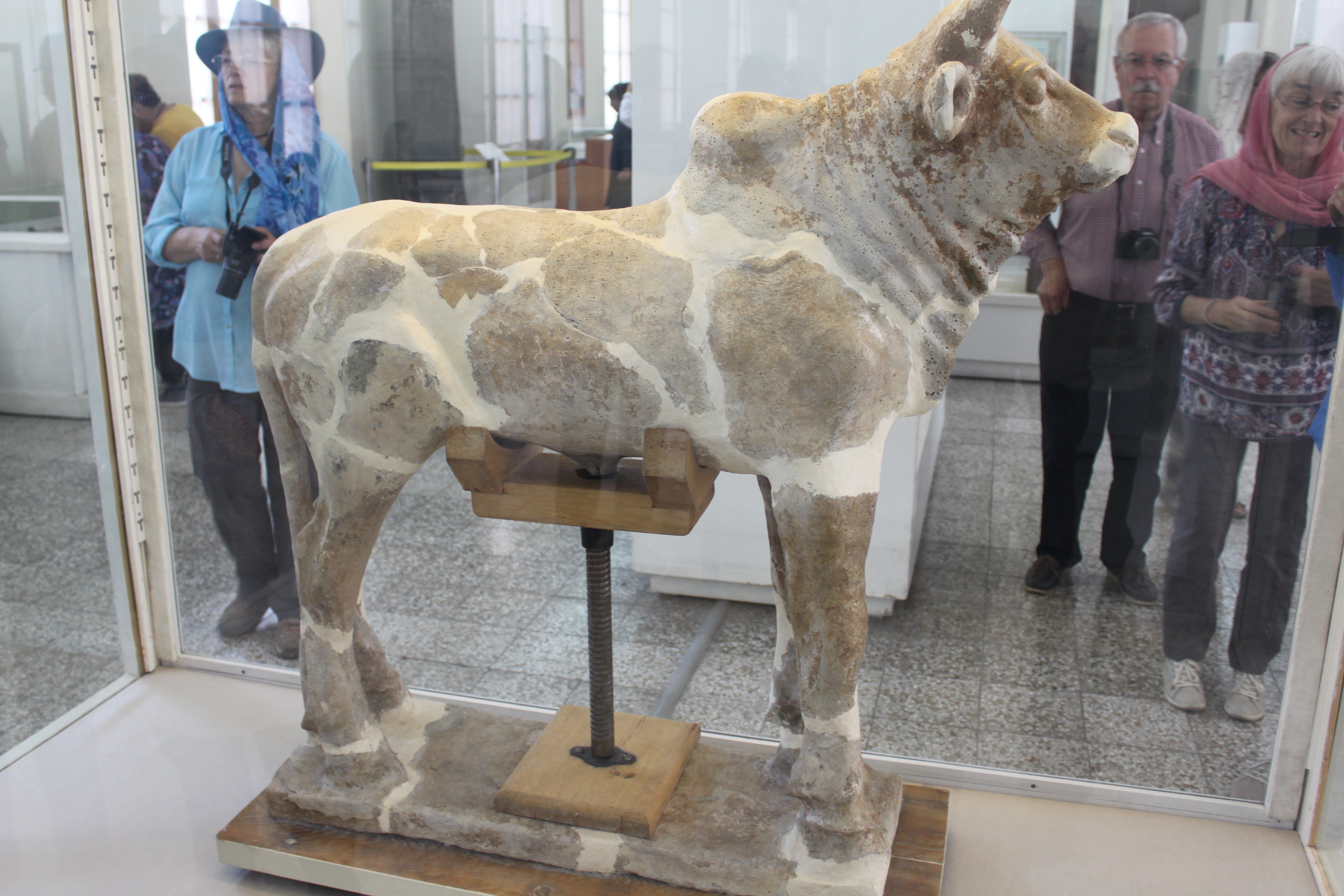
Chogha Zanbil was excavated in six seasons (a total of 21 months) between 1951 and 1962 by Roman Ghirshman with the French Archeological Mission. Almost 100,000 cubic yards of debris were removed in the process, using a crew of 100 to 125 workers at a time. Excavations exposed a quadrangle 1300 square foot wall enclosed sacred area with temples and courtyards. The five stage ziggurat stood at its center, with the corners oriented to the cardinal points. Every 11th level of bricks in the ziggurat was inscribed. Large gates were built into the four sides with three having stairs to the 2nd level and one, the southwest, to the 5th and highest level. At each gate there were half life sized statues, one, of blue-glazed terracotta with an inscription dedicated to the god Inshushinak. Excavation showed that the ziggurat was built in two phases, to the 2nd level first, with two temples, then subsequently to the 5th level. In one of the temples white and black glass tiles were found. Five tombs were found under rooms in the courtyard. Tomb 1 was apparently never used, Tomb V was robbed out in antiquity, Tomb II contained partially burned remains of five individuals (cremated elsewhere), and Tomb IV, completely undisturbed, contained an adult female between 40–60 years old accompanied by grave goods.
A number of inscribed bricks were found (5257 in total with most in Elamite but with 67 in Akkadian). One read:
Most recently the site was excavated by Behzad Mofidi Nasrabadi in 1999, 2002, 2004, and 2005. This included a 35 hectare magnetometer survey by the University of Kiel
Threats
Petroleum exploration due to increased global demand threatens the foundations of the site, as various seismic tests have been undertaken to explore for reserves of petroleum. Digging for oil has been undertaken as close as 300 m away from the ziggurat.{{cite news |access-date = September 29, 2009 |archive-url = https://web.archive.org/web/20071012212846/http://www.chnpress.com/news/Print/?Section=2&id=6832 |archive-date = October 12, 2007 |url-status = dead
Gallery
File:Dur Untash - Chgoha Zanbil -چغازنبیل - Shush -Susa -Khuzesten -Iran 2011.jpg|[[File:چغازنیبل روی مس.jpg|thumb]]Zigurat of Dur Untash File:Choqa Zanbil Darafsh 1 (36).JPG|Profile view of Dur Untash Zigurat structure File:The ziggurat at Aqar Quf.jpg|Similar Zigurat structures in Iraq: The ziggurat of Dur-Kurigalzu File:Ancient ziggurat at Ali Air Base Iraq 2005.jpg|Similar Zigurat structures in Iraq: Ziggurat of Ur File:West Asiatic Architecture 68.jpg|The Ziggurat at Chogha Zanbil is one of the main Ziggurats File:Choqa Zanbil 2.jpg File:Glazed (originally blue) door plaque with boss. The Elamite cuneiform inscription reads "Palace of Untash-Napirisha, King of Elam". 13th centiury BCE. From Choga Zanbil, Iran. British Museum.jpg|Glazed (originally blue) door plaque with boss. The Elamite cuneiform inscription reads "Palace of Untash-Napirisha, King of Elam". 13th century BCE. From Chogha Zanbil, Iran. British Museum
Notes
References
References
- R. Ghirshman, "The Ziggurat of Tchoga-Zanbil", Scientific American, vol. 204, pp. 69–76, 1961
- "Tchogha Zanbil". UNESCO World Heritage Centre.
- Carlson, Evan, "Inscribed and Uninscribed Spaces in Al Untash Napirisha: Interaction and Segregation in a Late Second-Millennium De Novo Capital", Iran, vol. 52, pp. 29–52, 2014.
- F. Pomponio, "Nabu, II culto e la figura di un dio del Pantheon babilonese ed assiro", StSem. 51, 1978
- A. Bramanti, "NA", Band 9 Nab - Nuzi, edited by A. Bramanti, J. Fechner, M. Greiner, S. Heigl, N. Morello, Erich Ebeling, Bruno Meissner and Michael P. Streck, Berlin, Boston: De Gruyter, pp. 1–191, 2001
- [https://www.scielo.cl/scielo.php?pid=S0718-915X2020000300366&script=sci_arttext&tlng=pt] Hosseini, Sara, et al., "Structural analysis of earth construction's vaults: Case of underground tombs of Chogha Zanbil", Revista de la construcción 19.3, pp. 366–380, 2020
- Mecquenem, R. de and Michaion, J., "Recherches à Tchogha Zembil", Mémoires de la Mission Archéologique en Iran 33, Presses Universitaires de France, Paris, 1953
- Ghirshman, Roman, "Quatrième Campagne de Fouilles à Tchoga-Zanbil Près Suse (1954–1955)", Arts Asiatiques, vol. 2, no. 3, pp. 162–77, 1955
- Ghirshman, Roman, "Tchoga-Zanbil près Suse. Rapport préliminaire de la 6 e campagne", Arts Asiatiques, vol. 4, no. 2, pp. 113–30, 1957
- Ghirshman, Roman, "Tchoga-Zanbil. Rapport préliminaire de la IX e campagne (1961–1962)", Arts Asiatiques, vol. 8, no. 4, pp. 243–62, 1961
- Ghirshman, Roman, "Troisième Campagne de Fouilles à Tchoga-Zanbil Près Suse: Rapport Preliminaire", Arts Asiatiques, vol. 1, no. 2, 1954, pp. 82–95, 1954
- Roman Ghirshman, Travaux de la mission archéologique en Susiane en hiver 1952–1953, Syria, T. 30, Fasc. 3/4, pp. 222–233, 1953
- Ghirshman, Roman, "Tchoga-Zanbil, rapport préliminaire de la VIII e campagne (1960-1961)", Arts Asiatiques, vol. 8, no. 2, pp. 121–38, 1961
- Ghirshman, Roman, "Tchoga-Zanbil, rapport préliminaire de la VII-e campagne (1958–1959)", Arts Asiatiques, vol. 6, no. 4, pp. 259–82, 1959
- Carter, Elizabeth, "Landscapes of Death in Susiana During the Last Half of the 2nd Millennium B.C.", Elam and Persia, edited by Javier Álvarez-Mon and Mark B. Garrison, University Park, US: Penn State University Press, pp. 45–58, 2011
- RIMI nn artifact entry (No. P388073). (2008, November 20). Cuneiform Digital Library Initiative (CDLI). https://cdli.ucla.edu/P388073
- Mofidi Nasrabadi, B., "Untersuchungen zu Sied lungsstrukturen in der Peripherie von Cogä Zanbil (Dur Untas)", AMT 35–36, pp. 241–65, 2003–4
- Mofidi Nasrabadi, B., "Archäologische Ausgrabungen und Untersuchungen in Cogä Zanbil", Agenda Verlag, Münster, 2007
- Mofidi Nasrabadi, B., "Planungsaspekte und die Struktur der altorientalischen neugegründeten Stadt in Chogha Zanbil", Shaker Verlag, Achen, 2013
This article was imported from Wikipedia and is available under the Creative Commons Attribution-ShareAlike 4.0 License. Content has been adapted to SurfDoc format. Original contributors can be found on the article history page.
Ask Mako anything about Chogha Zanbil — get instant answers, deeper analysis, and related topics.
Research with MakoFree with your Surf account
Create a free account to save articles, ask Mako questions, and organize your research.
Sign up freeThis content may have been generated or modified by AI. CloudSurf Software LLC is not responsible for the accuracy, completeness, or reliability of AI-generated content. Always verify important information from primary sources.
Report