From Surf Wiki (app.surf) — the open knowledge base
Chinnamunda
Buddhist goddess
Buddhist goddess
Chinnamunda
Chinnamunda is a Buddhist goddess. She is held as an aspect of Vajrayogini or Vajravārāhī.
Iconography
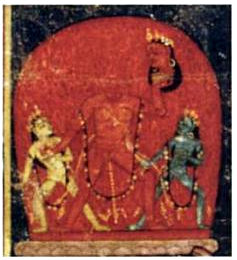
Her attributes and iconography are similar to those of the Hindu goddess Chinnamasta, although according to David Kinsley, Chinnamunda probably predates her Hindu counterpart. The main difference among them is that Chinnamasta is often portrayed as standing on a copulating couple, while Chinnamunda is not.
Chinnamunda is often portrayed alongside Mekhala and Kanakhala, the two headless sisters, Indian Buddhist tantric adepts who appear on the list of the 84 Mahasiddhas.
Story
According to a Buddhist story, Chinnamunda was a princess named Lakshminkara who once displeased her father. He sentenced punishment on her, but she replied that she would punish herself, and severed her own head with a golden razor. She then proceeded to parade around the city holding her head. As a consequence, the citizens called her Chinnamunda. She was eventually reborn as a devotee of Padmasambhava.
This content may have been generated or modified by AI. CloudSurf Software LLC is not responsible for the accuracy, completeness, or reliability of AI-generated content. Always verify important information from primary sources.