From Surf Wiki (app.surf) — the open knowledge base
Chinese Taipei
Name used by Taiwan in international organizations and events
Name used by Taiwan in international organizations and events
| Field | Value |
|---|---|
| t | 中華臺北 |
| s | 中华台北 |
| bpmf | ㄓㄨㄥ ㄏㄨㄚˊㄊㄞˊㄅㄟˇ |
| w | |
| p | Zhōnghuá Táiběi |
| psp | Chunghwa Taipei |
| tp | Jhong-huá Táiběi |
| mps | Jūnghuá Táiběi |
| mi | |
| gr | Jonghua Tairbeei |
| j | zung1 waa4 toi4 bak1 |
| y | Jūngwàh Tòihbāk |
| ci | |
| poj | Tiong-hôa Tâi-pak |
| tl | Tiong-huâ Tâi-pak |
| h | Chûng-fà Thòi-pet |
| buc | Dṳ̆ng-huà Dài-báe̤k |
| altname | Separate Customs Territory of Taiwan, Penghu, Kinmen, and Matsu |
| t2 | 臺 |
| s2 | 台澎金马个别关税领域 |
| bpmf2 | ㄊㄞˊㄆㄥˊㄐㄧㄣ ㄇㄚˇㄍㄜˋㄅㄧㄝˊㄍㄨㄢ ㄕㄨㄟˋㄌㄧㄥˇㄩˋ |
| w2 | |
| p2 | Tái Péng Jīn Mǎ Gèbié Guānshuì Lǐngyù |
| tp2 | Tái Péng Jin Mǎ Gè-bié Guan-shuèi Lǐng-yù |
| mi2 | |
| mps2 | Tái Péng Jīn Mǎ Gèbié Guānshuèi Lǐngyù |
| gr2 | Tair Perng Jin Maa Gehbye Guanshuey Liingyuh |
| poj2 | Tâi-phêⁿ-Kim-bé Kò-piàt Koan-sòe Léng-hèk |
| tl2 | Tâi-phêⁿ-Kim-bé Kò-piàt Kuan-sùe Líng-hìk |
the toponym used for diplomatic purposes
"Chinese Taipei" is the term used in various international organizations and tournaments for groups or delegations representing the Republic of China (ROC), a country commonly known as Taiwan.
Due to the one China principle stipulated by the People's Republic of China (PRC, China), Taiwan, being a non-UN member after its expulsion in 1971 with ongoing dispute of its sovereignty, was prohibited from using or displaying any of its national symbols that would represent the statehood of Taiwan, such as its national name, anthem and flag, at international events. The term "Chinese Taipei" was first proposed in 1979 and was eventually approved in the Nagoya Resolution, whereby both the ROC/Taiwan and the PRC/China obtained their right of participation and would remain as separate delegations in any activities of the International Olympic Committee (IOC) and its associated organizations. This term came into official use in 1981 following a name change of the Republic of China Olympic Committee (ROCOC) to the Chinese Taipei Olympic Committee. This arrangement later became a model for the ROC/Taiwan to continue participating in various international organizations and diplomatic affairs other than the Olympic Games, including the World Trade Organization, the World Health Organization, the Metre Convention, APEC, and international pageants.
"Chinese Taipei" is a deliberately ambiguous term, designed to be equivocal about the political status of the ROC/Taiwan. The meaning of "Chinese" (zh, ) is also ambiguous, so that either party is able to interpret it as national identity or cultural sphere (similar to ethnonyms as Anglo, Arab, Hispanic or Iranian). The specific mention of "Taipei" signifies its capital city without explicitly defining the certain territorial boundary of the ROC. Since the IOC has ruled out the use of the name "Republic of China", the neologism was considered as an expedient resolution and a more inclusive term than just "Taiwan" to both the Kuomintang, the ruling party of the ROC at the time during the Nagoya Resolution, and the PRC. The PRC's persistent policy is to keep Taipei isolated on the world stage and disagrees with any use of "Taiwan" as an official title, in order to prevent Taiwan from gaining international recognition for "independent statehood" separate from the PRC. The term "Taiwan, China" or "Taipei, China" was rejected by the ROC government because it could be construed as Taiwan being a subordinate region to the PRC.
Popular opinion in Taiwan has changed drastically in regard to the cross-strait relations and the nationalistic discourses since the democratization of Taiwan and the end of one-party rule by the Kuomintang. "Chinese Taipei" has since been viewed by many Taiwanese as an anachronistic, aggravating, and humiliating term. The Taiwan Name Rectification Campaign sought to alter the formal name from "Chinese Taipei" to "Taiwan" for representation in Olympic Games and further potential international events. A nationwide referendum was held in 2018, in which a proposal for the name change was rejected. The main argument against such a move was the uncertain consequences of such a renaming; at worst, the renaming dispute could be used by China as an excuse to pressure the IOC to exclude Taiwan from participating in the Olympic Games completely and force its existing membership to be revoked.
Origins
Two Chinas at the Olympics
In the aftermath of the Chinese Civil War in 1949, the People's Republic of China (PRC) was established and the nationalist Republic of China (ROC) government retreated to Taiwan, previously a Qing territory that was ceded to Japanese rule from 1895 until its surrender at the end of World War II in 1945. As time went on, the increased official recognition of the PRC in international activities, such as when accorded recognition in 1971 by the United Nations, instead of that accorded previously to the ROC saw existing diplomatic relations transfer from Taipei to Beijing. The ROC needed to come to a beneficial conclusion to how it would be referred when there was participation by the PRC in the same forum.
The International Olympic Committee (IOC) recognized both the PRC and the ROC Olympic Committees in 1954. In 1958, the PRC withdrew its membership from the IOC and nine other international sports organizations in protest against the two-Chinas policy. After the withdrawal of the PRC, the IOC had been using a number of names in international Olympic activities to differentiate the ROC from the PRC. "Formosa" was used at the 1960 Summer Olympics, and "Taiwan" was used in 1964 and 1968. In 1975, the PRC applied to rejoin the IOC as the sole sports organization representing the whole China. The Taiwanese team, competing under the name of Republic of China at the previous Olympics, was refused the right to represent itself as the "Republic of China" or use "China" in its name by the government of the host country, Canada, at the 1976 Summer Olympics. The IOC then voted to change the name of the ROC team to "Taiwan", which was rejected by the ROC, and the ROC announced their withdrawal from the 1976 Summer Olympics a day before the opening ceremony.
The top ROC leadership at the time asserted Chinese nationalism, contending both parts of divided China are Chinese territories and Taiwan did not represent all the regions of the ROC. What people refer to as Taiwan is one of several areas or islands (Penghu, Kinmen and Matsu in addition to Taiwan) and Taiwan alone did not reflect the "territorial extent" of the ROC. Furthermore, although it is true that most products from the area controlled by the ROC are labeled "made in Taiwan", the trade practices of the ROC are such that the regional area of production is used for labeling. Some wines from Kinmen are labeled "made in Kinmen", just as some perfume are labeled "made in Paris" and not "made in France". Therefore, the ROC government refused to accept the name of Taiwan during the period.
1979 IOC resolutions
Following the 1976 Montreal Olympics, IOC President Lord Killanin established a commission to examine the issue of "Two Chinas." Killanin aimed to reintegrate the PRC into the Olympic Movement, and the matter was designated as a principal topic of discussion at the 81st IOC Session, held in Montevideo in April 1979. At that session, the IOC officially recognized the Olympic Committee of the PRC while continuing to acknowledge the Olympic Committee based in Taipei. The resolution left problems relating to the names, anthems and flags of both committees unsolved. The PRC showed a willingness to allow Taiwan to be included in the IOC but objected to the resolution, reaffirming sports organizations in Taiwan must not use any of the emblems of the Republic of China. He Zhenliang, a representative of the PRC, stated in Montevideo:
According to the Olympic Charter, only one Chinese Olympic Committee should be recognized. In consideration of the athletes in Taiwan having an opportunity to compete in the Olympic Games, the sports constitution in Taiwan could function as a local organization of China and still remain in the Olympic Movement in the name of the Chinese Taipei Olympic Committee. However, its anthem, flag and constitutions should be changed correspondingly.
After the 81st Session, the IOC Executive Board designated the Olympic Committee in Beijing as the Chinese Olympic Committee, with the PRC's anthem, flag and emblem. The Olympic Committee in Taipei was designated as the Chinese Taipei Olympic Committee, with a different anthem, flag and emblem from those the ROC used and which must be approved by the executive board. Lord Killanin submitted the resolution to IOC members for a postal vote following the conclusion of the IOC Executive Board meeting held in October 1979 in Nagoya. The resolution, known as the Nagoya Resolution, was approved in November 1979 by the IOC members, and later other international sports federations adopted the resolution.
The Nagoya Resolution was welcomed by the PRC as the resolution followed the PRC's One China principle, whereas the ROC decided that the ROC Olympic Committee must strongly protest against the decisions. From November 1979, the ROC Olympic Committee and Taiwan's IOC member, Henry Hsu, filed a series of lawsuits in Lausanne against the IOC for annulment of the Nagoya Resolution. Taiwanese officials also boycotted the 1980 Winter and Summer Games in protest of not being allowed to use the ROC's official name, flag and national anthem.
1981 agreement
In 1980, the IOC amended the Olympic Charter so that all National Olympic Committees (NOCs) when participating in the Games could use delegation flags and anthems, instead of national ones. Juan Antonio Samaranch, the new president of the IOC, met Henry Hsu several times to discuss the ROC Olympic Committee's status in the IOC. In order for the youth to participate in the Olympic Games and counteract the PRC's strategy of isolating the ROC, the ROC government concluded that the ROC Olympic Committee should not withdraw from the IOC.
In 1981, the ROC government formally accepted the name "Chinese Taipei". A flag bearing the emblem of its Olympic Committee against a white background as the Chinese Taipei Olympic flag was confirmed in January. Based on the Olympic Charter amended at the 82nd IOC Session, an agreement was signed on 23 March in Lausanne by Juan Antonio Samaranch, the president of the IOC, and Shen Chia-ming, the president of the Chinese Taipei Olympic Committee (CTOC). The 1981 agreement, also known as the Lausanne Agreement, specified the name, flag and emblem of the CTOC. The CTOC is therefore entitled to be treated on the equal footing as other NOCs. In 1983, the National Flag Anthem of the Republic of China was chosen as the anthem of the Chinese Taipei delegation, and Chinese Taipei has been listed under the "T" group in IOC protocol order. Taiwan has competed under this name and flag exclusively at each Games since the 1984 Winter Olympics, as well as at the Paralympics and at other international events (with flags on which the Olympic rings are replaced by a symbol appropriate to the event).
Translation compromise
Chinese
Both the Republic of China (ROC) and the People's Republic of China (PRC) agree to use the English name "Chinese Taipei". The English word "Chinese" is ambiguous, and may refer to either the state or the culture. The ROC translates "Chinese Taipei" as zh (). The term zh is also used in the ROC's official name and state-owned enterprises. Meanwhile, the PRC translates the name as zh () or literally "Taipei, China", in the same manner as zh () ("Hong Kong, China"), explicitly connoting that Taipei is a part of the Chinese state.
In 1989, the two Olympic committees signed a pact in Hong Kong where the PRC agreed to use the ROC's translation in international sports-related occasions hosted in China. Domestically, the PRC continues to use its own "Taipei, China" translation. During the 2008 Summer Olympics, Chinese state media used the agreed-upon zh both internationally and in domestic press. However, during the 2020 Summer Olympics, state media began using zh domestically 93% of the time. During the 2022 Winter Olympics opening ceremony, China's state media's broadcast cut away to a clip of General Secretary of the Chinese Communist Party Xi Jinping when Taiwan's delegation paraded as zh. The broadcast in the stadium introduced the team as zh, while the television broadcast commentator of China Central Television announced the delegation's name as zh.
The World Health Organization, the international organization to both have Chinese as one of its official languages and have the ROC officially participate, uses zh in meeting minutes when the ROC is officially invited, but uses zh in all other contexts.
Other languages
In French, multiple different names have been officially used. The World Trade Organization officially translates the name as Taipei Chinois, which has an ambiguous meaning. The text of the IOC's Nagoya Resolution in 1979 used the name Taipei de Chine suggesting the state meaning of "Chinese". Before signing the agreement between the IOC and the Chinese Taipei Olympic Committee in 1981, representatives of two committees decided that the French name need not be stated. Only the English name would be used in the future IOC official documents. To this day, Chinese Taipei's page on the French-language IOC's website internally uses both Taipei de Chine and Taipei chinois (with a lowercase "c"; capitalization is not used by default for geographic origin adjectives in French) for some image alt text, but the title of the page itself simply uses the English name "Chinese Taipei". When the name is announced during the Parade of Nations, the French and English announcers both repeat the identical name "Chinese Taipei" in English.
In East Asian languages that would normally transcribe directly from Chinese, an English transliteration is used instead to sidestep the issue. Thus Japan uses Chainīzu Taipei () while South Korea uses Chainiseu Taibei () for their respective-language announcements during the Olympic Games or Asian Games. Meanwhile, Vietnam mostly follows ROC's translation and adapts the Sino-Vietnamese transcription to call Chinese Taipei as Đài Bắc Trung Hoa (alternatively Đài Bắc, Trung Hoa with a comma or Đài Bắc (Trung Hoa) with the brackets used; 臺北中華, ) likely due to the cosmetic and grammatical inconvenience when using direct English transliteration or the original English designation in Vietnamese context.
Use of the name
International organizations and forums

Besides the International Olympic Committee and sports organizations, Taiwan is a member economy of APEC and its official name in the organization is "Chinese Taipei". Taiwan's name in the World Trade Organization, "Separate Customs Territory of Taiwan, Penghu, Kinmen and Matsu", is frequently abbreviated as Chinese Taipei. It also participated as an invited guest in the World Health Organization (WHO) under the name of Chinese Taipei. The WHO is the only agency of the United Nations that the ROC is able, provided it is invited each year, to participate in since 1971.
The terminology has spilled into apolitical arenas. The PRC has successfully pressured some international organizations and NGOs to refer to the ROC as Chinese Taipei. The International Society for Horticultural Science replaced "Taiwan" with "Chinese Taipei" in designation used for the membership. In a similar case, two Taiwanese medical groups were forced to change the word "Taiwan" in their membership names of ISRRT due to a request by the WHO.
In the Miss World 1998, the government of the PRC pressured the Miss World Organization to rename Miss Republic of China 1998 to "Miss Chinese Taipei". The same happened in 2000, but with the Miss Universe Organization. Three years later at the Miss Universe pageant in Panama, the first official Miss China and Miss Taiwan competed alongside each other for the first time in history, prompting the PRC government to again demand that Miss Taiwan assume the title "Miss Chinese Taipei". Today, neither Miss Universe nor Miss World, the two largest pageant contests in the world, allow Taiwan's entrants to compete under the Taiwan label. In 2005, the third-largest pageant contest, Miss Earth, initially allowed Taiwanese contestant to compete as "Miss Taiwan"; a week into the pageant, however, the contestant's sash was updated to "Taiwan ROC". In 2008, Miss Earth changed the country's label to Chinese Taipei.
In Taiwan
The name is controversial in modern Taiwan; many Taiwanese see it as a result of shameful but necessary compromise, and a symbol of oppression that mainland China forced upon them. The title "Chinese Taipei" has been described as confusing, as it leads some people to believe that "Taipei" is a country or that it is located in or governed by mainland China. Taiwanese Olympian Chi Cheng has described competing under the name as "aggravating, humiliating and depressing."
Changing demographics and opinions in the country meant that more than 80% of citizens in 2016 saw themselves as Taiwanese, not Chinese, whereas in 1991, this figure was only 13.6%. This radical upswell in Taiwanese national identity has seen a re-appraisal and removal of "sinocentric" labels and figures established by the government during the period of Martial Law. For sporting events, the ROC team is abbreviated in Taiwan as the Team Zhonghua (). Starting around the time of the 2004 Summer Olympics, there has been a movement in Taiwan to change media references to the team to "Taiwan". During the 2020 Summer Olympics, most TV channels referred to the ROC as Team Zhonghua while some channels preferred Team Taiwan ().
2017 Summer Universiade

Use of the label came under vigorous renewed criticism during the run-up to the 2017 Summer Universiade, hosted in Taiwan. An English-language guide to the Universiade was lambasted for its "absurd" use of the label. The guide was rendered nonsensically by completely avoiding the name "Taiwan" not only when referring to the label under which Taiwanese athletes compete, but even when referring to geographical features such as the island of Taiwan itself. These statements included "Introduction of our Island: ... Chinese Taipei is long and narrow that lies north to south", and "Chinese Taipei is a special island and its Capital Taipei is a great place to experience Taipei's culture."
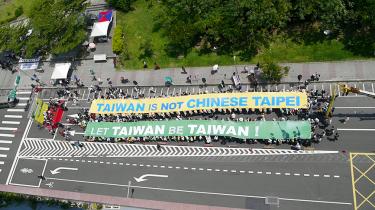
In response, the guide was withdrawn and shortly thereafter re-issued with the designation "Taiwan" reinstated. Despite these corrections, hundreds of Taiwanese demonstrated in Taipei, demanding that Taiwan cease using "Chinese Taipei" at sporting events.
2018 referendum
In February 2018, an alliance of civic organizations submitted a proposal to Taiwan's Central Election Commission (CEC). The proposed referendum asks if the nation should apply under the name of "Taiwan" for all international sports events, including the 2020 Tokyo Olympics. The proposal influenced the East Asian Olympic Committee (EAOC) to revoke Taichung's right to host the first East Asian Youth Games due to "political factors". An International Olympic Committee (IOC) representative reportedly said this was entirely the decision of the EAOC, and the IOC had no role in the ruling. The IOC also disapproved the altered name and sent three different warnings to the Chinese Taipei Olympic Committee ahead of the referendum vote, concerning the renaming issue which may disbar Taiwan from Olympic competitions.
Taiwanese people voted during the 2018 referendum to reject the proposal to change their official Olympic-designated name from Chinese Taipei to Taiwan. The main argument for opposing the name change was worrying that Taiwan may lose its Olympic membership under Chinese pressure, which would result in athletes unable to compete in the Olympics. Another proposal for the 2024 Summer Olympics was submitted to the Taiwan's CEC in 2021. The proposal was ultimately rejected by the CEC due to concerns that it might fall outside the scope of the Referendum Act of Taiwan, potentially rendering the Act inapplicable to the matter at hand.
Other alternative references to Taiwan
The terminology used to refer to the Republic of China has varied according to the geopolitical situation. Initially, the Republic of China was known simply as "China" until 1971, when the People's Republic of China replaced the Republic of China as the exclusive legitimate representative of "China" at the United Nations. In order to distinguish the Republic of China from the People's Republic of China, there has been a growing current of support for the use of "Taiwan" in place of "China" to refer to the former.
Separate Customs Territory of Taiwan, Penghu, Kinmen, and Matsu
In the World Trade Organization, the official full name of Taiwan is "Separate Customs Territory of Taiwan, Penghu, Kinmen, and Matsu", while its official short name is "Chinese Taipei". (In the same way, the official full name of the PRC is "People's Republic of China", while its official short name is "China", as seen in both members' accession protocols.)
As with "Chinese Taipei", the ROC and PRC also disagree on the Chinese translation of this name. The ROC uses Tái Pēng Jīn Mǎ Gèbié Guānshuì Lǐngyù (, lit. Separate Customs Territory of Taiwan, Penghu, Kinmen, and Matsu), while the PRC uses Zhōngguó Táiběi Dāndú Guānshuì Qū (, lit. Separate Customs Region of Taipei, China) and Tái Pēng Jīn Mǎ Dāndú Guānshuì Qū (, lit. Separate Customs Region of Taiwan, Penghu, Kinmen, and Matsu).
Taiwan, Province of China
International organizations in which the PRC participates generally do not recognize Taiwan or allow its membership. Thus, for example, whenever the United Nations makes reference to Taiwan, which does not appear on its member countries list, it uses the designation "Taiwan, Province of China", and organizations that follow UN standards usually do the same, such as the International Organization for Standardization in its listing of ISO 3166-1 country codes. Certain web-based postal address programs also label the country designation name for Taiwan as "Taiwan, Province of China".
Taiwan's Ministry of Foreign Affairs objected to the term together with other names including "Taiwan, China", "Taipei, China" and "Chinese Taiwan" in guidelines issued in 2018.
Island of Taiwan/Formosa
The term island of Taiwan or Formosa is used sometimes to avoid any misunderstanding about the Taiwan independence movement just referring to the island.
China or Republic of China
Some non-governmental organizations which the PRC does not participate in continue to use "China" or the "Republic of China". The World Organization of the Scout Movement is one of the few international organizations that continue to use the name of "Republic of China", and the ROC affiliate as the Scouts of China. This is because Scouting in mainland China is very limited or not really active. Likewise, Freemasonry is outlawed in the PRC and thus the Grand Lodge of China is based in Taiwan.
Governing authorities on Taiwan and TECRO
The United States uses the term "governing authorities on Taiwan" in the Taiwan Relations Act, officially defining the term "Taiwan" to "include...the islands of Taiwan and the Pescadores...and the governing authorities on Taiwan recognized by the United States as the Republic of China prior to January 1, 1979." Geographically and following the similar content in the earlier defense treaty from 1955, it excludes the other islands or archipelagos under the control of the Republic of China, such as Kinmen and the Matsu Islands.
In some contexts and agencies such as in Defense Security Cooperation Agency's notices of arms sales approvals, the so-called government of Taiwan is formally represented under the name of Taipei Economic and Cultural Representative Office (TECRO) in the United States, which practically serves as ROC's de facto embassy and diplomatic mission to the US.
Other non-specified areas
The United Nations publishes population projections for each nation, with nations grouped under geographic area; in 2015, the East Asia group contained an entry named "Other non-specified areas" referring to Taiwan. However, the 2017 publication updated the entry's name to the UN's preferred "Taiwan, Province of China".
Gallery of Chinese Taipei flags
File:Flag of the Republic of China.svg|Flag of the Republic of China, origin of the Blue Sky with a White Sun symbol used in Olympic and other "Chinese Taipei" flags File:Flag of Chinese Taipei for Olympic games.svg|Chinese Taipei Olympic flag File:Chinese Taipei Paralympic Flag.svg|Chinese Taipei Paralympic flag File:Flag of Chinese Taipei for Deaf.svg|Chinese Taipei Deaflympics flag File:Flag of Chinese Taipei for Universiade.svg|Chinese Taipei FISU World University Games (Universiade) flag File:Flag of Chinese Taipei (WorldSkills).svg|Chinese Taipei WorldSkills flag File:Flag of Chinese Taipei (FRC).svg|Chinese Taipei FIRST Robotics Competition flag File:Chinese Taipei Volleyball Flag.svg|Chinese Taipei volleyball flag File:Chinese Taipei esports flag.svg|Flag of Chinese Taipei used in the Overwatch World Cup
References
References
- Yang, William. (6 August 2021). "'Chinese Taipei': Taiwan's Olympic success draws attention to team name". [[Deutsche Welle]].
- Handley, Erin. (26 July 2021). "Why will Taiwan compete as Chinese Taipei at the Olympics in Tokyo?". [[ABC News (Australia).
- Zhong, Yang. (1 February 2016). "Explaining National Identity Shift in Taiwan". Journal of Contemporary China.
- Lin, Catherine K.. (5 August 2008). "How 'Chinese Taipei' came about". [[Taipei Times]].
- (27 July 2021). "Why is Taiwan not called Taiwan at the Olympics?". [[Agence France-Presse]].
- Helen Davidson and Jason Lu. (2 August 2021). "Will Taiwan's Olympic win over China herald the end of 'Chinese Taipei'?". [[The Guardian]].
- (1 June 2021). "What's in a name? Between "Chinese Taipei" and "Taiwan": The contested terrain of sport nationalism in Taiwan". International Review for the Sociology of Sport.
- Horton, Chris. (26 October 2018). "As China Rattles Its Sword, Taiwanese Push a Separate Identity". [[The New York Times]].
- Lucy, Lindell. (4 February 2022). "Olympic delegations should side with Taiwan and leave their national flags at home". [[The Japan Times]].
- Lee, Yimou. (3 August 2021). "Taiwan's medals revive debate over use of 'Chinese Taipei'". [[Reuters]].
- Tiezzi, Shannon. (5 August 2021). "Taiwan – Sorry, 'Chinese Taipei' – Is Having a Fantastic Olympics". [[The Diplomat (magazine).
- (24 July 2018). "Taipei condemns Beijing after youth games suspended". Agence France-Presse.
- (24 July 2018). "Taichung stripped of right to host East Asian Youth Games in Taiwan due to Chinese pressure {{!}} Taiwan News". Taiwan News.
- (26 Oct 2010). "Taiwan's retrocession procedurally clear: Ma". The China Post.
- Huang, Tai-lin. (22 May 2014). "Lien's campaign TV ads to stress love for Taiwan". Taipei Times.
- Eyal Propper. [http://israelcfr.com/documents/issue5_china.pdf "How China Views its National Security"], {{webarchive. link. (25 March 2012 ''[[Israel Council on Foreign Relations). The Israel Journal of Foreign Affairs]]'', May 2008.
- (August 2006). "Taiwan's Participation in Inter-Governmental Organizations: An Overview of Its Initiatives". Asian Survey.
- (Autumn 1985). "The "Two-Chinas" Problem and the Olympic Formula". Pacific Affairs.
- Cheung, Han. (30 August 2015). "An Olympic summer to remember".
- "Mexico 68, v.3".
- Meler, Bryan. (22 July 2021). "Canada's 'black eye' at the 1976 Montreal Olympics: Two major promises amid the two-Chinas dispute".
- (16 July 1976). "Taiwan controversy at the 1976 Montreal Olympics".
- (1 September 1976). "Fiasco at the Olympics".
- (June 2010). ""De jure" vs. "De facto" Discourse:Battle over ROC Membership with IOC (1960–1964)". Taiwan Historical Research.
- Lin, Catherine Kai-Ping. (2008). "Nationalism in International Politics: The Republic of China's Sports Foreign Policy-Making and Diplomacy from 1972 to 1981". Georgetown University.
- Barker, Philip. (1 May 2020). "The unluckiest IOC President".
- Barker, Philip. (10 September 2017). "The first-ever IOC Session in South America was an historic one for many reasons".
- Ritchie, Joe. (8 April 1979). "Olympic Group Admits Peking". The Washington Post.
- Pei, Dongguang. (2006). "Cultural Imperialism in Action: Critiques in the Global Olympic Trust: Eighth International Symposium for Olympic Research". International Centre for Olympic Studies.
- Amdur, Neil. (30 June 1979). "I.O.C. Paves Way to Let China in Olympics".
- (November 1979). "China and the Five Rings". Olympic Review.
- Amdur, Neil. (27 November 1979). "China Plan for the Olympics".
- (28 November 1979). "Olympic Conditions Rejected by Taiwan".
- (November 2016). "Reconsidering the 1980 Moscow Olympic Boycott: American Sports Diplomacy in East Asian Perspective". Diplomatic History.
- (June 2007). "A Study of the Signing of Lausanne Agreement between IOC and Chinese Taipei". Journal of Sport Culture.
- Hung, Joe. (10 January 2002). "Chinese Taipei". National Policy Foundation.
- link. Liu. Chin-Ping. (2007)
- (23 March 1981). "The International Olympic Committee (IOC) announced today that Taiwan...".
- (23 March 1981). "1981 Agreement with IOC".
- "洛桑協議及奧會模式".
- "List of NOCs in IOC Protocol Order".
- (June 1999). "我國國際暨兩岸體育交流之研究". Sports Affairs Council of the Executive Yuan.
- Lu, Pengqiao. (23 May 2017). "China Is Undermining Its Own Taiwan Strategy".
- (24 July 2008). "Mainland clarifies name issue of Taiwan team".
- (10 July 2008). "Beijing fiddles Taiwan's name for Olympics".
- (8 August 2021). "Beijing seeks to downgrade Taiwan's status: report".
- (4 February 2022). "Chinese Taipei were forced to march in the Ceremony".
- (4 February 2022). "China Knew It Couldn't Escape Politics at the Olympics Opening Ceremony. It Didn't Try".
- (2 May 2011). "第六十四届世界卫生大会". WHO.
- (2014). "预防自杀全球要务". WHO.
- "Le Territoire douanier distinct de Taiwan, Penghu, Kinmen, Matsu (Taipei Chinois) et l'OMC".
- (November 1979). "La Chine et les cinq anneaux". Revue Olympique.
- (27 July 2021). "Chinese Taipei – Comité National Olympique (CNO)".
- (26 September 2016). "Rio 2016 Opening Ceremony". International Olympic Committee.
- (30 March 2020). "PyeongChang 2018 Opening Ceremony". International Olympic Committee.
- Nojima, Tsuyoshi. (4 February 2022). "なぜ台湾は五輪で「チャイニーズ・タイペイ」なのか".
- (2022-02-05). "VFF – HLV Mai Đức Chung: Đội tuyển Nữ Việt Nam tự tin giành vé trước '''Đài Bắc Trung Hoa''' để đi World Cup".
- Government, Viet Nam. (2022-02-06). "NHỮNG NGÔI SAO VÀNG 'BAY' VÀO LỊCH SỬ!". [[Government of Vietnam]].
- Lan Phương. "Kết thúc ngày thi đấu đầu tiên tại ASIAD 2023: Đoàn Việt Nam được 2 huy chương Đồng".
- (11 November 2008). "APEC FAQ: Who are the members of APEC?". Asia Pacific Economic Cooperation.
- "Separate Customs Territory of Taiwan, Penghu, Kinmen and Matsu (Chinese Taipei) and the WTO".
- Reid, Katie. (18 May 2009). "Taiwan hopes WHO assembly will help boost its profile". Reuters.
- "Stilblüten".
- "Instances of Mainland China's Interference with Taiwan's International Presence, 2010". Ministry of Foreign Affairs, Republic of China (Taiwan).
- Lee, I-chia. (11 January 2021). "Society deletes Taiwan references".
- (11 November 2008). "Miss World 2008 Contestants". Miss World.
- "Chen Szu-yu with her two sashes".
- (23 May 2003). "Beauty queen renamed". Taipei Times.
- (11 November 2008). "85 Beauties Set Their Sights on 'Miss Earth 2008' Crown". [[OhmyNews]].
- (2 August 2021). "Will Taiwan's Olympic win over China herald the end of 'Chinese Taipei'?".
- (28 May 2016). "Taiwanese identity reaches record high". Taipei Times.
- Chang, Rich. (12 March 2006). "'Taiwan identity' growing: study". Taipei Times.
- (1 September 2004). "Rest in peace, 'Chinese Taipei'". Taipei Times.
- (4 August 2021). "媒體監看報告:國內媒體從頭到尾稱「台灣隊」僅一家 多呈「精神分裂」狀況". Newtalk.
- (24 August 2021). "統計公布!沃草:這2電視台東京奧運期間從不稱「台灣隊」".
- (8 August 2017). "Taiwan is sick and tired of competing as 'Chinese Taipei' in global sporting events". [[Quartz (publication).
- (9 August 2017). "NPP blasts 'absurd' English guide to Universiade". Taipei Times.
- (11 August 2017). "Universiade: 'Taiwan' back in English media guide". [[Focus Taiwan]].
- (13 August 2017). "Taipei Universiade: 'Chinese Taipei' brochure slammed". Taipei Times.
- (13 August 2017). "Taipei Universiade: Groups call for use of 'Taiwan' at Universiade". Taipei Times.
- (13 August 2017). "'Taiwan is not Chinese Taipei' and 'Let Taiwan be Taiwan' banners". Taipei Times.
- (16 August 2017). "What's in a Name? For Taiwan, Preparing for the Spotlight, a Lot". [[The New York Times]].
- Tai-lin, Huang. (9 July 2018). "INTERVIEW: Push for Olympic name change not political". Taipei Times.
- Pan, Jason. (1 August 2018). "Groups urge changing name of Olympic team". Taipei Times.
- Hsu, Stacy. (25 July 2018). "Taichung loses right to host Games". Taipei Times.
- DeAeth, Duncan. (31 July 2018). "Intl Olympic Committee approves of China's decision to cancel 2019 Youth Games in Taiwan". Taiwan News.
- Deaeth, Duncan. (20 November 2018). "IOC threatens to disbar Chinese Taipei Olympic Committee". [[Taiwan News]].
- Shan, Shelley. (20 November 2018). "ELECTIONS: IOC sends third warning on name change". Taipei Times.
- Strong, Matthew. (24 November 2018). "Push to use name "Taiwan" instead of "Chinese Taipei" at Tokyo Olympics falters". Taiwan News.
- (23 December 2021). "2024巴黎奧運台灣正名公投 中選會要開聽證會". The Liberty Times.
- (18 March 2022). "巴黎奧運正名公投提案 中選會:函請限期補正". Central News Agency.
- (20 May 2022). "屆期未補正 中選會駁回巴黎奧運正名公投提案". Radio Taiwan International.
- 林義鈞. [http://nccur.lib.nccu.edu.tw/bitstream/140.119/33730/7/26000207.pdf 第三章、國際因素對台灣認同的影響] {{Webarchive. link. (30 November 2016 . [[國立政治大學]]. 2003年 [2016年2月24日] {{in lang). zh-tw.
- 潘俊鐘. [http://nccur.lib.nccu.edu.tw/bitstream/140.119/34786/9/92100709.pdf 第四章 台灣民眾族群認同、國家認同與統獨態度] {{Webarchive. link. (30 November 2016 . 國立政治大學. 2003年 [2016年2月24日] {{in lang). zh-tw.
- 行政院研究發展考核委員會. (1 July 2009). "《政府開放政策對兩岸關係發展之影響與展望》". 威秀代理.
- "「聯合國學者專家訪華團」一行8人應邀訪華 – 新聞稿及聲明".
- (1 December 2011). "行政院全球資訊網".
- (18 November 2008). "Member Information: Separate Customs Territory of Taiwan, Penghu, Kinmen and Matsu (Chinese Taipei) and the WTO". World Trade Organization.
- [https://docs.wto.org/dol2fe/Pages/SS/directdoc.aspx?filename=q:/WT/L/433.pdf&Open=True Accession the Separate Customs Territory of Taiwan, Penghu, Kinmen and Matsu] wto.org
- [https://docs.wto.org/dol2fe/Pages/SS/directdoc.aspx?filename=q:/WT/L/432.pdf&Open=True China's accession to the WTO] WTO
- (11 November 2008). "United Nations Infonation". The United Nations.
- (13 December 2018). "陸宣傳Chinese Taipe為「中國台北」 外交部盼少用".
- (10 December 2018). "政府機關(構)辦理或補助民間團體赴海外出席國際會議或從事國際交流活動有關會籍名稱或參與地位之處理原則". Ministry of Foreign Affairs, Republic of China (Taiwan).
- Although such organizations are established in the mainland, there is no or less governmental or [[Chinese Communist Party. CPC]] support to them.
- "A mason in China".
- 陳鴻瑜. (July 20, 2008). "台灣法律地位之演變(1973–2005)". 淡江大學東南亞研究所.
- "Taipei Economic and Cultural Representative Office in the United States (TECRO)".
- Basten, Stuart. (2013). "Redefining "old age" and "dependency" in the East Asian social policy narrative". Asian Social Policy and Social Work Review.
- "2015 Revision of World Population Prospects". [[United Nations Department of Economic and Social Affairs]].

This article was imported from Wikipedia and is available under the Creative Commons Attribution-ShareAlike 4.0 License. Content has been adapted to SurfDoc format. Original contributors can be found on the article history page.
Ask Mako anything about Chinese Taipei — get instant answers, deeper analysis, and related topics.
Research with MakoFree with your Surf account
Create a free account to save articles, ask Mako questions, and organize your research.
Sign up freeThis content may have been generated or modified by AI. CloudSurf Software LLC is not responsible for the accuracy, completeness, or reliability of AI-generated content. Always verify important information from primary sources.
Report