From Surf Wiki (app.surf) — the open knowledge base
Chi (mythology)
Chinese dragon
Chinese dragon
Chi () means either "a hornless dragon" or "a mountain demon" (namely, ) in Chinese mythology. Hornless dragons were a common motif in ancient Chinese art, and the was an imperial roof decoration in traditional Chinese architecture.
Word
In Modern Standard Chinese usage, occurs in words such as:
- —"hornless dragon"; i.e. making it clear that a dragon and not a demon is being talked about.
- —"carved dragon handle (esp. on cups)"
- —"a roof ornament shaped like a dragon". Compare the homophonous variant .
- or —"an architectural adornment; gargoyle"
- —"carved patterns of sinuous dragons (esp. on pillars/bronzes)"
- —"steps of the imperial palace; the Emperor"
Characters

The Chinese character for , combines the "bug radical" {{linktext|虫}} (Kangxi radical #142)—typically used in words for insects, reptiles, and dragons—with a phonetic symbol, (). This phonetic element 离 is pronounced either zh when used for 螭 "demon; dragon" or zh when used for . The c. 3rd century BCE seal script character for 螭, which is the earliest known writing, has the same radical-phonetic combination.
This is also a variant Chinese character for (differentiated with the "ghost radical" {{linktext|鬼}}) "mountain demon", which only occurs in the compound . is sometimes written 螭魅 or 螭鬽 with . Note the "ghost radical" in the mei characters 魅 (with a phonetic of ) and {{linktext|鬽}} (with the "hair radical" {{linktext|彡}} representing the demon's hair, cf. variant 彲).
The Shuowen Jiezi (121 CE), which was the first Chinese dictionary of characters, gives , and 魑 definitions.
- :
- :
- : This "earth cricket" () compares with , which the Classic of Mountains and Seas mentions in , "There is an animal here [at the Mound of Offspringline] which looks like a ram, but has four horns. Its name is the earth-cricket. It devours humans."
Etymologies
The etymology of chi "dragon; demon" is obscure. Carr reviews three proposals by Peter A. Boodberg, Paul K. Benedict, and James Matisoff.
Boodberg proposed that chi 螭 or 魑 etymologically descends from a Sino-Tibetan root *brong-bri "wild oxen", from *brong "wild bull" and *bri or *brien "wild cow". He described this root as a "semantic atom, a referential complex with the meaning of 'wild' → 'wild animal' → 'couple'", and applied this etymon to many male and female animal couples, including lywung wong and *t'ia . Compare how Yin and Yang cosmology dichotomized rainbow-dragons between Yang/male and Yin/female . Benedict noted how Karlgren inconsistently reconstructed Old Chinese *t'lia for , , and ; but *lia for all the other words in this phonetic series (e.g., , ). Benedict reconstructed Old Chinese *xlia 魑 "a mountain demon", deriving from a Proto-Tibeto-Burman *sri(-n) "demon" root, also evident in Tibetan sri "a species of devil or demon; a vampire", srin-po "demons", and Lushai hri
Matisoff analyzes Benedict's *sri(-n) "demon" root as *s-r-i-n, and links Chinese *xlia 魑 with another Tibetan cognate hdre-srin "goblins and demons" (from hdre "goblin; demon; evil spirit").
Schuessler reconstructed Old Chinese *rhai for chī 离, 魑, and 螭 "mountain demon", and proposed a Sino-Tibetan etymology comparable with Tibetan ’dre
Meanings
Chinese classic texts use to mean both "a hornless dragon" and "a mountain demon". The following discussion focuses upon earliest recorded usages in pre-Han texts, some of which have uncertain dates of compilation.
Hornless dragon
The Lüshi Chunqiu (c. 239 BCE) quotes Confucius comparing , , and .
The dragon eats and swims in clear water; the one-footed dragon eats in clean water but swims in muddy water; fish eat and swim in muddy water. Now, I have not ascended to the level of a dragon but I have not descended to that of fish. I am perhaps a one-footed dragon!
The reason for translating "one-footed dragon" is unclear. Compare the legendary .
The Chuci (c. 2nd century CE) uses five times, which is more than any other Chinese classic. Two contexts mention ; "They lined water monsters up to join them in the dance"; and "Driving black dragons, I travel northwards." Another mentions and ; "With a team of azure dragons, white serpents in the traces." Two final contexts mention with ; one describes a team of four dragons: "I ride a water chariot with a canopy of lotus; Two dragons draw it, between two water-serpents"; the other uses the compound : "And water dragons swim side by side, swiftly darting above and below."
The Huainanzi (c. 139 BCE) chapter mentions and . The former occurs with : "When the red hornless dragon and the green horned dragon roamed the land of Chi 冀, the sky was limpid and the earth undisturbed." The latter occurs with : the chariot of Fu Xi and Nüwa was "preceded by white serpents and followed by speeding snakes."
The "Records of the Grand Historian" (c. 100 BCE) biography of Sima Xiangru includes two of his fu 賦 poems that mention . "The Shanglin Park" 上林賦 mentions them with , "Here horned dragons and red hornless dragons"; "Sir Fantasy" 子虛賦 mentions them with
Theses texts describe black, white, and red , which contradicts the Shuowen Jiezi "like a dragon and yellow" definition. However, a possible explanation might be found in the Hanshu (揚雄傳) commentary of Wei Zhao, which describes the demon as "resembling a tiger with scales".
Many later dictionaries—for instance, the Guangya (c. 230 CE), Longkan Shoujian (997 CE), and Piya (c. 1080 CE)—define a contrast between and . De Groot provides a picture of a sepulchral stone tablet decorated with a chi and the Gujin Tushu Jicheng illustration of this hornless dragon.
Mountain demon
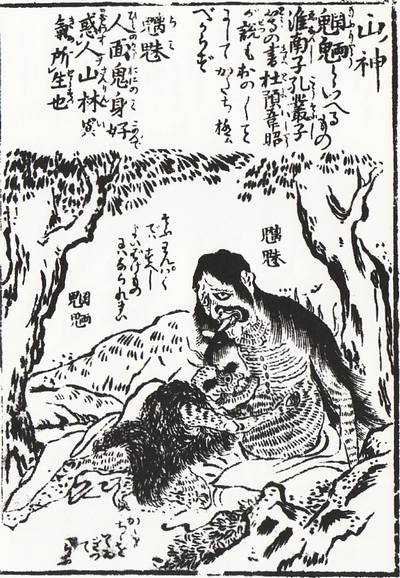
The variant used in only occurs as a bound morpheme in zh, but ) occurs in other expressions such as . Both modern Chinese and Japanese normally use "ghost radical" 鬼 characters to write and wǎngliǎng or , but these were not regularly used in classical texts. The Hanshu (111 CE) first wrote zh as 魑魅, but earlier texts like Zuozhuan and Shiji wrote it as 螭魅, with the "hornless dragon" variant. The Guoyu (c. 4th century BCE) first wrote zh as 魍魎, but more classics like the Shuoyuan, Zhuangzi, Huainanzi, and Chuci) phonetically wrote it as 罔兩, without the ghost radical.
Chīmèi 螭魅 is joined with wǎngliǎng in the expression . Since some commentators differentiate between zh "demons of the mountains and forests" and zh "demons of the rivers and marshes", zh can mean either "'demons, monsters' generally or 'mountain and water demons' separately". De Groot describes chimei as "another demon-tribe" because the "Chinese place in their great class of hill-spirits certain quadrumana, besides actual human beings, mountaineers alien to Chinese culture, perhaps a dying race of aborigines."
The Zuozhuan (c. 389 BCE) commentary to the Chunqiu has the earliest textual usages of both and .
Both the zh contexts concern banishing evildoers into dangerous wilderness regions. The former (文公18;) refers to the (, , , and ); the legendary ruler Shun, "banished these four wicked ones, Chaos, Monster, Block, and Glutton, casting them out into the four distant regions, to meet the spite of the sprites and evil things". Du Yu's commentary glosses zh as "born in the strange qi of mountains and forests, harmful to humans". The latter context only mentions the villainous Taowu: "The ancient kings located T'aou-wuh in [one of] the four distant regions, to encounter the sprites and other evil things."
The context records how Yu the Great, legendary founder of the Xia dynasty, cast nine instructional bronze ding "tripod cauldrons" to acquaint people with all the dangerous creatures in China's Nine Provinces.
Anciently, when Hea was distinguished for its virtue, the distant regions sent pictures of the [remarkable] objects in them. The nine pastors sent in the metal of their provinces, and the tripods were cast, with representations on them of those objects. All the objects were represented, and [instructions were given] of the preparations to be made in reference to them, so that the people might know the sprites and evil things. Thus the people, when they went among the rivers, marshes, hills, and forests, did not meet with the injurious things, and the hill-sprites, monstrous things, and water-sprites, did not meet with them [to do them injury].
Note how Legge translates each zh syllable individually: zh "injurious things, and the hill-sprites" and zh "monstrous things, and water-sprites".
Wang Chong's (late 1st century CE) considers the zh as a dragon hybrid, "Those who give their opinion on the ch'i, state that they are dragon-like beings; therefore, as the word mei is copulated to (the name of) a dragon, the mei must be a congener of this animal."
Mythic parallels
In Chinese folklore and art, most dragons, including the , are represented with two horns. Besides the , only a few dragons supposedly lacked horns, for instance, or .
In comparative mythology as well, horned dragons are generally more common than hornless ones. Based upon the roof adornment, Kroll translates chi as wyvern, "a footed winged dragon with a serpent's tail, becoming in medieval times an oft-pictured heraldic beast."
Notes
References
- {{cite journal |last=Carr |first=Michael |date=1990 |title=Chinese Dragon Names |journal=Linguistics of the Tibeto-Burman Area |volume=13 |number=2 |pages=87–189 |doi=10.32655/LTBA.13.2.04 |url=http://sealang.net/sala/archives/pdf4/carr1990chinese.pdf
- {{cite book |last=de Groot |first=Jan Jakob Maria |author-link=J. J. M. de Groot |date=1892–1910 |title=The Religious System of China: Its Ancient Forms, Evolution, History and Present Aspect, Manners, Customs and Social Institutions Connected Therewith |others=6 volumes: pp. XXIV+360, 468, 640, 464, 464, 414 |location=Leiden |publisher=E. J. Brill |url=http://classiques.uqac.ca/classiques/groot_jjm_de/religious_system_of_china/religious_system.html
- Digitalized edition 2007 Chicoutimi Canda - Paris by Pierre Palpant.
- Digitalized edition 2007 Chicoutimi Canda - Paris by Pierre Palpant.
- {{cite book |last=de Groot |first=Jan Jakob Maria |author-link=J. J. M. de Groot |date=1910 |title=The Religious System of China |others=Volume VI Book II On the Soul and Ancestral Worship. Part IV. The War against Spectres. — Part V. The priesthood of Animism |location=Leiden |publisher=E. J. Brill |url=https://commons.wikimedia.org/w/index.php?title=File:Groot_de_J.J.M._-The_Religious_System_of_China(vol_6)_1910.pdf&page=11
- {{cite book |author=Qu Yuan |translator-last=Hawkes |translator-first=David |date=1985 |title=The Songs of the South: An Anthology of Ancient Chinese Poems by Qu Yuan and Other Poets |publisher=Penguin |isbn=9780140443752 |ref=CITEREFQu_YuanHawkes1985 |url-access=registration |url=https://archive.org/details/songsofsouthanci0000unse
- {{cite book |last=Le Blanc |first=Charles |date=1985 |title=Huai-nan tzu: philosophical synthesis in early Han thought: the idea of resonance () with a translation and analysis of chapter six |publisher=Hong Kong University Press |isbn=9789882201798
- {{cite book |last=Visser |first=Marinus Willern de |date=2008 |orig-date=1913 |others=Introduction by Loren Coleman |title=The Dragon in China and Japan |location=Amsterdam - New York City |publisher=J. Müller - Cosimo Classics (reprint) |isbn=9781605204093 |ref=CITEREFVisser1913 |url=https://books.google.com/books?id=Mpg6Xd2jW2YC
Footnotes
References
- {{harvnb. Carr. 1990. Visser. 1913
- Tr. {{harvnb. Legge. 1872
- Anonymous. (2000). "[[Classic of Mountains and Seas". Penguin.
- Boodberg, Peter A.. (1979). "Selected Works of Peter A. Boodberg". University of California Press.
- Benedict, Paul K.. (1976). "Sino-Tibetan: Another Look". Journal of the American Oriental Society.
- Karlgren, Bernhard. (1957). "Grammata Serica Recensa". Museum of Far Eastern Antiquities.
- Matisoff, James A. (1985). "God and the Sino-Tibetan Copula with some good news concerning Selected Tibeto-Burman Rhymes". Journal of Asian and African Studies.
- (2000). "The Annals of Lü Buwei: A Complete Translation and Study". [[Stanford University Press]].
- Sima Qian. (1993). "[[Records of the Grand Historian]]". [[Columbia University Press]].
- Kroll, Paul W. (1989). "Review of ''Le Symbolisme du dragon dans la Chine antique'' by Jean-Pierre Dieny". Journal of the American Oriental Society.
This article was imported from Wikipedia and is available under the Creative Commons Attribution-ShareAlike 4.0 License. Content has been adapted to SurfDoc format. Original contributors can be found on the article history page.
Ask Mako anything about Chi (mythology) — get instant answers, deeper analysis, and related topics.
Research with MakoFree with your Surf account
Create a free account to save articles, ask Mako questions, and organize your research.
Sign up freeThis content may have been generated or modified by AI. CloudSurf Software LLC is not responsible for the accuracy, completeness, or reliability of AI-generated content. Always verify important information from primary sources.
Report