From Surf Wiki (app.surf) — the open knowledge base
Chemical oxygen generator
Device that releases oxygen via a chemical reaction
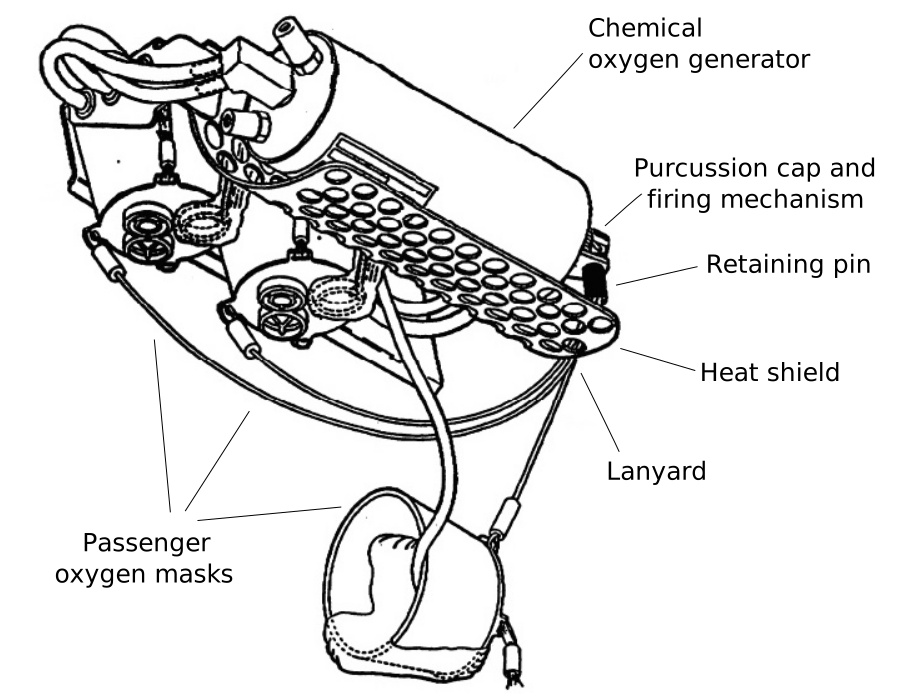
Device that releases oxygen via a chemical reaction
A chemical oxygen generator is a device that releases oxygen via a chemical reaction. The oxygen source is usually an inorganic superoxide, chlorate, or perchlorate. The generators are usually ignited by a firing pin, and the chemical reaction is usually exothermic, making the generator a potential fire hazard. Potassium superoxide was used as an oxygen source on early crewed missions of the Soviet space program, in submarines for use in emergency situations, for firefighters, and for mine rescue.
In commercial airliners

Commercial aircraft provide emergency oxygen to passengers to protect them in case of loss of cabin pressure. Chemical oxygen generators are not used for the cockpit crew, who are typically supplied using compressed oxygen cylinders, also known as oxygen bottles. In narrow body airliners, overhead oxygen masks and oxygen generators are provided for each row of seats. In some wide-body airliners, such as the DC-10 and IL-96, oxygen generators and oxygen masks are mounted in the top portion of the seat backs, due to the increased ceiling height. If a decompression occurs, access panels are opened either by an automatic pressure switch or by a manual switch, and the masks are released. When passengers pull down on the mask, they remove the retaining pins and trigger the production of oxygen.
The oxidizer core is sodium chlorate (NaClO3), which is mixed with less than 5percent barium peroxide (BaO2) and less than 1 percent potassium perchlorate (KClO4). The explosives in the percussion cap are a lead styphnate and tetrazene explosive mixture. The chemical reaction is exothermic and the exterior temperature of the generator will reach 260 °C. It will produce oxygen for 12 to 22 minutes. A two-mask generator is approximately 63 mm in diameter and 223 mm long. A three-mask generator is approximately 70 mm in diameter and 250 mm long.
On May 11, 1996, accidental activation of improperly shipped expired generators, mistakenly labeled as empty "oxy canisters", caused the ValuJet Flight 592 crash, killing all on board. On August 10, 1986, an ATA DC-10, Flight 131, was destroyed while parked at O'Hare Airport. The cause was the accidental activation of an oxygen generator, contained in the back of a broken DC-10 seat, being shipped in the cargo compartment to a repair station. There were no fatalities or injuries as the plane contained no passengers when the fire broke out.
Oxygen candle
A chlorate candle, or an oxygen candle, is a cylindrical chemical oxygen generator that contains a mix of sodium chlorate and iron powder, which when ignited smolders at about 600 °C, producing sodium chloride, iron oxide, and oxygen at a fixed rate of about 6.5 man-hours per kilogram of the mixture. The mixture has an indefinite shelf life if stored properly: candles have been stored for 20 years without decreased oxygen output. Thermal decomposition releases the oxygen. The burning iron supplies the heat. The candle must be wrapped in thermal insulation to maintain the reaction temperature and to protect surrounding equipment. The key reaction is: :2 NaClO3 → 2 NaCl + 3 O2
Potassium and lithium chlorate, and sodium, potassium and lithium perchlorates can also be used in oxygen candles.
In the Vika oxygen generator used on some spacecraft, lithium perchlorate is the source of oxygen. At 400 °C, it releases 60% of its mass as oxygen:{{cite journal|title=Lithium Perchlorate Oxygen Candle. Pyrochemical Source of Pure Oxygen|author1=M. M. Markowitz |author2=D. A. Boryta |author3=Harvey Stewart Jr. |journal=Ind. Eng. Chem. Prod. Res. Dev.|year=1964|volume=3|issue=4|pages=321–330 :LiClO4 → LiCl + 2 O2
Pressure swing adsorption (PSA) oxygen generators
Main article: Oxygen concentrator
Advances in technology have provided industrial oxygen generator systems for use where air is available and a higher concentration of oxygen is desired. Pressure swing adsorption (PSA) incorporates a molecular sieve for gas separation. In the case of oxygen generation a zeolite-based sieve forces preferential adsorption for nitrogen. Clean, dry air is passed through the sieve beds on the oxygen generator, producing an oxygen-enriched gas. Nitrogen separation membrane equipment is also used.
Uses
Chemical oxygen generators are used in aircraft, breathing apparatus for firefighters and mine rescue crews, submarines, and everywhere a compact emergency oxygen generator with long shelf life is needed. They usually contain a device for absorption of carbon dioxide, sometimes a filter filled with lithium hydroxide; a kilogram of LiOH absorbs about half a kilogram of CO2.
- Self-contained oxygen generators (SCOGs) are used in submarines.
- They were successfully used by the USS New Hampshire, an American nuclear-powered submarine, in March 2011 when the submarine suffered an oxygen generator failure while under the Arctic ice cap.
- An explosion caused by a so-called oxygen candle killed two Royal Navy sailors on , a nuclear-powered submarine, under the Arctic on 21 March 2007. The candle had likely become contaminated with hydraulic oil, which would have caused the mixture to explode rather than burn.
- Self-contained self-rescue devices (SCSRs) are used to facilitate escape from mines.
- On the International Space Station, chemical oxygen generators are used as a backup supply. Each Vika oxygen generator can produce enough oxygen for one crewmember for one day.
References
References
- Hayyan M., Hashim M.A., AlNashef I.M., Superoxide Ion: Generation and Chemical Implications, Chem. Rev., 2016, 116 (5), pp 3029–3085. [[DOI: 10.1021/acs.chemrev.5b00407]]
- (1993). "Functions of Barium Peroxide in Sodium Chlorate Chemical Oxygen". Ind. Eng. Chem. Res..
- (1950). "Chlorate Candles as a Source of Oxygen". Industrial & Engineering Chemistry.
- (19 December 2022). "McDonnell Douglas DC-9-32 {{!}} ValuJet Airlines Flight 592, N904VJ". [[Federal Aviation Administration]].
- (10 August 2012). "Fire in the Hold".
- "OT McDonnell Douglas DC-10-40 N184AT". [[Aviation Safety Network]].
- [http://www.airliners.net/photo/American-Trans-Air/McDonnell-Douglas-DC-10-40/0148751/L/&sid=faf57dd90832c5c13834020fb2255dc2 Airliners.net, Photograph, Dave Campbell]
- {{Greenwood&Earnshaw2nd
- (21 March 2011). "Exclusive: UTC-built oxygen generator fails on U.S. submarine". Reuters.
- "Degraded Modes and the 'Culture of Coping' in Military Operations: An Analysis of a Fatal Incident on-board HMS Tireless on 20/21 March 2007".
- Page, Lewis. (22 March 2007). "'Oxygen candle' caused explosion". The Register.
- Barry, Patrick. (2000). "Breathing Easy on the Space Station". [[National Aeronautics and Space Administration]].
This article was imported from Wikipedia and is available under the Creative Commons Attribution-ShareAlike 4.0 License. Content has been adapted to SurfDoc format. Original contributors can be found on the article history page.
Ask Mako anything about Chemical oxygen generator — get instant answers, deeper analysis, and related topics.
Research with MakoFree with your Surf account
Create a free account to save articles, ask Mako questions, and organize your research.
Sign up freeThis content may have been generated or modified by AI. CloudSurf Software LLC is not responsible for the accuracy, completeness, or reliability of AI-generated content. Always verify important information from primary sources.
Report