From Surf Wiki (app.surf) — the open knowledge base
Charpy impact test
Method of measuring the amount of energy absorbed by a material during fracture
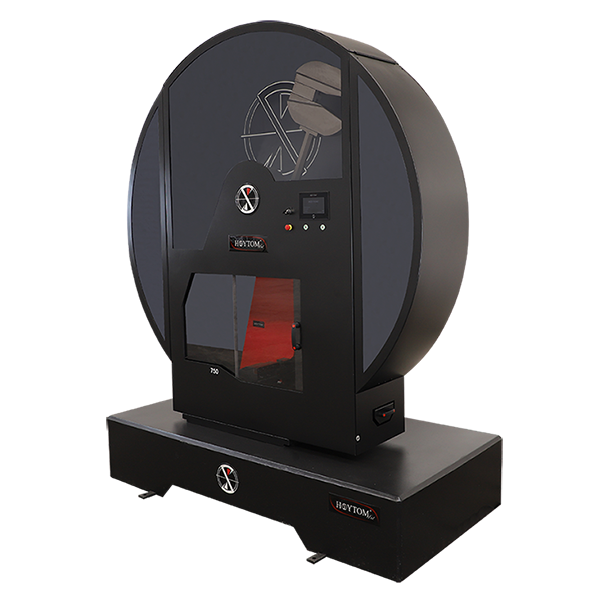
Method of measuring the amount of energy absorbed by a material during fracture
In materials science, the Charpy impact test, also known as the Charpy V-notch test, is a standardized high strain rate test which determines the amount of energy absorbed by a material during fracture. Absorbed energy is a measure of the material's notch toughness. It is widely used in industry, since it is easy to prepare and conduct and results can be obtained quickly and cheaply. A disadvantage is that some results are only comparative.
The test was developed around 1900 by S. B. Russell (1898, American) and Georges Charpy (1901, French). The test became known as the Charpy test in the early 1900s due to the technical contributions and standardization efforts by Charpy.
History
In 1896, S. B. Russell introduced the idea of residual fracture energy and devised a pendulum fracture test. Russell's initial tests measured un-notched samples. In 1897, Frémont introduced a test to measure the same phenomenon using a spring-loaded machine. In 1901, Georges Charpy proposed a standardized method improving Russell's by introducing a redesigned pendulum and notched sample, giving precise specifications.
Definition
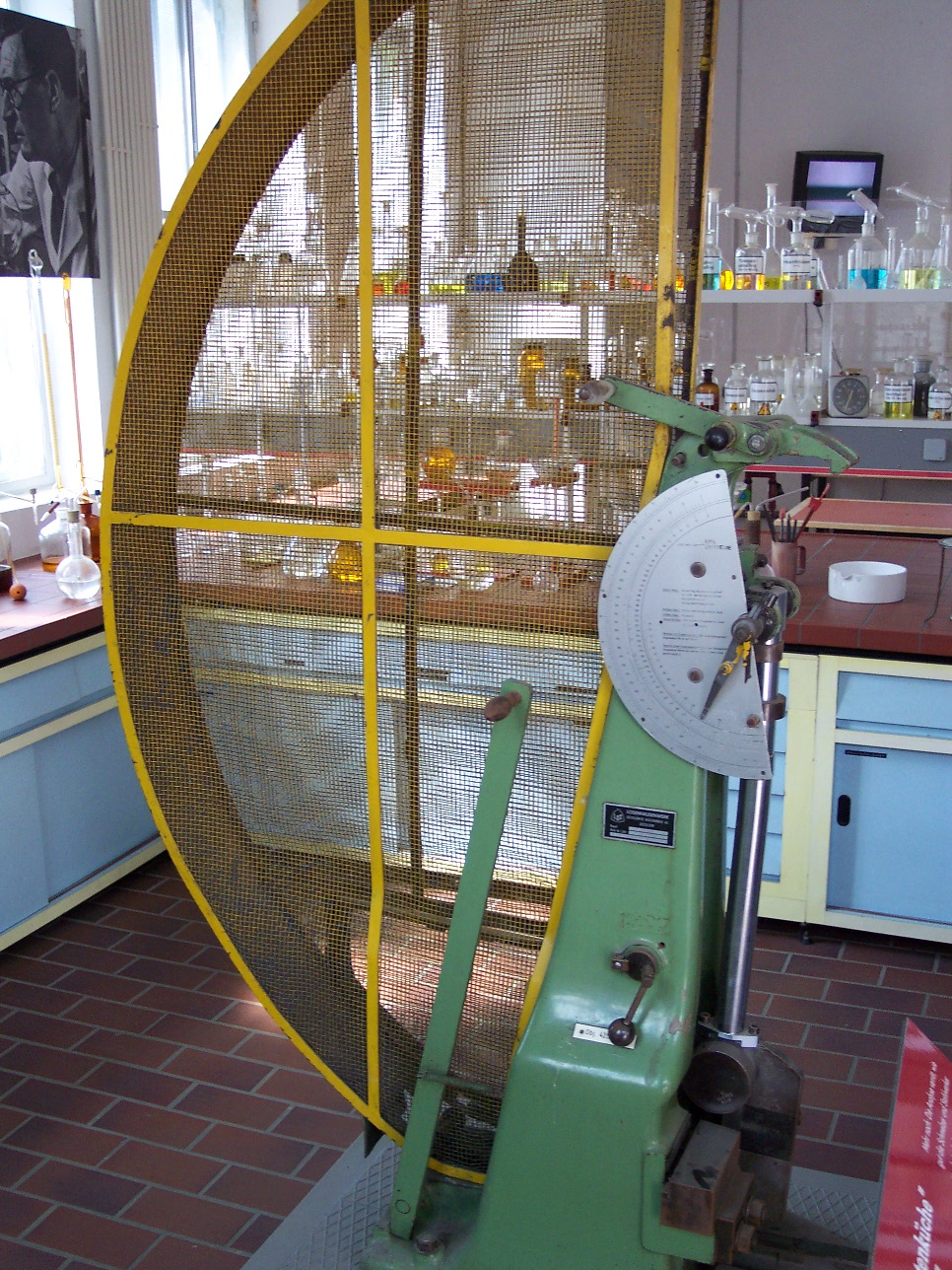
The apparatus consists of a pendulum of known mass and length that is dropped from a known height to impact a notched specimen of material. The energy transferred to the material can be inferred by comparing the difference in the height of the hammer before and after the fracture (energy absorbed by the fracture event).
The notch in the sample affects the results of the impact test, |doi-access=free
The Standard methods for Notched Bar Impact Testing of Metallic Materials can be found in ASTM E23, ISO 148-1 or EN 10045-1 (retired and replaced with ISO 148-1), where all the aspects of the test and equipment used are described in detail.
Quantitative results
The quantitative result of the impact tests the energy needed to fracture a material and can be used to measure the toughness of the material. There is a connection to the yield strength but it cannot be expressed by a standard formula. Also, the strain rate may be studied and analyzed for its effect on fracture.
The ductile-brittle transition temperature (DBTT) may be derived from the temperature where the energy needed to fracture the material drastically changes. However, in practice there is no sharp transition and it is difficult to obtain a precise transition temperature (it is really a transition region). An exact DBTT may be empirically derived in many ways: a specific absorbed energy, change in aspect of fracture (such as 50% of the area is cleavage), etc.
Qualitative results
The qualitative results of the impact test can be used to determine the ductility of a material.
Sample sizes

According to ASTM A370, the standard specimen size for Charpy impact testing is 10 mm × 10 mm × 55 mm. Subsize specimen sizes are: 10 mm × 7.5 mm × 55 mm, 10 mm × 6.7 mm × 55 mm, 10 mm × 5 mm × 55 mm, 10 mm × 3.3 mm × 55 mm, 10 mm × 2.5 mm × 55 mm. Details of specimens as per ASTM A370 (Standard Test Method and Definitions for Mechanical Testing of Steel Products).
According to EN 10045-1 (retired and replaced with ISO 148), standard specimen sizes are 10 mm × 10 mm × 55 mm. Subsize specimens are: 10 mm × 7.5 mm × 55 mm and 10 mm × 5 mm × 55 mm.
According to ISO 148, standard specimen sizes are 10 mm × 10 mm × 55 mm. Subsize specimens are: 10 mm × 7.5 mm × 55 mm, 10 mm × 5 mm × 55 mm and 10 mm × 2.5 mm × 55 mm.
According to MPIF Standard 40, the standard unnotched specimen size is 10 mm (±0.125 mm) x 10 mm (±0.125 mm) x 55 mm (±2.5 mm).
Impact test results on low- and high-strength materials
The impact energy of low-strength metals that do not show a change of fracture mode with temperature, is usually high and insensitive to temperature. For these reasons, impact tests are not widely used for assessing the fracture-resistance of low-strength materials whose fracture modes remain unchanged with temperature. Impact tests typically show a ductile-brittle transition for high-strength materials that do exhibit change in fracture mode with temperature such as body-centered cubic (BCC) transition metals. Impact tests on natural materials (can be considered as low-strength), such as wood, are used to study the material toughness and are subjected to a number of issues that include the interaction between the pendulum and a specimen as well as higher modes of vibration and multiple contacts between pendulum tup and the specimen.
Generally, high-strength materials have low impact energies which attest to the fact that fractures easily initiate and propagate in high-strength materials. The impact energies of high-strength materials other than steels or BCC transition metals are usually insensitive to temperature. High-strength BCC steels display a wider variation of impact energy than high-strength metal that do not have a BCC structure because steels undergo microscopic ductile-brittle transition. Regardless, the maximum impact energy of high-strength steels is still low due to their brittleness.
Notes
References
- (July 1947). "The Design and Methods of Construction Of Welded Steel Merchant Vessels: Final Report of a (U.S. Navy) Board of Investigation". Welding Journal.
- Williams, M. L.. (1948). "Investigation of Fractured Steel Plates Removed from Welded Ships". National Bureau of Standards Rep.
- Siewert
- Cedric W. Richards. (1968). "Engineering materials science". Wadsworth Publishing Company, Inc..
- ASTM E23 Standard Test Methods for Notched Bar Impact Testing of Metallic Materials
- ISO 148-1 Metallic materials - Charpy pendulum impact test - Part 1: Test method
- EN 10045-1 Charpy impact test on metallic materials. Test method (V- and U-notches)
- ASTM A370 Standard Test Methods and Definitions for Mechanical Testing of Steel Products
- (2006). "Standard Test Methods for Metal Powders and Powder Metallurgy Products". Metal Powder Industries Federation.
- (2017-11-01). "State-of-the-art: intermediate and high strain rate testing of solid wood". Wood Science and Technology.
- (2017-03-01). "What was Timoshenko's Small-Increment Method? With an Application to Low-Velocity Impact of a Wood Beam". Journal of Dynamic Behavior of Materials.
- (2017-09-01). "Design of Experiment and Pitfalls of Low-Velocity Pendulum Impact Testing". Journal of Dynamic Behavior of Materials.
This article was imported from Wikipedia and is available under the Creative Commons Attribution-ShareAlike 4.0 License. Content has been adapted to SurfDoc format. Original contributors can be found on the article history page.
Ask Mako anything about Charpy impact test — get instant answers, deeper analysis, and related topics.
Research with MakoFree with your Surf account
Create a free account to save articles, ask Mako questions, and organize your research.
Sign up freeThis content may have been generated or modified by AI. CloudSurf Software LLC is not responsible for the accuracy, completeness, or reliability of AI-generated content. Always verify important information from primary sources.
Report