From Surf Wiki (app.surf) — the open knowledge base
Chaise
Two-wheeled horse-drawn carriage
_Bokay,_RP-P-2009-1378.jpg)
Two-wheeled horse-drawn carriage
.jpg)
A chaise ( ), sometimes called shay, is a light two-wheeled carriage for one or two people. It may also have a folding hood. The coachmaker William Felton (1796) considered chaises a family of vehicles which included all two-wheel one-horse vehicles such as gigs and whiskies, whereas a similar carriage pulled by two-horses was considered a curricle.
Etymology
The name, in use in England before 1700, came from the French word chaise, meaning chair. The spelling shay is a colloquial variant of chaise, particularly in North America. A variant chay is slang and sometimes refers to other types of vehicle.
Design

The chaise is a two-wheeled carriage pulled by a single horse, usually with a chair-backed seat suitable for one or two persons. Felton writes that it is the finished look which dictates which type of chaise they are, but their construction is one of only two types: "the one, a chair-back body for gig or curricle, which hangs by braces—the other, a simple half-pannel whiskey, which fixes on the shafts".
A light chaise having two seats is a double chair. A chaise-cart is a light carriage used for transporting lightweight goods instead of people. A sjees is often referred to as a Friesian chaise. A post chaise is a vehicle designed for private long-distance travel via posting stations, originally with two-wheels (known as chaise-a-porteurs or posting chariot) but later becoming a four-wheeled vehicle while retaining the word "chaise" in the name.
A riding chair was a chaise body with no top. This type of a chaise was also known under multiple other names: Windsor riding chair, solo chair, gig. The riding chair originated in England, but using the Windsor chair was an American contribution, with the earliest known mention from Charleston, North Carolina in 1757.
Whiskey
A whiskey (also spelled whisky, plural whiskies ) was a lightweight two-wheeled chaise that seated one or two persons. It was so named because it would "whisk" along at great speeds. It was often constructed with caned sides and no dashboard which further lightened the vehicle. Shafts were fitted under the body and it was hung on shallow-sideways platform springs. It was popular in the late 18th and early 19th centuries.
American shay
According to Berkebile, "The chaise was one of the most popular vehicles used in colonial America and did not pass from the scene until the mid-nineteenth century. It was widely used by all social classes." In America, the chaise was constructed with a standing or falling hood, whereas the same vehicle without a hood was called a chair. The body was either directly on the shafts or used leather thoroughbraces, or was constructed with wooden cantilever springs and braces which is thought to be an American development.
The vehicle was commonly called a shay in New England, and the word shay was further popularized by Oliver Wendell Holmes's 1858 poem The Deacon's Masterpiece, or The Wonderful One-Hoss Shay.
"Shay" was also a term used in Nova Scotia. One memoirist writes of an early 19th century judge using "a vehicle, then generally called a chaise, or as a rustic would style it, a shay."
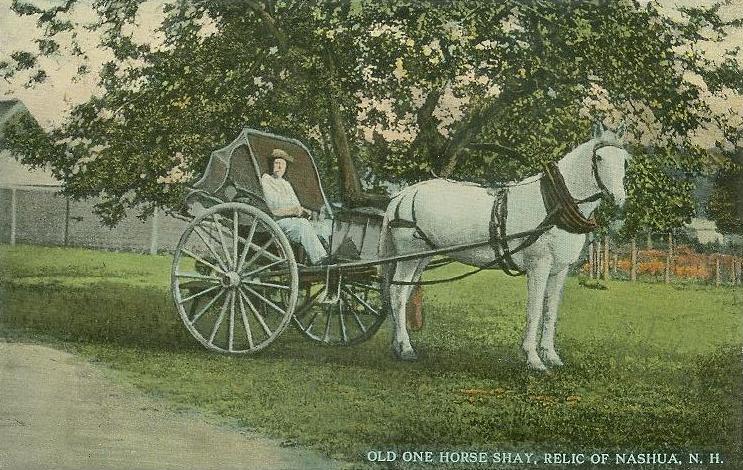
One-hoss shay
In economics, the term "one-hoss shay" is used, following the scenario in Holmes' poem, to describe a model of depreciation, in which a durable product delivers the same services throughout its lifetime before failing, or being retired, with no salvage value.
Explanatory notes
References
References
- {{cite EB1911
- Huntington, A.S.. (1892). "Under a Colonial Roof-tree: Fireside Chronicles of Early New England". Wolcott and West.
- Evans, N.G.. (1997). "American Windsor Furniture: Specialized Forms". Hudson Hills Press.
- Holmes, Oliver Wendell. (1905). "The one-hoss shay, with its companion poems". Houghton, Mifflin and Company.
- A Brief History of Public Proceedings[...]in the Province of Nova Scotia[....], [https://www.canadiana.ca/view/oocihm.17434/11 pg. 5] (Image 11). Accessed 21 August 2024
- "One-Hoss Shay". [[OECD]].
- (February 2017). "Getting Rental Prices Right for Computers: Reconciling Different Perspectives on Depreciation". [[Review of Income and Wealth]].
- Berkebile, Donald H.. (1978). "Carriage Terminology: An Historical Dictionary". Smithsonian Institution Scholarly Press.
- "chay n., also chay-cart, shay". [[Green's Dictionary of Slang]].
- Cowie, L.W.. (1996). "The Wordsworth Dictionary of British Social History". [[Wordsworth Editions]].
- Felton, William. (1996). "A Treatise on Carriages". Astragal Press.
- Smith, D.J.M.. (1988). "A Dictionary of Horse Drawn Vehicles". J. A. Allen & Co. Ltd..
- Walrond, Sallie. (1979). "The Encyclopaedia of Driving". Country Life Books.
This article was imported from Wikipedia and is available under the Creative Commons Attribution-ShareAlike 4.0 License. Content has been adapted to SurfDoc format. Original contributors can be found on the article history page.
Ask Mako anything about Chaise — get instant answers, deeper analysis, and related topics.
Research with MakoFree with your Surf account
Create a free account to save articles, ask Mako questions, and organize your research.
Sign up freeThis content may have been generated or modified by AI. CloudSurf Software LLC is not responsible for the accuracy, completeness, or reliability of AI-generated content. Always verify important information from primary sources.
Report