From Surf Wiki (app.surf) — the open knowledge base
Central Powers
Military coalition in World War I
Military coalition in World War I
| Field | Value | ||
|---|---|---|---|
| conventional_long_name | Central Powers | ||
| common_name | Central Powers | ||
| image_map | WW1 Central Powers 6 Sept 1915.svg | ||
| map_caption | The Central Powers as of 14 October 1915 in Europe. | ||
| image_map2 | File:Improved Belligerents map for ww1.png | ||
| map_caption2 | Central Powers around the world in orange. | ||
| membership | {{plainlist | style = padding-left: 0.6em; text-align: left; | |
| status | Military alliance | ||
| year_end | 1918 | ||
| year_start | 1914 | ||
| event_end | Dissolved | ||
| p1 | Dual Alliance (1879) | ||
| p2 | German–Ottoman alliance | ||
| p3 | Bulgaria–Germany treaty (1915) | ||
| p4 | Triple Alliance (1882) | ||
| era | World War I |
- German Empire
- Austria-Hungary
- Ottoman Empire
- Kingdom of Bulgaria (from 1915)
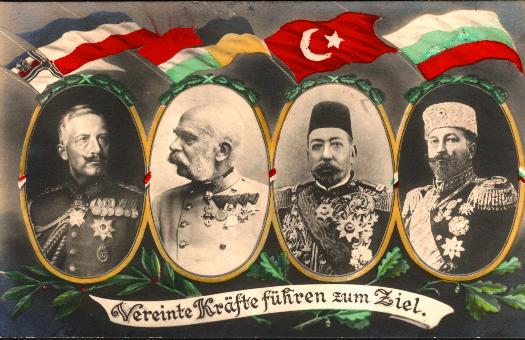
The Central Powers, also known as the Central Empires,; ; , Bağlaşma Devletleri; were one of the two main coalitions that fought in World War I (1914–1918). It consisted of the German Empire, Austria-Hungary, the Ottoman Empire, and the Kingdom of Bulgaria; this was also known as the Quadruple Alliance., , ,
The Central Powers' origin was the alliance of Germany and Austria-Hungary in 1879. Despite having nominally joined the Triple Alliance before, Italy did not take part in World War I on the side of the Central Powers and later joined on the side of the Allies. The Ottoman Empire and Bulgaria did not join until after World War I had begun. The Central Powers faced, and were defeated by, the Allied Powers, which themselves had formed around the Triple Entente. They dissolved in 1918 after they lost the war.
Name
The name 'Central Powers' is derived from the location of its member countries. All four were located between the Russian Empire in the east and France and the United Kingdom in the west. The Central Powers too used the name in their languages respectively, with the exception of Turkish, in which the Central Powers were called the دولتري, İttıfâq Devletleri, or Bağlaşma Devletleri, 'Allied States'.
Collaboration
Germany had plans to create a Mitteleuropa economic association. Members would include Austria-Hungary, Germany, and others.
History
Alliance formation
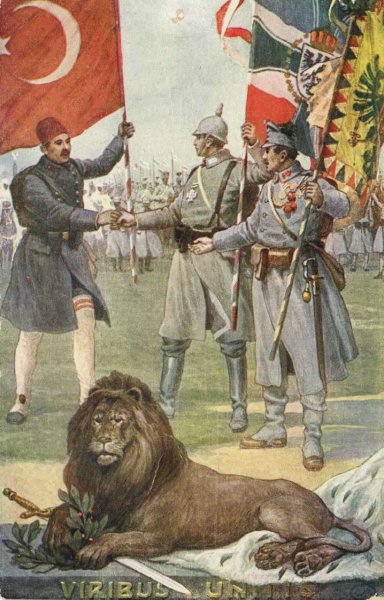
On , Austria-Hungary, supported by Germany, declared war on Serbia. Germany then supported its only reliable and dependable ally, the Dual Monarchy, and attempted to localize the Austro-Serbian conflict, without success.
Officially neutral at the outbreak of the conflict, the Ottoman Empire was nevertheless bound to Germany by a secret treaty; for nearly two months, the Ottoman government maneuvered, pursued a policy favorable to German interests, and prepared for war but did not formally commit. The autumn of 1914 was marked by the strategic failure of Germany and the Dual Monarchy, and on , an action by cruisers sold to the Ottoman Empire in prompted the Ottoman Empire's entry into the war alongside the Central Powers.
Bulgarian intervention

Throughout 1915, the Bulgarian government was courted by both alliance blocs, but, faced with the distant and hypothetical promises of the Allies, the government aligned with Germany and its allies, signing an alliance treaty with the Central Powers, the Dual Monarchy, and the Ottoman Empire; the signing of this treaty solidified Germany’s alliances until , the date when the armistice between Bulgaria and the Allies took effect.
Thus, King Ferdinand tied his country to the alliance bloc that guaranteed rapid annexations over its Serbian rivals.
Under this convention, the Bulgarian government agreed to subordinate its army to directives issued by the German Emperor.
Main member states
| Nation | Date of entry |
|---|---|
| Austria-Hungary Austro-Hungarian Empire | 28 July 1914 |
| German Empire | 1 August 1914 |
| Ottoman Empire | 29 October 1914 |
| Kingdom of Bulgaria | 14 October 1915 |
At the start of the war, the Central Powers consisted of the German Empire and the Austro-Hungarian Empire. The Ottoman Empire joined later in 1914, followed by the Tsardom of Bulgaria in 1915.
German Empire
Main article: German entry into World War I, History of Germany during World War I, German Empire
War justifications
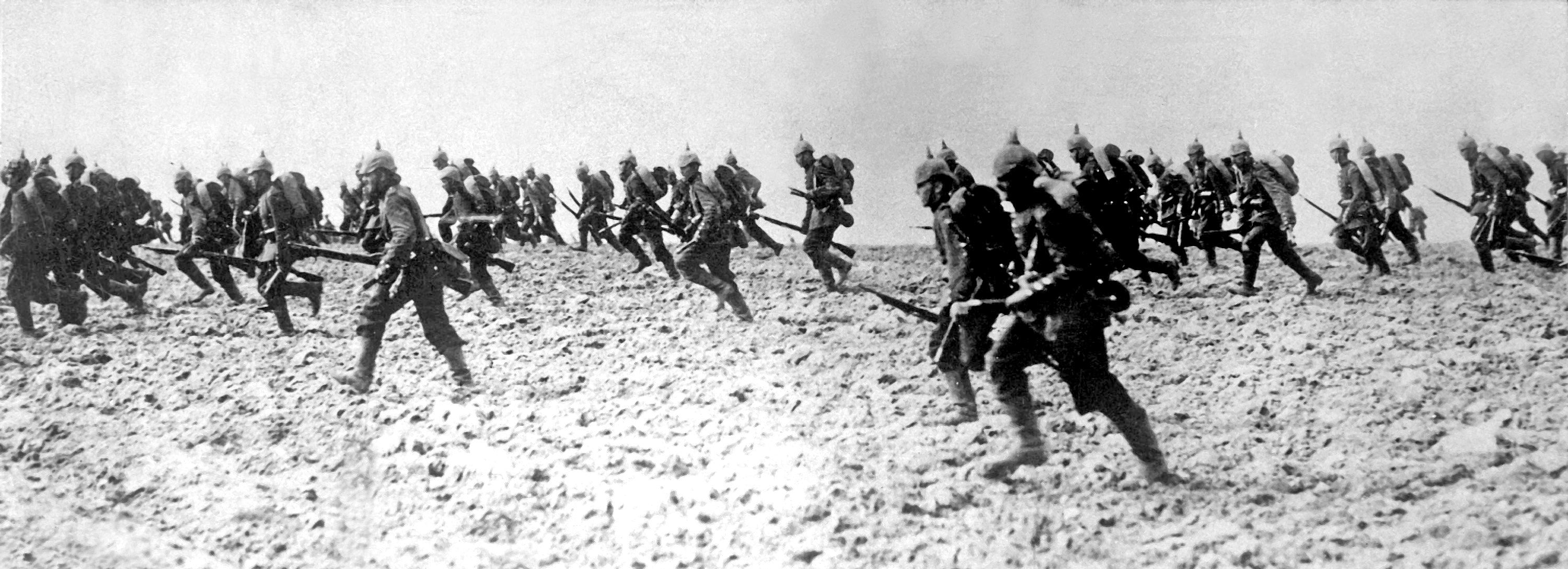
In early July 1914, in the aftermath of the assassination of Austro-Hungarian Archduke Franz Ferdinand and faced with the prospect of war between Austria-Hungary and Serbia, Kaiser Wilhelm II and the German government informed the Austro-Hungarian government that Germany would uphold its alliance with Austria-Hungary and defend it from possible Russian intervention if a war between Austria-Hungary and Serbia took place. When Russia enacted a general mobilization, Germany viewed the act as provocative. The Russian government promised Germany that its general mobilization did not mean preparation for war with Germany but was a reaction to the tensions between Austria-Hungary and Serbia. The German government regarded the Russian promise of no war with Germany to be nonsense in light of its general mobilization, and Germany, in turn, mobilized for war. On 1 August, Germany sent an ultimatum to Russia stating that since both Germany and Russia were in a state of military mobilization, an effective state of war existed between the two countries. Later that day, France, an ally of Russia, declared a state of general mobilization.
In August 1914, Germany attacked Russia, citing Russian aggression as demonstrated by the mobilization of the Russian army, which had resulted in Germany mobilizing in response.
After Germany declared war on Russia, France, with its alliance with Russia, prepared a general mobilization in expectation of war. On 3 August 1914, Germany responded to this action by declaring war on France. Germany, facing a two-front war, enacted what was known as the Schlieffen Plan, which involved German armed forces moving through Belgium and swinging south into France and towards the French capital of Paris. This plan was hoped to quickly gain victory against the French and allow German forces to concentrate on the Eastern Front. Belgium was a neutral country and would not accept German forces crossing its territory. Germany disregarded Belgian neutrality and invaded the country to launch an offensive towards Paris. This caused Great Britain to declare war against the German Empire, as the action violated the Treaty of London that both nations signed in 1839 guaranteeing Belgian neutrality.
Subsequently, several states declared war on Germany in late August 1914, with Italy declaring war on Germany in August 1916, the United States in April 1917, and Greece in July 1917.
Colonies and dependencies
Main article: German colonial empire
Europe
The German Empire had incorporated the province of Alsace-Lorraine, after successfully defeating France in the Franco-Prussian War. However, the province was still claimed by French revanchists, leading to its return to France at the Treaty of Versailles.
Africa
The German Empire was late to colonization, only beginning overseas expansion in the 1870s and 1880s. Colonization was opposed by much of the government, including chancellor Otto von Bismarck, but it became a colonial power after participating in the Berlin Conference. Then, private companies were founded and began settling parts of Africa, the Pacific, and China. Later these groups became German protectorates and colonies.
Cameroon was a German colony existing from 1884 until its complete occupation in 1915. It was ceded to France as a League of Nations Mandate at the war's end.
German East Africa was founded in 1885 and expanded to include modern-day Tanzania (except Zanzibar), Rwanda, Burundi, and parts of Mozambique. It was the only German colony to not be fully conquered during the war, with resistance by commander Paul von Lettow-Vorbeck lasting until November 1918. Later it was surrendered to the Allies in 1919 and split between the Belgian Congo, Portuguese Mozambique, and the newly founded colony of Tanganyika.
South West Africa, modern-day Namibia, came under German rule in 1885 and was absorbed into South Africa following its invasion in 1915.
Togoland, now part of Ghana, was made a German protectorate in 1884. However, after a swift campaign, it was occupied by the Allies in 1915 and divided between French Togoland and British Togoland.
Asia
The Jiaozhou Bay Leased Territory was a German dependency in East Asia leased from China in 1898. Japanese forces occupied it following the Siege of Tsingtao.
The Austrian Empire had a foreign concession in Tianjin which was swiftly invaded by China in 1917. The German concessions in Tianjin and Hankou were also invaded.
Pacific
German New Guinea was a German protectorate in the Pacific. It was occupied by Australian forces in 1914.
German Samoa had been a German protectorate since the Tripartite Convention. It was occupied by the New Zealand Expeditionary Force in 1914.
Austro-Hungarian Empire
Main article: Austro-Hungarian entry into World War I, Austria-Hungary

War justifications
Austria-Hungary regarded the assassination of Archduke Franz Ferdinand as having been orchestrated with the assistance of Serbia. The country viewed the assassination as setting a dangerous precedent of encouraging the country's South Slav population to rebel and threaten to tear apart the multinational country. Austria-Hungary sent a formal ultimatum to Serbia demanding a full-scale investigation of Serbian government complicity in the assassination and complete compliance by Serbia in agreeing to the terms demanded by Austria-Hungary. Serbia submitted to accept most of the demands. However, Austria-Hungary viewed this as insufficient and used this lack of full compliance to justify military intervention. These demands have been viewed as a diplomatic cover for an inevitable Austro-Hungarian declaration of war on Serbia.
Russia had warned Austria-Hungary that the Russian government would not tolerate Austria-Hungary invading Serbia. However, with Germany supporting Austria-Hungary's actions, the Austro-Hungarian government hoped that Russia would not intervene and that the conflict with Serbia would remain a regional conflict.
Austria-Hungary's invasion of Serbia resulted in Russia declaring war on the country, and Germany, in turn, declared war on Russia, setting off the beginning of the clash of alliances that resulted in the World War. In support of his German ally, on Thursday, 6 August 1914, Emperor Franz Joseph signed the declaration of war on Russia.
Territory
Austria-Hungary was internally divided into two states with their own governments, joined through the Habsburg throne. Austria, also known as Cisleithania, contained various duchies and principalities but also the Kingdom of Bohemia, the Kingdom of Dalmatia, and the Kingdom of Galicia and Lodomeria. Hungary (Transleithania) was composed of the Kingdom of Hungary and the Kingdom of Croatia-Slavonia. In Bosnia and Herzegovina, sovereign authority was shared by both Austria and Hungary.
Ottoman Empire
Main article: Ottoman Empire, Ottoman entry into World War I
War justifications
The Ottoman Empire joined the war on the side of the Central Powers in November 1914. The Ottoman Empire had gained strong economic connections with Germany through the Berlin-to-Baghdad railway project that was still incomplete at the time. The Ottoman Empire made a formal alliance with Germany signed on 2 August 1914. The alliance treaty expected that the Ottoman Empire would become involved in the conflict in a short amount of time. However, for the first several months of the war, the Ottoman Empire maintained neutrality though it allowed a German naval squadron to enter and stay near the strait of Bosphorus. Ottoman officials informed the German government that the country needed time to prepare for conflict. Germany provided financial aid and weapons shipments to the Ottoman Empire.
After pressure escalated from the German government demanding that the Ottoman Empire fulfill its treaty obligations, or else Germany would expel the country from the alliance and terminate economic and military assistance, the Ottoman government entered the war with the recently acquired cruisers from Germany, along with their own navy, launching a naval raid on the Russian ports of Odessa, Sevastopol, Novorossiysk, Feodosia, and Yalta, thus engaging in military action in accordance with its alliance obligations with Germany. Shortly after, the Triple Entente declared war on the Ottoman Empire.
Bulgaria
Main article: Tsardom of Bulgaria (1908–1946)
War justifications

After Bulgaria's defeat in July 1913 at the hands of Serbia, Greece and Romania, it signed a treaty of defensive alliance with the Ottoman Empire on 19 August 1914. Bulgaria was the last country to join the Central Powers, which it did in October 1915 by declaring war on Serbia. It invaded Serbia in conjunction with German and Austro-Hungarian forces.
Bulgaria held claims on the region of Vardar Macedonia then held by Serbia following the Balkan Wars of 1912–1913 and the Treaty of Bucharest (1913). As a condition of entering the war on the side of the Central Powers, Bulgaria was granted the right to reclaim that territory.
Co-belligerents

South African Republic
In opposition to offensive operations by the Union of South Africa, which had joined the war, Boer army officers of what is now known as the Maritz Rebellion "refounded" the South African Republic in September 1914. Germany assisted the rebels, with some operating in and out of the German colony of German South-West Africa. The rebels were all defeated or captured by South African government forces by 4 February 1915.
Senussi Order
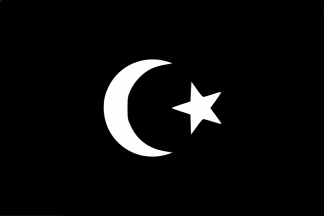
The Senussi Order was a Muslim political-religious tariqa (Sufi order) and clan in Libya, previously under Ottoman control, which had been lost to Italy in 1912. In 1915, they were courted by the Ottoman Empire and Germany, and Grand Senussi Ahmed Sharif as-Senussi declared jihad and attacked the Italians in Libya and the British in Egypt in the Senussi Campaign.
Sultanate of Darfur
In 1915, the Sultanate of Darfur renounced allegiance to the Sudanese government and aligned with the Ottomans. They were able to contact them via the Senussi. Prior to this they were a British ally. The Anglo-Egyptian Darfur Expedition preemptively invaded to prevent an attack on Sudan. A small force was sent after the sultan and he was killed in action in November 1916. The invasion ended with an Anglo-Egyptian victory in November 1916.
Zaian Confederation
The Zaian Confederation began to fight against France in the Zaian War to prevent French expansion into Morocco. The fighting lasted from 1914 and continued after the First World War ended, to 1921. The Central Powers (mainly the Germans) began to attempt to incite unrest to hopefully divert French resources from Europe.
Dervish State

The Dervish State fought against the British, Ethiopian, Italian, and French Empires between 1896 and 1925. During World War I, the Dervish State received many supplies from the German and Ottoman Empires to carry on fighting the Allies. However, looting from other Somali tribes in the Korahe raid eventually led to its collapse in 1925.
Client states
Both the Ottomans and Germans had client states, they are listed below.
| Client state | State in charge | ||||
|---|---|---|---|---|---|
| Flag of Poland (1919-1928).svg Poland | German Empire | ||||
| Flag of Lithuania (1918).svg Lithuania | German Empire | ||||
| Flag of Belarus (1918, 1991–1995).svg Belarus | German Empire | ||||
| Flag of Ukraine (1917–1921).svg Ukraine | German Empire | ||||
| Flag of the Crimean Regional Government.svg Crimea | German Empire | ||||
| Courland and Semigallia | German Empire | ||||
| title=Things to know about the United Baltic Duchy | url=https://eng.lsm.lv/article/culture/history/things-to-know-about-the-united-baltic-duchy.a274793/ | access-date=2024-09-29 | website=eng.lsm.lv | language=en}} | German Empire |
| Flag of Finland 1918 (state).svg Finland | German Empire | ||||
| Flag of Georgia (1918–1921, 4-5).svg Georgia | German Empire | ||||
| Flag of Kuban People's Republic.svg Kuban People's Republic | German Empire | ||||
| Jabal Shammar Jabal Shammar | Ottoman Empire | ||||
| Flag of the Mountain Republic.svg Mountain Republic | Ottoman Empire | ||||
| Azerbaijan Democratic Republic | Ottoman Empire | ||||
| Flag of the Republic of Aras.svg Republic of Aras | Ottoman Empire | ||||
| Qatar | Ottoman Empire | ||||
| Yemen | Ottoman Empire |
Nations supported by the Central Powers
States listed in this section were not officially members of the Central Powers. Still, during the war, they cooperated with one or more Central Powers members on a level that makes their neutrality disputable.
Ethiopia
The Ethiopian Empire was officially neutral throughout World War I but widely suspected of sympathy for the Central Powers between 1915 and 1916. At the time, Ethiopia was one of only two fully independent states in Africa (the other being Liberia) and a major power in the Horn of Africa. Its ruler, Lij Iyasu, was widely suspected of harbouring pro-Islamic sentiments and being sympathetic to the Ottoman Empire. The German Empire also attempted to reach out to Iyasu, dispatching several unsuccessful expeditions to the region to attempt to encourage it to collaborate in an Arab Revolt-style uprising in East Africa. One of the unsuccessful expeditions was led by Leo Frobenius, a celebrated ethnographer and personal friend of Kaiser Wilhelm II. Under Iyasu's directions, Ethiopia probably supplied weapons to the Muslim Dervish rebels during the Somaliland Campaign of 1915 to 1916, indirectly helping the Central Powers' cause.
The Allies jointly pressured the aristocracy for the designated emperor's removal on the 10th of September, 1916 stating he was a threat to both the Allies and Ethiopia. Fearing the rising influence of Iyasu and the Ottoman Empire, the Christian nobles of Ethiopia conspired against Iyasu. Iyasu was first excommunicated by the Ethiopian Orthodox Patriarch and eventually deposed in a coup d'état on 27 September 1916. A less pro-Ottoman regent, Ras Tafari Makonnen, was installed on the throne.
Liechtenstein
Liechtenstein was officially neutral throughout World War I, though the general population and government was supportive of the Central Powers, particularly Austria-Hungary, with which the two countries had been in a customs union since 1852. However, from September 1914 food deliveries from Austria-Hungary began to decrease, which quickly soured the initial war support. By 1916 all food deliveries from Austria-Hungary had ceased, which forced Liechtenstein to seek closer ties with Switzerland in order to ensure food deliveries continued. From 1916, Liechtenstein was embargoed by the Entente countries due to its connections with the Central Powers; this caused mass unemployment in the country. The government remained sympathetic to the Central Powers until 7 November 1918, when the November 1918 Liechtenstein putsch took place and a new government took power.
Upper Asir
Upper Asir, a sheikdom in Arabia, revolted away from Asir in 1916, possibly with Hejazi aid. It was led by Hassan bin Ali al-Aidh. It was then partitioned between the Saudi and the Idrisi on 30 August 1920.
Kingdom of Greece
The Kingdom of Greece was in a political dispute with Venizelists. The Central Powers supported the royalists until King Constantine's abdication in 1917.
Romania
Following their armistice with the Central Powers, Romania was involved in the Russian Civil War against both the Whites and the Reds. Romania fought alongside the Central Powers until it rejoined the war against them on November 10, 1918.
Kelantan
Kelantanese rebels were supported by the Ottoman and German Empires during their anti-colonial uprising against the British Empire in 1915.
Non-state combatants
Other movements supported the efforts of the Central Powers for their own reasons, such as the radical Irish Nationalists who launched the Easter Rising in Dublin in April 1916; they referred to their "gallant allies in Europe". However, most Irish Nationalists supported the British and allied war effort up until 1916, when the Irish political landscape was changing. In 1914, Józef Piłsudski was permitted by Germany and Austria-Hungary to form independent Polish legions. Piłsudski wanted his legions to help the Central Powers defeat Russia and then side with France and the UK and win the war with them. Below is a list of these non-state combatants.
- Ahl Haydara Mansur
- Albanian Muslim rebels
- IMRO
- Irish Citizen Army
- Irish Republican Brotherhood
- Irish Volunteers
- White Guard (Finland)
- Polish Legions
Armistice and treaties
Bulgaria signed an armistice with the Allies on 29 September 1918, following a successful Allied advance in Macedonia. The Ottoman Empire followed suit on 30 October 1918 in the face of British and Arab gains in Palestine and Syria. Austria and Hungary concluded ceasefires separately during the first week of November following the disintegration of the Habsburg Empire and the Italian offensive at Vittorio Veneto;{{cite journal
| Country | Date |
|---|---|
| Tsardom of Bulgaria (1908–1946) Bulgaria | |
| Ottoman Empire Ottoman Empire | |
| Austria-Hungary Austria-Hungary | |
| German Empire Germany |
| Country | Treaty of | Results | Date signed | |
|---|---|---|---|---|
| Weimar Republic Germany | Versailles | Germany was required to demilitarize the Rhineland, to reduce their army to 100,000 men, and the navy to 15,000 sailors, and to pay 132 billion gold marks (US$33 billion). Tanks, submarines, and an air force were all forbidden. | ||
| Austria Austria | Saint-Germain | |||
| Tsardom of Bulgaria (1908–1946) Bulgaria | Neuilly | |||
| Kingdom of Hungary (1920–1946) Hungary | Trianon | Hungary lost 72% of its total land area, and 31% of ethnic Hungarians became minorities in the neighboring countries (Romania, Czechoslovakia, Yugoslavia, Austria). | ||
| Ottoman Empire Ottoman Empire/Turkey | Sèvres/Lausanne | The Treaty of Sèvres caused resentment among the Turkish populace of the Ottoman Empire and resulted in the outbreak of the Turkish War of Independence, after which the Treaty of Lausanne was signed. | / |
File:CentralPowersPoster3.jpg|A postcard depicting the flags of the Central Powers' countries File:Winold Reiss - WWI poster Charity Bazaar.jpg|Poster for a 1916 charity bazaar raising funds for widows and orphans of the Central Power states File:Drei Kaiser Bund.jpg|The leaders of the Central Powers in 1914
Leaders
Main article: Leaders of the Central Powers of World War I
| Portrait | Leader | Title | Time period | |||||||||
|---|---|---|---|---|---|---|---|---|---|---|---|---|
| [[File:Franz Joseph of Austria 1910 old.jpg | 128px]] | Franz Joseph I | Emperor of Austria and Apostolic King of Hungary | 1848–1916 | ||||||||
| [[File:Theodor Mayerhofer Kaiser Karl I von österreich 1917.jpg | 128px]] | Karl I | Emperor of Austria and Apostolic King of Hungary | 1916–1918 | ||||||||
| [[File:Kaiser Wilhelm II of Germany - 1902.jpg | 128px]] | Wilhelm II | German Emperor | 1888–1918 | ||||||||
| [[File:Sultan Muhammed Chan V., Kaiser der Osmanen 1915 C. Pietzner.jpg | 128px]] | Mehmed V | Sultan of the Ottoman Empire | 1909–1918 | ||||||||
| [[File:Sultan Mehmed VI of the Ottoman Empire.jpg | 128px]] | Mehmed VI | Sultan of the Ottoman Empire | 1918–1922 | ||||||||
| [[File:Zar Ferdinand Bulgarien.jpg | 128px]] | Ferdinand I | Tsar of Bulgaria | 1887–1918 | ||||||||
| Ali Dinar | Sultan of Darfur | 1899–1916 | ||||||||||
| [[File:Genl Manie Maritz(1) (cropped).jpg | 128px]] | Manie Maritz | Leader of the Maritz Rebellion | 1914–1915 | ||||||||
| [[File:Mohammed Abdullah Hassan-dj.jpg | 128px]] | Mohammed Abdullah Hassan | Emir of the Dervish State | 1896–1920 | ||||||||
| [[File:Ahmed Sharif es Senussi.jpg | 128px]] | wstitle=Senussi | volume=24 | pages=649–651 | first=Frank Richardson | last=Cana}} | Leader of the Senussi | 1902–1933 | ||||
| [[File:Saud alrasheed.jpg | 128px]] | Saud bin Abdulaziz | Emir of Jabal Shammar | 1908–1920 | ||||||||
| [[File:Fatali Khan Khoyski.jpg | 128px]] | last=Ahmadova | first=Firdovsiyya | date=2017 | title=Founders of the Republic: Fatali Khan Khoyski | url=http://irs-az.com/new/pdf/201508/1440762901408949551.pdf | url-status=dead | archive-url=https://web.archive.org/web/20170714121016/http://irs-az.com/new/pdf/201508/1440762901408949551.pdf | archive-date=2017-07-14 | website=irs-az.com/new/pdf/201508/1440762901408949551.pdf}} | Prime Minister of Azerbaijan | 1918–1919 |
| [[File:Pavlo Skoropadsky portrait, colorized by Ruslan Habanets.jpg | 128px]] | url=https://books.google.com/books?id=tXniAAAAMAAJ&q=%22%D0%93%D0%B5%D1%82%D1%8C%D0%BC%D0%B0%D0%BD%20%D1%83%D1%81%D1%96%D1%94%D1%97%20%D0%A3%D0%BA%D1%80%D0%B0%D1%97%D0%BD%D0%B8%22 | title=Історія України в особах XIX–XX ст | date=1995 | publisher=Вид-во "Україна" | isbn=978-5-319-00882-4 | page=222 | language=uk}} | Hetman of Ukraine | 1918–1918 |
Statistics

| Country | Population | |||
|---|---|---|---|---|
| (millions) | Area | |||
| (million km2) | GDP | |||
| ($ billion) | GDP per | |||
| capita | ||||
| ($) | ||||
| German Empire (1914) | Mainland | 67.0 | 0.5 | 244.3 |
| Colonies | 10.7 | 3.0 | 6.4 | 601 |
| **Total** | 77.7 | 3.5 | 250.7 | 3,227 |
| Austro-Hungarian Empire Austria-Hungary (1914) | 50.6 | 0.6 | 100.5 | 1,980 |
| Ottoman Empire (1914) | 23.0 | 1.8 | 25.3 | 1,100 |
| Kingdom of Bulgaria (1915) | 4.8 | 0.1 | 7.4 | 1,527 |
| **Total** | 156.1 | 6.0 | 383.9 | 2,459 |
| **Allies**, total, November 1914 | 793.3 | 67.5 | 1,096.5 | |
| UK, France and Russia only | 259.0 | 22.6 | 622.8 |
| Country | Mobilized | Killed in action | Wounded | Missing | ||
|---|---|---|---|---|---|---|
| in action | Total | |||||
| casualties | Casualties | |||||
| as % of | ||||||
| total force | ||||||
| mobilized | ||||||
| German Empire | 13,250,000 | 2,037,000 (13.65%) | 6,267,143 | 1,152,800 | 9,456,943 | 71% |
| Austria-Hungary | 7,800,000 | 1,494,200 (11.82%) | 3,620,000 | 2,200,000 | 7,314,200 | 94% |
| Ottoman Empire | 3,056,000 | 771,884 (10.84%) | 763,163 | 250,000 | 1,785,000 | 60% |
| Kingdom of Bulgaria | 1,200,000 | 75,844 (6.32%) | 153,390 | 27,029 | 255,263 | 21% |
| **Total** | 25,257,321 | 4,378,928 | 10,803,533 | 3,629,829 | 18,812,290 | 75% |
Disintegration
Waning solidarity
As the war lasted longer than expected, Germany’s allies gradually sought to remove themselves from its sphere of its influence. Thus, the death of Francis Joseph and the accession of his successor Charles marked a paradigm shift in relations between Germany and the Dual Monarchy. Indeed, the young emperor quickly sought to distance himself from the policy pursued in Germany: this distancing was materialized by the transfer of the Austro-Hungarian Armeeoberkommando, the high command, from Teschen, near Pless, the seat of the OHL, to Baden, near Vienna; this move was intended, according to its architects, to loosen Germany’s grip on the Dual Monarchy.
Moreover, from 1916, Dual Monarchy leaders sought to exit the conflict at all costs, aware of the risks of disintegration if the war continued.
Finally, the peace treaties of early 1918 led to the fall of the Bulgarian government of Vasil Radoslavov and its replacement by Aleksandar Malinov, less loyal to the 1915 alliance. Feeling cheated by the division of the 1915 and 1916 conquests, Bulgarian leaders fueled discontent with the conflict, funding press campaigns unfavorable to Germany and the Dual Monarchy.
Bulgarian defection
Main article: Battle of Doiran (1918)
Under the command of Louis Franchet d'Espèrey, Franco-Serbian troops launched a breakthrough offensive against Bulgarian units weakened by privations, plagued by desertions, pacifist propaganda, and exhausted by three years of positional warfare in Macedonia. This breakthrough quickly shattered the Macedonian front and dismantled the Bulgarian position through the by Franco-Serbian troops.
Faced with this alarming situation, the German high command ordered the deployment of occupation troops from Ukraine to the Balkans and the organization of a front south of Niš. Moreover, on , Erich Ludendorff ordered the commander of the few German divisions positioned in the Balkans to redeploy around Sofia to ensure Bulgaria’s continued commitment alongside its Quadruple Alliance partners; this attempt to counter Bulgaria’s unilateral initiative failed immediately due to the speed of the armistice negotiations between Allied plenipotentiaries and Bulgarian representatives.
Footnotes
References
References
- Harris, Luke. (2015). "Britain and the Olympic Games, 1908–1920: Perspectives on Participation and Identity". [[Palgrave Macmillan]].
- Hindenburg. (1920). "Out of My Life". [[Cassell (publisher).
- "Central Powers".
- "The September Memorandum (September 9, 1914)".
- (2007). "An Introduction to the Causes of War: Patterns of Interstate Conflict from World War I to Iraq.". Rowman & Littlefield.
- Meyer, G. J.. (2006). "A World Undone: The Story of the Great War, 1914 to 1918". [[Delacorte Press]].
- Hagen, William W.. (2012). "German History in Modern Times: Four Lives of the Nation". [[Cambridge University Press]].
- Tucker, Spencer C. (2009). "Global Chronology of Conflict: From the Ancient World to the Modern Middle East". [[ABC-CLIO]].
- Kossmann, E. H.. (1978). "The Low Countries, 1780–1940". [[Oxford University Press]].
- (6 March 2015). "Il 1861 e le quattro Guerre per l'Indipendenza (1848–1918)".
- McDuffie, Jerome; Piggrem, Gary Wayne; Woodworth, Steven E. (2005). ''U.S. History Super Review''. Piscataway, NJ: Research & Education Association. p. 418. {{ISBN. 978-0-7386-0070-3.
- Leon, George B.. (1990). "Greece and the First World War: From Neutrality to Intervention, 1917–1918". East European Monographs.
- Seager, Frederic H. (1969). "The Alsace-Lorraine Question in France, 1871–1914". in Charles K. Warner, ed., ''From the Ancien Régime to the Popular Front'', pp. 111–126.
- Jay, Robert. (January 1984). "Alphonse de Neuville's 'The Spy' and the Legacy of the Franco-Prussian War". Metropolitan Museum Journal.
- Grandhomme, Jean-Noël. (November 2008). "Le retour de l'Alsace–Lorraine". L'Histoire.
- von Washausen, Helmut. (1968). "Hamburg und die Kolonialpolitik des Deutschen Reiches". H. Christians.
- Elango, Lovett. (1985). "The Anglo-French 'Condominium' in Cameroon, 1914–1916: The Myth and the Reality". The International Journal of African Historical Studies.
- Louis, William Roger. (2006). "Ends of British Imperialism: The Scramble for Empire, Suez, and Decolonization". [[I.B. Tauris]].
- "German South West Africa".
- Martin, Lawrence. (2007). "The Treaties of Peace, 1919–1923". The Lawbook Exchange, Ltd..
- Gottschall, Terrell. (2003). "By Order of the Kaiser: Otto von Diederichs and the Rise of the Imperial German Navy, 1865–1902". [[Naval Institute Press]].
- (2014). "第一次世界大战中的远东战场———青岛之战述评". 军事历史研究.
- Singerton, Jonathan. (May 2024). "Michael Falser. Habsburgs Going Global: The Austro-Hungarian Concession in Tientsin/Tianjin in China (1901–1917) Vienna: Austrian Academy of Sciences Press, 2022. Pp. 286.". Austrian History Yearbook.
- "British and German New Guinea.".
- Ryden, George Herbert. (1975). "The Foreign Policy of the United States in Relation to Samoa". [[Octagon Books]].
- Smith, Stephen John. (1924). "The Samoa (N.Z.) Expeditionary Force 1914–1915". Ferguson & Osborn.
- Hosch, William L.. (2009). "World War I: People, Politics, and Power". The Rosen Publishing Group, Inc..
- Pánek, Jaroslav. (2009). "A History of the Czech Lands". [[Karolinum Press]].
- Biondich, Mark. (2000). "Stjepan Radić, the Croat Peasant Party, and the Politics of Mass Mobilization, 1904–1928". [[University of Toronto Press]].
- Magocsi, Paul R.. (1983). "Galicia: A Historical Survey and Bibliographic Guide". University of Toronto Press.
- (2002). "Magyarország története előidőktől 2000-ig".
- "Catholic Encyclopedia's : Hungary".
- Zovko, Ljubomir. (2007). "Studije iz pravne povijesti Bosne i Hercegovine: 1878–1941". [[University of Mostar]].
- (2003). "The First World War". Routledge.
- (2012). "An Improbable War: The Outbreak of World War 1 and European Political Culture". Berghan Books.
- Kent, Mary. (1998). "''The Great Powers and the End of the Ottoman Empire''. end ed. Frank Cass.".
- McMeekin, Sean. (2011). "The Russian Origins of the First World War". Harvard University Press.
- Miller, Geoffrey. (December 1999). "Turkey Enters the War and British Actions". Great War Primary Document Archive.
- Trumpener, Ulrich. (1962). "Turkey's Entry into World War I: An Assessment of Responsibilities". Journal of Modern History.
- Robbins, Keith. (1971). "British Diplomacy and Bulgaria 1914–1915". [[The Slavonic and East European Review]].
- Pajic, B.. (2019). "Our Forgotten Volunteers: Australians and New Zealanders with Serbs in World War One". Arcadia.
- "Bulgaria in the First World War".
- (1986). "The establishment of the Balkan national states, 1804–1920". University of Washington Press.
- Richard C. Hall, "Bulgaria in the First World War". ''Historian'' 73.2 (2011): 300–315.
- T. R. H. Davenport, "The South African Rebellion, 1914." ''English Historical Review'' 78.306 (1963): 73–94, {{JSTOR. 559800.
- (31 May 2009). "Uşi (Ouchy) Antlaşması". Bildirmem.com.
- (1996). "Military Operations: Egypt and Palestine: From the Outbreak of War with Germany to June 1917".
- Gillan, J.A.. (1939). "Darfur, 1916". Sudan Notes and Records.
- (1922). "Principal Events 1914–1918". [[HMSO]].
- Hoisington, William. "Lyautey and the French Conquest of Morocco". [[St. Martin's Press]].
- Schmitz, David. (2009). "Morocco: From Empire to Independence". [[Oneworld Publications]].
- Omar, Mohamed. (2001). "The Scramble in the Horn of Africa: History of Somalia (1827–1977)".
- (2013). "Churchill and the Mad Mullah of Somaliland". Pen and Sword.
- (2002). "Imperialismo e resistenza in corno d'Africa: Mohammed Abdullah Hassan". Rubbettino Editore.
- "King's College London, King's collection: Ismay's summary as Intelligence Officer (1916–1918) of Mohammed Abdullah Hassan".
- (1990). "The warrior mullah: the Horn aflame, 1892–1920". Bellew.
- The Regency Kingdom has been referred to as a [[puppet state]] by Norman Davies in ''Europe: A history'' ([https://books.google.com/books?id=jrVW9W9eiYMC&dq=%22Kingdom+of+Poland%22+1916+puppet&pg=PA910 Google Print, p. 910]); by Jerzy Lukowski and Hubert Zawadzki in ''A Concise History of Poland'' ([https://books.google.com/books?id=HMylRh-wHWEC&pg=PA218 Google Print, p. 218]); by Piotr J. Wroblel in ''Chronology of Polish History'' and ''Nation and History'' ([https://books.google.com/books?id=lzWHDEE6OqkC&pg=PA454 Google Print, p. 454]); and by Raymond Leslie Buell in ''Poland: Key to Europe'' ([https://books.google.com/books?id=-KcfGbrKptoC&q=Poland+Key+to+Europe Google Print, p. 68]: "The Polish Kingdom... was merely a pawn [of Germany]").
- Maksimaitis, Mindaugas. (2005). "Lietuvos valstybės konstitucijų istorija (XX a. pirmoji pusė)". Justitia.
- (2020-11-27). "The History of the Statehood of Belarus – Rada of the Belarusian Democratic Republic".
- Wolczuk, Kataryna. (2001). "The Moulding of Ukraine: The Constitutional Politics of State Formation". [[Central European University Press]].
- Vilayet. (2006-12-02). "ПОЛЬСКИЕ ТАТАРЫ НА СЛУЖБЕ АЗЕРБАЙДЖАНСКОЙ ГОСУДАРСТВЕННОСТИ". Zerkalo.
- "How the Duchy of Courland was briefly resurrected in 1918".
- "Things to know about the United Baltic Duchy".
- (1988). "The Establishment of Finnish Democracy". GPO for the Library of Congress.
- Suny, Robert Grigor. (1994). "The Making of the Georgian Nation". [[Indiana University Press]].
- Kubijovyč, Volodymyr. (1963). "Ukraine: A Concise Encyclopedia". [[University of Toronto Press]].
- "Jabal Shammar". Encyclopedia.com.
- Michael A. Reynolds. (2011). "Shattering Empires: the Clash and Collapse of the Ottoman and Russian Empires, 1908–1918".
- (2010). "Rural Transition in Azerbaijan". [[Lexington Books]].
- Dr. Andrew Andersen, Ph.D. [http://www.conflicts.rem33.com/images/Armenia/disp.htm Atlas of Conflicts: Armenia: Nation Building and Territorial Disputes: 1918–1920] {{Webarchive. link. (2016-12-28)
- (1979). "The Creation of Qatar". Croom Helm.
- Gerteiny, Alfred G.. (April 1974). "Muddle of the Middle East, Volumes I and II". History: Reviews of New Books.
- Bekele, Shiferaw. (2018). "The First World War from Tripoli to Addis Ababa". [[Centre français des études éthiopiennes]].
- (25 September 2016). "How Ethiopian prince scuppered Germany's WW1 plans". BBC News.
- (1986). "Emperor Menelik's Ethiopia, 1865–1916 National Unification Or Amhara Communal Domination". UMI Howard University.
- Quaderer, Rupert. (31 December 2011). "Erster Weltkrieg".
- (21 March 1915). "10,000 Neutrals Starving; Swiss Government Sends Food to Liechtenstein Population.". [[The New York Times]].
- Marxer, Roland. (31 December 2011). "Neutralität".
- Quaderer, Rupert. (31 December 2011). "Novemberputsch 1918".
- Bang, Anne K.. (1997). "The Idrisi State in Asir: Politics, Religion and Prestige in Arabia". [[C. Hurst & Co]].
- Jean-Marc, Merklin. "w.ethnia.org".
- Leon, George B.. (April 1977). "Greece and the Great Powers, 1914–1917". Institute for Balkan Studies.
- Istodor, Gheorghe. (2016). "Renaşterea Gnozei Păgâne Î România – UN Mare Pericol Pentru Tineretul Ortodox". Altarul Reîntregirii.
- Cheah, Boon Kheng. (2006). "To' Janggut: Legends, Histories, and Perceptions of the 1915 Rebellion in Kelantan". Singapore University Press.
- Rothschild, Joseph. (1990). "East Central Europe Between the Two World Wars".
- Jacob, H.. (10 March 1916). "Present Political Situation in our Hinterland and Beyond the Border". Political Resident, Aden.
- Hasan Kaleshi. (1976). "Haxhi Qamili".
- "Macedonia and the Internal Macedonian Revolutionary Organization / 1.0 / encyclopedic".
- Townshend, Charles. (2006). "Easter 1916: The Irish Rebellion". Penguin Books.
- Haapala, Pertti. (2009). "Sisällissodan Pikkujättiläinen". Söderström.
- (2017). "Russia's Last Gasp: The Eastern Front 1916–17". Osprey Publishing.
- (2018-09-28). "The National Archives – Milestones to peace: the Armistice of Salonica".
- Fromkin, David. (2009). "[[A Peace to End All Peace: The Fall of the Ottoman Empire and the Creation of the Modern Middle East]]". Macmillan.
- [http://www.forost.ungarisches-institut.de/pdf/19181103-1.pdf Armistice Convention with Austria-Hungary]
- (2010). "U.S. Foreign Policy and National Security: Chronology and Index for the 20th Century". Praeger Security International.
- Macartney, C. A.. (1937). "Hungary and her successors: The Treaty of Trianon and Its Consequences 1919–1937". [[Oxford University Press]].
- Bernstein, Richard. (9 August 2003). "East on the Danube: Hungary's Tragic Century". [[The New York Times]].
- Hart, Peter. (2015). "The Great War: A Combat History of the First World War". [[Oxford University Press]].
- (2015). "Ferdinand". Encyclopædia Britannica, Inc..
- O'Fahey, R.S.. (2008). "The Darfur Sultanate: A History". Columbia University Press.
- "Salomon Gerhardus Maritz {{!}} Boer War, Commando Leader, Transvaal {{!}} Britannica".
- Abdullahi (Badiyow), Abdurahman. (2015). "The Islamic Movement in Somalia". Adonis & Abbey Publishers Ltd..
- {{cite EB1911. Frank Richardson. Cana
- Glubb, John Bagot. (2014). "Ibn Sa'ud". Encyclopædia Britannica, Inc..
- Ahmadova, Firdovsiyya. (2017). "Founders of the Republic: Fatali Khan Khoyski".
- (1995). "Історія України в особах XIX–XX ст". Вид-во "Україна".
- [https://books.google.com/books?id=Y9GP9gtGlkgC S.N. Broadberry, Mark Harrison. The Economics of World War I]. illustrated ed. Cambridge University Press, 2005, pp. 9–10.
- Spencer Tucker. (1996). "The European Powers in the First World War". Taylor & Francis.
- Bled, Jean-Paul. (2014). "L'agonie d'une monarchie". Tallandier.
- Lacroix-Riz, Annie. (1996). "Le Vatican, l'Europe et le Reich". [[Armand Colin]].
- Renouvin, Pierre. (1934). "La Crise européenne et la Première Guerre mondiale". [[Presses universitaires de France]].
This article was imported from Wikipedia and is available under the Creative Commons Attribution-ShareAlike 4.0 License. Content has been adapted to SurfDoc format. Original contributors can be found on the article history page.
Ask Mako anything about Central Powers — get instant answers, deeper analysis, and related topics.
Research with MakoFree with your Surf account
Create a free account to save articles, ask Mako questions, and organize your research.
Sign up freeThis content may have been generated or modified by AI. CloudSurf Software LLC is not responsible for the accuracy, completeness, or reliability of AI-generated content. Always verify important information from primary sources.
Report