From Surf Wiki (app.surf) — the open knowledge base
Central Park, Sydney
Urban precinct in Sydney, Australia
Urban precinct in Sydney, Australia
| Field | Value |
|---|---|
| name | The Mark |
| image | The_Mark_Sydney_Kent_Road_Facade_1.JPG |
| image_size | 270 |
| image_caption | Kent Road facade |
| map_type | Australia NSW inner Sydney |
| map_caption | Location in greater metropolitan Sydney |
| map_size | 270 |
| relief | 1 |
| status | Complete |
| building_type | Residential apartment |
| location | Broadway, , Sydney, New South Wales |
| location_country | Australia |
| coordinates | |
| floor_count | 27 |
| floor_area | 24000 m2 |
| architecture_firm | Johnson Pilton Walker |
| developer | Frasers Property and Sekisui House Australia |
| main_contractor | Watpac |
| awards | 2015 UDIA NSW High-Density Development Award |
| website |
Central Park is a major mixed-use urban renewal project in Sydney, New South Wales, Australia located on Broadway in the suburb of Chippendale. The development is focused on a new public park located just off Broadway of approximately 6,500 m2 in size. For many decades the southern side of Broadway was dominated by a brewery, which closed in the 2000s and the site was put up for sale. Frasers Property purchased the site from the Foster's Group on 29 June 2007. On a difficult site, the design fitted the towers around the streets, created new public spaces and connections to the city, added 30,000 specially selected plants, included art work, and incorporated pedestrian as well as vehicular access.
The project includes the award-winning high-rise building One Central Park, an apartment complex known for its hanging vertical gardens.
Precincts
The entire Central Park project site covered 15 ha on Broadway. It is a redeveloped industrial site, with boundaries at O'Connor Street, Carlton Street, Broadway and Chippendale Way. The Central Park redevelopment delivered 1,426 apartments and total gross floor area (GFA) of over 150000 m2, which GFA for The Mark is 24000 m2.
One Central Park
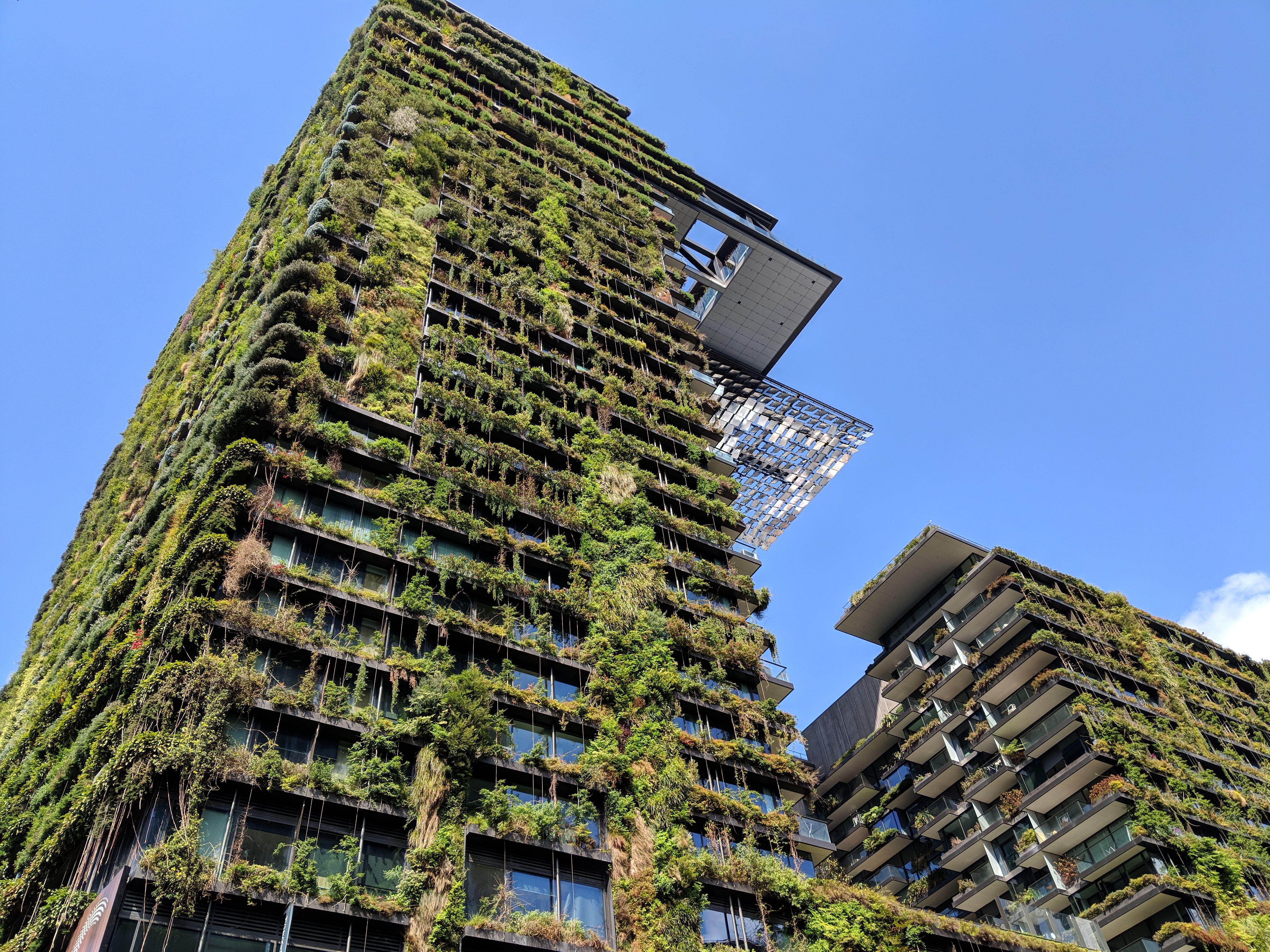
Main article: One Central Park
The first stage of the redevelopment is a tower called One Central Park, a 117 m residential tower designed by Jean Nouvel featuring vertical gardens by Patrick Blanc and LED art by Yann Kersalé. Located opposite the UTS Tower, One Central Park is an apartment complex with a shopping centre called Central Park Mall located on the lower levels. The design includes a cantilevered section including a heliostat to provide light to the parkland below. It is the tallest building on the site. Construction by Watpac Construction was completed in October 2013.
In May 2014, the One Central Park East tower was ranked by Emporis as one of the world's best skyscrapers. In July of the same year, it was chosen as the best tall building in Asia and Australia by the Chicago-based Council for Tall Buildings and Urban Habitat (CTBUH). In November 2014 it was named the best tall building in the world by CTBUH. In October 2014 it was named the Overall Winner of the 2014 LEAF Award.
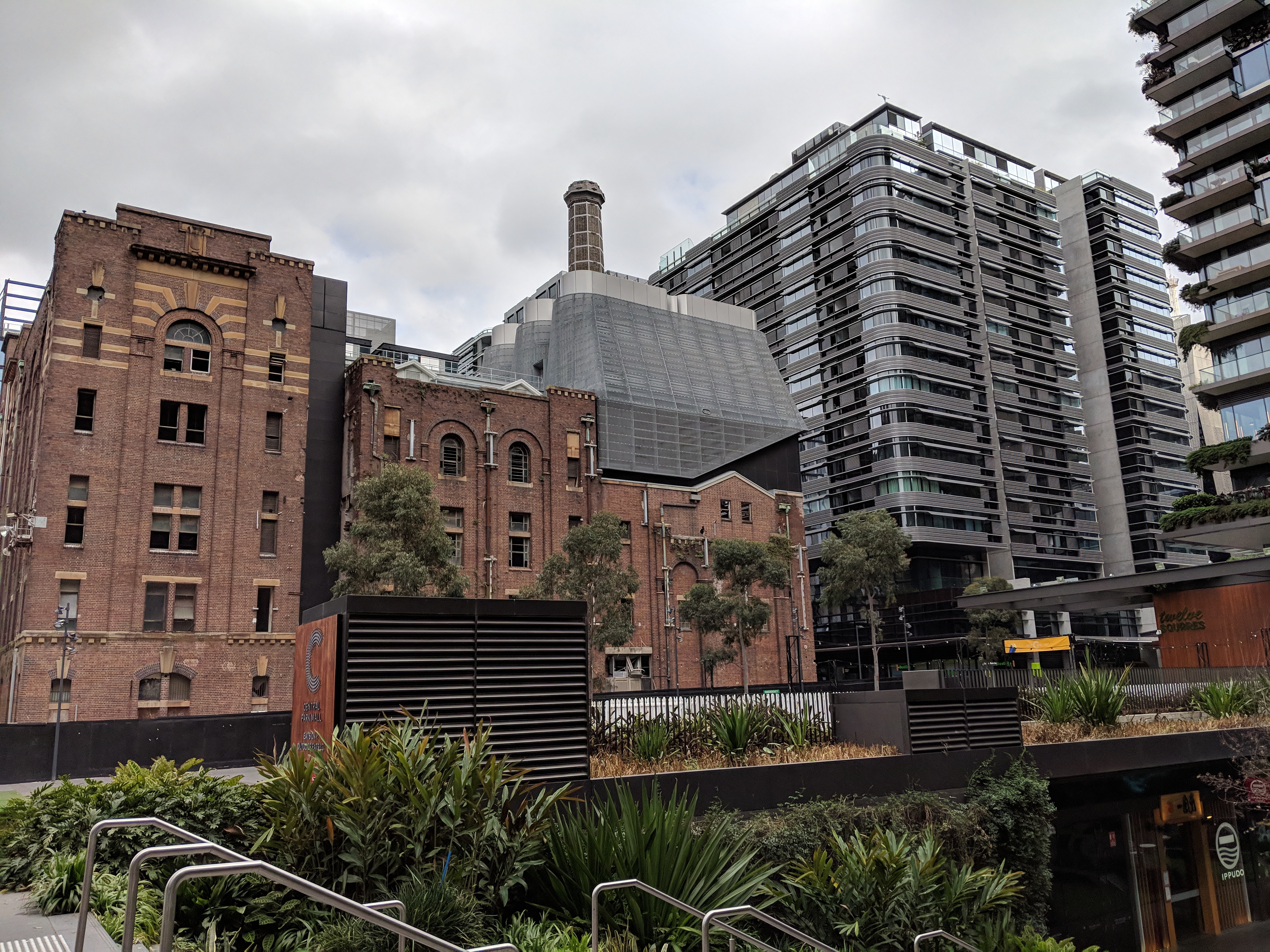
The Mark
The Mark is a residential apartment complex located in Central Park. The building comprises two building groups: Mark One and Mark Two. Mark One is level 1–19, which primarily one and two bedroom floor plans. Mark Two is level 20–27, with two and three bedroom apartment units.
The Mark is located south of the Sydney central business district, in the Central Park development, which comprises residential, retail and commercial. Central Park was jointly developed by Frasers Property and Sekisui House Australia and was designed by Johnson Pilton Walker. The development was contracted to Watpac. The building was one of the stage two development of Central Park, which was started in September 2011 and was completed in August 2014.
Sustainability features include:

- Establishment of a sustainability team which consisted of experienced consultants and committed subcontractors.
- An on-site trigeneration plant to reduce carbon emissions.
- A recycled water treatment plant (blackwater system to minimise the demand of main water. The water is collected from rainwater at roof, storm water, groundwater, sewage from adjacent public sewer and building within the development, backwash from pools and spas in the development, and irrigation water from green walls. The recycled water is used for toilet flushing, irrigation, washing machines and mechanical plant.
- Sub-meters and smart metre panels are provided in each apartment.
- Use of environment-friendly materials throughout the project.
- Use of highest available water and energy rated appliances to every apartment.
- Series of training sessions were provided to staffs, client and project's subcontractors.
Awards
- Winner of High-Density Development category of UDIA NSW 2015 Awards (NSW).
- Shortlisted in Design and Innovation category of UDIA NSW 2015 Awards (NSW).
Heritage

The site formally was Carlton & United Breweries site in Chippendale. Heritage consultants Godden Mackay Logan was engaged to undertake the comprehensive site survey, analysis, archaeological investigation and documentation. Urbis, who is heritage architect was engaged to adaptively reuse of heritage structures in collaboration with the project architects. In the end, there are 33 items were identified as heritage items and have been retained. The heritage items including the tiled arch at Kent Road, terraces and warehouses along Kensington Street, three hotels, the brewery yard buildings and brick stack and the administration building will be restored or adaptively reused.
Commercial buildings
London architects Foster + Partners are the designers behind Central Park's first commercial buildings known as Central Park Mall, which is anchored by Woolworths and features over 75,000 square metres of office and retail space.
Parkland
Central Park includes two parks. In addition to the main park, a pocket park known as the Balfour Street Park was created by closing a section of Balfour Street. The park provides a connection between Central Park and the rest of Chippendale. It opened in April 2010. The main park, called Chippendale Green, opened on 17 December 2012.
Artworks
Halo, a wind powered kinetic sculpture by Jennifer Turpin and Michaelie Crawford was installed in Central Park in 2012. It involves a ring turning and tilting atop a mast in response to wind.
References
References
- "Frasers Broadway (formerly CUB site)". City of Sydney.
- Farrelly, Elizabeth. (20 November 2020). "Central Park v Barangaroo: which one triumphs and why?". The Sydney Morning Herald.
- . (2015). ["The Skyscraper Center One Central Park"](http://skyscrapercenter.com/building/one-central-park/10710). *CTBUH (Council on Tall Buildings and Urban Habitat)*.
- "The Best New Tall Buildings On The Planet". Business Insider International.
- "One Central Park Gardens". Frasers Property.
- "Central Park Sydney – Architecture". Frasers Property.
- "Shop Central". Frasers Property.
- Goncalves, Ricardo. (20 May 2014). "Sydney's Central Park East tower ranked one of the world's best". [[Special Broadcasting Service]] (SBS) Online.
- Tan, Monica. (11 November 2014). "Sydney's One Central Park wins international best tall building award". The Guardian Australia.
- (14 October 2014). "Winners of the 2014 LEAF Award". ArchDaily.
- "One Central Park, and Park Lane and The Mark". [[BESIX Watpac.
- "Central Park, Technical paper". ACAA.
- "Central Park Sydney". Frasers Property.
- "Introducing Halo". Turpin + Crawford Studio.
This article was imported from Wikipedia and is available under the Creative Commons Attribution-ShareAlike 4.0 License. Content has been adapted to SurfDoc format. Original contributors can be found on the article history page.
Ask Mako anything about Central Park, Sydney — get instant answers, deeper analysis, and related topics.
Research with MakoFree with your Surf account
Create a free account to save articles, ask Mako questions, and organize your research.
Sign up freeThis content may have been generated or modified by AI. CloudSurf Software LLC is not responsible for the accuracy, completeness, or reliability of AI-generated content. Always verify important information from primary sources.
Report