From Surf Wiki (app.surf) — the open knowledge base
Census in the Philippines
National census
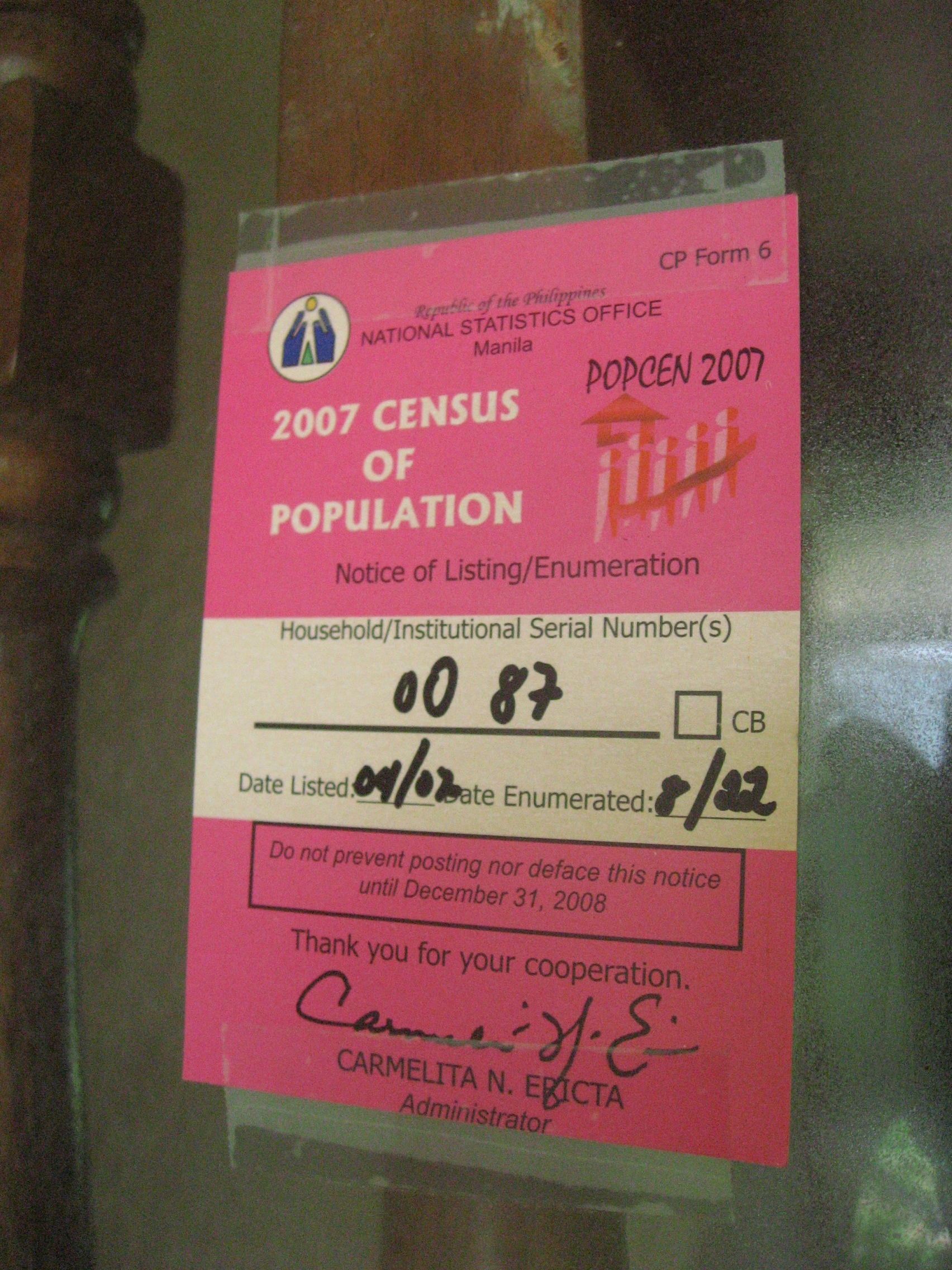
National census
| Field | Value |
|---|---|
| name | Philippine census |
| image | A Philippine Statistics Authority (PSA) enumerator interviews a resident of Molino Homes II Subdivision.jpg |
| caption | A census enumerator interviewing a resident of Dasmariñas in October 2020 |
| status | |
| genre | |
| date | |
| begins | |
| ends | |
| frequency | Every five years |
| coordinates | |
| country | Philippines |
| years_active | |
| first | |
| founder_name | |
| last | [2024](2024-philippine-census); |
| prev | [2020](2020-philippine-census); |
| next | |
| organized | Philippine Statistics Authority (since 2015) |
The Philippine census is a regularly occurring and official inventory of the human population and housing units in the Philippines. Since 1970, the population has been enumerated every five years. Results from the censuses are used to allocate congressional seats and fund government programs.
The mid-year census is known as the Census of Population (POPCEN), while the decennial census is referred to as the Census of Population and Housing (CPH).
By virtue of Republic Act No. 10625, known as the Philippine Statistical Act of 2013, censuses in the Philippines have been administered by the Philippine Statistics Authority (PSA) since the 2015 census.
History
The first census in the Philippines in 1591, was based on tributes collected and yielded about 666,712 people in the islands. In 1799, Friar Manuel Buzeta estimated the population count as 1,502,574. However, the first official census in the Philippines was carried out by the Spanish government pursuant to a royal decree calling for the counting of persons living as of the midnight of December 31, 1877. Based on this census, the Philippines had a population of 5,567,685 as of the reference date. This was followed by another censuses, the 1887 census that yielded a count of 5,984,727.
The first census conducted by the U.S. military forces took place in 1903 to fulfill Public Act 467 which was approved by the United States Philippine Commission on October 6, 1902.
A four-volume description of this census was on hand some years ago at the National Archives in San Bruno, California, but the volumes appear to have since been misplaced.
Statistics
For years between the censuses, the PSA and its precursor agencies have been issuing estimates made using surveys and statistical systems.
Based on the 2024 Philippine census, the national population is 112,729,484 as of July 1, 2024. From 2020 to 2024, the population grew by 0.80% per year on the average.
| Year | Population | Change | Most populated region | Most populated city | Notes | Organized by |
|---|---|---|---|---|---|---|
| *1799* | 1,502,574 | — | — | — | According to Fr. Buzeta | — |
| *1800* | 1,561,251 | 3.91% | — | — | According to Fr. Zuniga | — |
| *1812* | 1,933,331 | 1.80 % | — | — | According to cedulas | — |
| *1819* | 2,106,230 | 1.23% | — | — | According to cedulas | — |
| *1829* | 2,593,287 | 2.10% | — | — | According to the Church | — |
| *1840* | 3,096,031 | 1.62% | — | — | According to local officials | — |
| *1850* | 3,857,424 | 2.22% | — | — | According to Fr. Buzeta | — |
| *1858* | 4,290,381 | 1.34% | — | — | According to Bowring | — |
| *1870* | 4,712,006 | 0.78% | — | — | According to Guia de Manila | — |
| 1877 | 5,567,685 | 2.41% | — | — | First official census by the Spanish government | Spanish colonial government |
| 1887 | 5,984,727 | 0.72% | — | — | ||
| *1896* | 6,261,339 | 0.50% | — | — | According to Plehn | — |
| 1903 | 7,635,426 | 2.87% | — | Manila | ||
| (219,928) | First official census by the US government | United States government | ||||
| 1918 | 10,314,310 | 2.03% | — | Manila | ||
| (285,306) | ||||||
| 1939 | 16,000,303 | 2.11% | — | Manila | ||
| (623,492) | Only census of the Commonwealth of the Philippines | |||||
| 1948 | 19,234,182 | 2.07% | — | Manila | ||
| (983,906) | First census of the independent Republic of the Philippines | Bureau of the Census and Statistics | ||||
| 1960 | 27,087,685 | 2.89% | — | Manila | ||
| (1,138,611) | ||||||
| 1970 | 36,684,486 | 3.08% | — | Manila | ||
| (1,330,788) | ||||||
| 1975 | 42,070,660 | 2.79% | — | Manila | ||
| (1,479,116) | National Census and Statistics Office | |||||
| 1980 | 48,098,460 | 2.71% | Metro Manila | |||
| (5,925,884) | Manila | |||||
| (1,630,485) | ||||||
| 1985 | *No census was held due to a political and economic crisis* | |||||
| 1990 | 60,703,206 | 2.36% | Metro Manila | |||
| (7,948,392) | Quezon City | |||||
| (1,669,776) | ||||||
| 1995 | 68,616,536 | 2.32% | Metro Manila | |||
| (9,454,040) | Quezon City | |||||
| (1,989,419) | National Statistics Office | |||||
| 2000 | 76,506,928 | 2.36% | Metro Manila | |||
| (9,932,560) | Quezon City | |||||
| (2,173,831) | ||||||
| 2007 | 88,566,732 | 2.04% | Metro Manila | |||
| (11,553,427) | Quezon City | |||||
| (2,679,450) | Originally planned for 2005 but postponed due to 2005-06 reenacted budget | |||||
| 2010 | 92,337,852 | 1.53% | Calabarzon | |||
| (12,609,803) | Quezon City | |||||
| (2,761,720) | ||||||
| [2015](2015-philippine-census) | 100,981,437 | 1.72% | Calabarzon | |||
| (14,414,774) | Quezon City | |||||
| (2,936,116) | First census to record a population exceeding 100 million | Philippine Statistics Authority | ||||
| [2020](2020-philippine-census) | 109,035,343 | 1.63% | Calabarzon | |||
| (16,195,042) | Quezon City | |||||
| (2,960,048) | Only census conducted during COVID-19 pandemic | |||||
| [2024](2024-philippine-census) | 112,729,484 | 0.80% | Calabarzon | |||
| (16,933,234) | Quezon City | |||||
| (3,084,270) |
Notes
References
References
- "Republic Act No. 10625".
- "Census of Population {{!}} Philippine Statistics Authority".
- Aurora E. Perez. (1997). "The Population of The Philippines".
- (n.d.). "An act to provide for taking a census of the Philippine Islands". LawPH.com.
- (July 17, 2025). "2024 Census of Population (POPCEN) Population Counts Declared Official by the President".
- "Philippine Statistics Authority | Republic of the Philippines".
- "Highlights of the Philippine Population 2015 Census of Population". [[Philippine Statistics Authority]].
- Ordinario, Cai. (April 17, 2008). "Population up to 88.57M in 2007". ABS-CBN News.
- link
- 2007 Census Results CD-ROM, DISDiv NSO, Manila
- (2020). "2020 Philippine Statistical Yearbook". [[Philippine Statistics Authority]].
- (2022). "2022 Philippine Statistical Yearbook". [[Philippine Statistics Authority]].
- "Proclamation No. 973". Presidential Communications Office (PCO).
This article was imported from Wikipedia and is available under the Creative Commons Attribution-ShareAlike 4.0 License. Content has been adapted to SurfDoc format. Original contributors can be found on the article history page.
Ask Mako anything about Census in the Philippines — get instant answers, deeper analysis, and related topics.
Research with MakoFree with your Surf account
Create a free account to save articles, ask Mako questions, and organize your research.
Sign up freeThis content may have been generated or modified by AI. CloudSurf Software LLC is not responsible for the accuracy, completeness, or reliability of AI-generated content. Always verify important information from primary sources.
Report