From Surf Wiki (app.surf) — the open knowledge base
Celtic languages
Language family

Language family
| Field | Value |
|---|---|
| name | Celtic |
| region | Formerly widespread in much of Europe and central Anatolia; today Cornwall, Wales, Scotland, Ireland, Brittany, the Isle of Man, Chubut Province (Y Wladfa), and Nova Scotia |
| familycolor | Indo-European |
| fam2 | Italo-Celtic? |
| protoname | Proto-Celtic |
| child1 | Celtiberian |
| child2 | Gallaecian |
| child3 | Lepontic |
| child4 | Gaulish |
| child5 | Noric? |
| child6 | Brythonic |
| child7 | Goidelic |
| iso2 | cel |
| iso5 | cel |
| lingua | 50= (phylozone) |
| glotto | celt1248 |
| glottorefname | Celtic |
| map | Celts in Europe.png |
| mapcaption | Distribution of Celtic speakers: |
The Celtic languages ( ) are a branch of the Indo-European language family, descended from the hypothetical Proto-Celtic language. The term "Celtic" was first used to describe this language group by Edward Lhuyd in 1707, following Paul-Yves Pezron, who made the explicit link between the Celts described by classical writers and the Welsh and Breton languages.
During the first millennium BC, Celtic languages were spoken across much of Europe and central Anatolia. Today, they are restricted to the northwestern fringe of Europe and a few diaspora communities. There are six living languages: the four continuously living languages Breton, Irish, Scottish Gaelic and Welsh, and the two revived languages Cornish and Manx. All are minority languages in their respective countries, though there are continuing efforts at revitalisation. Welsh is an official language in Wales and Irish is an official language across the island of Ireland and of the European Union. Welsh is the only Celtic language not classified as endangered by UNESCO. The Cornish and Manx languages became extinct in modern times but have been revived. Each now has several hundred second-language speakers.
Irish, Manx and Scottish Gaelic form the Goidelic languages, while Welsh, Cornish and Breton are Brittonic. All of these are Insular Celtic languages, since Breton, the only living Celtic language spoken in continental Europe, is descended from the language of settlers from Britain. There are a number of extinct but attested Continental Celtic languages, such as Celtiberian, Galatian and Gaulish. Beyond that, there is no agreement on the subdivisions of the Celtic language family. Traditionally, they are considered to be divided into P-Celtic and Q-Celtic. However, Gaulish is widely considered more closely related to Insular Celtic than either of these two are to Celtiberian; together, Gaulish and Insular Celtic may form the Nuclear Celtic subfamily.
The Celtic languages have a rich literary tradition. The earliest specimens of written Celtic are Lepontic inscriptions from the 6th century BC in the Alps. Early Continental inscriptions used Italic and Paleohispanic scripts. Between the 4th and 8th centuries, Irish and Pictish were occasionally written in an original script, Ogham, but Latin script came to be used for all Celtic languages. Welsh has had a continuous literary tradition from the 6th century AD.
Living languages
SIL Ethnologue lists six living Celtic languages, of which four have retained a substantial number of native speakers. These are: the Goidelic languages (Irish and Scottish Gaelic, both descended from Middle Irish) and the Brittonic languages (Welsh and Breton, descended from Common Brittonic). The other two, Cornish (Brittonic) and Manx (Goidelic), died out in modern times with their presumed last native speakers in 1777 and 1974 respectively. Revitalisation movements in the 2000s led to the re-emergence of native speakers of both languages following their adoption by adults and children.
Demographics
| Language | Native name | Grouping | Number of native speakers | Number of skilled speakers | Area of origin | |||||||||
|---|---|---|---|---|---|---|---|---|---|---|---|---|---|---|
| (still spoken) | Regulated by/language body | Estimated number of speakers in major cities | ||||||||||||
| Irish | Gaeilge / Gaedhilg / Gaelainn / Gaeilig / Gaeilic | Goidelic | 40,000–80,000 | |||||||||||
| In the Republic of Ireland, 73,803 people use Irish daily outside the education system. | url= http://www.cso.ie/en/media/csoie/census/documents/census2011pdr/Pdf%208%20Tables.pdf | title=cso.ie Central Statistics Office, Census 2011 – This is Ireland – see table 33a | access-date=27 April 2012 | archive-url= https://web.archive.org/web/20130525115907/http://www.cso.ie/en/media/csoie/census/documents/census2011pdr/Pdf%208%20Tables.pdf | archive-date=25 May 2013 | url-status=dead}} | ||||||||
| 1,873,997 (of whom 788,927 (14.6% of the population) could speak it "well")(2022) | *Gaeltacht* of Ireland | Foras na Gaeilge | Dublin: 184,140 | |||||||||||
| Galway: 37,614 | ||||||||||||||
| Cork: 57,318 | ||||||||||||||
| Belfast: 14,086 | ||||||||||||||
| Welsh | Cymraeg / Y Gymraeg | Brittonic | 538,000 (17.8% of the population of Wales) claim that they "can speak Welsh" (2021) | title=Welsh language skills by local authority, gender and detailed age groups, 2011 Census | url= https://statswales.wales.gov.uk/Catalogue/Welsh-Language/WelshLanguageSkills-by-LocalAuthority-Gender-DetailedAgeGroups-2011Census | work=StatsWales website | publisher=Welsh Government | access-date=13 November 2015 | archive-url= https://web.archive.org/web/20151117063712/https://statswales.wales.gov.uk/Catalogue/Welsh-Language/WelshLanguageSkills-by-LocalAuthority-Gender-DetailedAgeGroups-2011Census | archive-date=17 November 2015 | url-status=dead}} | |||
| England: 150,000 | ||||||||||||||
| Chubut Province, Argentina: 5,000 | ||||||||||||||
| United States: 2,500 | ||||||||||||||
| Canada: 2,200 | Wales | Welsh Language Commissioner | ||||||||||||
| The Welsh Government | ||||||||||||||
| (previously the Welsh Language Board, Bwrdd yr Iaith Gymraeg) | Cardiff: 54,504 | |||||||||||||
| Swansea: 45,085 | ||||||||||||||
| Newport: 18,490 | ||||||||||||||
| Bangor: 7,190 | ||||||||||||||
| Breton | Brezhoneg | Brittonic | 206,000 | fr}} [Données clés sur breton, Ofis ar Brezhoneg](http://www.ofis-bzh.org/fr/langue_bretonne/chiffres_cles/index.php) | Brittany | Ofis Publik ar Brezhoneg | Rennes: 7,000 | |||||||
| Brest: 40,000 | ||||||||||||||
| Nantes: 4,000 | ||||||||||||||
| Scottish Gaelic | Gàidhlig | Goidelic | url= https://web.archive.org/web/20140604200212/http://www.scotlandscensus.gov.uk/ods-web/data-warehouse.html | date=4 June 2014}}, Table QS211SC. | title=Scotland's Census 2022 – Ethnic group, national identity, language and religion | url=https://www.scotlandscensus.gov.uk/2022-results/scotland-s-census-2022-ethnic-group-national-identity-language-and-religion/ | access-date=2024-12-28 | website=Scotland's Census | language=en}} (2.5% of the population) | Scotland | Bòrd na Gàidhlig | Glasgow: 5,726 | ||
| Edinburgh: 3,220 | ||||||||||||||
| Aberdeen: 1,397 | ||||||||||||||
| Cornish | Kernowek / Kernewek | Brittonic | 563 | title=South West | url= http://www.teachingenglish.org.uk/uk-languages/south-west | access-date=9 February 2010 | work=TeachingEnglish.org.uk | publisher=BBC / British Council | date=2010 | url-status=dead | archive-url= https://web.archive.org/web/20100108190250/http://www.teachingenglish.org.uk/uk-languages/south-west | archive-date=8 January 2010}} | Cornwall | Akademi Kernewek |
| Cornish Language Partnership (Keskowethyans an Taves Kernewek) | Truro: 118 | |||||||||||||
| Manx | Gaelg / Gailck | Goidelic | url= https://www.independent.co.uk/news/education/education-news/anyone-here-speak-jersey-657175.html | title=Anyone here speak Jersey? | work=The Independent | date=11 April 2002 | access-date=19 August 2011 | archive-url= https://web.archive.org/web/20110911095902/http://www.independent.co.uk/news/education/education-news/anyone-here-speak-jersey-657175.html | archive-date=11 September 2011 | url-status=dead}} including a small number of children who are new native speakers | 2,223 have some skills in Manx, of whom 2,023 could speak it (2021) | Isle of Man | Coonceil ny Gaelgey | Douglas: 507 |
Mixed languages
- Beurla Reagaird, Highland travellers' language
- Shelta, based largely on Irish and Hiberno-English (some 86,000 speakers in 2009).
Classification
]]

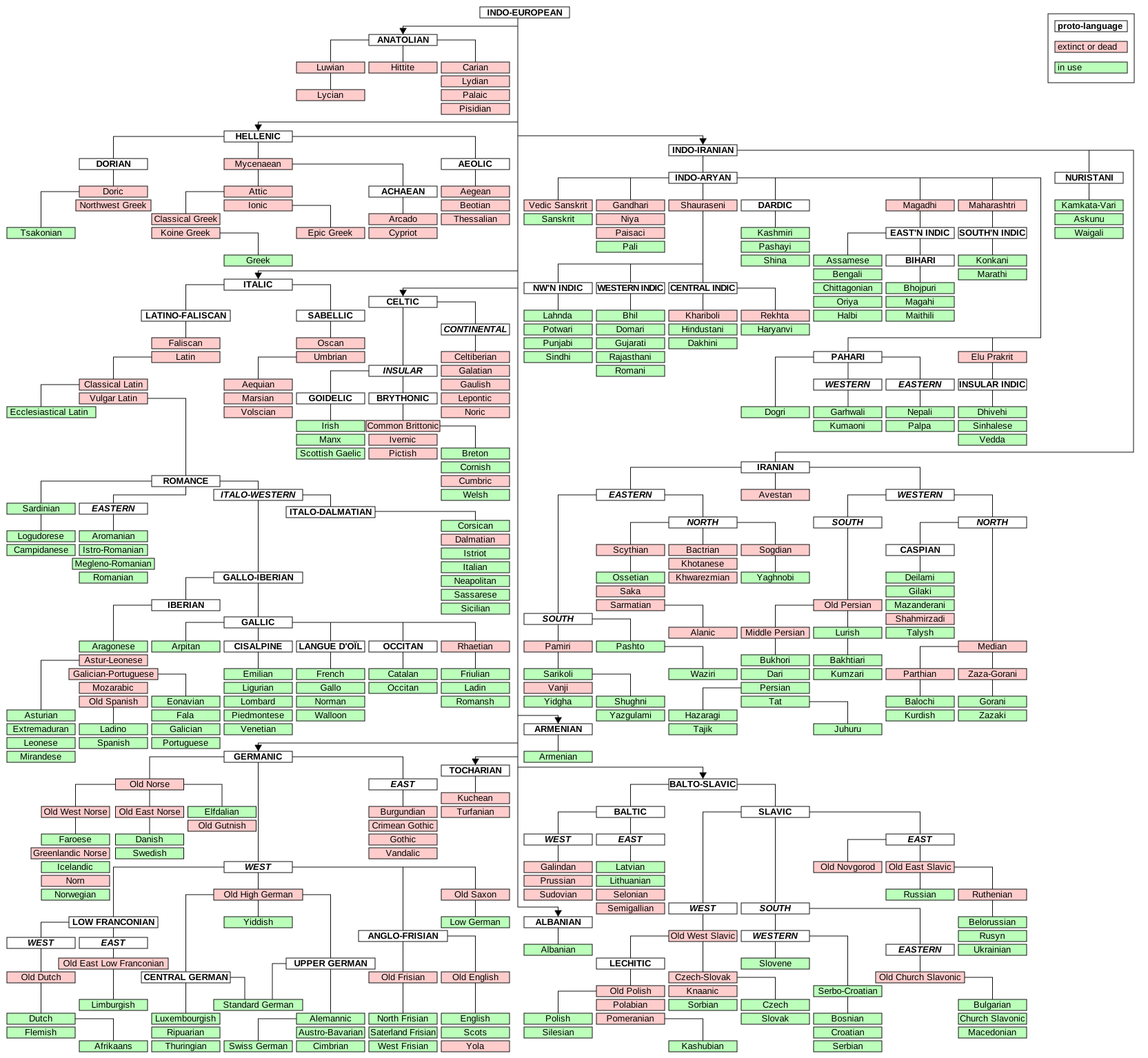
Celtic is divided into various branches:
- Lepontic, the oldest attested Celtic language (from the 6th century BC). Anciently spoken in Switzerland and in Northern-Central Italy. Coins with Lepontic inscriptions have been found in Noricum and Gallia Narbonensis.
- Celtiberian, also called Eastern or Northeastern Hispano-Celtic, spoken in the ancient Iberian Peninsula, in the eastern part of Old Castile and south of Aragon. Modern provinces: Segovia, Burgos, Soria, Guadalajara, Cuenca, Zaragoza and Teruel. The relationship of Celtiberian with Gallaecian, in northwest Iberia, is uncertain.
- Gallaecian, also known as Western or Northwestern Hispano-Celtic, anciently spoken in the northwest of the peninsula (modern Northern Portugal, and the Spanish regions of Galicia, Asturias and northwestern Castile and León).
- Gaulish languages, including Galatian and possibly Noric. These were once spoken in a wide arc from Belgium to modern-day Turkey. They are now all extinct.
- Brittonic, spoken in Great Britain and Brittany. Including the living languages Breton, Cornish, and Welsh, and the lost Cumbric and Pictish, though Pictish may be a sister language rather than a daughter of Common Brittonic. Before the arrival of Scotti on the Isle of Man in the 9th century, there may have been a Brittonic language there. The theory of a Brittonic Ivernic language predating Goidelic speech in Ireland has been suggested, but is not widely accepted.
- Goidelic, including the extant Irish, Manx, and Scottish Gaelic.
Continental/Insular Celtic and P/Q-Celtic hypotheses
Scholarly handling of Celtic languages has been contentious owing to scarceness of primary source data. Some scholars (such as Cowgill 1975; McCone 1991, 1992; and Schrijver 1995) posit that the primary distinction is between Continental Celtic and Insular Celtic, arguing that the differences between the Goidelic and Brittonic languages arose after these split off from the Continental Celtic languages. Other scholars (such as Schmidt 1988) make the primary distinction between P-Celtic and Q-Celtic languages based on the replacement of initial Q by initial P in some words. Most of the Gallic and Brittonic languages are P-Celtic, while the Goidelic and Hispano-Celtic (or Celtiberian) languages are Q-Celtic. The P-Celtic languages (also called Gallo-Brittonic) are sometimes seen (for example by Koch 1992) as a central innovating area as opposed to the more conservative peripheral Q-Celtic languages. According to Ranko Matasović in the introduction to his 2009 Etymological Dictionary of Proto-Celtic: "Celtiberian ... is almost certainly an independent branch on the Celtic genealogical tree, one that became separated from the others very early."
The Breton language is Brittonic, not Gaulish; though there may be some input from the latter, having been introduced from Southwestern regions of Britain in the post-Roman era. In the P/Q classification schema, the first language to split off from Proto-Celtic was Gaelic. It has characteristics that some scholars see as archaic, but others see as also being in the Brittonic languages (see Schmidt). In the Insular/Continental classification schema, the split of the former into Gaelic and Brittonic is seen as being late.
The distinction of Celtic into these four sub-families most likely occurred about 900 BC according to Gray & Atkinson but, because of estimation uncertainty, it could be any time between 1200 and 800 BC. However, they only considered Gaelic and Brythonic. A controversial paper by Forster & Toth included Gaulish and put the break-up much earlier at 3200 BC ± 1500 years. They support the Insular Celtic hypothesis. The early Celts were commonly associated with the archaeological Urnfield culture, the Hallstatt culture, and the La Tène culture, though the earlier assumption of association between language and culture is now considered to be less strong.
There are legitimate scholarly arguments for both the Insular Celtic hypothesis and the P-/Q-Celtic hypothesis. Proponents of each schema dispute the accuracy and usefulness of the other's categories. However, since the 1970s the division into Insular and Continental Celtic has become the more widely held view (Cowgill 1975; McCone 1991, 1992; Schrijver 1995), but in the middle of the 1980s, the P-/Q-Celtic theory found new supporters (Lambert 1994), because of the inscription on the Larzac piece of lead (1983), the analysis of which reveals another common phonetical innovation -nm- -nu (Gaelic ainm / Gaulish anuana, Old Welsh enuein 'names'), that is less accidental than only one. The discovery of a third common innovation would allow the specialists to come to the conclusion of a Gallo-Brittonic dialect (Schmidt 1986; Fleuriot 1986).
The interpretation of this and further evidence is still quite contested, and the main argument for Insular Celtic is connected with the development of verbal morphology and the syntax in Irish and British Celtic, which Schumacher regards as convincing, while he considers the P-Celtic/Q-Celtic division unimportant and treats Gallo-Brittonic as an outdated theory. Stifter affirms that the Gallo-Brittonic view is "out of favour" in the scholarly community as of 2008 and the Insular Celtic hypothesis "widely accepted".
When referring only to the modern Celtic languages, since no Continental Celtic language has living descendants, "Q-Celtic" is equivalent to "Goidelic" and "P-Celtic" is equivalent to "Brittonic".
How the family tree of the Celtic languages is ordered depends on which hypothesis is used: "Insular Celtic hypothesis"
- Proto-Celtic
- Continental Celtic
- Celtiberian
- Gallaecian
- Gaulish
- Insular Celtic
- Brittonic
- Goidelic "P/Q-Celtic hypothesis"
- Continental Celtic
- Proto-Celtic
- Q-Celtic
- Celtiberian
- Gallaecian
- Goidelic
- P-Celtic
- Gaulish
- Brittonic
- Q-Celtic
Eska (2010)
Eska evaluates the evidence as supporting the following tree, based on shared innovations, though it is not always clear that the innovations are not areal features. It seems likely that Celtiberian split off before Cisalpine Celtic, but the evidence for this is not robust. On the other hand, the unity of Gaulish, Goidelic, and Brittonic is reasonably secure. Schumacher (2004, p. 86) had already cautiously considered this grouping to be likely genetic, based, among others, on the shared reformation of the sentence-initial, fully inflecting relative pronoun **i̯os, *i̯ā, i̯od into an uninflected enclitic particle. Eska sees Cisalpine Gaulish as more akin to Lepontic than to Transalpine Gaulish.
- Celtic
- Hispano-Celtic
- Celtiberian
- Gallaecian
- Nuclear Celtic
- Cisalpine Celtic: Lepontic → Cisalpine Gaulish
- Core Celtic (secure)
- Transalpine Gaulish ("Transalpine Celtic")
- Insular Celtic
- Goidelic
- Brittonic
- Hispano-Celtic
Eska considers a division of Transalpine–Goidelic–Brittonic into Transalpine and Insular Celtic to be most probable because of the greater number of innovations in Insular Celtic than in P-Celtic, and because the Insular Celtic languages were probably not in great enough contact for those innovations to spread as part of a sprachbund. However, if they have another explanation (such as an SOV substratum language), then it is possible that P-Celtic is a valid clade, and the top branching would be:
- Core Celtic (P-Celtic hypothesis)
- Goidelic
- Gallo-Brittonic
- Transalpine Gaulish ("Transalpine Celtic")
- Brittonic
Italo-Celtic
Within the Indo-European family, the Celtic languages have sometimes been placed with the Italic languages in a common Italo-Celtic subfamily. This hypothesis fell somewhat out of favour after reexamination by American linguist Calvert Watkins in 1966. Irrespectively, some scholars such as Ringe, Warnow and Taylor and many others have argued in favour of an Italo-Celtic grouping in 21st century theses.
Characteristics
Although there are many differences between the individual Celtic languages, they do show many family resemblances.
- consonant mutations (Insular Celtic only)
- inflected prepositions (Insular Celtic only)
- two grammatical genders (modern Insular Celtic only; Old Irish and the Continental languages had three genders, although Gaulish may have merged the neuter and masculine in its later forms)
- a vigesimal number system (counting by twenties)
- Cornish hwetek ha dew ugens "fifty-six" (literally "sixteen and two twenty")
- verb–subject–object (VSO) word order (probably Insular Celtic only)
- an interplay between the subjunctive, future, imperfect, and habitual, to the point that some tenses and moods have ousted others
- an impersonal or autonomous verb form serving as a passive or intransitive
- Welsh dysgaf "I teach" vs. dysgir "is taught, one teaches"
- Irish múinim "I teach" vs. múintear "is taught, one teaches"
- no infinitives, replaced by a quasi-nominal verb form called the verbal noun or verbnoun
- frequent use of vowel mutation as a morphological device, e.g. formation of plurals, verbal stems, etc.
- use of preverbal particles to signal either subordination or illocutionary force of the following clause
- mutation-distinguished subordinators/relativisers
- particles for negation, interrogation, and occasionally for affirmative declarations
- pronouns positioned between particles and verbs
- lack of simple verb for the imperfective "have" process, with possession conveyed by a composite structure, usually BE + preposition
- Cornish Yma kath dhymm "I have a cat", literally "there is a cat to me"
- Welsh Mae cath gyda fi "I have a cat", literally "a cat is with me"
- Irish Tá cat agam "I have a cat", literally "there is a cat at me"
- use of periphrastic constructions to express verbal tense, voice, or aspectual distinctions
- distinction by function of the two versions of BE verbs traditionally labelled substantive (or existential) and copula
- bifurcated demonstrative structure
- suffixed pronominal supplements, called confirming or supplementary pronouns
- use of singulars or special forms of counted nouns, and use of a singulative suffix to make singular forms from plurals, where older singulars have disappeared
Examples: : : (Literal translation) Do not bother with son the beggar's and not will-bother son the beggar's with-you. :* bhacaigh is the genitive of bacach. The igh the result of affection; the is the lenited form of . :* leat is the second person singular inflected form of the preposition le. :* The order is verb–subject–object (VSO) in the second half. Compare this to English or French (and possibly Continental Celtic) which are normally subject–verb–object in word order.
: : (Literally) four on fifteen and four twenties :* bymtheg is a mutated form of pymtheg, which is pump ("five") plus deg ("ten"). Likewise, phedwar is a mutated form of pedwar. :* The multiples of ten are deg, ugain, deg ar hugain, deugain, hanner cant, trigain, deg a thrigain, pedwar ugain, deg a phedwar ugain, cant.
Comparison table
The lexical similarity between the different Celtic languages is apparent in their core vocabulary, especially in terms of actual pronunciation. Moreover, the phonetic differences between languages are often the product of regular sound change (i.e. lenition of into or Ø).
The table below has words in the modern languages that were inherited direct from Proto-Celtic, as well as a few old borrowings from Latin that made their way into all the daughter languages. There is often a closer match between Welsh, Breton and Cornish on the one hand and Irish, Scottish Gaelic and Manx on the other. For a fuller list of comparisons, see the Swadesh list for Celtic.
| English | Brittonic | Goidelic | Welsh | Breton | Cornish | Irish | ||
|---|---|---|---|---|---|---|---|---|
| Gaelic | Scottish | |||||||
| Gaelic | Manx | |||||||
| bee | gwenynen | gwenanenn | gwenenen | beach | seillean | shellan | ||
| big | mawr | meur | meur | mór | mòr | mooar | ||
| dog | ci | ki | ki | madra, gadhar | ||||
| (cú "hound") | cù | coo | ||||||
| fish | pysgodyn† | pesk† | pysk† | iasc | iasg | yeeast | ||
| full | llawn | leun | leun | lán | làn | lane | ||
| goat | gafr | gavr | gaver | gabhar | gobhar | goayr | ||
| house | tŷ | ti | chi | teach, tigh | taigh | thie | ||
| lip (anatomical) | gwefus | gweuz | gweus | liopa, beol | bile | meill | ||
| mouth of a river | aber | aber | aber | inbhear | inbhir | inver | ||
| four | pedwar | pevar | peswar | ceathair, cheithre | ceithir | kiare | ||
| night | nos | noz | nos | oíche | oidhche | oie | ||
| number† | rhif, nifer† | niver† | niver† | uimhir | àireamh | earroo | ||
| three | tri | tri | tri | trí | trì | tree | ||
| milk | llaeth† | laezh† | leth† | bainne, leacht | bainne, leachd | bainney | ||
| you (sg) | ti | te | ty | tú, thú | thu, tu | oo | ||
| star | seren | steredenn | steren | réalta | reult, rionnag | rollage | ||
| today | heddiw | hiziv | hedhyw | inniu | an-diugh | jiu | ||
| tooth | dant | dant | dans | fiacail, déad | fiacaill, deud | feeackle | ||
| (to) fall | cwympo | kouezhañ | kodha | tit(im) | tuit(eam) | tuitt(ym) | ||
| (to) smoke | ysmygu | mogediñ, butuniñ | megi | caith(eamh) tobac | smocadh | toghtaney, smookal | ||
| (to) whistle | chwibanu | c'hwibanat | hwibana | feadáil | fead | fed | ||
| time, weather | amser | amzer | amser "time", | |||||
| kewer "weather" | aimsir | aimsir | emshyr |
† Borrowings from Latin
Examples
Article 1 of the Universal Declaration of Human Rights: All human beings are born free and equal in dignity and rights. They are endowed with reason and conscience and should act towards one another in a spirit of brotherhood.
Possible members of the family
Several poorly-documented languages may have been Celtic.
- Ancient Belgian
- Camunic is an extinct language spoken in the first millennium BC in the Val Camonica and Valtellina valleys of the Central Alps. It has recently been proposed that it was a Celtic language.
- Ivernic has been suggested to be Celtic by T. F. O'Rahilly, though this theory has been refuted and is not widely accepted by experts.
- Ligurian, on the Northern Mediterranean Coast straddling the southeast French and northwest Italian coasts, including parts of Tuscany, Elba and Corsica. Xavier Delamarre argues that Ligurian was a Celtic language similar to Gaulish. The Ligurian-Celtic question is also discussed by Barruol (1999). Ancient Ligurian is listed as either Celtic (epigraphic), or Para-Celtic (onomastic).
- Lusitanian, spoken in the area between the Douro and Tagus rivers of western Iberia (a region straddling the present border of Portugal and Spain). Known from only five inscriptions and various place names. It is an Indo-European language and some scholars have proposed that it may be a para-Celtic language that evolved alongside Celtic or formed a dialect continuum or sprachbund with Tartessian and Gallaecian. This is tied to a theory of an Iberian origin for the Celtic languages. It is also possible that the Q-Celtic languages alone, including Goidelic, originated in western Iberia (a theory that was first put forward by Edward Lhuyd in 1707) or shared a common linguistic ancestor with Lusitanian. Other scholars see greater linguistic affinities between Lusitanian, Old Gallo-Italic (particularly with Ligurian) and Old European. Prominent modern linguists such as Ellis Evans, believe Gallaecian-Lusitanian was in fact one same language (not separate languages) of the "P" Celtic variant.
- Rhaetic, spoken in central Switzerland, Tyrol in Austria, and the Alpine regions of northeast Italy. Documented by a limited number of short inscriptions (found through Northern Italy and Western Austria) in two variants of the Etruscan alphabet. Its linguistic categorisation is not clearly established, and it presents a confusing mixture of what appear to be Etruscan, Indo-European, and uncertain other elements. Howard Hayes Scullard argues that Rhaetian was also a Celtic language. However, today most scholars believe that Rhaetic was a Tyrrhenian language closely related to Etruscan.
- Tartessian, spoken in the southwest of the Iberia Peninsula (mainly southern Portugal and southwest Spain). Tartessian is known by 95 inscriptions, with the longest having 82 readable signs. John T. Koch argues that Tartessian was also a Celtic language.
Notes
References
- Ball, Martin J. & James Fife (ed.) (1993). The Celtic Languages. London: Routledge. .
- Borsley, Robert D. & Ian Roberts (ed.) (1996). The Syntax of the Celtic Languages: A Comparative Perspective. Cambridge: Cambridge University Press. .
- Celtic Linguistics, 1700–1850 (2000). London; New York: Routledge. 8 vols comprising 15 texts originally published between 1706 and 1844.
- Lewis, Henry & Holger Pedersen (1989). A Concise Comparative Celtic Grammar. Göttingen: Vandenhoeck & Ruprecht. .
References
- "The Celtic languages: An Overview", Donald MacAulay, ''The Celtic Languages'', ed. Donald MacAulay, Cambridge University Press, 1992, 3.
- Cunliffe, Barry W. 2003. ''The Celts: a very short introduction''. pg.48
- Alice Roberts, ''The Celts'' (Heron Books 2015)
- "Celtic Branch".
- Koch, John T.. (2006). "Celtic Culture: A Historical Encyclopedia". [[ABC-CLIO]].
- "A brief history of the Cornish language". Maga Kernow.
- Beresford Ellis, Peter. (2005). "The Story of the Cornish Language". Tor Mark Press.
- . ["Fockle ny ghaa: schoolchildren take charge"](http://www.iomtoday.co.im/manx-language/Fockle-ny-ghaa-schoolchildren-take.3901786.jp). *Iomtoday.co.im*.
- (2010). "South West". [[BBC]] / [[British Council]].
- (24 November 2004). "Irish Examiner – 2004/11/24: EU grants Irish official language status". Archives.tcm.ie.
- Christina Bratt Paulston. (24 March 1994). "Linguistic Minorities in Multilingual Settings: Implications for Language Policies". J. Benjamins Pub. Co.
- Pierce, David. (2000). "Irish Writing in the Twentieth Century". Cork University Press.
- Ó hÉallaithe, Donncha. (1999). "Cuisle".
- (23 November 2017). "Just 6.3% of Gaeilgeoirí speak Irish on a weekly basis". [[TheJournal.ie]].
- "Main language – full detail MS-B13".
- (4 December 2024). "Knowledge of languages by generation status, mother tongue, age and gender: Canada, provinces and territories and economic regions".
- "cso.ie Central Statistics Office, Census 2011 – This is Ireland – see table 33a".
- "F8014: Irish speakers aged three years and over by sex, single year of age, level of Irish spoken and frequency of speaking Irish, 2022".
- "Frequency of Speaking Irish [Updated]".
- Central Statistics Office. "Population Aged 3 Years and Over by Province County or City, Sex, Ability to Speak Irish and Census Year". Government of Ireland.
- Department of Finance and Personnel. "Census 2011 Key Statistics for Northern Ireland". Northern Ireland Statistics and Research Agency.
- (2022-12-06). "Welsh language: Fewer speakers in Wales in past decade".
- "Welsh language skills by local authority, gender and detailed age groups, 2011 Census". [[Welsh Government]].
- Office for National Statistics 2011 [http://ons.gov.uk/ons/rel/census/2011-census/key-statistics-for-unitary-authorities-in-wales/stb-2011-census-key-statistics-for-wales.html#tab---Proficiency-in-Welsh 2011-census-key-statistics-for-wales]{{Webarchive. link. (5 June 2013)
- United Nations High Commissioner for Refugees. "World Directory of Minorities and Indigenous Peoples – UK: Welsh". United Nations High Commission for Refugees.
- (2008). "Wales and Argentina". [[Welsh Government]].
- (27 April 2010). "Table 1. Detailed Languages Spoken at Home and Ability to Speak English for the Population 5 Years and Over for the United States: 2006–2008 Release Date: April 2010". [[United States Census Bureau]].
- (7 December 2010). "2006 Census of Canada: Topic based tabulations: Various Languages Spoken (147), Age Groups (17A) and Sex (3) for the Population of Canada, Provinces, Territories, Census Metropolitan Areas and Census Agglomerations, 2006 Census – 20% Sample Data". [[Statistics Canada]].
- (4 December 2024). "Knowledge of languages by generation status, mother tongue, age and gender: Canada, provinces and territories and economic regions".
- "Welsh language skills by local authority, gender and detailed age groups, 2011 Census". Welsh Government.
- {{in lang. fr [http://www.ofis-bzh.org/fr/langue_bretonne/chiffres_cles/index.php Données clés sur breton, Ofis ar Brezhoneg] {{Webarchive. link. (15 March 2012)
- Pole Études et Développement Observatoire des Pratiques Linguistiques. "Situation de la Langue". Office Public de la Langue Bretonne.
- [http://www.scotlandscensus.gov.uk/ods-web/data-warehouse.html 2011 Scotland Census] {{Webarchive. link. (4 June 2014, Table QS211SC.)
- "Scotland's Census 2022 – Ethnic group, national identity, language and religion".
- (11 September 2013). "National Household Survey Profile, Nova Scotia, 2011". Statistics Canada.
- "Standard Outputs". National Records of Scotland.
- Campsie, Alison. (9 May 2014). "New bid to get us speaking in Gaelic". The Press and Journal.
- "Main language (detailed)".
- See [[Cornish language#Geographic distribution and number of speakers. Number of Cornish speakers]]
- (2010). "South West". [[BBC]] / [[British Council]].
- Equalities and Wellbeing Division. "Language in England and Wales: 2011". Office for National Statistics.
- (11 April 2002). "Anyone here speak Jersey?". The Independent.
- (14 January 2008). "Documentation for ISO 639 identifier: glv". Sil.org.
- (January 2022). "Isle of Man Census Report 2021". Statistics Isle of Man, Cabinet Office.
- Whitehead, Sarah. (2 April 2015). "How the Manx language came back from the dead". [[The Guardian]].
- "Shelta". Ethnologue.
- link. (31 March 2017; Koch, John T.; Vol 1, p. 233.)
- (2003). "I Celti: una civiltà europea". Giunti Editore.
- Stifter, David. (2008). "Old Celtic Languages".
- MORANDI 2004, pp. 702–703, n. 277
- Prósper, B.M.. (2002). "Lenguas y religiones prerromanas del occidente de la península ibérica". Ediciones Universidad de Salamanca.
- Villar F., B. M. Prósper. (2005). ''Vascos, Celtas e Indoeuropeos: genes y lenguas. Ediciones Universidad de Salamanca''. pgs. 333–350. {{ISBN. 84-7800-530-7.
- "In the northwest of the Iberian Peninsula, and more specifically between the west and north Atlantic coasts and an imaginary line running north-south and linking Oviedo and Merida, there is a corpus of Latin inscriptions with particular characteristics of its own. This corpus contains some linguistic features that are clearly Celtic and others that in our opinion are not Celtic. The former we shall group, for the moment, under the label northwestern Hispano-Celtic. The latter are the same features found in well-documented contemporary inscriptions in the region occupied by the Lusitanians, and therefore belonging to the variety known as LUSITANIAN, or more broadly as GALLO-LUSITANIAN. As we have already said, we do not consider this variety to belong to the Celtic language family." Jordán Colera 2007: p.750
- "Etext".
- "What are the Celtic Languages?". Celtic Studies Resources.
- Matasović, Ranko. (2009). "Etymological Dictionary of Proto-Celtic". [[Brill Publishers.
- Barbour and Carmichael, Stephen and Cathie. (2000). "Language and nationalism in Europe". [[Oxford University Press]].
- (2003). "Language-tree divergence times support the Anatolian theory of Indo-European origin". [[Nature (journal).
- (2003). "Cladistic analysis of languages: Indo-European classification based on lexicostatistical data". [[Cladistics (journal).
- (2003). "Toward a phylogenetic chronology of ancient Gaulish, Celtic, and Indo-European". [[Proceedings of the National Academy of Sciences of the United States of America]].
- Renfrew, Colin. (1987). "Archaeology and Language: The Puzzle of Indo-European Origins". [[Jonathan Cape]].
- (1999). "The Atlantic Celts: Ancient People or Modern Invention?". [[British Museum]] Press.
- (2004). "Die keltischen Primärverben. Ein vergleichendes, etymologisches und morphologisches Lexikon". Institut für Sprachen und Kulturen, [[University of Innsbruck]].
- Stifter, David. (2008). "Old Celtic Languages".
- Joseph F. Eska (2010) "The emergence of the Celtic languages". In Martin J. Ball and Nicole Müller (eds.), ''The Celtic languages''. Routledge. {{ISBN. 9781138969995
- (1966). "Ancient Indo-European dialects". [[University of California Press]].
- (March 2002). "Indo-European and Computational Cladistics". Transactions of the Philological Society.
- (2012). "The Celts: History, Life, and Culture". [[Bloomsbury Publishing.
- "Dictionnaires bretons parlants".
- "Trinity College Phonetics and Speech Lab".
- "Learn Gaelic Dictionary".
- (2008). "Shared Symbolics, Genre Diffusion, Token Perception and Late Literacy in North-Western Europe". NOWELE.
- O'Rahilly, T. F.. (1946). "Early Irish History and Mythology". Dublin Institute for Advanced Studies.
- Koch, John T.. (2006). "Celtic Culture: A Historical Encyclopedia". [[ABC-CLIO]].
- "Celtic Gods: The Gaulish and Ligurian god, Vasio (He who is given Libation)".
- Kruta, Venceslas. (1991). "The Celts". Thames and Hudson.
- Kruta, Venceslas. (1991). "The Celts". Thames and Hudson.
- Wodtko, Dagmar S. (2010). "Celtic from the West Chapter 11: The Problem of Lusitanian". [[Oxbow Books]].
- Ballester, X.. (2004). ""Páramo" o del problema del la */p/ en celtoide". Studi Celtici.
- [https://books.google.com/books?id=fDYyBwAAQBAJ&dq=edward+lhuyd+lusitanian+celtic&pg=PA8 Unity in Diversity, Volume 2: Cultural and Linguistic Markers of the Concept] Editors: Sabine Asmus and Barbara Braid. Google Books.
- (2000). "Indoeuropeos y no indoeuropeos en la Hispania Prerromana". Ediciones Universidad de Salamanca.
- ''The inscription of Cabeço das Fráguas revisited. Lusitanian and Alteuropäisch populations in the West of the Iberian Peninsula'' Transactions of the Philological Society vol. 97 (2003)
- "Callaica_Nomina".
- (2006). "Celtic Culture: A-Celti". [[Bloomsbury Publishing.
- (1967). "The Etruscan Cities and Rome". [[Cornell University Press]].
- VAN DER MEER, L.B.. (2004-01-01). "Etruscan origins". BABESCH - Bulletin Antieke Beschaving.
- Koch, John T.. (2010). "Celtic from the West Chapter 9: Paradigm Shift? Interpreting Tartessian as Celtic". [[Oxbow Books]].
- Cunliffe, Barry. (2003). "The Celts – A Very Short Introduction – see figure 7". Oxford University Press.
- Cólera, Carlos Jordán. (16 March 2007). "The Celts in the Iberian Peninsula:Celtiberian". E-Keltoi.
- Koch, John T.. (2011). "Tartessian 2: The Inscription of Mesas do Castelinho ro and the Verbal Complex. Preliminaries to Historical Phonology". [[Oxbow Books]].
This article was imported from Wikipedia and is available under the Creative Commons Attribution-ShareAlike 4.0 License. Content has been adapted to SurfDoc format. Original contributors can be found on the article history page.
Ask Mako anything about Celtic languages — get instant answers, deeper analysis, and related topics.
Research with MakoFree with your Surf account
Create a free account to save articles, ask Mako questions, and organize your research.
Sign up freeThis content may have been generated or modified by AI. CloudSurf Software LLC is not responsible for the accuracy, completeness, or reliability of AI-generated content. Always verify important information from primary sources.
Report