From Surf Wiki (app.surf) — the open knowledge base
Caucasian wisent
Extinct bison subspecies

Extinct bison subspecies
The Caucasian wisent (Bison bonasus caucasicus), also known as the Eurasian bison or dombay (домбай) is an extinct subspecies of European bison that inhabited the Caucasus Mountains of Eastern Europe.
Description
Little is known about the morphology of this subspecies, including its body size, as its extinction occurred in a time before the onset of many modern scientific approaches.
Compared to the extant lowland wisent, the Caucasian bison was more adapted to mountainous habitat. It is thought that the Caucasian bison was generally smaller, had shorter and rounder hooves, had more developed shoulder girdles, had significantly thicker and larger horns, less shaggy coats, and curly hairs on the rear of its head.
It was hunted by the Caspian tiger and the Asiatic lion, as well as by other predators such as steppe wolves and Syrian brown bears.
Extinction and conservation
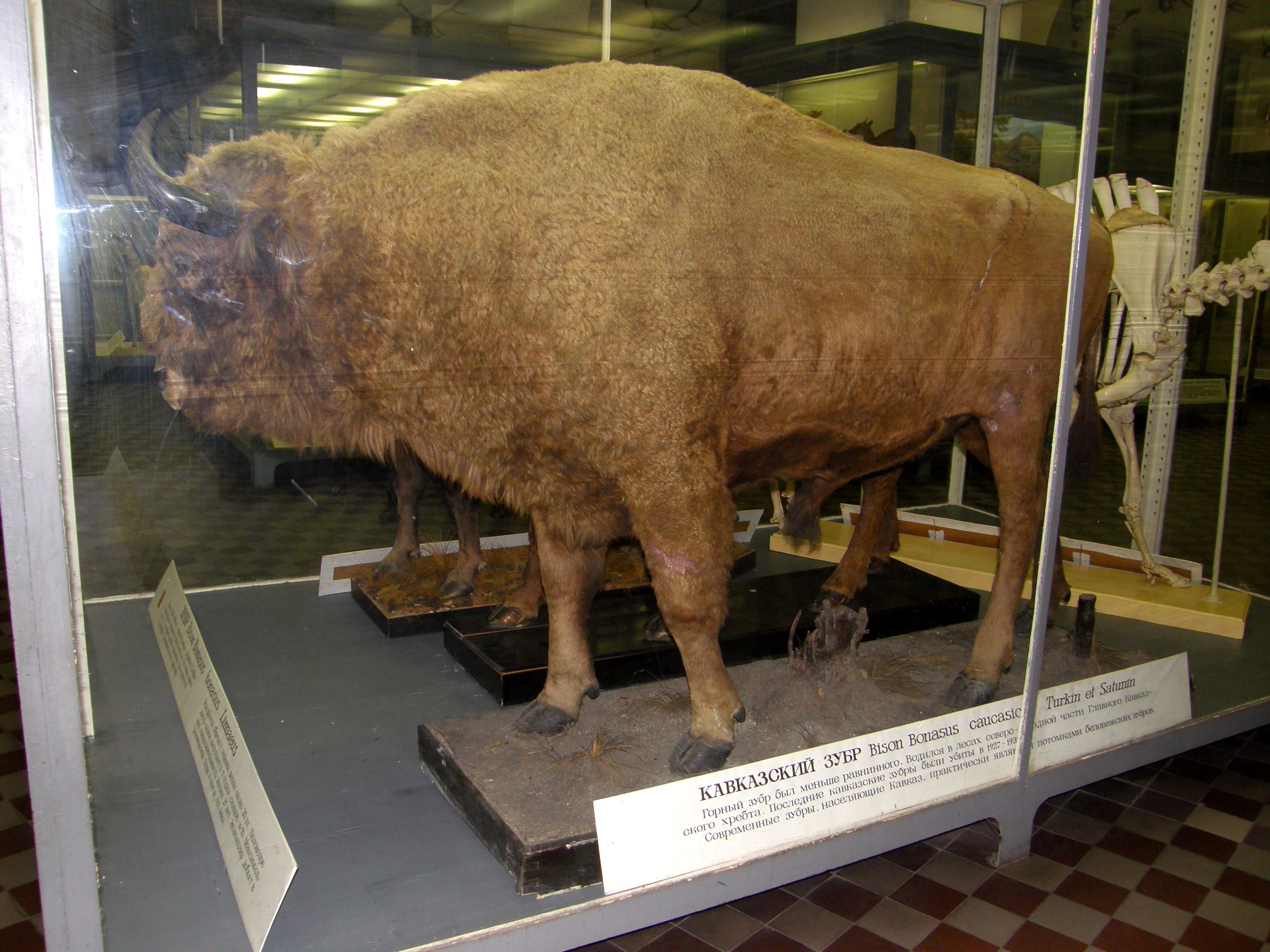
In the 17th century, the Caucasian bison still populated a large area of the Western Caucasus. After that, human settlement in the mountains intensified and the range of the Caucasian wisent had become reduced to about one tenth of its original range by the end of the 19th century. In the 1860s, the population still numbered about 2,000, but had been reduced to only 500–600 by 1917 and to only 50 by 1921. Local poaching continued; finally, in 1927, the last three Caucasian wisent were killed.
Only one Caucasian bison bull is known to have been kept in captivity. This bull, named Kaukasus, was born in the Caucasus Mountains in 1907 and brought to Germany in 1908 where he lived until 26 February 1925. While in captivity, he bred with cows from the lowland subspecies Bison bonasus bonasus. Thus, he became one of the twelve ancestors of the present lowland-Caucasian breeding line of the European wisent pedigree book.
In 1940, a group of wisent-American bison hybrids were released into the Caucasian Biosphere Reserve and later in 1959 in the Nalchik Forestry Game Management Unit (Kabardino-Balkariya). Later some pure-blood wisent of the lowland-Caucasian breeding line were released there to form a single mixed herd together with the hybrids. In 2000, these hybrids were described as a different (without scientific basis) subspecies, the highland bison - Bison bonasus montanus (Polish).
References
References
- Plumb, G.. (2020). "''Bison bonasus''".
- Semenov U.A. of [[World Wide Fund for Nature. WWF]]-Russia, 2014, "The Wisents of Karachay-Cherkessia", Proceedings of the [[Sochi National Park]] (8), pp.23–24, {{ISBN. 978-5-87317-984-8, KMK Scientific Press
- Ninell Melkadze, Nargiza Ninua, Izabella Skhirtladze (2009): Catalogue of the type specimens of Caucasian large mammalian fauna in the collection of the National Museum of Georgia
- Daniel Foidl, 2013, Over-purity as a danger for the Wisent?, The Breeding-back blog, [[Tauros Programme]]
- (26–30 September 1988). "Origin of the Hybrids of North American and European Bison in the Caucasus Mountains". SSC/IUCN.
- Bashkirov, I. S.. (1939). "Caucasian European Bison". Central Board for Reserves, Forest Parks and Zoological Gardens, Council of the People's Commissars of the RSFSR.
- Puzek, Z.. (2002). "European Bison ''Bison bonasus'': Current State of the Species and an Action Plan for Its Conservation". Mammal Research Institute, Polish Academy of Sciences.
- (2000). "A New subspecies of the European Bison, ''Bison bonasus montanus'' ssp. nov.". Doklady Biological Sciences.
This article was imported from Wikipedia and is available under the Creative Commons Attribution-ShareAlike 4.0 License. Content has been adapted to SurfDoc format. Original contributors can be found on the article history page.
Ask Mako anything about Caucasian wisent — get instant answers, deeper analysis, and related topics.
Research with MakoFree with your Surf account
Create a free account to save articles, ask Mako questions, and organize your research.
Sign up freeThis content may have been generated or modified by AI. CloudSurf Software LLC is not responsible for the accuracy, completeness, or reliability of AI-generated content. Always verify important information from primary sources.
Report