From Surf Wiki (app.surf) — the open knowledge base
Catholic Church in the Philippines
none

none
| Field | Value |
|---|---|
| icon | Emblem of the Papacy SE.svg |
| name | Catholic Church in the Philippines |
| native_name | fil |
| image | Front view of The Cathedral in Intramuros, Manila.jpg |
| caption | Manila Cathedral of the Archdiocese of Manila, the oldest Catholic diocese in the Philippines |
| type | National polity |
| main_classification | Catholic |
| orientation | Latin |
| scripture | Bible |
| theology | Catholic theology |
| polity | Episcopal |
| governance | Catholic Bishops' Conference of the Philippines |
| leader_title | Pope |
| leader_name | |
| leader_title1 | President |
| leader_name1 | Gilbert A. Garcera |
| leader_title2 | Apostolic Nuncio |
| leader_name2 | Charles John Brown |
| area | Philippines |
| language | Latin, Filipino, Native Philippine regional languages, English, Spanish |
| headquarters | Intramuros, Manila |
| founded_date | March 17, 1521 |
| founded_place | Spanish East Indies, Spanish Empire |
| separations | Apostolic Catholic Church (1992) |
| branched_from | Catholic Church in Spain |
| members | 89,000,000 (2023) |
| tertiary | See list |
| seminaries | San Carlos Seminary, San Jacinto Seminary |
| other_names | |
| website | |
As part of the worldwide Catholic Church, the Catholic Church in the Philippines (), or the Philippine Catholic Church or Philippine Roman Catholic Church, is part of the world's largest Christian church under the spiritual leadership of the Pope in Rome. The Philippines is one of the two nations in Asia having a substantial portion of the population professing the Catholic faith, along with East Timor, and has the third largest Catholic population in the world after Brazil and Mexico. The episcopal conference responsible in governing the faith is the Catholic Bishops' Conference of the Philippines (CBCP).
Christianity, through Catholicism, was first brought to the Philippine islands by Spanish soldiers, missionaries and settlers, who arrived in waves beginning in the early 16th century in Cebu by way of colonization. Catholicism served as the country's state religion during the Spanish colonial period; since the American colonial period, the faith today is practiced in the context of a secular state. In 2023, it was estimated that 89 million Filipinos, or roughly 80% of the population profess the Catholic faith.
History
Spanish Era
On May 4, 1493, Pope Alexander VI issued Bull Inter Caetera granted permission to the Spanish crown to make explore and conquer the mainlands and islands in Asia that came to be known as the Spanish Pacific and distinguishing it from the area granted to the Portuguese. Explorations were motivated by evangilization and finding spices. In 1519, Ferdinand Magellan set out to the Pacific and discovered the Philippines in March 1521. Magellan's chronicler, Antonio Pigafetta, noted mass was celebrated on March 31, 1521 which was an Easter Sunday in Mazaua and was attended by Rajah Colambu and Siaui. In commemoration a cross was erected on the site. There are contentions, however, on the actual First Mass in the Philippines with contradicting claims that it was held in Butuan, Limasawa, Bolinao, and Homonhon. They worked to evangelize the natives of Cebu and performed wholesale baptisms.
The Spanish Crown first entrusted the conversion of Philippine natives to the Augustinians. In 1564, the Culhuacan convent in Mexico City issued the religious warrant establishing the first branch of the order in the Philippines. In 1565, the Legazpi expedition set off from Mexico City and marked the beginning of the Hispanisation of the Philippines, beginning with Cebu. This expedition was an effort to occupy the islands with as little conflict as possible, ordered by Phillip II. Lieutenant Legazpi set up colonies in an effort to make peace with the natives and achieve swift conquest.
Christianity expanded from Cebu when the remaining Spanish missionaries were forced westwards due to conflict with the Portuguese, and laid the foundations of the Christian community in the Panay between around 1560 to 1571. A year later the second batch of missionaries reached Cebu. The island became the ecclesiastical "seat" and the center for evangelization. Augustinian Missionary Fray Alfonso Jimenez traveled into the Camarines region through the islands of Masbate, Leyte, Samar, and Burias and centered the church on Naga City. He was named the first apostle of the region. By 1571 Fray Herrera, who was assigned as chaplain of Legazpi, advanced further north from Panay and founded the local church community in Manila. Herrera travelled further in the Espiritu Santo and shipwrecked in Catanduanes, where he died attempting to convert the natives. In 1572, the Spaniards led by Juan de Salcedo marched north from Manila with the second batch of Augustinian missionaries and pioneered the evangelization in the Ilocos (starting with Vigan) and the Cagayan regions.[[File:Filipino ceremonial photography 1919.jpg|left|thumb|Group picture of students Ateneo de Manila Philippines. At the center is a ceremonial presence of [[Pope Benedict XV]] in the form of his portrait.]]Under the encomienda system, Filipinos had to pay tribute to the encomendero of the area, and in return the encomendero taught them the Christian faith and protected them from enemies. Although Spain had used this system in America, it did not work as effectively in the Philippines, and the missionaries were not as successful in converting the natives as they had hoped. In 1579, Bishop Salazar and clergymen were outraged because the encomenderos had abused their powers. Although the natives were resistant, they could not organize into a unified resistance towards the Spaniards, partly due to geography and ethno-linguistic differences.
With the increasing number of colonists, Spain and Mexico pressured other religious orders to join the evangelical mission started by the Augustinian in the Philippines. The Franciscans arrived in 1577, followed by the Jesuits in 1581, the Dominicans in 1587, and Augustinian Recollects in 1606.
Cultural impact

Each barangay had a mutable caste system, with any sub-classes varying from one barangay to the next. Generally, patriarchal lords and kings were called datus and rajas, while the mahárlika were the knight-like freedmen and the timawa were freedmen. The alipin or servile class were dependent on the upper classes, an arrangement regarded as slavery by the Spaniards. Intermarriage between the timawa and the alipin was permitted, which created a more or less flexible system of privileges and labor services. The Spaniards attempted to suppress this class system based on their interpretation that the dependent, servile class was an oppressed group. They failed at completely abolishing the system, but instead eventually worked to use it to their own advantage.
Religion and marriage were also issues that the Spanish missionaries wanted to reform. Polygyny was not uncommon, but was mostly confined to wealthier chieftains. Divorce and remarriage were also common as long as the reasons were justified. Accepted reasons for divorce included illness, infertility, or finding better potential to take as a spouse. The missionaries also disagreed with the practices of paying dowries, the "bride price" where the groom paid his father-in-law in gold, and "bride-service", in which the groom performed manual labor for the bride's family, a custom which persisted until the late 20th century. Missionaries disapproved of these because they felt bride-price was an act of selling one's daughter, and labor services in the household of the father allowed premarital sex between the bride and groom, which contradicted Christian beliefs.[[File:983Manila Cathedral Intramuros Manila Landmarks 22.jpg|thumb|290x290px|Statue of [[Saint Peter]], Manila Cathedral]]
Pre-conquest, the natives had followed a variety of monotheistic and polytheistic faiths, often localized forms of Buddhism, Hinduism, Islam or Tantrism mixed with Animism. Bathala (Tagalog – Central Luzon) or Laon (Visayan) was the ultimate creator deity above subordinate gods and goddesses. Natives Filipinos also worshiped nature and venerated the spirits of their ancestors, whom they propitiated with sacrifices. There was ritualistic drinking and many rituals aimed to cure certain illnesses. Magic and superstition were also practiced. The Spaniards saw themselves as liberating the natives from sinful practices and showing them the correct path to God.
In 1599, negotiation began between a number of lords and their freemen and the Spaniards. The native rulers agreed to submit to the rule of the Castilian king and convert to Christianity, and allow missionaries to spread the faith. In return, the Spaniards agreed to protect the natives from their enemies, mostly Japanese, Chinese, and Muslim pirates.
Difficulties

Several factors slowed the Spaniards' attempts to spread Christianity throughout the archipelago. The low number of missionaries on the island made it difficult to reach all the people and harder to convert them. This was also due to the fact that the route to the Philippines was a rigorous journey, and some clergy fell ill or waited years for an opportunity to travel there. For others, the climate difference once they arrived was unbearable. Other missionaries desired to go to Japan or China instead and some who remained were more interested in mercantilism. The Spaniards also came into conflict with the Chinese population in the Philippines. The Chinese had set up shops in the Parian (or bazaar) during the 1580s to trade silk and other goods for Mexican silver. The Spaniards anticipated revolts from the Chinese and were constantly suspicious of them. The Spanish government was highly dependent on the influx of silver from Mexico and Peru, since it supported the government in Manila, to continue the Christianization of the archipelago.[[File:Archbishop's palace Manila Philippines.jpg|thumb|Throne Room interior of the [[Palacio Arzobispal]] in [[Intramuros]] Manila as it was during the Spanish colonial period.|331x331px]][[File:2665Santo Cristo Saint Andrew Kim Taegon Parish Church 06.jpg|thumb|upright=1.0|[[Stained glass]] featuring [[Lorenzo Ruiz|Saint Lorenzo Ruiz]], [[Pedro Calungsod|Saint Pedro Calungsod]], [[José María of Manila|Blessed José María de Manila]] and [[Veneration of Mary in the Catholic Church|Our Lady of Mercy]] in [[Shrine of Saint Andrew Kim]] in [[Bocaue]], [[Bulacan]].]]
The most difficult challenges for the missionaries were the dispersion of the Filipinos and the wide variety of languages and dialects. The geographical isolation forced the Filipino population into numerous small villages, and every other province supported a different language. Furthermore, frequent privateering from Japanese Wokou pirates and slave-raiding by Muslims blocked Spanish attempts to Christianize the archipelago, and to offset the disruption of continuous warfare with them, the Spanish militarized the local populations, importing soldiers from Latin America, and constructed networks of fortresses across the islands. As the Spanish and their local allies were in a state of constant war against pirates and slavers, the Philippines became a drain on the Vice-royalty of New Spain in Mexico City, which paid to maintaining control of Las Islas Filipinas in lieu of the Spanish crown.[[File:SantoNinodeCebu.jpg|thumb|The [[Santo Niño de Cebú]], the oldest Christian artifact in the Philippines. In 1521, [[Ferdinand Magellan]] gave this statue to a [[Cebuano people|Cebuano]] chieftain that converted to [[Christianity]]|161x161px|left]]
Religious orders
The Philippines is home to many of the world's major religious congregations, these include the Rogationists of the Heart of Jesus, the Redemptorists, Augustinians, Recollects, Jesuits, Dominicans, Benedictines, Franciscans, Carmelites, Divine Word Missionaries, De La Salle Christian Brothers, Salesians of Don Bosco, the indigenous Religious of the Virgin Mary, and Clerics Regular of St. Paul are known as Barnabites.[[File:Magellan's Cross in Cebu.jpg|thumb|[[Magellan's Cross]] outside of the [[Basilica del Santo Niño]], [[Cebu City]]. The Cross is a symbol of the introduction of Christianity to the islands.|296x296px]]
During the Spanish colonial period, the five earliest regular orders assigned to Christianize the natives were the Augustinians, who came with Legazpi, the Discalced Franciscans (1578), the Jesuits (1581), the Dominican friars (1587) and the Augustinian Recollects (simply called the Recoletos, 1606). In 1594, all had agreed to cover a specific area of the archipelago to deal with the vast dispersion of the natives. The Augustinians and Franciscans mainly covered the Tagalog country while the Jesuits had a small area. The Dominicans encompassed the Parian. The provinces of Pampanga and Ilocos were assigned to the Augustinians. The province of Camarines went to the Franciscans. The Augustinians and Jesuits were also assigned the Visayan Islands. The Christian conquest had not reached Mindanao due to a highly resistant Muslim community that existed pre-conquest.
The task of the Spanish missionaries, however, was far from complete. By the seventeenth century, the Spaniards had created about 20 large villages and almost completely transformed the native lifestyle. For their Christian efforts, the Spaniards justified their actions by claiming that the small villages were a sign of barbarism and only bigger, more compact communities allowed for a richer understanding of Christianity. The Filipinos faced much coercion; the Spaniards knew little of native rituals. The layout of these villages was in gridiron form that allowed for easier navigation and more order. They were also spread far enough to allow for one cabecera or capital parish, and small visita chapels located throughout the villages in which clergy only stayed temporarily for Mass, rituals, or nuptials.
The Philippines served as a base for sending missions to other Asian and Pacific countries such as China, Japan, Formosa, Indochina, and Siam.
American period: 1898–1946
When the Spanish clergy were driven out in 1898, there were so few indigenous clergy that the Catholic Church in the Philippines was in imminent danger of complete ruin. Under American administration, the situation was saved and the proper training of Filipino clergy was undertaken. In 1906, Jorge Barlin was consecrated as the Bishop of Nueva Caceres, making him the first Filipino bishop of the Catholic Church.
During the sovereignty of the United States, the American government implemented the separation of church and state, which reduced the significant political power exerted by the Catholic Church and led to the establishment of other faiths (particularly Protestantism) within the country. A provision of the 1935 Philippine Constitution mimicked the First Amendment to the United States Constitution and added the sentences: "The exercise and enjoyment of religious profession and worship, without discrimination or preference, shall be forever allowed. No religious test shall be required for the exercise of civil political rights." But the Philippine experience has shown that this theoretical wall of separation has been crossed several times by secular authorities and culturally the Western church and state separation has been viewed as blasphemous among the Filipino people.
It was during the American Period when newer religious orders arrived in the Philippines. The Spanish friars gradually fled by the hundreds and left parishes without pastors. This prompted bishops to ask for non-Spanish Religious Congregations to set up foundations in the Philippines and help augment the lack of pastors. The American Jesuits and other religious orders from their American province filled the void left by their Spanish counterparts, creating a counterbalance to the growth of Protestant congregations by American Protestant missionaries.
1946–present
After the war, most of the religious orders resumed their ecclesiastical duties and helped in the rehabilitation of towns and cities ravaged by war. Classes in Catholic schools run by religious orders resumed, with American priests specializing in academic and scientific fields fulfilling faculty roles until the mid-1970s. American and foreign bishops were gradually succeeded by Filipino bishops by the 1950s.
The Second Vatican Council from 1962 to 1965 instituted a dramatic change for the Catholic Church in the Philippines, transforming the Latin Spanish church imposed upon the country to a Filipino church deeply rooted in Philippine culture and language.
When the Philippines was placed under Martial Law by 10th president and dictator Ferdinand Marcos Sr., relations between Church and State changed dramatically, as some bishops expressly and openly opposed Martial Law. The turning point came in 1986 when the CBCP President and then-Archbishop of Cebu Cardinal Ricardo Vidal appealed to the Filipinos and the bishops against the government and the fraudulent result of the snap election; with him was then-Archbishop of Manila Cardinal Jaimé Sin, who broadcast over church-owned Radio Veritas a call for people to support anti-regime rebels. The people's response became what is now known as the People Power Revolution, which ousted Marcos.
Church and State today maintain generally cordial relations despite differing opinions over specific issues. With the guarantee of religious freedom in the Philippines, the Catholic clergy subsequently remained in the political background as a source of moral influence, especially during elections. Political candidates continue to court the clergy and religious leaders for support. In the 21st century, Catholic practice ranges from traditional orthodoxy, to Folk Catholicism and Charismatic Catholicism.
At the onset of the COVID-19 pandemic in 2020, mass gatherings were prohibited as part of community quarantines to contain the virus; this prompted the Church to broadcast most liturgical services and spiritual activities through the Internet, television, and radio, and the CBCP allowed bishops to dispense the faithful from Sunday obligation. Physical Holy Masses in churches gradually resumed by June at limited capacities, but were suspended multiple times in response to multiple surges of cases between August 2020 and January 2022. As quarantine restrictions eased, the CBCP, on October 14, 2022, released a circular encouraging the faithful to resume attending Sunday Masses; since then, several dioceses and archdioceses lifted its dispensations from physical attendance of Masses. Despite the setbacks brought by the pandemic, in 2021, the Church celebrated the quincentennial of the arrival of Christianity in the country; the celebrations commemorated the first Mass in the country and the re-enactment of the first Baptism in Cebu City, among others.
In 2024, the Philippine Church marked the declaration of Antipolo Cathedral as the country's first international shrine.

Demographics
These statistics are from Annuario Pontificio.
| Jurisdiction | % | Catholics | Population | As of | Ref | |||
|---|---|---|---|---|---|---|---|---|
| Archdiocese of Caceres | 89.3% | 1,973,650 | 1,761,509 | 2022 | ||||
| Diocese of Daet | 91% | 636,202 | 699,478 | 2022 | ||||
| Diocese of Legazpi | 92.3% | 1,389,658 | 1,505,170 | 2022 | ||||
| Diocese of Libmanan | 85% | 511,196 | 601,407 | 2022 | ||||
| Diocese of Masbate | 88.9% | 930,324 | 1,045,988 | 2022 | ||||
| Diocese of Sorsogon | 93% | 779,900 | 838,600 | 2022 | ||||
| Diocese of Virac | 95% | 265,162 | 279,118 | 2022 | ||||
| Archdiocese of Cagayan de Oro | 80.2% | 1,443,993 | 1,799,450 | 2022 | ||||
| Diocese of Butuan | 79.1% | 1,003,809 | 1,269,529 | 2022 | ||||
| Diocese of Malaybalay | 77.6% | 1,363,026 | 1,756,058 | 2022 | ||||
| Diocese of Surigao | 82.1% | 453,963 | 553,231 | 2022 | ||||
| Diocese of Tandag | 78.6% | 600,144 | 763,780 | 2022 | ||||
| Archdiocese of Capiz | 90.1% | 828,386 | 918,900 | 2022 | ||||
| Diocese of Kalibo | 74.7% | 679,400 | 909,900 | 2022 | ||||
| Diocese of Romblon | 81.4% | 472,660 | 580,485 | 2022 | ||||
| Archdiocese of Cebu | 86.8% | 4,678,039 | 5,388,718 | 2022 | ||||
| Diocese of Dumaguete | 88.4% | 1,412,394 | 1,598,455 | 2022 | ||||
| Diocese of Maasin | 83.5% | 706,966 | 846,620 | 2022 | ||||
| Diocese of Tagbilaran | 94.3% | 705,898 | 748,916 | 2022 | ||||
| Diocese of Talibon | 78.3% | 604,548 | 771,795 | 2022 | ||||
| Archdiocese of Cotabato | 45.6% | 1,108,300 | 2,431,960 | 2022 | ||||
| Diocese of Kidapawan | 58.5% | 626,150 | 1,069,640 | 2022 | ||||
| Diocese of Marbel | 79.1% | 1,691,050 | 2,137,340 | 2022 | ||||
| Archdiocese of Davao | 82.4% | 1,506,873 | 1,829,041 | 2022 | ||||
| Diocese of Digos | 62.9% | 856,039 | 1,362,021 | 2022 | ||||
| Diocese of Mati | 62.4% | 369,160 | 591,289 | 2022 | ||||
| Diocese of Tagum | 73.1% | 1,245,690 | 1,703,438 | 2022 | ||||
| Archdiocese of Jaro | 83.1% | 3,082,540 | 3,708,350 | 2022 | ||||
| Diocese of Bacolod | 79% | 1,309,520 | 1,657,620 | 2022 | ||||
| Diocese of Kabankalan | 80% | 785,657 | 982,071 | 2022 | title=Diocese of Kabankalan latest statistics (2022) | url=https://gcatholic.org/dioceses/diocese/kaba1.htm?tab=stat | website=gcatholic | access-date=May 29, 2024}} |
| Diocese of San Carlos | 85.7% | 992,732 | 1,158,670 | 2022 | ||||
| Diocese of San Jose de Antique | 70.8% | 499,000 | 704,400 | 2022 | ||||
| Archdiocese of Lingayen-Dagupan | 79% | 1,232,511 | 1,560,927 | 2022 | ||||
| Diocese of Alaminos | 82.4% | 660,545 | 802,114 | 2022 | ||||
| Diocese of Cabanatuan | 84.3% | 1,036,081 | 1,228,762 | 2022 | ||||
| Diocese of San Fernando de La Union | 83% | 690,339 | 831,734 | 2022 | ||||
| Diocese of San Jose de Nueva Ecija | 69% | 636,422 | 922,351 | 2022 | ||||
| Diocese of Urdaneta | 81% | 702,058 | 866,340 | 2022 | ||||
| Archdiocese of Lipa | 97.7% | 3,337,746 | 3,414,937 | 2022 | ||||
| Diocese of Boac | 88% | 257,064 | 292,019 | 2022 | ||||
| Diocese of Gumaca | 85% | 909,321 | 1,070,269 | 2022 | ||||
| Diocese of Lucena | 89% | 939,506 | 1,055,544 | 2022 | ||||
| Territorial Prelature of Infanta | 76.9% | 373,000 | 485,240 | 2022 | ||||
| Archdiocese of Manila | 81% | 2,694,960 | 3,327,180 | 2022 | ||||
| Diocese of Antipolo | 81.5% | 3,144,550 | 3,856,230 | 2022 | ||||
| Diocese of Cubao | 78.8% | 1,478,766 | 1,877,260 | 2022 | ||||
| Diocese of Imus | 79.9% | 3,500,260 | 4,381,812 | 2022 | ||||
| Diocese of Kalookan | 80% | 1,831,719 | 2,289,649 | 2022 | ||||
| Diocese of Malolos | 82.1% | 3,757,226 | 4,577,850 | 2022 | ||||
| Diocese of Novaliches | 78% | 2,500,327 | 3,205,547 | 2022 | ||||
| Diocese of Parañaque | 79.5% | 1,504,036 | 1,891,869 | 2022 | ||||
| Diocese of Pasig | 87.1% | 1,756,388 | 2,017,214 | 2022 | ||||
| Diocese of San Pablo | 87.8% | 3,115,119 | 3,547,994 | 2022 | ||||
| Archdiocese of Nueva Segovia | 83% | 642,183 | 773,834 | 2022 | ||||
| Diocese of Baguio | 72.6% | 601,130 | 828,190 | 2022 | ||||
| Diocese of Bangued | 84.8% | 227,532 | 268,438 | 2022 | ||||
| Diocese of Laoag | 59% | 374,623 | 635,283 | 2022 | ||||
| Archdiocese of Ozamis | 58.2% | 447,471 | 768,883 | 2022 | ||||
| Diocese of Dipolog | 69.4% | 726,168 | 1,045,745 | 2022 | ||||
| Diocese of Iligan | 59.3% | 716,993 | 1,209,061 | 2022 | ||||
| Diocese of Pagadian | 80.4% | 1,098,000 | 1,366,200 | 2022 | ||||
| Territorial Prelature of Marawi | 3.7% | 38,800 | 1,039,000 | 2016 | ||||
| Archdiocese of Palo | 95.9% | 1,519,171 | 1,584,942 | 2022 | ||||
| Diocese of Borongan | 99% | 472,168 | 477,168 | 2022 | ||||
| Diocese of Calbayog | 91.9% | 745,592 | 811,630 | 2022 | ||||
| Diocese of Catarman | 93.9% | 639,679 | 681,299 | 2022 | ||||
| Diocese of Naval | 86.3% | 336,713 | 390,228 | 2022 | ||||
| Archdiocese of San Fernando | 85.9% | 2,535,615 | 2,951,705 | 2022 | ||||
| Diocese of Balanga | 80% | 690,890 | 863,610 | 2022 | ||||
| Diocese of Iba | 80% | 739,793 | 924,741 | 2022 | ||||
| Diocese of Tarlac | 67.4% | 1,116,210 | 1,656,200 | 2022 | ||||
| Archdiocese of Tuguegarao | 79.3% | 1,669,800 | 2,105,970 | 2022 | ||||
| Diocese of Bayombong | 54.3% | 406,000 | 748,153 | 2022 | ||||
| Diocese of Ilagan | 70% | 1,187,935 | 1,697,050 | 2022 | ||||
| Territorial Prelature of Batanes | 94.8% | 18,089 | 19,090 | 2022 | ||||
| Archdiocese of Zamboanga | 67.2% | 707,170 | 1,052,763 | 2022 | ||||
| Diocese of Ipil | 75% | 582,608 | 776,811 | 2022 | ||||
| Territorial Prelature of Isabela | 28.8% | 131,560 | 456,400 | 2022 | ||||
| Apostolic Vicariate of Bontoc-Lagawe | 60.5% | 221,750 | 366,766 | 2022 | ||||
| Apostolic Vicariate of Calapan | 92.7% | 931,000 | 1,003,940 | 2022 | ||||
| Apostolic Vicariate of Jolo | 1.4% | 19,240 | 1,374,259 | 2022 | ||||
| Apostolic Vicariate of Puerto Princesa | 64.1% | 536,225 | 836,615 | 2022 | ||||
| Apostolic Vicariate of San Jose in Mindoro | 75.9% | 403,900 | 532,445 | 2022 | ||||
| Apostolic Vicariate of Tabuk | 75% | 375,000 | 499,800 | 2022 | ||||
| Apostolic Vicariate of Taytay | 83% | 633,821 | 763,640 | 2022 |
Internal movements
Catholic Charismatic Renewal
A number of Catholic Charismatic Renewal movements emerged vis-a-vis the Born-again movement during the 70s. The charismatic movement offered In-the-Spirit seminars in the early days, which have now evolved and have different names; they focus on the charismatic gifts of the Holy Spirit. Some of the charismatic movements were the Ang Ligaya ng Panginoon, Assumption Prayer Group, Couples for Christ, the Brotherhood of Christian Businessmen and Professionals, El Shaddai, Elim Communities, Kerygma, the Light of Jesus Family, Shalom, and Soldiers of Christ.
Neocatechumenal Way
The Catholic Church's Neocatechumenal Way in the Philippines has been established for more than 40 years. Membership in the Philippines now exceeds 35,000 persons in more than 1,000 communities, with concentrations in Manila and Iloilo province. A neocatechumenal diocesan seminary, Redemptoris Mater, is located in Parañaque, while many families in mission are all over the islands. The Way has been mostly concentrated on evangelization initiatives under the authority of the local bishops.
Organization
Main article: List of Catholic dioceses in the Philippines
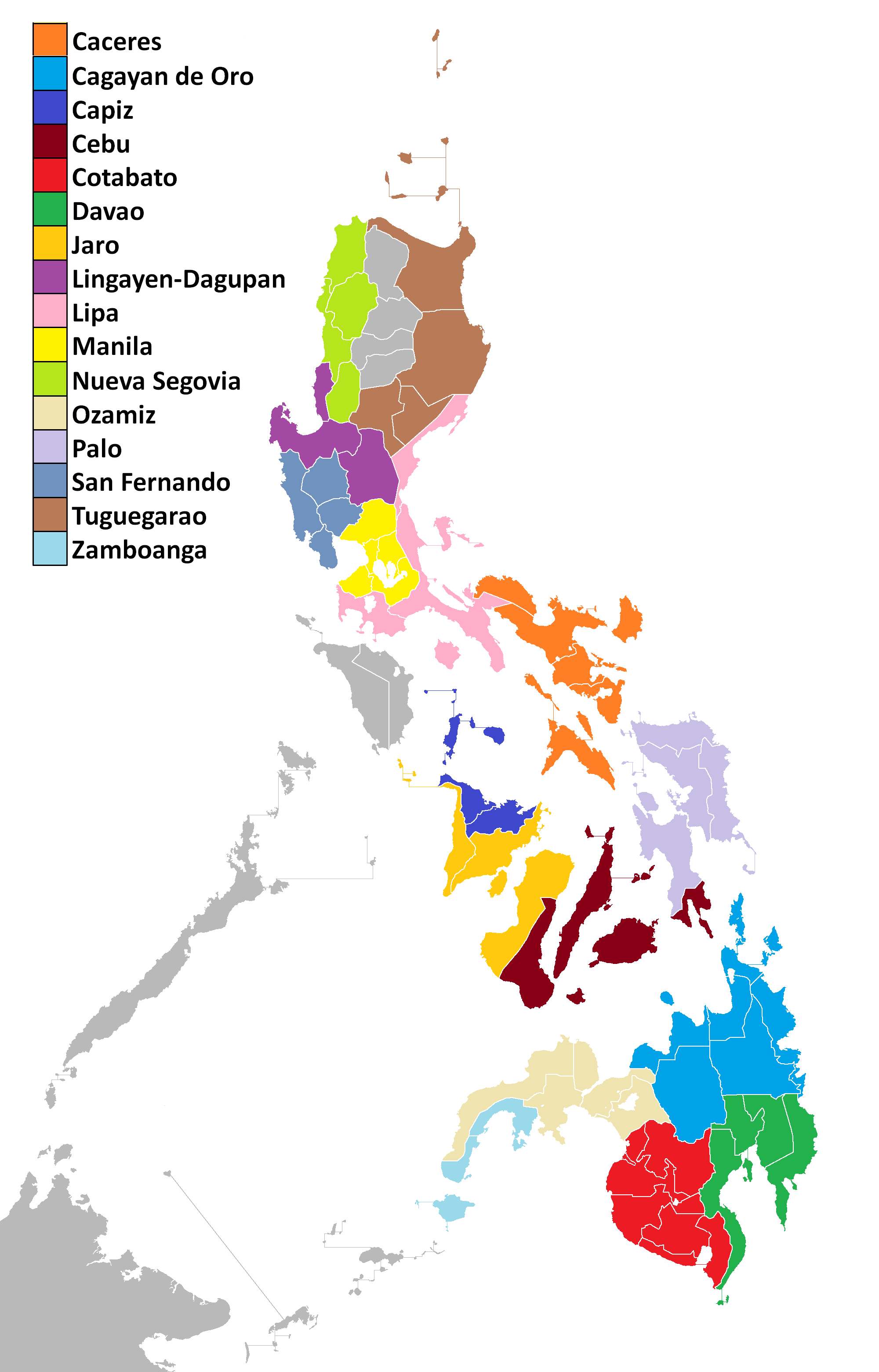
The Catholic Church in the Philippines is organized into 72 dioceses in 16 Ecclesiastical Provinces, as well as 7 Apostolic Vicariates and a Military Ordinariate.
Extraordinary ministers of Holy Communion
Due to large number of attendees, virtually all Masses in the Philippines employ the use of extraordinary ministers of Holy Communion; commissioning of ministers and renewal of their vows is a regular occurrence. In early 2023, claims regarding Freemasons distributing Holy Communion in some parishes prompted the Catholic Bishops' Conference of the Philippines to restate its stance on "the unacceptability of Masonry, given its serious errors".
Society
Education

The Catholic Church is involved in education at all levels. It has founded and continues to sponsor hundreds of secondary and primary schools as well as a number of colleges and internationally known universities. The earliest universities in the Philippines were the University of San Carlos and the University of Santo Tomas, founded during the Spanish colonial period. The Jesuit Ateneo de Manila University, La Salle Brothers De La Salle University, and the Dominican University of Santo Tomas are listed in the "World's Best Colleges and Universities" in the Times Higher Education-QS World University Rankings.
Other Catholic educational institutions in the country include the Notre Dame institution system in Mindanao, the Rogationist College in Silang, Cavite, and the Divine Word and Saint Louis school systems in Luzon.
More than 1,500 Catholic schools throughout the Philippines are members of the Catholic Educational Association of the Philippines (CEAP), the national association of Catholic schools in the country founded in 1941.
Politics
The Catholic Church wields great influence on Philippine society and politics, notably reaching its political peak in 1986. Then-Archbishops of Cebu and Manila—Cardinals Ricardo Vidal and Jaime Sin, respectively—were influential during the People Power Revolution of 1986 against dictator Ferdinand E. Marcos. Vidal, who was president of the Catholic Bishops' Conference of the Philippines (CBCP) at that time, led the rest of the Philippine bishops and made a joint declaration against Marcos and the results of the snap election, while Sin appealed to the public via radio to march along Epifanio delos Santos Avenue in support of rebel forces. Some seven million people responded in the non-violent revolution which lasted from February 22–25, effectively driving Marcos out of power and into exile in Hawaii.
In 1989, President Corazon Aquino asked Vidal to convince General Jose Comendador, who was sympathetic to the rebel forces fighting her government, to peacefully surrender. Vidal's efforts averted what could have been a bloody coup.
In October 2000, Sin expressed his dismay over the allegations of corruption against President Joseph Estrada. His call sparked the second EDSA Revolution, dubbed as "EDSA Dos". Vidal personally asked Estrada to step down, to which he agreed at around 12:20 p.m. of January 20, 2001, after five continuous days of protest at the EDSA Shrine, and various parts of the Philippines and the world. Estrada's Vice-President, Gloria Macapagal-Arroyo, succeeded him and was sworn in on the terrace of the shrine in front of Sin. However, in 2008, more than halfway into Arroyo's presidency, the Catholic Church apologized, and the CBCP President at the time and the Archbishop of Jaro, Angel Lagdameo, called EDSA II a mistake.
On the death of Pope John Paul II in 2005, President Gloria Macapagal Arroyo declared three days of national mourning and was one of many dignitaries at his funeral in Vatican City. Political turmoil in the Philippines widened the rift between the State and the Church. Arroyo's press secretary Ignacio Bunye called the bishops and priests who attended an anti-Arroyo protest as hypocrites and "people who hide their true plans".
The Catholic Church in the Philippines strongly opposed the Responsible Parenthood and Reproductive Health Act of 2012, commonly known as the RH Bill. The country's populace – 80% of which self-identify as Catholic – was deeply divided in its opinions over the issue. Members of the CBCP vehemently denounced and repeatedly attempted to block President Benigno Aquino III's plan to push for the passage of the reproductive health bill. The bill, which was popular among the public, was signed into law by Aquino, and was seen as a point of waning moral and political influence of the Catholic Church in the country.
During the Duterte administration, the Catholic Church in the Philippines was vocally critical of extrajudicial killings taking place during the war on drugs, in what the church sees as the administration's approval of the bloodshed. Efforts by the church to rally public support against the administration's war on drugs were less effective due to Duterte's popularity and high trust rating. Some churches reportedly offered sanctuary to those who fear death due to the drug war violence.
During the 2022 presidential elections campaign, the church supported and endorsed the candidacy of vice president Leni Robredo in an effort to prevent Bongbong Marcos, son of dictator Ferdinand Marcos, from winning the election. Robredo, who won in 18 of the 86 dioceses in the country, lost the presidential race in a landslide.
Missionary activities
The Philippines has been active in sending Catholic missionaries around the world and has been a training center for foreign priests and nuns.
To spread the Christian religion and the teachings of Jesus Christ, missionaries enter local communities. Depending on where a missionary or group of missionaries are travelling, their work will vary (international or local communities).
Marian devotion
The Philippines has shown a strong devotion to Mary, evidenced by her patronage of various towns and locales nationwide. Particularly, there are pilgrimage sites dedicated to a specific apparition or title of Mary. With Spanish regalia, indigenous miracle stories, and Asian facial features, Filipino Catholics have created hybridized, localized images, the popular devotions to which have been recognized by various Popes.
Filipino Marian images with an established devotion have generally received a Canonical Coronation, with the icon's principal shrine being customarily elevated to the status of minor basilica. Below are some pilgrimage sites and the year they received a canonical blessing:
- Our Lady of the Abandoned (Nuestra Señora de los Desamparados) Marikina – 2005
- Our Lady of La Leche (Nuestra Señora de la Leche y Buen Parto) Diocese of Imus, Silang, Cavite
- Our Lady of Aranzazu (Nuestra Señora de Aranzazu) San Mateo, Rizal – 2017
- Our Lady of Bigláng Awà (Nuestra Señora del Pronto Socorro) Boac, Marinduque – 1978
- Our Lady of Caysasay (Nuestra Señora de Caysásay) Taal, Batangas – 1954
- Our Lady of Charity (Nuestra Señora de Caridad) – Basilica Minore of Our Lady of Charity
- Bantay, Ilocos Sur – 1956
- Agoo, La Union – 1971
- Our Lady of the Assumption (Nuestra Señora dela Asuncion) Santa Maria Church, Santa Maria, Ilocos Sur
- Our Lady of Consolation (Nuestra Señora de Consolación y Correa) San Agustin Church, Intramuros, City of Manila
- Our Lady, the Divine Shepherdess (La Virgen Divina Pastora) – Gapan Church, Gapan, Nueva Ecija – 1964
- Our Lady of Namacpacan (Nuestra Señora de Namacpacan) Luna, La Union – 1959
- Our Lady of Buen Suceso (Parañaque) (Nuestra Señora del Buen Suceso de Parañaque) Parañaque – 2005
- Our Lady of Guadalupe (Nuestra Señora de Guadalupe) Pagsanjan, Laguna
- Our Lady of Guadalupe of Cebu (Nuestra Señora de Guadalupe de Cebú) Cebu City – 2006
- Our Lady of Guidance (Nuestra Señora de Guia) Ermita, City of Manila – 1955
- Our Lady of the Immaculate Conception of Pasig (Nuestra Señora de la Inmaculada Concepción de Pásig) Pasig – 2008
- Our Lady of the Immaculate Conception (Nuestra Señora de La Inmaculada Concepción de Malabón) Malabon – 1986
- Our Lady of the Immaculate Conception (Virgen Inmaculada Concepción de Malolos) Malolos, Bulacan – 2012
- Our Lady of La Naval (Nuestra Señora del Santísimo Rosario de la Naval de Manila) Quezon City – 1907
- Our Lady of Lourdes (Nuestra Señora de Lourdes) Quezon City – 1951
- Our Lady of Manaoag (Nuestra Señora del Santísimo Rosario de Manáoag) Manaoag, Pangasinan – 1926
- Our Lady of Orani (Nuestra Señora del Santo Rosario de Orani) – Orani, Bataan
- Our Lady of Peace and Good Voyage (Nuestra Señora de la Paz y Buen Viaje) Antipolo, Rizal – 1926
- Our Lady of Peñafráncia of Naga (Nuestra Señora de Peñafráncia de Naga) Naga City, Camarines Sur – 1924
- Our Lady of Peñafráncia of Manila (Nuestra Señora del Rosario de Río Pásig) Paco, City of Manila – 1985
- Our Lady of Piat (Nuestra Señora de Píat) Piat, Cagayan – 1954
- Our Lady of the Pillar (Nuestra Señora la Virgen del Pilar) Zamboanga City – 1960
- Our Lady of the Pillar of Imus (Nuestra Señora del Pilar de Imus) Imus, Cavite – 2012
- Our Lady of the Pillar of Manila (Nuestra Señora del Pilar de Manila) Santa Cruz, Manila – 2017
- Our Lady of the Rule (Nuestra Señora de la Regla) Opon, Cebu – 1954
- Our Lady of Solitude of Vaga Gate (Nuestra Señora de la Soledad de Porta Vaga) Cavite City
- Our Lady of Sorrows of Turúmba (Nuestra Señora de los Dolores de Turúmba) Pakil, Laguna
- Our Lady of the Candles (Nuestra Señora de la Candelaria) Jaro, Iloilo City
- Our Mother of Perpetual Help (Nuestra Señora del Perpetuo Socorro) Baclaran, Parañaque
- Our Lady of Salvation (Nuestra Señora de la Salvación) Joroan, Tiwi, Albay
- Our Lady of Mercy (Nuestra Señora de la Merced) Novaliches, Quezon City – 2021, Matatalaib, Tarlac City – 2023
- Our Lady of Soterraña de Nieva, currently owned by former First Lady Imelda Marcos
- Virgen de los Remedios de Pampanga (Indu Ning Capaldanan) Archdiocese of San Fernando, Pampanga
- Our Lady of Hope of Palo (Nuestra Señora de la Esperanza) Archdiocese of Palo, Palo, Leyte
- Our Lady of the Rose of Makati (Nuestra Señora de la Rosa de Macati) Archdiocese of Manila, Población, Makati
Religious observances
Catholic holy days, such as Christmas and Good Friday, are observed as national holidays, with local saints' days being observed as holidays in different towns and cities. The Hispanic-influenced custom of holding fiestas in honor of patron saints have become an integral part of Filipino culture, as it allows for communal celebration while serving as a celebration of the town's existence. A nationwide fiesta occurs on the third Sunday in January, on the country-specific Feast of the Santo Niño de Cebú. Major festivals include Sinulog in Cebu City, Ati-Atihan in Kalibo, Aklan, and Dinagyang in Iloilo City.
Although the Catholic Church observes ten holy days of obligation, the Philippines only observes three. These are:
- December 8: Solemnity of the Immaculate Conception of the Blessed Virgin Mary
- December 25: Christmas (The Nativity of the Lord)
- January 1: Solemnity of Mary, the Holy Mother of God In 2001, the CBCP also approved a reform in the liturgical calendar, which added to its list of obligatory memorials the Feasts of Our Lady of Guadalupe, Maximilian Kolbe, Rita of Cascia, Ezequiel Moreno and many others.--
Filipino diaspora
Overseas Filipinos have spread Filipino culture worldwide, bringing Filipino Catholicism with them. Filipinos have established two shrines in the Chicago Metropolitan Area: one at St. Wenceslaus Church dedicated to Santo Niño de Cebú and another at St. Hedwig's with its statue to Our Lady of Manaoag. The Filipino community in the Archdiocese of New York has the San Lorenzo Ruiz Chapel (New York City) for its apostolate.
Papal visits
- Pope Paul VI (1970) was the target of an assassination attempt at Manila International Airport in the Philippines in 1970. The assailant, a Bolivian surrealist painter named Benjamín Mendoza y Amor Flores, lunged toward Pope Paul with a kris, but was subdued.
- Pope John Paul II (1981 and 1995) returned for World Youth Day 1995 which was reported to have an attendance of around five million Filipino and foreign people in Rizal Park.
- Pope Francis (2015) visited the country on January 15–19, 2015, and was invited by then-Manila Archbishop, Cardinal Luis Antonio Tagle to return for the International Eucharistic Congress in Cebu in 2016. At the Mass at Manila's Quirino Grandstand inside Rizal Park on Sunday, January 18, 2015, the attendance was pegged at about six to seven million worshippers, making the event the highest number ever recorded in papal history according to Fr. Federico Lombardi, director of the Vatican Press Office.
References
- This article incorporates material from the U.S. Library of Congress and is available to the general public.
Bibliography
- {{Cite book
References
- Mapa, Dennis S.. (February 22, 2023). "Religious Affiliation in the Philippines (2020 Census of Population and Housing)".
- (December 21, 2011). "Philippines still top Christian country in Asia, 5th in world". Inquirer Global Nation.
- Abellanosa, Rhoderick John. (2008). "The CBCP and Philippine Philippine Politics: 2005 and After". Asia-Pacific Social Science Review.
- Yraola, Abigail Marie P.. (February 22, 2023). "Catholics make up nearly 79% of Philippine population". BusinessWorld.
- Robertson, James Alexander. (1918). "Catholicism in the Philippine Islands". The Catholic Historical Review.
- (March 23, 2020). "The Spanish Pacific, 1521–1815: A Reader of Primary Sources". Amsterdam University Press.
- Field, Richard J.. (2006). "Revisiting Magellan's Voyage to the Philippines". Philippine Quarterly of Culture and Society.
- Doeppers, Daniel. (April 1, 1976). "The evolution of the geography of religious adherence in the Philippines before 1898". Journal of Historical Geography.
- (May 1, 2023). "Homonhon Island the Correct Site of the First Mass in the Philippines: A Book Review". Asian Journal of Social Sciences and Legal Studies.
- (December 4, 2014). "Cebu – Cradle of the Philippine Church and Seat of Far-East Christianity". International Eucharistic Congress 2016.
- Scott, William Henry. (1994). "Barangay: Sixteenth-century Philippine Culture and Society". Ateneo University Press.
- "The Legazpi Expedition". Stuart Exchange.
- Lawler, Thomas B.. (July 1, 1907). "The Position and Work of the Roman Catholic Church in the Philippines". The Annals of the American Academy of Political and Social Science.
- Philippines, National Museum of the. (2022-04-15). "SENAKULO – National Museum".
- "Spanish Fortifications".
- (2004). "Southeast Asia: A Historical Encyclopedia, from Angkor Wat to East Timor". ABC-CLIO.
- {{cite encyclopedia. Donald. Attwater. (1958). [[Macmillan Publishers]]
- (February 3, 2020). "Christianity in East and Southeast Asia". Edinburgh University Press.
- (January 1, 1990). "Religious Resurgence and Politics in the Contemporary World". SUNY Press.
- "Living Faith in God Iii / Becoming a Community". Rex Bookstore, Inc..
- (2022). "A Survey of Literatures on Post-Vatican II Liturgical Reforms in the Philippines". [[University of Santo Tomas]].
- (February 15, 1986). "Philippine Bishops Assail Vote Fraud and Urge Protest". [[The New York Times]].
- (27 February 1986). "The 3-Day Revolution: How Marcos Was Toppled". [[Los Angeles Times]].
- (February 17, 2004). "Filipinos as Christians". Camperspoint Philippines.
- Soliman, Michelle Anne P.. (March 18, 2020). "Virtual religious gatherings amidst COVID-19". [[BusinessWorld]] Online.
- (March 9, 2020). "Mass livestream, alcohol at church entrances as Manila archdiocese guards against COVID-19".
- (June 6, 2020). "Quiapo Church resumes 1st Friday mass service with 10 devotees". Manila Bulletin.
- Depasupil, William B.. (August 5, 2020). "Public Masses suspended during MECQ". The Manila Times.
- Kabagani, Lade Jean. (January 5, 2022). "NTF OKs suspension of Traslacion 2022, physical masses". Philippine News Agency.
- Ramirez, Robertzon. (October 15, 2022). "CBCP To Faithful: Return To Face-To-Face Sunday Mass". One News.
- Naval, Gerard. (April 3, 2023). "In-church Masses resume in Cubao diocese". Malaya Business Insight.
- (May 29, 2023). "Malolos Bishop Villarojo to lift dispensation on attending Sunday masses". GMA Integrated News.
- Esmaquel, Paterno II. (April 4, 2021). "Bishops open Jubilee Doors to mark 500 years of Christianity in PH". Rappler.
- Gabieta, Joey. (31 March 2021). "First Easter Mass in PH commemorated on Limasawa Island". Philippine Daily Inquirer.
- Erram, Morexette Marie. (April 14, 2021). "Cebu holds reenactment of First Baptism with face shields and masks". Cebu Daily News.
- Santos, Jamil. (January 26, 2024). "Bishops, devotees mark declaration of Antipolo Cathedral as international shrine". GMA Integrated News.
- "Metropolitan Archdiocese of Caceres latest statistics (2022)".
- "Diocese of Daet latest statistics (2022)".
- "Diocese of Legazpi latest statistics (2022)".
- "Diocese of Libmanan latest statistics (2022)".
- "Diocese of Masbate latest statistics (2022)".
- "Diocese of Sorsogon latest statistics (2022)".
- "Diocese of Virac latest statistics (2022)".
- "Metropolitan Archdiocese of Cagayan De Oro latest statistics (2022)".
- "Diocese of Butuan latest statistics (2022)".
- "Diocese of Malaybalay latest statistics (2022)".
- "Diocese of Surigao latest statistics (2022)".
- "Diocese of Tandag latest statistics (2022)".
- "Metropolitan Archdiocese of Capiz latest statistics (2022)".
- "Diocese of Kalibo latest statistics (2022)".
- "Diocese of Romblon latest statistics (2022)".
- "Metropolitan Archdiocese of Cebu latest statistics (2022)".
- "Diocese of Dumaguete latest statistics (2022)".
- "Diocese of Maasin latest statistics (2022)".
- "Diocese of Tagbilaran latest statistics (2022)".
- "Diocese of Talibon latest statistics (2022)".
- "Metropolitan Archdiocese of Cotabato latest statistics (2022)".
- "Diocese of Kidapawan latest statistics (2022)".
- "Diocese of Marbel latest statistics (2022)".
- "Metropolitan Archdiocese of Davao latest statistics (2022)".
- "Diocese of Digos latest statistics (2022)".
- "Diocese of Mati latest statistics (2022)".
- "Diocese of Tagum latest statistics (2022)".
- "Metropolitan Archdiocese of Jaro latest statistics (2022)".
- "Diocese of Bacolod latest statistics (2022)".
- "Diocese of Kabankalan latest statistics (2022)".
- "Diocese of San Jose de Antique latest statistics (2022)".
- "Metropolitan Archdiocese of Lingayen-Dagupan latest statistics (2022)".
- "Diocese of Alaminos latest statistics (2022)".
- "Diocese of Cabanatuan latest statistics (2022)".
- "Diocese of San Fernando de La Union latest statistics (2022)".
- "Diocese of San Jose de Nueva Ecija latest statistics (2022)".
- "Diocese of Urdaneta latest statistics (2022)".
- "Metropolitan Archdiocese of Lipa latest statistics (2022)".
- "Diocese of Boac latest statistics (2022)".
- "Diocese of Gumaca latest statistics (2022)".
- "Diocese of Lucena latest statistics (2022)".
- "Territorial Prelature of Infanta latest statistics (2022)".
- "Metropolitan Archdiocese of Manila latest statistics (2022)".
- "Diocese of Antipolo latest statistics (2022)".
- "Diocese of Cubao latest statistics (2022)".
- "Diocese of Imus latest statistics (2022)".
- "Diocese of Kalookan latest statistics (2022)".
- "Diocese of Malolos latest statistics (2022)".
- "Diocese of Novaliches latest statistics (2022)".
- "Diocese of Parañaque latest statistics (2022)".
- "Diocese of Pasig latest statistics (2022)".
- "Diocese of San Pablo latest statistics (2022)".
- "Metropolitan Archdiocese of Nueva Segovia latest statistics (2022)".
- "Diocese of Baguio latest statistics (2022)".
- "Diocese of Bangued latest statistics (2022)".
- "Diocese of Laoag latest statistics (2022)".
- "Metropolitan Archdiocese of Ozamis latest statistics (2022)".
- "Diocese of Dipolog latest statistics (2022)".
- "Diocese of Iligan latest statistics (2022)".
- "Diocese of Pagadian latest statistics (2022)".
- "Territorial Prelature of Marawi latest statistics (2016)".
- "Metropolitan Archdiocese of Palo latest statistics (2022)".
- "Diocese of Borongan latest statistics (2022)".
- "Diocese of Calbayog latest statistics (2022)".
- "Diocese of Catarman latest statistics (2022)".
- "Diocese of Naval latest statistics (2022)".
- "Metropolitan Archdiocese of San Fernando latest statistics (2022)".
- "Diocese of Balanga latest statistics (2022)".
- "Diocese of Iba latest statistics (2022)".
- "Diocese of Tarlac latest statistics (2022)".
- "Metropolitan Archdiocese of Tuguegarao latest statistics (2022)".
- "Diocese of Bayombong latest statistics (2022)".
- "Diocese of Ilagan latest statistics (2022)".
- "Territorial Prelature of Batanes latest statistics (2022)".
- "Metropolitan Archdiocese of Zamboanga latest statistics (2022)".
- "Diocese of Ipil latest statistics (2022)".
- "Territorial Prelature of Isabela latest statistics (2022)".
- "Apostolic Vicariate of Bontoc-Lagawe latest statistics (2022)".
- "Apostolic Vicariate of Calapan latest statistics (2022)".
- "Apostolic Vicariate of Jolo latest statistics (2022)".
- "Apostolic Vicariate of Puerto Princesa latest statistics (2022)".
- "Apostolic Vicariate of San Jose in Mindoro latest statistics (2022)".
- "Apostolic Vicariate of Tabuk latest statistics (2022)".
- "Apostolic Vicariate of Taytay latest statistics (2022)".
- builder. "home".
- "Soldiers Of Christ Catholic Charismatic Healing Ministry Official".
- (November 5, 2019). "Extraordinary Ministers' Limits". [[EWTN]].
- (June 4, 2018). "Exraordinary Ministers Of The Holy Communion renewed their vows of service and commitment". Shrine & Parish of Our Lady of Aranzazu.
- (October 12, 2021). "Commissioning of Extraordinary Ministers of Holy Communion". Don Bosco Philippines South Province.
- (March 28, 2023). "Philippine bishops warn against 'Catholic-Freemasons'". [[Union of Catholic Asian News]].
- (March 31, 2011). "Higher Education in Southeast Asia: Blurring Borders, Changing Balance". [[Routledge]].
- [http://www.topuniversities.com/university-rankings/world-university-rankings/2009/results Top Universities] {{webarchive. link. (January 2, 2010)
- "About Us".
- Maresca, Thomas. (April 29, 2017). "Catholic Church dissents on Duterte's drug war". USA Today.
- (October 6, 2015). "Briefly In Religion".
- (December 11, 1989). "Cardinal Vidal says dialogue helped limit bloodshed during coup". [[Union of Catholic Asian News]].
- Ayen Infante. (February 20, 2008). "Edsa II a mistake, says CBCP head". The Daily Tribune.
- (April 5, 2005). "GMA set to leave for Rome; RP starts 3-day mourning". [[The Philippine Star]].
- (August 16, 2011). "Church to continue opposition vs RH bill passage". SunStar.
- [http://www2.ttcn.ne.jp/~honkawa/9460.html Dentsu Communication Institute Inc., Research Centre Japan (2006)]{{in lang. ja
- (16 December 2012). "'Fight vs RH bill is Catholic Church's biggest challenge'". The Philippine Star.
- (July 25, 2012). "Aquino's RH bill endorsement an open war on Church, bishops say". Philippine Daily Inquirer.
- (March 6, 2013). "Power of the Catholic Church slipping in Philippines". [[Christian Science Monitor]].
- (December 29, 2012). "Philippines contraception law signed by Benigno Aquino". BBC News.
- Neuman, Scott. (August 20, 2017). "Church Leaders In Philippines Condemn Bloody War On Drugs". National Public Radio.
- (July 5, 2018). "Catholic Church Opens Sanctuaries to the Hunted in Philippines Drug War". Wall Street Journal.
- (June 29, 2022). "Catholic nation? The Filipino Church rethinks its role in politics.". [[Christian Science Monitor]].
- (May 9, 2022). "36 years after ousting Marcos, Filipinos elect son as president". [[Rappler]].
- (July 16, 2015). "Religious and lay Filipino missionaries in the world are "Christ first witnesses". AsiaNews.
- (December 2, 2019). "Filipinos hold Grand Marian Procession ahead of Mary's feast".
- (November 9, 2022). "Our Lady of Hope of Palo crowned November 8 in Leyte".
- [https://web.archive.org/web/20170622132641/https://www.gov.ph/events-and-holidays gov.ph]
- (2002). "Culture and Customs of the Philippines". Greenwood Publishing Group.
- (2009). "Philippines". Infobase Publishing.
- "International Consumer Product Testing Across Cultures and Countries". ASTM International.
- (July 9, 2019). "Diasporic Journeys, Ritual, and Normativity among Asian Migrant Women". Routledge.
- (May 10, 2016). "Philippines: A Visual Journey". Tuttle Publishing.
- Balinbin, Arjay L.. (December 30, 2017). "December 8 a special non-working holiday every year". BusinessWorld.
- (April 19, 2018). "Filipino Diaspora: Modern-day Missionaries of the World". Omnis Terra.
- "[https://web.archive.org/web/20070930231158/http://www.time.com/time/magazine/article/0,9171,877149-1,00.html Apostle Endangered]". ''Time'', December 7, 1970. Retrieved April 13, 2007.
- AsiaNews.it. "The Philippines, 1995: Pope dreams of".
- (January 16, 1995). "Millions flock to papal Mass in Manila Gathering is called the largest the pope has seen at a service".
- "CBCP: Pope Francis may visit Philippines in 2016".
- "Pope Francis invited to Cebu event in 2016 – Tagle".
- Rodriguez, Jon Carlos. (January 18, 2015). "'Luneta Mass is largest Papal event in history'".
This article was imported from Wikipedia and is available under the Creative Commons Attribution-ShareAlike 4.0 License. Content has been adapted to SurfDoc format. Original contributors can be found on the article history page.
Ask Mako anything about Catholic Church in the Philippines — get instant answers, deeper analysis, and related topics.
Research with MakoFree with your Surf account
Create a free account to save articles, ask Mako questions, and organize your research.
Sign up freeThis content may have been generated or modified by AI. CloudSurf Software LLC is not responsible for the accuracy, completeness, or reliability of AI-generated content. Always verify important information from primary sources.
Report