From Surf Wiki (app.surf) — the open knowledge base
Catatumbo lightning
Atmospheric phenomenon in Venezuela
.jpeg)
Atmospheric phenomenon in Venezuela
Catatumbo lightning () is an atmospheric phenomenon that occurs over and around Lake Maracaibo in Venezuela, typically over a bog area formed where the Catatumbo River flows into the lake. Catatumbo means "House of Thunder" in the language of the Barí people. It originates from a mass of storm clouds at an altitude of more than 1 km, and occurs for 140 to 160 nights a year, nine hours per day, and with lightning flashes from 16 to 40 times per minute. The phenomenon sees the highest density of lightning in the world, at 250 per km2. In summers, the phenomenon may even occur as dry lightning without rainfall.
The lightning changes its flash frequency throughout the year, and it is different from year to year. For example, it ceased from January to March 2010, apparently due to drought, leading to speculation that it might have been extinguished permanently.
Location and mechanism
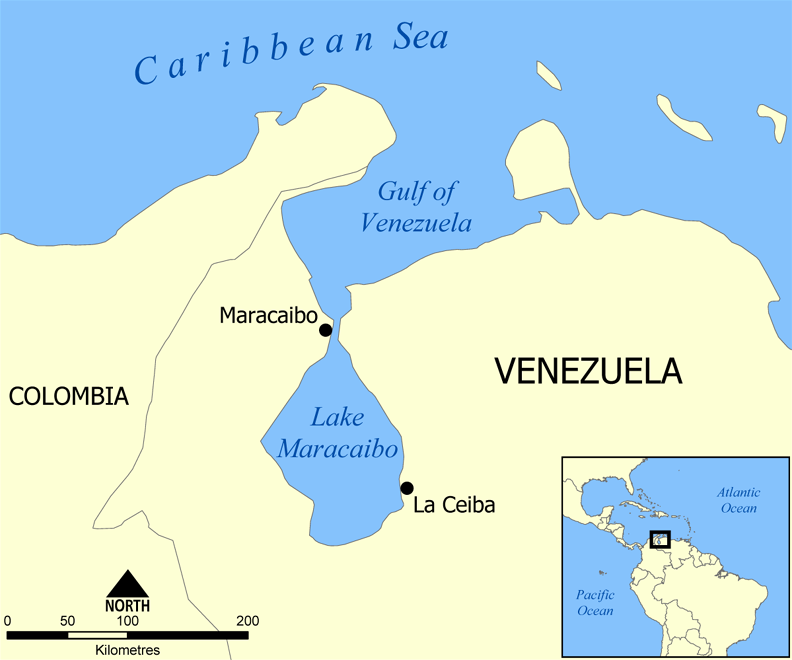
Catatumbo lightning usually develops between and , toward the west of Lake Maracaibo. The storms are thought to be the result of winds blowing across the lake and the surrounding swampy plains. These air masses meet the high mountain ridges of the Andes, the Perijá Mountains (3,750 m), and Mérida Cordillera, enclosing the plain from three sides. The heat and moisture collected across the plains create electrical charges and, as the air masses are destabilized by the mountain ridges, result in thunderstorm activity.
Cause
Russian researcher Andrei Zavrotsky investigated the area several times. He concluded that the lightning has several epicenters in the marshes of Juan Manuel de Aguas National Park, Claras Aguas Negras, and western Lake Maracaibo. In 1991, he suggested that the phenomenon occurred due to cold and warm air currents meeting around the area. The study also speculated that an isolated cause for the lightning might be the presence of uranium in the bedrock.
Between 1997 and 2000, a series of four studies proposed that the methane produced by the swamps and the massive oil deposits in the area were a major cause of the phenomenon. The methane model is based on the symmetry properties of methane. Other studies have indicated that this model is contradicted by the observed behavior of the lightning, as it would predict that there would be more lightning in the dry season (January–February), and less in the wet season (April–May and September–October).
A team from the Universidad del Zulia has investigated the impact of different atmospheric variables on Catatumbo lightning's daily, seasonal and year-to-year variability, finding relationships with the Inter-Tropical Convergence Zone (ITCZ), El Niño–Southern Oscillation (ENSO), the Caribbean Low-Level Jet, and the local winds and convective available potential energy (CAPE). Using satellite data, NASA counts that there are around 250 instances of lightning per km2.
Predictability
A 2016 study showed that it is possible to forecast lightning in the Lake Maracaibo basin up to a few months in advance, based on the variability of the Lake Maracaibo Low-Level Jet and its interactions with predictable climate modes like the ENSO and the Caribbean Low-Level Jet. The study also showed that the forecast accuracy is significantly higher when an index based on a combination of winds and convective available potential energy (CAPE) is used. The index seems to capture well the compound effect of multiple climate drivers.
Historical references
There are several references by colonial Portuguese and Spanish sources that name this phenomenon as "Lanterns of Saint Anthony" or the "Lighthouse of Maracaibo", as also noted by Alexander Walker in 1822. Based on M. Palacios book "Viage de Varinas", Prussian naturalist and explorer Alexander von Humboldt described the lightning in 1826. Italian geographer Agustin Codazzi described it in 1841 as "like a continuous lightning, and its position such that, located almost on the meridian of the mouth of the lake, it directs the navigators as a lighthouse."
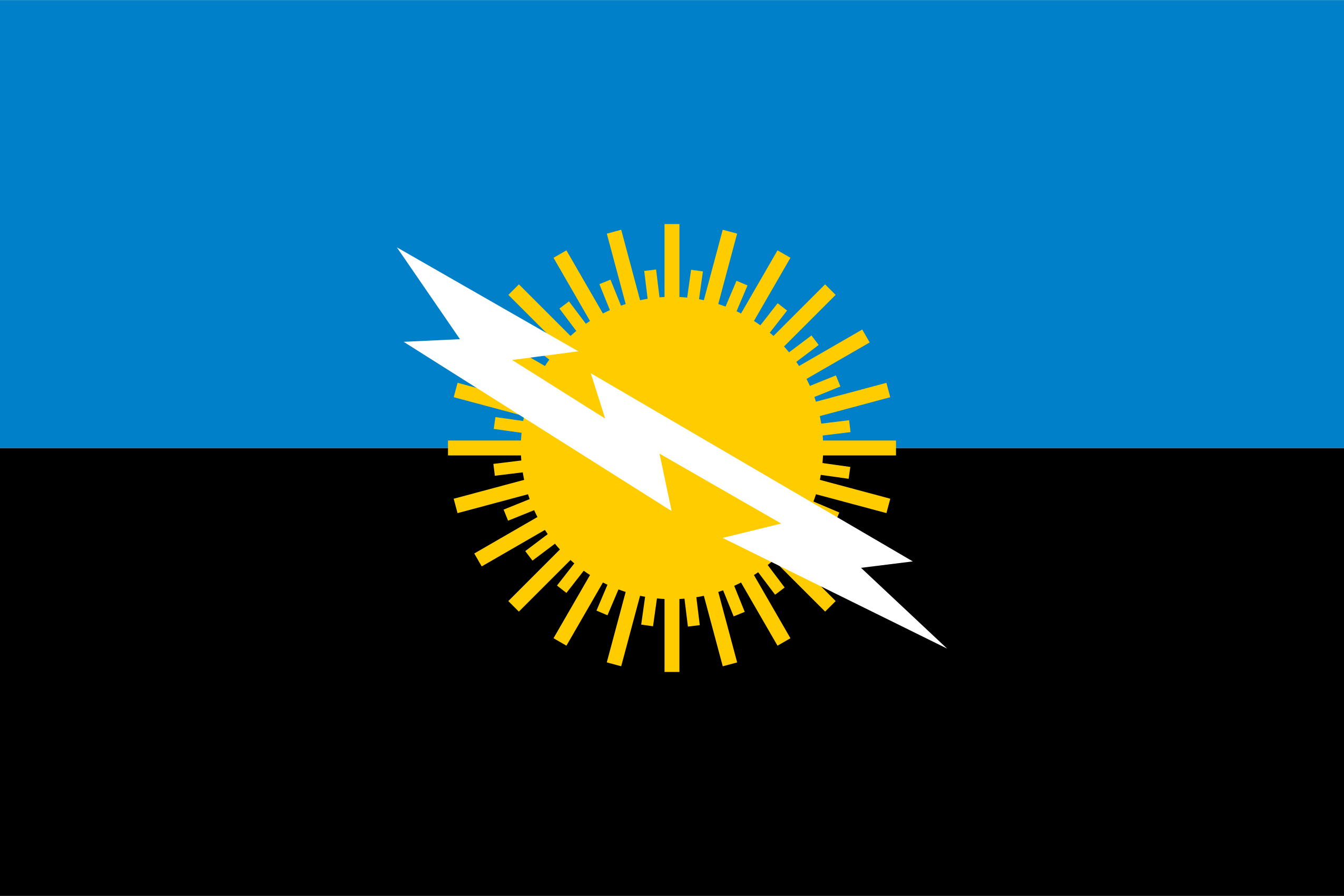
The phenomenon has been known to indigenous cultures (e.g., Wayuu, Yukpa, and Barí) for millennia and is believed to have always been there. It is incorporated into their cosmology. In Wayuu culture, the phenomenon is believed to be a signal from nature for respect and strength.[[File:Escudo Estado Zulia.png|thumb|upright=0.7|Coat of arms of Zulia. The lightning is on the right top quarter of the shield.]]
Cultural impact
Some authors have misinterpreted a reference to a glow in the night sky in Lope de Vega's description in his epic, "La Dragontea" of the attack against San Juan de Puerto Rico by Sir Francis Drake as an early literary allusion to the lightning (since in another verse the poet does mention Maracaibo), but it was actually a reference to the glow produced by burning ships during the battle.
References
References
- "Fogonazos: Catatumbo, the everlasting storm". Fogonazos.blogspot.com.
- "Catatumbo Lightning – Congo". Real Travel.
- (19 July 2022). "Eternal Thunder: This Place in Venezuela Has the Highest Concentration of Lightning Strikes in the World".
- Falcon, Nelson. (2021-05-21). "Review and Microphysics of the maximum electricity atmospheric activity in the Word: the Catatumbo Lightning (Venezuela)". Journal of Atmospheric Science Research.
- (2010-08-21). "Catatumbo Lightning". Wondermondo.
- Carroll, Rory. (5 March 2010). "Drought extinguishes Venezuela's lightning phenomenon". [[The Guardian]].
- Guttman, Matt. "Venezuela's Mysterious Catatumbo Lightning Phenomenon Vanishes for Months, Then Reappears". [[ABC News (United States).
- The phenomenon is characterized by almost continuous lightning, mostly within the clouds. The lightning produces a great quantity of [[ozone]], though whether or not this contributes to the [[Ozone layer. link. (2016-03-05. Agencia de noticias de la [[Universidad del Zulia]].)
- "In Venezuela, nature's most electrifying lightning show".
- Cárdenas, Yamile. (1997). "Una vida consagrada a los números".
- (2002-10-17). "Phenomena – A science salon hosted by National Geographic Magazine". Blogs.ngm.com.
- (2012). "Characterization of the lightning activity of "Relámpago del Catatumbo". Journal of Atmospheric and Solar-Terrestrial Physics.
- (2016). "Seasonal prediction of lightning activity in North Western Venezuela: Large-scale versus local drivers". Atmospheric Research.
- Muñoz, Á. G.; Díaz-Lobatón, J., 2011: "The Catatumbo Lightnings: A review", Memoirs of the XIV International Conference on Atmospheric Electricity. Brazil.
- (2010). "La corriente en chorro de bajo nivel sobre los Llanos Venezolanos de Sur América". Revista de Climatología.
- Muñoz, Á.G., Díaz-Lobatón, J., 2012: Los Relámpagos del Catatumbo y el Flujo Energético Medio en la Cuenca del Lago de Maracaibo. Reporte público CMC-GEO-DDI-02-2011. Centro de Modelado Científico. Universidad del Zulia. 12 p. En http://cmc.org.ve/portal/archivo.php?archivo=241
- Muñoz, Á.G., Núñez, A., Chourio, X., Díaz-Lobatón, J., Márquez, R., Moretto, P., Juárez, M., Casanova, V., Quintero, A., Zurita, D., Colmenares, V., Vargas, L., Salcedo, M.L., Padrón, R., Contreras, L., Parra, H., Vaughan, C., Smith, D., 2015: Reporte Final de la Expedición Catatumbo: Abril 2015. Reporte Público CMC-01-2015. Centro de Modelado Científico (CMC). Universidad del Zulia. 20 p. {{doi. 10.13140/RG.2.1.1351.0566
- Albrecht, R., et al., 2011. The 13 years of TRMM Lightning Imaging Sensor: from individual flash characteristics to decadal tendencies. XIV Int. Conf. Atmos. Elec., Rio de Janeiro, Brazil.
- (2016). "Where are the lightning hotspots on Earth?". Bulletin of the American Meteorological Society.
- (2016). "Seasonal prediction of lightning activity in Northwestern Venezuela: Large-scale versus local drivers". Atmospheric Research.
- Walker, Alexander (1822). «Part 1». Colombia, relación geográfica, topográfica, agrícola.
- Alexander von Humboldt and [[Aimé Bonpland]], ''[[Viage a las Regiones Equinocciales del Nuevo Continente]],'' volume 2, book V, chapter XVI, p. 390, note, Casa de Rosa, Paris, 1826; Ediciones del Ministerio de Educación, 2a. ed., Caracas, 1956.
- Codazzi Agustín, ''[[Resumen de la Geografía de Venezuela]]'', Fournier, Paris, 1841, pp. 20, 464 y 466.
- BBC Global. (2022-07-10). "The remote lake where lightning strikes 1.6 million times per year – BBC REEL".
- (2002-10-17). "Lightning Up, 4 Feb 2010". Blogs.ngm.com.
- Muñoz Garcia, Ángel Vicente. (July 2016). "Dislates y Disparates sobre el Relámpago del Catatumbo: La expedición de Drake, de 1595". Centro de Modelado Científico.
This article was imported from Wikipedia and is available under the Creative Commons Attribution-ShareAlike 4.0 License. Content has been adapted to SurfDoc format. Original contributors can be found on the article history page.
Ask Mako anything about Catatumbo lightning — get instant answers, deeper analysis, and related topics.
Research with MakoFree with your Surf account
Create a free account to save articles, ask Mako questions, and organize your research.
Sign up freeThis content may have been generated or modified by AI. CloudSurf Software LLC is not responsible for the accuracy, completeness, or reliability of AI-generated content. Always verify important information from primary sources.
Report