From Surf Wiki (app.surf) — the open knowledge base
Carpet bombing
Area bombardment technique
Area bombardment technique
Carpet bombing, also known as "saturation bombing" and "obliteration bombing", is a large area bombardment done in a progressive manner to inflict damage in every part of a selected area of land. Carpet bombing refers to a type of area bombing that aims to effect complete destruction of the target area by exploding bombs in every part of it. The phrase evokes the image of explosions completely covering an area, in the same way that a carpet covers a floor. Carpet bombing is usually achieved by dropping many unguided bombs.
The term "obliteration bombing” is sometimes used to describe especially intensified bombing with the intention of destroying a city or a large part of a city. The term "area bombing" refers to indiscriminate bombing of an area and also encompasses cases of carpet bombing, including obliteration bombing. It was used in that sense especially during World War II and the Korean War. Area bombing is contrasted with precision bombing. The latter is directed at a selected target – not necessarily a small, and not necessarily a tactical target, as it could be an airfield or a factory – and it does not intend to inflict widespread damage. The term “area bombing” came into prominence during World War II.
Carpet bombing of cities, towns, villages or other areas containing a concentration of protected civilians has been considered a war crime since 1977, through Article 51 of Additional Protocol I of the Geneva Conventions.
Early history
One of the first attempts at carpet bombing was at the Battle of El Mazuco during the Spanish Civil War in 1937, against widely-dispersed infantry on rocky slopes, and the attacking Condor Legion learned that carpet bombing was not very effective in such terrain.
In March 1938, the Bombing of Barcelona saw Italian and German airstrikes killing up to 1,300 people and wounding 2,000. It is considered the first carpet bombing of a city, and set a precedent for several such bombings in World War II.
The Japanese bombing of China's wartime capital Chongqing from 18 February 1938 to 23 August 1943 caused 23,600 deaths and over 30,000 wounded.
During World War II
Pre-war expectation
In the inter-war years, a growing expectation developed that, on the outbreak of war, cities would be rapidly destroyed by bombing raids. The use of poison gas was expected and a high level of devastation was anticipated from high explosive bombs. This originated, in part, from the views of military experts such as Douhet, and was taken up by politicians and journalists, with, for example, Stanley Baldwin coining the phrase "The bomber will always get through”. The targeting of the civilian population would, some theories suggested, cause a breakdown in morale that would lead to civil unrest that would compel a government to surrender. The combatant powers could, according to Baldwin, be in a competition to break the morale of the other side's civilian population first.
There were two results from this. Firstly, civil defence programs were set up, with gas masks being issued, plans for air raid shelters were set up and organizations to manage civilians before a raid and deal with damage and casualties after one were put in place. Secondly, agreements were sought to make the targeting of civilians illegal under international law. At the time that Douhet and others were publishing their ideas, no air force had planned their capabilities with the intent of making a "knockout blow" against civilian targets. The Hague Rules of Air Warfare were developed in 1922–23 to prevent deliberately attacking civilians, yet it was not ratified by any country. At the start of World War II, the Royal Air Force had an initial instruction to abide by the Hague Rules for as long as the enemy did. This restraint was followed by both Britain and Germany until 11 May 1940, when, with Winston Churchill now in the role of Prime Minister and the war in France going badly, the RAF attacked industrial and transport infrastructure targets in Mönchengladbach. This raid caused civilian casualties.
Bombing by Germany
In the European theatre, the first city to suffer heavily from aerial bombardment was Warsaw, on 25 September 1939 following the start of the German invasion of Poland. Continuing this trend in warfare, the Rotterdam Blitz was an aerial bombardment of Rotterdam by 90 bombers of the German air force on 14 May 1940, during the German invasion of the Netherlands. The objective was to support the German assault on the city, break Dutch resistance, and force the Dutch to surrender. Despite a ceasefire, the bombing destroyed almost the entire historic city centre, killing nearly nine hundred civilians and leaving 30,000 people homeless. The destructive success of the bombing led the Oberkommando der Luftwaffe (OKL, the Luftwaffe High Command) to threaten to destroy the city of Utrecht if the Dutch Government did not surrender. The Dutch capitulated early the next morning.
As the war progressed, the Battle of Britain developed from a fight for air supremacy into the strategic and aerial bombing of London, Liverpool, Coventry and other British cities.
Bombing by the Western Allies
At the beginning of war, RAF Bomber Command lacked both the navigation systems for finding a target and the numbers of bombers that were needed to make attacks of any scale in Germany.
The Nazis entered this war under the rather childish delusion that they were going to bomb everyone else, and nobody was going to bomb them. At Rotterdam, London, Warsaw, and half a hundred other places, they put their rather naive theory into operation. They sowed the wind, and now they are going to reap the whirlwind. Cologne, Lubeck, Rostock – Those are only just the beginning. We cannot send a thousand bombers a time over Germany every time, as yet. But the time will come when we can do so. Let the Nazis take good note of the western horizon. There they will see a cloud as yet no bigger than a man’s hand. But behind that cloud lies the whole massive power of the United States of America.
As heavy bombers were brought into service and technology and tactics were improved, the selection of targets was changed. The intention of avoiding civilian casualties as collateral damage disappeared. Instead, the civilian population which worked in war-related industries—and their housing—became the target.
Some of this change came from a wish to retaliate for the German attack on Coventry. It was also based on what was learnt from being the target in the Blitz. It had been found that factory buildings were more resistant to critical damage than the homes of their workers. Absenteeism of the workforce rose significantly if their housing was uninhabitable, so affecting industrial production. Whilst morale was still discussed, the meaning of the word changed from its pre-war usage. Now a reduction in morale was intended to reduce industrial production that supported the war effort. The area bombing directive was issued to RAF Bomber Command in 1942.
The Eighth Air Force of the USAAF arrived in Britain over the summer of 1942. Despite Roosevelt’s pleas to Hitler to avoid bombing civilians prior to the United States joining the war, he was a supporter of bombing Germany. Both Churchill and Roosevelt were in the position that Stalin was pressing for the Western Allies to open a new front in Europe, something which they were not ready to do. Therefore a bombing campaign—the Combined Bomber Offensive—following the Casablanca directive to the Allied air forces was all they could offer to support the Soviet Union.
Operation Gomorrah, carried out by Bomber Command against Hamburg, targeted a city with both high susceptibility to fire and a large number of factories making products for the German war effort. The raid caused substantial damage to the city, especially the housing of industrial workers. A carefully developed mix of high explosive bombs and incendiaries was used. High explosives broke windows and made fire-fighting dangerous, whilst the incendiaries set the buildings on fire. This methodology was used for further attacks on urban areas (though not with such major effect) throughout the war, with Dresden being one of the final targets.
Carpet bombing was also used as close air support (as "flying artillery") for ground operations. The massive bombing was concentrated in a narrow and shallow area of the front (a few kilometers by a few hundred meters deep), closely coordinated with the advance of friendly troops. The first successful use of the technique was on 6 May 1943, at the end of the Tunisia Campaign. Carried out under Sir Arthur Tedder, it was hailed by the press as Tedder's bomb-carpet (or Tedder's carpet). The bombing was concentrated in a four by three-mile area, preparing the way for the First Army. This tactic was later used in many cases in the Normandy Campaign; for example, in the Battle for Caen.
Pacific War
In the Pacific War, carpet bombing was used extensively against Japanese cities such as Tokyo. On the night of 9/10 March 1945, 334 B-29 Superfortress heavy bombers were directed to attack the most heavily populated civilian sectors of Tokyo. In just one night, over 100,000 people burned to death from a heavy bombardment of incendiary bombs, These attacks were followed by similar ones against Kobe, Osaka and Nagoya, as well as other sectors of Tokyo, where over 9,373 tons
During the final months of the war in the Philippines, the United States military used carpet bombing against the Japanese forces in Manila and Baguio, reducing much of the cities to rubble. Manila became the second-most-destroyed city of World War II.
Korean War
Main article: [Bombing of North Korea 1950-1953}}From June 1950, air forces of the [[United Nations Command]] began an extensive [Bombing of North Korea, [bombing campaign against North Korea]] that lasted until the end of the [[Korean War]] in July 1953. The American strategic bombing campaign destroyed 85 percent of North Korea’s buildings and 95 percent of its power generation.Harden, Blaine (2017). ''King of Spies: The Dark Reign of America's Spymaster in Korea''. New York, p. 9. Conventional weapons such as explosives, [Incendiary device, thumb, [Photo of bombing of Waegwan, 1950]]Between June and October 1950, USAF [Pacific Air Forces#Far East Air Forces, [Far East Air Force]] (FEAF) [Boeing B-29 Superfortress, [B-29 bombers]] carried out massive aerial attacks on transport centers and industrial hubs in North Korea. Having soon established air supremacy by the destruction of the [Korean People's Army Air Force, thumb
North Korea suffered heavy damage from US bombing. Major General William F. Dean, the highest-ranking American POW from the war, reported that the majority of North Korean cities and villages he saw were either rubble or snow-covered wasteland. North Korean factories, schools, hospitals, and government offices were forced to move underground, and air defenses were "non-existent”. North Korea ranks as among the most heavily bombed countries in history, as the US dropped a total of 635,000 tons of bombs (including 32,557 tons of napalm) on Korea, more than during the entire Pacific War.
Vietnam War
During the Vietnam War, with the escalating situation in Southeast Asia, 28 B-52Fs were fitted with external racks for twenty-four 750-pound (340 kg) bombs under project South Bay in June 1964; an additional 46 aircraft received similar modifications under project Sun Bath. In March 1965, the United States commenced Operation Rolling Thunder. The first combat mission, Operation Arc Light, was flown by B-52Fs on 18 June 1965, when thirty bombers of the 9th and 441st Bombardment Squadrons struck a communist stronghold near the Bến Cát District in South Vietnam. The first wave of bombers arrived too early at a designated rendezvous point, and while maneuvering to maintain station, two B-52s collided, which resulted in the loss of both bombers and eight crewmen. The remaining bombers, minus one more that turned back for mechanical problems, continued toward the target. Twenty-seven Stratofortresses dropped on a one-mile by two-mile target box from between 19,000 and, a little more than 50 percent of the bombs falling within the target zone. The force returned to Andersen AFB except for one bomber with electrical problems that recovered to Clark AFB, the mission having lasted thirteen hours. Post-strike assessment by teams of South Vietnamese troops with American advisors found evidence that the VC had departed the area before the raid, and it was suspected that infiltration of the South's forces may have tipped off the north because of the ARVN troops involved in the post-strike inspection.
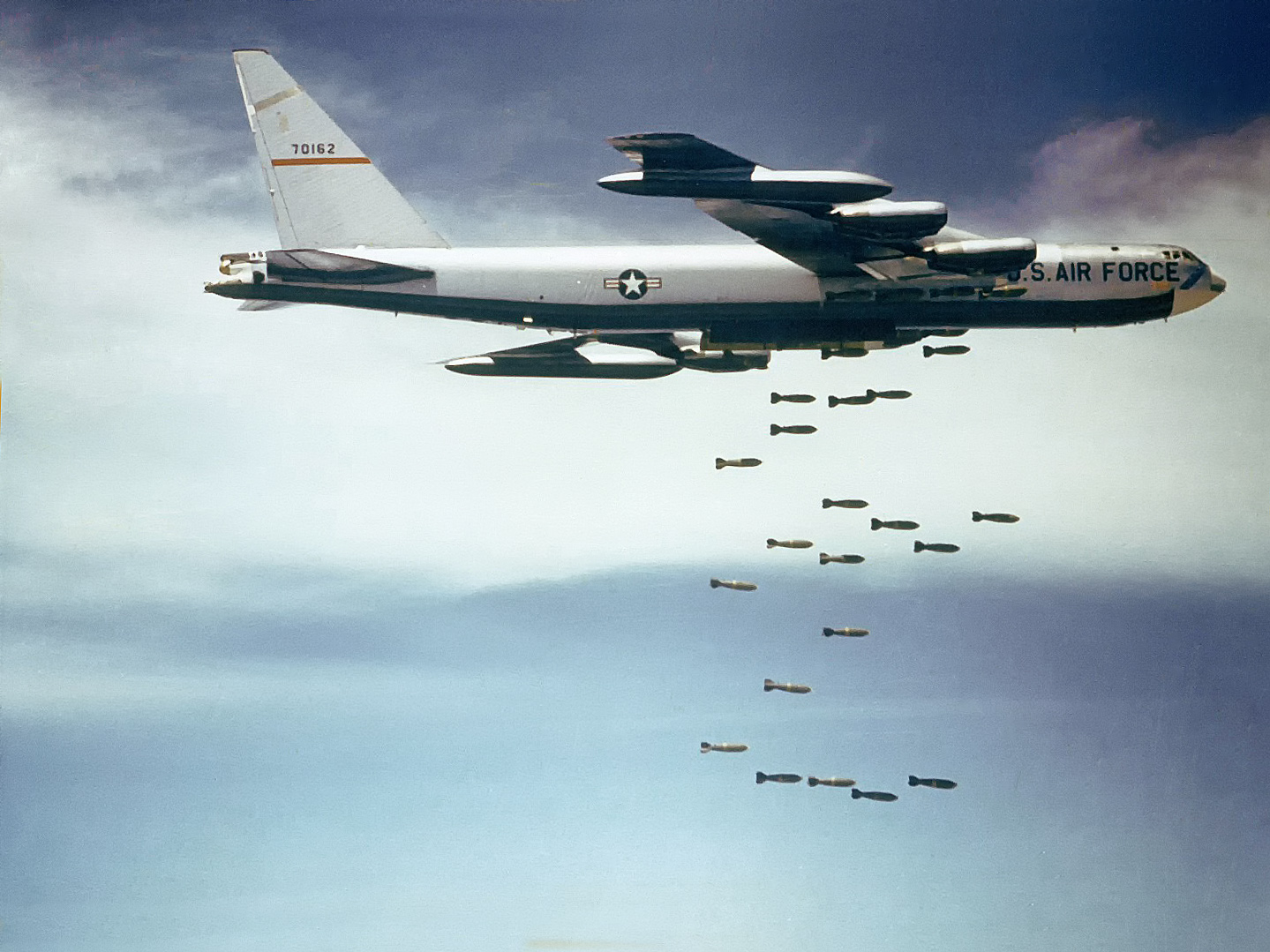
Beginning in late 1965, a number of B-52Ds underwent Big Belly modifications to increase bomb capacity for carpet bombings. While the external payload remained at twenty-four 500-pound (227 kg) or 750-pound (340 kg) bombs, the internal capacity increased from twenty-seven to eighty-four 500-pound bombs or from twenty-seven to forty-two 750-pound bombs. The modification created enough capacity for a total of 60,000 pounds (27,215 kg) in 108 bombs. Thus modified, B-52Ds could carry 22,000 pounds (9,980 kg) more than B-52Fs. Designed to replace B-52Fs, modified B-52Ds entered combat in April 1966 flying from Andersen Air Force Base, Guam. Each bombing mission lasted ten to twelve hours with an aerial refueling by KC-135 Stratotankers. In spring 1967, the aircraft began flying from U-Tapao Airfield in Thailand giving the aircraft the advantage of not requiring in-flight refueling.
The zenith of B-52 attacks in Vietnam was Operation Linebacker II (sometimes referred to as the Christmas Bombing) which consisted of waves of B-52s (mostly D models, but some Gs without jamming equipment and with a smaller bomb load). Over twelve days, B-52s flew 729 sorties and dropped 15,237 tons of bombs on Hanoi, Haiphong and other targets. Originally 42 B-52s were committed to the war; however, numbers were frequently twice this figure.
Gaza war
During the Gaza war that began in October 2023, the scale of Israeli airstrikes drew increasing international condemnation.
Notes
References
Bibliography
References
- Gooderson, Ian. (1997). "Air Power at the Battlefront: Allied Close Air Support in Europe, 1943–45". F. Cass.
- "Crimes of War – Carpet or Area Bombing".
- "Carpet bombing". [[Britannica.com]].
- (8 June 1977). "Treaties, States parties, and Commentaries - Additional Protocol (I) to the Geneva Conventions, 1977 - 51 - Protection of the civilian population". International Committee of the Red Cross (ICRC).
- "Treaties, States parties, and Commentaries - Additional Protocol (I) to the Geneva Conventions, 1977 - 51 - Protection of the civilian population - Commentary of 1987". International Committee of the Red Cross (ICRC).
- Juan Antonio de Blas, "El Mazuco (La defensa imposible)" (pp. 369–383), in ''La guerra civil en Asturias'', Ediciones Júcar, Gijón 1986.
- "El Mazuco (The Impossible Defense)".
- Thomas, Hugh. (2003). "The Spanish Civil War". Penguin.
- Bevan, Robert. (2016). "The Destruction of Memory: Architecture at War". Reaktion Books.
- Richards, Denis. (1975). "The Royal Air Force: 1939–1945 Volume II: The Fight Avails". H.M.S.O..
- Levine, Alan J.. (1992). "The Strategic Bombing of Germany: 1940–1945". Praeger.
- (10 March 2005). "Tokyo remembers 1945 bombing raid". BBC News.
- Colhoun, Jack. "Strategic Bombing". [[Institute for Energy and Environmental Research]].
- (17 August 2010). "Japan's Wartime Medical Atrocities: Comparative Inquiries in Science, History, and Ethics". Taylor & Francis.
- Selden, Mark. (2007). "A Forgotten Holocaust: US Bombing Strategy, the Destruction of Japanese Cities and the American Way of War from World War II to Iraq". The Asia-Pacific Journal: Japan Focus.
- (3 September 2019). "The Palgrave Handbook of Global Perspectives on Emotional Labor in Public Service". [[Springer Nature]].
- (December 2002). "Vestiges of War: The Philippine-American War and the Aftermath of an Imperial Dream 1899-1999". [[NYU Press]].
- (24 March 2015). "Economies under Occupation: The Hegemony of Nazi Germany and Imperial Japan in World War II". Routledge.
- (November 22, 2017). "Teacher Unions, Social Movements and the Politics of Education in Asia: South Korea, Taiwan and the Philippines". Routledge.
- Harden, Blaine (2017). ''King of Spies: The Dark Reign of America's Spymaster in Korea''. New York, p. 9.
- Robinson, Michael E.. (2007). "Korea's Twentieth-Century Odyssey". University of Hawaii Press.
- Crane, Conrad C.. (2000). "American Airpower Strategy in Korea, 1950-1953". University of Kansas Press.
- Kim, Taewoo. (2012). "Limited War, Unlimited Targets: U.S. Air Force Bombing of North Korea during the Korean War, 1950-1953". Critical Asian Studies.
- Conway-Lanz, Sahr. (15 September 2014). "The Ethics of Bombing Civilians After World War II: The Persistence of Norms Against Targeting Civilians in the Korean War". The Asia-Pacific Journal.
- Mark Peterson. (1 December 2009). "Brief History: Brief History of Korea". Facts on File.
- William F. Dean (1954) ''General Dean's Story'', (as told to William L. Worden), Viking Press, pp. 272–73.
- Armstrong, Charles. (20 December 2010). "The Destruction and Reconstruction of North Korea, 1950–1960". The Asia-Pacific Journal.
- (27 April 2015). "Making More Enemies than We Kill? Calculating U.S. Bomb Tonnages Dropped on Laos and Cambodia, and Weighing Their Implications". The Asia-Pacific Journal.
- Fisher, Max. (2015-08-03). "Americans have forgotten what we did to North Korea".
- Lake. ''International Air Power Review'' Summer 2003, p. 103.
- link. (17 June 2013 ''Chicago Tribune'', 18 June 1965.)
- "carpet-bombing". Memidex/WordNet Dictionary.
- (2010). "Terror from the sky : the bombing of German cities in World War II". Berghahn Books.
- Keane, Michael. (2005). "Dictionary of modern strategy and tactics". Naval Institute Press.
- Dickson, Paul. (2004). "War slang : American fighting words and phrases since the Civil War". Brassey's.
This article was imported from Wikipedia and is available under the Creative Commons Attribution-ShareAlike 4.0 License. Content has been adapted to SurfDoc format. Original contributors can be found on the article history page.
Ask Mako anything about Carpet bombing — get instant answers, deeper analysis, and related topics.
Research with MakoFree with your Surf account
Create a free account to save articles, ask Mako questions, and organize your research.
Sign up freeThis content may have been generated or modified by AI. CloudSurf Software LLC is not responsible for the accuracy, completeness, or reliability of AI-generated content. Always verify important information from primary sources.
Report