From Surf Wiki (app.surf) — the open knowledge base
Carmenta
Roman goddess of childbirth and prophecy
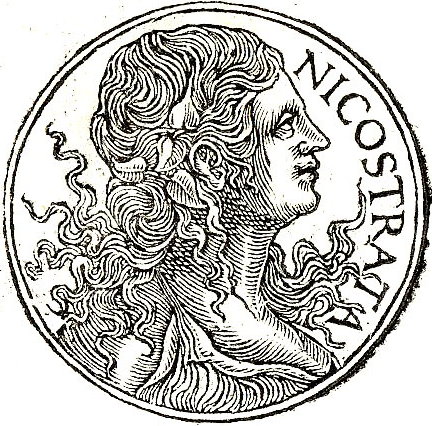
Roman goddess of childbirth and prophecy
| Field | Value |
|---|---|
| type | Roman |
| name | Carmenta |
| deity_of | Goddess of childbirth and prophecy, protector of mothers and children, patron of midwives, inventor of the alphabet |
| member_of | the Camenae |
| image | Nycostrata - Les vies des femmes célèbres d'Antoine Dufour.jpg |
| alt | |
| caption | Nicostrata-Carmenta inventing the Latin alphabet (Antoine Dufour, 1504) |
| other_names | Nicostrate |
| cult_center | a shrine near the Porta Carmentalis |
| offspring | Evander of Pallantium |
| gender | female |
| festivals | Carmentalia |
In ancient Roman religion and myth, Carmenta (Greek) or Carmentis (Latin) was a goddess of childbirth and prophecy, associated with technological innovation, specifically, the invention or adaptation of the Latin alphabet as well as the protection of mothers and children and a patron of midwives.
Background

The name Carmenta is derived from Latin carmen, meaning a magic spell, oracle or song, and also the root of the English word charm. Her original name was Nicostrate (, "victory-army"), but it was changed later to honor her renown for giving oracles (Latin singular: carmen). She was the mother of Evander of Pallene (fathered by Hermes) and, along with other Greek followers, they founded the town of Pallantium which later was one of the sites of the start of Rome. Gaius Julius Hyginus (Fab. 277) mentions the legend that it was she who altered fifteen letters of the Greek alphabet to become the Latin alphabet which her son Evander introduced into Latium. Carmenta was one of the Camenae and the Cimmerian Sibyl. The leader of her cult was called the flamen carmentalis.
It was forbidden to wear leather or other forms of dead skin in her temple which was next to the Porta Carmentalis, and close to the Theater of Marcellus in Rome. Her festival, called the Carmentalia, was celebrated primarily by women on January 11 and January 15. She is remembered in De Mulieribus Claris, a collection of biographies of historical and mythological women by the Florentine author Giovanni Boccaccio, composed in 136162. It is notable as the first collection devoted exclusively to biographies of women in Western literature.
References
Primary sources
- Ovid, Fasti i.461-542
- Servius, In Aeneida viii.51
- Solinus, Collectanea rerum memorabilium i.10, 13
Secondary sources
- The Dictionary of Classical Mythology by Pierre Grimal, page 89 "Carmenta"
- The Book of the City of Ladies, by Christine de Pizan, section I.33.2
- The Lincoln Beacon, Lincoln, Kansas, United States of America "Carmenta" 16 September 1880.
References
- "Samuel Ball Platner, Thomas Ashby, A Topographical Dictionary of Ancient Rome, CARMENTIS".
- Archive, History. "Language {{!}} Latin Alphabet".
- [[Livy]]. "[[History of Rome (Livy)".
- Brandt, J. Rasmus. (2012-08-30). "Greek and Roman Festivals: Content, Meaning, and Practice". OUP Oxford.
- Boccaccio, Giovanni. (2003). "Famous Women". Harvard University Press.
This article was imported from Wikipedia and is available under the Creative Commons Attribution-ShareAlike 4.0 License. Content has been adapted to SurfDoc format. Original contributors can be found on the article history page.
Ask Mako anything about Carmenta — get instant answers, deeper analysis, and related topics.
Research with MakoFree with your Surf account
Create a free account to save articles, ask Mako questions, and organize your research.
Sign up freeThis content may have been generated or modified by AI. CloudSurf Software LLC is not responsible for the accuracy, completeness, or reliability of AI-generated content. Always verify important information from primary sources.
Report