From Surf Wiki (app.surf) — the open knowledge base
Carigara
Municipality in Leyte, Philippines

Municipality in Leyte, Philippines
| Field | Value | |
|---|---|---|
| name | ||
| image_skyline | Carigara, Leyte Downtown Area.jpg | |
| image_caption | Downtown Area (Real St.) | |
| image_flag | Flag_of_Carigara,_Leyte.png | |
| flag_size | 120x80px | |
| image_seal | Carigara, Leyte Official Seal.png | |
| seal_size | 100x80px | |
| image_map | ||
| map_caption | ||
| mapframe | yes | |
| pushpin_map | Philippines | |
| pushpin_label_position | right | |
| pushpin_map_caption | Location within the | |
| coordinates | ||
| settlement_type | ||
| subdivision_type | Country | |
| subdivision_name | Philippines | |
| subdivision_type1 | Region | |
| subdivision_name1 | ||
| subdivision_type2 | Province | |
| subdivision_name2 | ||
| official_name | ||
| etymology | *Kan Gara* to *Kalgara* | |
| named_for | Datu Gara | |
| other_name | ||
| subdivision_type3 | District | |
| subdivision_name3 | ||
| established_title | Founded | |
| established_date | ||
| parts_type | Barangays | |
| parts_style | para | |
| p1 | (see Barangays) | |
| leader_title | Mayor | |
| leader_name | Eduardo "Ed" T. Ong Jr. | |
| leader_title1 | Vice Mayor | |
| leader_name1 | Jimmy A. Camposano | |
| leader_title2 | Representative | |
| leader_name2 | Lolita T. Javier | |
| leader_title3 | Councilors | |
| leader_name3 | {{Collapsible list | |
| title | List | |
| frame_style | border:none; padding: 0; | |
| list_style | text-align:left;display:none; | |
| 1 | • Joenlee C. Larraga | |
| 2 | • Anabella N. Crisostomo | |
| 3 | • Mildred C. Modesto | |
| 4 | • Raul Z. Lloren | |
| 5 | • Lorna A. Marpa | |
| 6 | • Joselu N. Guia | |
| 7 | • Kim Anthony G. Agner | |
| 8 | • Leny T. Ong | |
| 9 | [DILG Masterlist of Officials](https://bis.dilg.gov.ph/bops/default/master?psgc=08) | |
| leader_title4 | Electorate | |
| leader_name4 | voters (electorate_point_in_time}} | ) |
| government_type | ||
| government_footnotes | ||
| elevation_m | ||
| elevation_max_m | 1267 | |
| elevation_min_m | 0 | |
| elevation_footnotes | ||
| area_footnotes | ||
| area_total_km2 | ||
| population_footnotes | ||
| population_total | ||
| population_as_of | ||
| population_density_km2 | auto | |
| population_blank1_title | Households | |
| population_blank1 | ||
| population_demonym | **Carigaran-on** | |
| *Kalgaran-on* | ||
| (*vernacular term*) | ||
| timezone | PST | |
| utc_offset | +8 | |
| postal_code_type | ZIP code | |
| postal_code | ||
| postal2_code_type | ||
| postal2_code | ||
| area_code_type | ||
| area_code | ||
| website | ||
| demographics_type1 | Economy | |
| demographics1_title1 | ||
| demographics1_info1 | ||
| demographics1_title2 | Poverty incidence | |
| demographics1_info2 | % () | |
| demographics1_title3 | Revenue | |
| demographics1_info3 | ||
| demographics1_title4 | Revenue rank | |
| demographics1_title5 | Assets | |
| demographics1_info5 | ||
| demographics1_title6 | Assets rank | |
| demographics1_title7 | IRA | |
| demographics1_title8 | IRA rank | |
| demographics1_title9 | Expenditure | |
| demographics1_info9 | ||
| demographics1_title10 | Liabilities | |
| demographics1_info10 | ||
| demographics_type2 | Service provider | |
| demographics2_title1 | Electricity | |
| demographics2_info1 | ||
| demographics2_title2 | Water | |
| demographics2_info2 | Metro Carigara Water District (MCWD) | |
| demographics2_title3 | Telecommunications | |
| demographics2_info3 | Bayan Telecommunications, Globe Telecom, Smart Communications, Dito Telecommunity | |
| demographics2_title4 | Cable TV | |
| demographics2_info4 | G Sat, Sky Direct, Cignal, SatLite | |
| blank_name_sec1 | ||
| blank_info_sec1 | ||
| blank1_name_sec1 | Native languages | |
| blank1_info_sec1 | ||
| blank2_name_sec1 | Crime index | |
| blank1_name_sec2 | Religion | |
| blank1_info_sec2 | [[File:AP Icon.svg | 18px]] Christianity, *with other minorities* |
| blank2_name_sec2 | Local Feast | |
| blank2_info_sec2 | Magara Festival | |
| blank3_name_sec2 | Feast Date | |
| blank3_info_sec2 | every 16th day of July | |
| blank4_name_sec2 | Patron saint |
Kalgaran-on (vernacular term)
Carigara (), officially the Municipality of Carigara (; ), is a First Income Class municipality in the province of Leyte, Philippines. According to the 2020 census, it has a population of 54,656 people.
Established in 1571, Carigara is the first town founded in the Eastern Visayas region. A pivotal development occurred in 1735 when Leyte and Samar were separated from Cebu province, forming a unified provincial governance structure with Carigara serving as provincial capital during this era.
Carigara is renowned for its distinct offerings, including pastillas, humba, sundang (machete), and the hubhob delicacy. Hubhob, a local delight, is crafted from grated cassava, eggs, kalamay, milk, and sugar, cooked within a bagacay (bamboo pole) over charcoal, bringing a unique and flavorful taste to this traditional specialty.
History
Carigara was originally known as "Kan Gara," which translates to "that of Gara" or simply "Gara's." Legend has it that Gara hailed from Borneo and was among the unnamed companions of the ten datus who purchased Panay from the Ati (or Aeta) chief Marikudo. Over time, "Kan Gara" transformed into Kalgara for ease of pronunciation. Upon the arrival of the Spaniards, the place was renamed to Carigara, thus its present spelling.
Carigara celebrates its festival every 16 July, marking the arrival of the Spaniards on July 16, 1569. This festivity, spanning nearly the entire month of July, attracts tourists and visitors from nearby towns.
Carigara's Attempt for a World Record
On July 14, 2018, Carigara made a bold attempt to secure the Guinness World Records for the "Largest Participants in Philippine Folk Dance," showcasing the Kuratsa. This event formed a part of the town's 423rd fiesta celebration slated for July 16, instilling a sense of pride among the locals and fostering hopes for an economic and tourism upsurge. The event boasted nearly 5,000 participants, predominantly comprising students, teachers from various schools, municipal employees, representatives from the private sector, and residents. Carigara had promptly submitted its bid and eagerly awaited official confirmation.
Geography
Geography
It is located in the northern part of Leyte province on the coast of Carigara Bay, surrounded by rice fields and mountains.
Carigara shares borders with Capoocan to the west, Ormoc to the south, Jaro to the southeast, Tunga to the east and Barugo to the northeast.
Flora and Fauna
''Flora''
The climatic and topographical characteristics of Carigara's expansive terrain, encompassing wide rice fields and hilly landscapes, create an optimal environment for cultivating fruit-bearing trees, vegetables, and a variety of crops. Noteworthy trees suitable for cultivation include bananas, coconuts, jackfruits, mangoes, guavas, rambutans, santol, and star apples. In terms of vegetables, gabi, karubasa, pipino, kamalunggay, marigoso, munggos, sitaw, and upo are extensively grown by local farmers and residents, thriving exceptionally well within the community. Additionally, root crops like kamote and balanghoy flourish alongside rice crops, constituting a substantial part of the agricultural landscape in Carigara.
''Fauna''
Carigara features vast highland forests and a diverse fauna, including domesticated animals like carabaos, horses, cats, dogs, chickens, and pigs. The area is home to snakes, frogs, insects, various lizards, and a variety of birds, among other wildlife species.
Barangays
Carigara is politically subdivided into 49 barangays. Each barangay consists of puroks and some have sitios.
- Bagong Lipunan
- Balilit
- Barayong
- Barugohay Central
- Barugohay Norte
- Barugohay Sur
- Baybay (Poblacion)
- Binibihan
- Bislig
- Caghalo
- Camansi
- Canal
- Candigahub
- Canfabi
- Canlampay
- Cogon
- Cutay
- East Visoria
- Guindapunan East
- Guindapunan West
- Hiluctogan
- Jugaban (Poblacion)
- Libo
- Lower Hiraan
- Lower Sogod
- Macalpi
- Manloy
- Nauguisan
- Paglaum
- Pangna
- Parag-um
- Parena (Parina)
- Piloro
- Ponong (Poblacion)
- Rizal (Tagak East)
- Sagkahan
- San Isidro
- San Juan
- San Mateo (Poblacion)
- Santa Fe
- Sawang (Poblacion)
- Tagak
- Tangnan
- Tigbao
- Tinaguban
- Upper Hiraan
- Upper Sogod
- Uyawan
- West Visoria
Climate
| access-date = 9 February 2020 }}
Demographics

In the 2020 census, the population of Carigara, Leyte, was 54,656 people, with a density of {{sigfig|54,656/117.86|2}} PD/km2.
Language
The predominant language in the municipality is Waray-waray, with Cebuano and Tagalog recognized as minority languages. English functions as the official language, often mixed with Waray in colloquial exchanges. Although Spanish maintains residual relevance, it is not used in verbal or day-to-day communication.
Religion
Carigara is mostly Christian due to Spanish Empire's rule. Due to economic migrations, there are other people from minority religions that reside in Carigara for improved economic conditions and standard of living.
Government
Main article: Sangguniang Bayan
| Position | Name | Party | *Ex Officio* Municipal Council Members |
|---|---|---|---|
| **Mayor** | Eduardo T. Ong Jr. | ||
| **Vice Mayor** | Jimmy A. Camposano | ||
| **Councilors** | Fernando N. Moriel | ||
| Vilma M. Domus | |||
| Mildred C. Modesto | |||
| Carlo Angelo B. Go | |||
| Ulpiano U. Arpon Jr. | |||
| Joenlee C. Larraga | |||
| Myla L. Aguilar | |||
| Guillermo I. Panal | |||
| **ABC President** | TBD | ||
| **SK Federation President** | TBD |
Economy
Culture
Festival

On January 25, 2019, Carigara commemorated its inaugural festival, the Magara Festival, coinciding with its 448th founding anniversary. Magara locally connotes abundance, elegance, and vibrancy. The inaugural Magara Festival primarily centered on celebrating the town's agricultural richness, local products, historical heritage, and its community.
Events
Turugpo is a significant public spectacle featuring duels between two male carabaos or two male horses, occurring annually on Black Saturday. This widely attended event garners immense popularity within the town, drawing thousands of both local and international tourists eager to witness this renowned and culturally significant fight.{{cite web|url=https://www.sunstar.com.ph/ampArticle/65719
Tourism
List of some tourist attractions in Carigara.
Attractions include:
- Lauron's Boulevard (Brgy. Baybay & Ponong) This is the place where people can buy street foods like isaw, pork barbecues, and many more.
- Carigara Municipal Library and Museum (Brgy. Baybay)
- Cassidy Elementary School (Brgy. Ponong) A school famous for its classical-style building.
- Datu Gara Shrine (Brgy. Canal)
- Gawas an Harigue (Brgy. Baybay) An old house with exposed posts on the sides.
- Heroes Shrine (Brgy. Baybay & Ponong) Located right between Carigara Boulevard and the Kan Gara Gymnasium.
- Kan Gara Gymnasium (Brgy. Ponong) The largest gymnasium.
- Lumen Ancestral House (Brgy. Sawang) The only house in the town which serves as a shelter for balinsasayaos.
- Plaza Triunfo (Brgy. Ponong) The largest plaza.
- St. Francis Assisi Parish (Brgy. Jugaban)
Infrastructures
Transportation
Land Transport
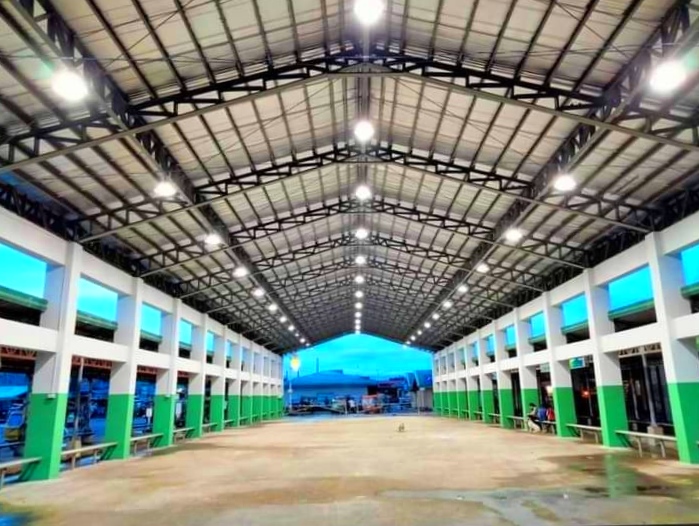
- Pedicabs are the common mode of transportation within the town proper.
- Tricycles and habal-habals are commonly used for travelling to the far-flung barangays.
- Vans, jeepneys and buses are the go-to mode of transport when travelling to the cities of Tacloban and Ormoc or to municipalities that are faraway from the town. There are a few bus companies located in Carigara.
New modernized PUVs that travel from Carigara to Tacloban and vice versa are being issued by the local government starting from 24 November 2021.
Sea Transport

Carigara has a port located in Barangay Baybay where local boats and ships dock.
Healthcare Service
Carigara District Hospital, commonly referred to as CDH, serves as the sole public hospital in the town. Residents from neighboring towns also visit the hospital to seek additional medical services and attention.
Utilities
- Electricity: Leyte III Electric Cooperative, Inc. (LEYECO 3), provides Carigara with electricity to residents and businesses.
- Water Supply: Water services are managed by the Metro Carigara Water District (MCWD).
- Telecommunications: Bayan Telecommunications, Globe Telecom, Smart Communications, and Dito Telecommunity, operate in Carigara and offers a range of services such as mobile, internet, and landline connections.
- Cable Television: G Sat, Sky Direct, Cignal, and SatLite, offers a variety of local and international channels.
Education
There are a total of 30 elementary schools, 6 high schools (1 private, 4 public, 1 pending construction) and 2 college institutions located on Carigara.
Grade School/Elementary School
- Balilit Elementary School
- Barugohay Norte Elementary School
- Barugohay Sur Elementary School
- Binibihan Elementary School
- C.A.T.A.M.C.S. (Cong. Alberto T. Aguja Memorial Central School)
- Caghalo Elementary School
- Camansi Elementary School
- Candigahub Elementary School
- Canfabi ES (Santa Fe ES)
- Canlampay Elementary School
- Carigara II CS
- Cassidy Central School (Cassidy Elementary School)
- Cogon Elementary School
- Guindapunan Elementary School
- Hiluctogan Elementary School
- Hira-an Elementary School
- M. Morales Memorial Elementary School
- Macalpi Elementary School
- Manloy Elementary School
- Nauguisan Elementary School
- Pangna Elementary School
- Parag-um Elementary School
- Ponong Elementary School
- Sagkahan Elementary School
- Sogod Elementary School
- Santa Fe Elementary School
- Tagak Elementary School
- Tigbao Elementary School
- Tinaguban Elementary School
- Uyawan Elementary School
Secondary School/High School
- Carigara National High School
- Carigara National Vocational School (formerly Carigara School of Fisheries)
- Jugaban National High School
- Sogod National High School
- Parag-um National High School (soon)
College/University
- Eastern Visayas State University (Carigara Campus)
- Holy Cross College of Carigara (Formerly Holy Cross Academy) located at Brgy Ponong (Pob)
Notable personalities
- Eduardo Makabenta Sr. - Waray-language poet and translator
- Mike Hanopol - musician, singer-songwriter
Gallery
| Century-old houses in Brgy. Jugaban, Carigara, Leyte | Gawas an Harigue | Carigara Municipal Library and Museum |
|---|
| Cassidy Central School | Plaza Triunfo | Carigara Tide Embankment |
|---|
References
References
- {{DILG detail
- (14 July 2018). "Carigara attempts Guinness' largest participants in folk dance".
- (24 January 2019). "Oldest town in Leyte holding first official festival".
- (27 March 2016). ""No animal cruelty" in Turugpo".
- "Schools Directory | Trokis Philippines". School Torkis Directory.
- (1995). "Tinipigan: An Anthology of Waray Literature". National Commission for Culture and the Arts.
This article was imported from Wikipedia and is available under the Creative Commons Attribution-ShareAlike 4.0 License. Content has been adapted to SurfDoc format. Original contributors can be found on the article history page.
Ask Mako anything about Carigara — get instant answers, deeper analysis, and related topics.
Research with MakoFree with your Surf account
Create a free account to save articles, ask Mako questions, and organize your research.
Sign up freeThis content may have been generated or modified by AI. CloudSurf Software LLC is not responsible for the accuracy, completeness, or reliability of AI-generated content. Always verify important information from primary sources.
Report