From Surf Wiki (app.surf) — the open knowledge base
Carboxylate
Chemical group (RCOO); conjugate base of a carboxylic acid
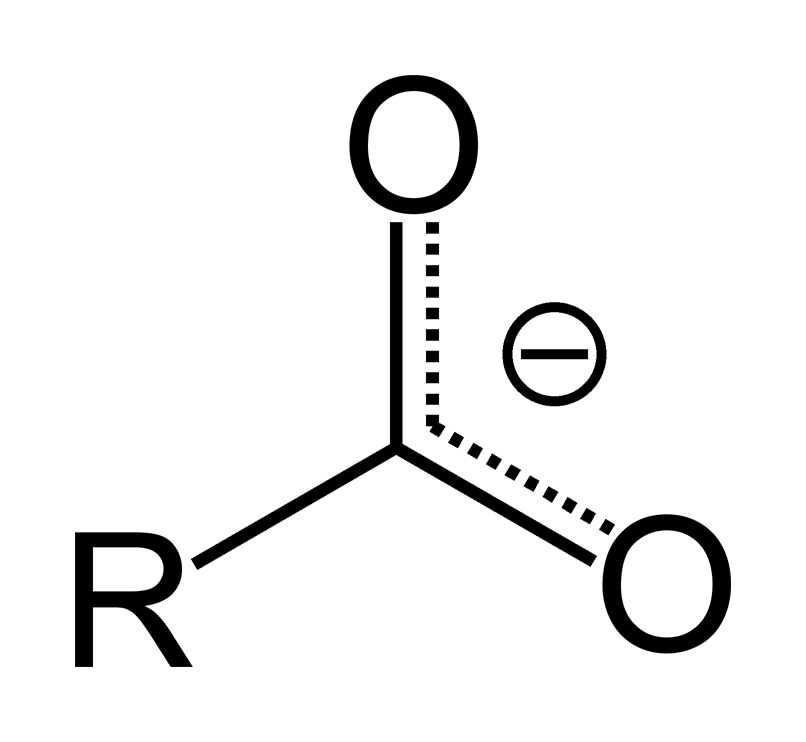
Chemical group (RCOO); conjugate base of a carboxylic acid

In organic chemistry, a carboxylate is the conjugate base of a carboxylic acid, (or ). It is an anion, an ion with negative charge.
Carboxylate salts are salts that have the general formula , where M is a metal and n is 1, 2,.... Carboxylate esters have the general formula (also written as ), where R and R′ are organic groups.
Synthesis
Carboxylate ions can be formed by deprotonation of carboxylic acids. Such acids typically have pKa of less than 5, meaning that they can be deprotonated by many bases, such as sodium hydroxide or sodium bicarbonate.
:
Resonance stabilization of the carboxylate ion
Carboxylic acids easily dissociate into a carboxylate anion and a positively charged hydrogen ion (proton), much more readily than alcohols do (into an alkoxide ion and a proton), because the carboxylate ion is stabilized by resonance. The negative charge that is left after deprotonation of the carboxyl group is delocalized between the two electronegative oxygen atoms in a resonance structure. If the R group is an electron-withdrawing group (such as –CF3), the basicity of the carboxylate will be further weakened.
:[[File:Carboxylate-resonance-2D.png|400px|Equivalence of the resonance forms the delocalised form of a general carboxylate anion]]
This delocalization of the electron means that both of the oxygen atoms are less strongly negatively charged: the positive proton is therefore less strongly attracted back to the carboxylate group once it has left; hence, the carboxylate ion is more stable and less basic as a result of resonance stabilization of the negative charge. In contrast, an alkoxide ion, once formed, would have a strong negative charge localized on its lone oxygen atom, which would strongly attract any nearby protons (indeed, alkoxides are very strong bases). Because of resonance stabilization, carboxylic acids have much lower pKa values (and are therefore stronger acids) than alcohols. For example, the pKa value of acetic acid is 4.8, while ethanol has a pKa of 16. Hence acetic acid is a much stronger acid than ethanol. This in turn means that for equimolar solutions of a carboxylic acid or an alcohol in water, the carboxylic acid would have a much lower pH.
Reactions
Alkyation
Carboxylic acid salts with a hydrogen atom in the alpha position next to the carboxylate group can be converted to dianions with strong bases like lithium diisopropylamide. These react with alkyl halides to give derivatives:
: :
Nucleophilic substitution
Carboxylate ions are good nucleophiles. They react with alkyl halides to form esters. The following reaction shows the reaction mechanism.
The nucleophilicity of carboxylate ions is much weaker than that of hydroxide and alkoxide ions, but stronger than that of halide anions (in a polar aprotic solvent, though there are other effects such as solubility of the ion).
Reduction
Unlike the reduction of ester, the reduction of carboxylate is different, due to the lack of the leaving group and the relatively electron-rich carbon atom (due to the negative charge on the oxygen atoms). With a small amount of acid, the reaction occurs with lithium aluminium hydride by changing the LAH into the Lewis acid AlH3 in the process, converting the oxyanion to 4 Al–O bonds.


Examples
This list is for cases where there is a separate article for the anion or its derivatives. All other organic acids should be found at their parent carboxylic acid.
- Formate ion, HCOO−
- Acetate ion, CH3COO−
- Methanetetracarboxylate ion, C(COO−)4
- Oxalate ion,
References
References
- {{March4th
This article was imported from Wikipedia and is available under the Creative Commons Attribution-ShareAlike 4.0 License. Content has been adapted to SurfDoc format. Original contributors can be found on the article history page.
Ask Mako anything about Carboxylate — get instant answers, deeper analysis, and related topics.
Research with MakoFree with your Surf account
Create a free account to save articles, ask Mako questions, and organize your research.
Sign up freeThis content may have been generated or modified by AI. CloudSurf Software LLC is not responsible for the accuracy, completeness, or reliability of AI-generated content. Always verify important information from primary sources.
Report