From Surf Wiki (app.surf) — the open knowledge base
Caput succedaneum
Scalp swelling in newborns due to pressure during birth
Scalp swelling in newborns due to pressure during birth
| Field | Value |
|---|---|
| name | Caput succedaneum |
| image | Scalp hematomas.jpg |
| caption | Newborn Scalp bleeds |
It involves bleeding below the scalp and above the periosteum.
Etiology
Risk factors for development of caput succedaneum include vertex presentation, vacuum-assisted delivery, forceps-assisted delivery, prolonged labor, maternal nulliparity, oligohydramnios, premature rupture of membranes, and macrosomia. The cause of the fluid collection is due to pressure on the fetal scalp by the vaginal walls and uterus during vaginal delivery. As one side of the infant's head is compressed during delivery, blood and lymph flow to the compressed side is obstructed. As a result, blood and lymph flow to the scalp opposite the side being compressed is unable to flow appropriately. This leads to blood and lymph accumulation, causing distension opposite the side of compression.
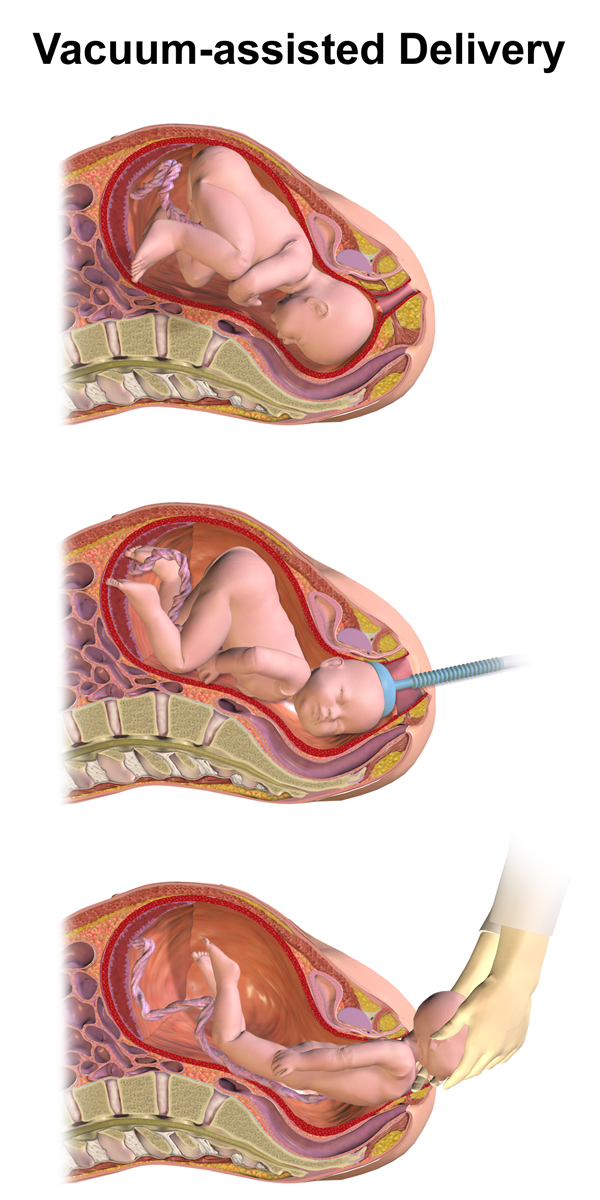
In the setting of vacuum-assisted delivery, a cup connected to vacuum pressure is placed onto the infant's scalp and used to provide extra pulling force on the head to assist with the birthing process during difficult or prolonged labor. The pressure from the vacuum along with the pulling force leads to injury and resultant swelling. This swelling is called a chignon, an artificial caput succedaneum.[[File:Caput succedaneum.jpg|thumb|Close-up of a newborn with caput succedaneum|left]]
Presentation
Caput succedaneum typically presents as a soft, boggy, uneven mass that crosses cranial suture lines. The size of the caput is typically 1-2 cm deep with a varying circumference dependent on degree of injury. Petechiae, purpura, and ecchymoses (bruises) may also be present. Since the fluid collection is not bound by suture lines, the swelling will shift with gravity as the baby's head is repositioned.
Complications
Complications are rare with development of caput succedaneum. Possible complications include scarring, jaundice from ongoing red blood cell breakdown within the fluid collection, and halo scalp ring alopecia, a temporary form of alopecia resulting from prolonged pressure on the scalp during delivery.
Treatment and Prognosis
Caput succedaneum is a benign, self-limited condition with typical treatment reserved to observation of the swelling and its resolution. Medical intervention is generally not required. Parents should be reassured that the condition is self-limited and not associated with any significant complications. Most cases will self-resolve within 48 hours after birth without any significant adverse long-term effects.
For infants with a large caput succedaneum that either does not resolve within 48 to 72 hours after birth or enlarges more than 24 hours after birth, imaging studies for further evaluation are indicated. Imaging studies are also appropriate for infants with caput succedaneum with worsening neurological status (e.g., decreased activity, trouble feeding, increased irritability) or those with signs of hemodynamic instability (e.g., low blood pressure, abnormal heart rate, blue skin color, cold skin, loss of consciousness).
References
References
- Nicholson, Lisa. (2007). "Caput Succedaneum and Cephalohematoma: The Cs that Leave Bumps on the Head". Neonatal Network.
- Diane Fraser. (9 April 2009). "Myles Textbook for Midwives". Elsevier Health Sciences.
- (2017-12-12). "Neurological Neonatal Birth Injuries: A Literature Review". Cureus.
- (2002-02-01). "Halo Scalp Ring: A Case Series and Review of the Literature". Archives of Pediatrics & Adolescent Medicine.
- (2024). "Caput Succedaneum". StatPearls Publishing.
- "Neurological disorders in newborns".
- "Hemodynamic Instability".
This article was imported from Wikipedia and is available under the Creative Commons Attribution-ShareAlike 4.0 License. Content has been adapted to SurfDoc format. Original contributors can be found on the article history page.
Ask Mako anything about Caput succedaneum — get instant answers, deeper analysis, and related topics.
Research with MakoFree with your Surf account
Create a free account to save articles, ask Mako questions, and organize your research.
Sign up freeThis content may have been generated or modified by AI. CloudSurf Software LLC is not responsible for the accuracy, completeness, or reliability of AI-generated content. Always verify important information from primary sources.
Report