From Surf Wiki (app.surf) — the open knowledge base
Capri
Island in the Tyrrhenian Sea, Italy
Island in the Tyrrhenian Sea, Italy
| Field | Value |
|---|---|
| name | Capri |
| image_name | Capri in Cartolina - Vista da Termini (Massa Lubrense).jpg |
| image_caption | View from Massa Lubrense, Campania |
| map | Italy Campania |
| map_caption | Location within Campania, Italy |
| map_width | 220 |
| coordinates | |
| location | Tyrrhenian Sea |
| area_km2 | 10.4 |
| highest_mount | Monte Solaro |
| elevation_m | 589 |
| country | Italy |
| country_admin_divisions_title | Region |
| country_admin_divisions | Campania |
| country_admin_divisions_title_1 | Metropolitan City |
| country_admin_divisions_1 | Naples |
| country_largest_city | Capri |
| country_largest_city_population | 7,058 (Capri comune, 2022) |
| population | 12,903 (Capri + Anacapri comuni) |
| population_as_of | 1 Jan 2022 |
| density_km2 | 1170 |
the Italian island
Capri ( , ; ) is an island located in the Tyrrhenian Sea off the Sorrento Peninsula, on the south side of the Gulf of Naples in the Campania region of Italy. A popular resort destination since the time of the Roman Republic, its natural beauty, historic sites, and upscale tourism have made it famous worldwide.
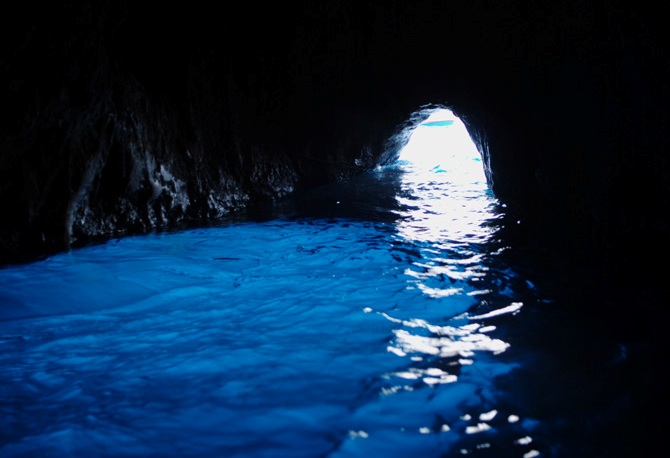
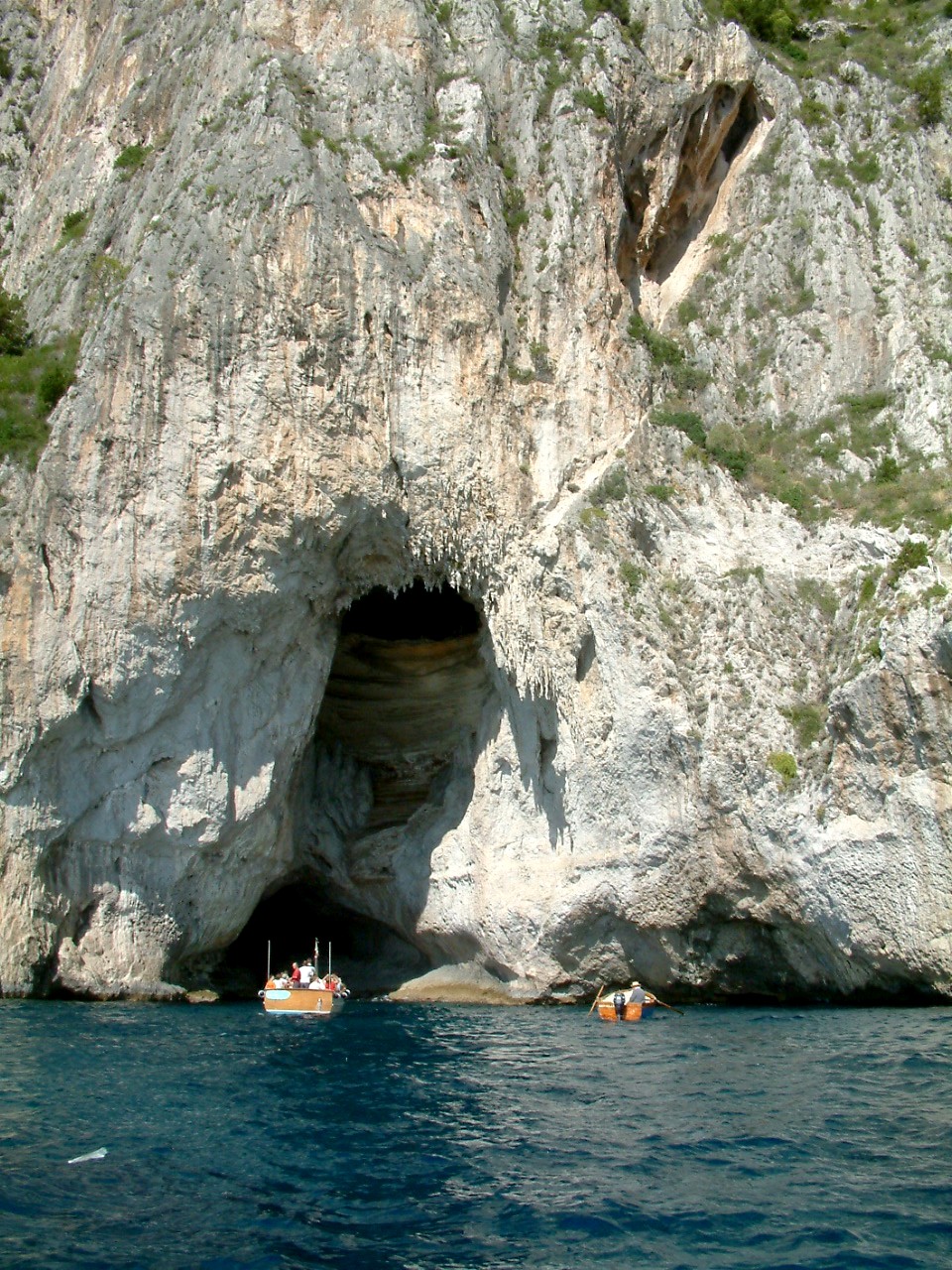
The island is characterized by its rugged limestone landscape, sea stacks (Faraglioni), coastal grottoes including the renowned Blue Grotto, and high cliffs overlooking the sea. Notable features include the harbours of Marina Grande and Marina Piccola, the panoramic Belvedere of Tragara, the ruins of Roman imperial villas such as Villa Jovis, and the towns of Capri and Anacapri, the latter situated higher up the slopes of Monte Solaro, the island's highest point.
Administratively, Capri is part of the Metropolitan City of Naples within the Campania region. The island is divided into two municipalities (comuni): Capri and Anacapri.
Etymology
The origin of the name Capri is uncertain. It may derive from the Ancient Greek κάπρος (kápros), meaning 'wild boar'. Ancient Greek colonists from Magna Graecia were the first recorded inhabitants, calling the island Kapreai (Καπρέαι). Alternatively, the name could come from the Latin capreae, meaning 'goats'. Fossils of wild boars have been found on the island, supporting the Greek etymology. A less likely theory suggests an Etruscan origin meaning 'rocky', referencing the island's limestone terrain.
History
Main article: History of Capri
Antiquity
Archaeological evidence indicates human presence on Capri dating back to the Neolithic and Bronze Age. The Roman historian Suetonius recounts that when workers excavated the foundations for Emperor Augustus's villa, they discovered giant bones and stone weapons, which Augustus displayed in his residence, the Palazzo a Mare. (Modern analysis suggests these may have been fossils of large extinct mammals).
The Roman poet Virgil, in the Aeneid, referred to the island being inhabited by Greek settlers from the Ionian Islands (the Teleboi). The geographer Strabo noted that Capri anciently had two towns, later reduced to one.
Emperor Augustus developed Capri as a private resort, building villas, temples, and aqueducts, and planting gardens. His successor, Tiberius, constructed twelve villas on the island according to Tacitus. The most famous, Villa Jovis, is one of the best-preserved Roman villas in Italy. In AD 27, Tiberius moved permanently to Capri, governing the Roman Empire from the island until his death in AD 37. Later, in AD 182, Emperor Commodus exiled his sister Lucilla to Capri, where she was subsequently executed.
Middle Ages and Modern Era
After the fall of the Western Roman Empire, Capri came under the control of the Duchy of Naples. The island suffered raids by pirates and Saracens. In 866, Emperor Louis II granted the island to the Duchy of Amalfi. In 987, Pope John XV established the Diocese of Capri, initially as a suffragan to the Archdiocese of Amalfi. Capri remained a diocese until 1818, when it was absorbed into the Archdiocese of Sorrento. It is now listed as a titular see.
In 1496, King Frederick IV of Naples established administrative parity between the settlements of Capri and Anacapri. Pirate raids intensified during the 16th century; admirals Barbarossa Hayreddin Pasha and Turgut Reis captured the island for the Ottoman Empire in 1535 and 1553, respectively.
The French antiquarian Jean-Jacques Bouchard visited in the 17th century and is considered one of the first modern tourists; his diary provides valuable insights.
19th Century to Present
During the Napoleonic Wars, French troops occupied Capri in January 1806 but were ousted by the British in May. Britain established a naval base (a "Second Gibraltar") but caused damage to archaeological sites during construction. The French recaptured the island in 1808 and held it until 1815, when it was returned to the Bourbon Kingdom of Naples.
In the 19th century, naturalist Ignazio Cerio catalogued the island's flora and fauna. His work was continued by his son, Edwin Cerio, an author and engineer known for his writings on Capri life.
From the later 19th century, Capri became an increasingly popular resort for European artists, writers, and expatriates. It gained a reputation as a tolerant haven, attracting wealthy gay men and lesbians seeking a more open life than elsewhere in Europe. Notable figures who lived or spent significant time on the island include John Ellingham Brooks, Somerset Maugham, Norman Douglas, Jacques d'Adelswärd-Fersen, Christian Wilhelm Allers, Emil von Behring, Axel Munthe, Louis Coatalen, Maxim Gorky, Oscar Wilde (briefly), Compton Mackenzie, Romaine Brooks, Dame Gracie Fields, and Lenin (hosted by Gorky in 1908). Queen Victoria of Baden was a frequent visitor. German industrialist Friedrich Alfred Krupp funded archaeological work but left after a scandal involving accusations of homosexual orgies.
Today, Capri remains a major tourist destination, particularly popular during the summer months, attracting visitors from Italy and abroad.
Geography

Capri is located in the Tyrrhenian Sea at the western entrance to the Gulf of Naples, approximately 5 km from the mainland tip of the Sorrento Peninsula. The island has an area of 10.4 km2 (4.0 sq mi). The terrain is mountainous, consisting primarily of limestone and sandstone; steep cliffs dominate much of the coastline.
The highest point is Monte Solaro at 589 m (1,932 ft). The island's western part, culminating in Monte Solaro, is known as Anacapri, distinct from the eastern part centered around the town of Capri. The two main harbours are Marina Grande on the north coast (the primary port) and Marina Piccola on the south coast.
Notable natural features include the famous sea stacks known as the Faraglioni off the southeast coast, the Blue Grotto sea cave on the northwest coast, and the Arco Naturale, a large natural arch on the east coast.
Climate
Capri experiences a Mediterranean climate (Köppen: Csa). Summers are warm to hot and generally dry, while winters are mild and wet. Sub-zero temperatures are rare.
| Jan record high C =20.8 | Feb record high C =22.6 | Mar record high C =28.2 | Apr record high C =32.2 | May record high C =36.4 | Jun record high C =38.0 | Jul record high C =39.8 | Aug record high C =42.9 | Sep record high C =36.2 | Oct record high C =32.2 | Nov record high C =27.6 | Dec record high C =21.4 | Jan record low C =-0.2 | Feb record low C =-0.4 | Mar record low C =1.2 | Apr record low C =2.8 | May record low C =8.6 | Jun record low C =10.0 | Jul record low C =10.0 | Aug record low C =14.8 | Sep record low C =10.8 | Oct record low C =5.8 | Nov record low C =0.0 | Dec record low C =0.0 | Jan dew point C =5.5 | Feb dew point C =4.9 | Mar dew point C =7.0 | Apr dew point C =9.4 | May dew point C =13.1 | Jun dew point C =17.0 | Jul dew point C =19.3 | Aug dew point C =20.3 | Sep dew point C =16.7 | Oct dew point C =13.9 | Nov dew point C =10.1 | Dec dew point C =6.4
Administration
The island is divided into two municipalities (comuni):
- Capri
- Anacapri
These are administratively part of the Metropolitan City of Naples, which is part of the Campania region.
Main sights
File:Capri sights.png|520px|center|thumb|A clickable map showing some of the most important sights on Capri. (Use icon on the right to enlarge) rect 49 952 212 1050 Punta Carena Lighthouse rect 701 575 898 725 Monte Solaro rect 1157 562 1325 636 Via Krupp rect 1599 396 1768 497 Arco Naturale rect 1627 101 1789 182 Villa Lysis rect 1772 174 1897 249 Villa Jovis rect 1553 765 1731 866 Faraglioni rect 774 206 983 286 Villa San Michele rect 236 42 408 128 Blue Grotto rect 270 682 466 881 Capri Philosophical Park rect 1725 544 1910 663 Villa Malaparte rect 1346 552 1551 618 Certosa di San Giacomo rect 475 246 765 518 Anacapri rect 1338 500 1514 554 Capri (town) rect 1287 429 1462 501 Piazzetta rect 1191 185 1446 299 Marina Grande rect 1101 644 1307 699 Marina Piccola rect 1151 499 1318 561 Gardens of Augustus rect 294 552 483 671 Torre Materita
- the following entries do not yet have articles:
- rect 129 128 344 211 Villa Damecuta
- rect 827 90 1007 180 Bagni di Tiberio
- rect 1568 523 1710 643 Monte Tuoro
- rect 1335 309 1537 422 Monte San Michele
- rect 771 369 937 511 Monte Cappello
- rect 1793 66 1990 171 Monte Tiberio
Notable sights include:
- Arco Naturale
- Blue Grotto (Grotta Azzurra)
- Capri Philosophical Park
- Certosa di San Giacomo (Charterhouse, contains museum dedicated to painter Karl Wilhelm Diefenbach)
- Faraglioni (sea stacks)
- Gardens of Augustus
- Marina Grande (main port)
- Marina Piccola (small harbour)
- Monte Solaro (highest point, accessible by chairlift)
- Piazza Umberto I (The Piazzetta)
- Punta Carena Lighthouse
- Torre Materita
- Via Krupp (historic switchback path, often closed due to landslide risk)
- Villa Jovis (ruins of Tiberius's main villa)
- Villa Lysis (built by Jacques d'Adelswärd-Fersen)
- Villa Malaparte (modern architectural landmark)
- Villa San Michele (built by Axel Munthe in Anacapri)
Economy

Capri's economy is mostly based on tourism. The island has been a major resort destination since the 19th century, attracting visitors from Italy and internationally. During summer, particularly July and August, the island experiences a large influx of tourists, including many day-trippers arriving by ferry from Naples and the Sorrento Peninsula. The central Piazza Umberto I, commonly known as the Piazzetta, is the hub of social life and tourism in Capri town.
The island is known for upscale hotels, shopping (including luxury brands and local products like Limoncello and handmade leather sandals, and restaurants. Agriculture is very limited, though some wine and olive oil are produced locally. Handicrafts also contribute to the economy. The popularity of the island has led to concerns about overtourism, particularly during peak season, with discussions about measures to limit day-tripper numbers. The international luxury linen brand 100% Capri originated on the island.
Culture
In arts and literature
During the latter half of the 19th century and early 20th century, Capri became a popular destination and residence for European artists, writers, and other prominent figures. August Kopisch's account of his 1826 rediscovery of the Blue Grotto significantly boosted the island's profile.
Painters John Singer Sargent, Frank Hyde, and Charles Caryl Coleman worked on the island. Writers who set works on Capri or lived there include Norman Douglas (South Wind), Compton Mackenzie (Vestal Fire, Extraordinary Women), Jacques d'Adelswärd-Fersen (Et le feu s'éteignit sur la mer), Somerset Maugham ("The Lotus Eater"), and Maxim Gorky. Notable memoirs set on the island include Axel Munthe's The Story of San Michele, Edwin Cerio's Aria di Capri, and Shirley Hazzard's Greene on Capri: A Memoir about Graham Greene. Claude Debussy titled one of his préludes Les collines d'Anacapri (1910).
Annual events
Capri hosts numerous annual events, including religious festivals, cultural happenings, and traditional celebrations. Key events include:
-
Festival of San Costanzo (patron saint of Capri town) – May 14
-
Festival of Sant'Antonio (patron saint of Anacapri) – June 13
-
International Folklore Festival (Anacapri) – August
-
Settembrata Anacaprese (Anacapri harvest festival) – September
-
Capri Hollywood International Film Festival – Late December/early January
-
Capri Art Film Festival
-
Capri Tango Festival
-
Capri Hollywood
-
Eventi Villa San Michele
-
Premio San Michele
-
Premio Faraglioni
-
Premio Cari dell Enigma
-
Maraton del Golfo Capri
Food
Capri is known in Campania for its marjoram, which has a dominant presence in the famous local dish of caciotta-filled ravioli. Locally, it is held that pasta e piselli () is a specialty, and numerous versions are cooked, including with prosciutto or pancetta, and fats including prosciutto fat, oil or butter. It is almost always made with short tube pasta.
Transport
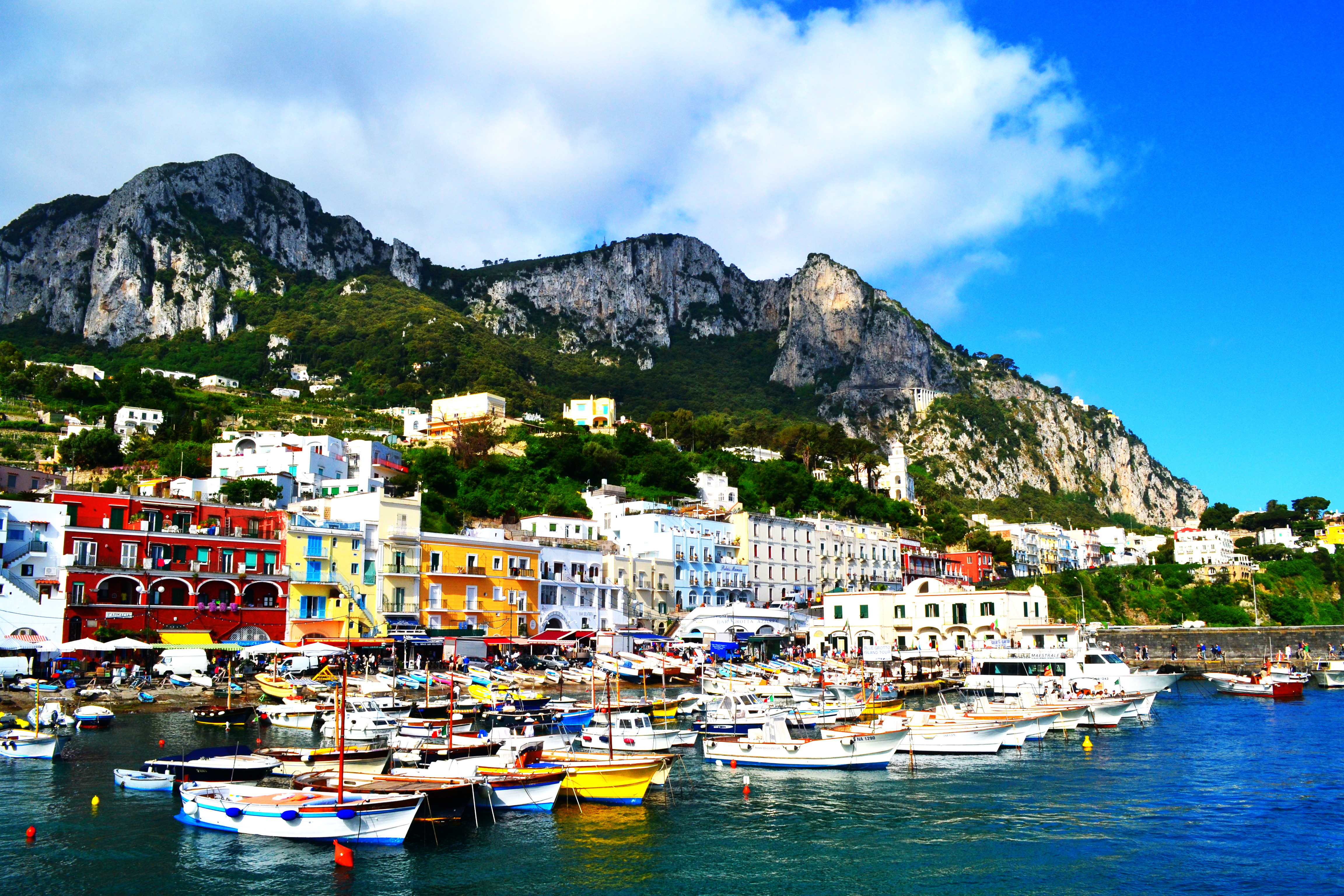

Capri is accessible via ferry and hydrofoil services operating from Naples (ports of Molo Beverello and Calata di Massa), Sorrento, Positano, and Amalfi. Services also run from Ischia and other locations during the summer months.
Boats arrive at Marina Grande. From there, the Capri Funicular ascends to Capri town centre (the Piazzetta). A public bus network connects Marina Grande, Capri town, Marina Piccola, Anacapri, the Blue Grotto, and other points. Taxis, often open-top limousine-style cars, are also available.
Vehicle access for non-residents is heavily restricted for much of the year (typically April to November), due to the island's narrow roads. Visitors generally rely on public transport, taxis, or walking.
Airports
The island does not have an airport. The nearest airports are:
- Naples International Airport (NAP)
- Salerno Costa d'Amalfi Airport (QSR)
Twin towns – sister cities
Capri municipality is twinned with:
- UK Crosby, Merseyside, United Kingdom
- PSE Bethlehem, Israeli-administered regions (Palestinian Authority)
References
References
- (1 January 2022). "Bilancio demografico mensile". [[National Institute of Statistics (Italy).
- "capri {{!}} Etymology, origin and meaning of the name capri by etymonline".
- [[Strabo]], ''[[Geographica]]'', 5.4.9
- Gellhorn, Martha. "Everybody's Happy on Capri". Saturday Evening Post.
- "The Lives of the Twelve Caesars. Augustus".
- See discussion in, e.g., A. Mayor, The First Fossil Hunters (2000).
- Strabo, ''Geography'', 5.4.9
- Fiori, Pamela. "Italy's Pleasure Island Capri". Town & Country.
- link. (2019-07-09 , p. 164 & subsequent volumes.)
- [https://archive.org/details/bub_gb_as_XHufGgeYC Bolla ''De utiliori''], in ''Bullarii romani continuatio'', Tomo XV, Romae 1853, pp. 56–61
- ''Annuario Pontificio 2013'' (Libreria Editrice Vaticana 2013 {{ISBN. 978-88-209-9070-1), p. 858
- See, e.g., Gregory Woods, Homintern (2016)
- Selina Shirley Hastings: ''The Secret Lives of Somerset Maugham: A Biography'',Random House Pub ,2009
- (2025). "Capri. Annotazioni antiquarie". La nave di Teseo.
- (2017). "Oscar Wilde: the unrepentant years". Harvard University Press.
- A monument to Lenin by [[Giacomo Manzù]] was erected in 1970.
- "Storia gay – Friedrich Alfred Krupp (1854–1902), l'omosessualità e lo scandalo di Capri".
- Swallow, Nicky. (2012). "Amalfi Coast with Naples, Capri & Pompeii". John Wiley & Sons Inc.
- "World Meteorological Organization Climate Normals for 1991-2020: Capri-16294". [[National Oceanic and Atmospheric Administration]] / National Centers for Environmental Information.
- Swallow, Nicky. (2012). "Amalfi Coast with Naples, Capri & Pompeii". John Wiley & Sons Inc.
- Sendlhofer, Thomas. (13 May 2018). "Zu viele Touristen: Hallstatt zieht Notbremse". [[Kurier]].
- Gafurova, Olga. (25 November 2018). "100% Capri opens its flagship boutique in Middle East at Dubai Mall Fashion Avenue". AviaMost.
- See A. Kopisch, ''Entdeckung der blauen Grotte auf der Insel Capri'' (1838).{{cn span. (September 2023)
- Hazzard, Shirley. (2000). "Greene on Capri". Farrar, Straus and Giroux.
- "Events". Capri Tourism.
- "Events".
- "Going Through Italy (website), accessed 9 January 2012".
- (29 April 2011). "Capri Art 2011 – Festival della diversità". Capriartfilmfestival.com.
- "Capritourism". Azienda Autonoma Cura Suggiorno e Tourismo Isola di Capri.
- Schwartz, Arthur. (1998). "Naples at Table: Cooking in Campania". [[HarperCollins]].
- Schwartz, Arthur. (1998). "Naples at Table: Cooking in Campania". [[HarperCollins]].
- "Capri Ferry Schedule & Timetables".
- "Getting Around Capri {{!}} Island Transport".
This article was imported from Wikipedia and is available under the Creative Commons Attribution-ShareAlike 4.0 License. Content has been adapted to SurfDoc format. Original contributors can be found on the article history page.
Ask Mako anything about Capri — get instant answers, deeper analysis, and related topics.
Research with MakoFree with your Surf account
Create a free account to save articles, ask Mako questions, and organize your research.
Sign up freeThis content may have been generated or modified by AI. CloudSurf Software LLC is not responsible for the accuracy, completeness, or reliability of AI-generated content. Always verify important information from primary sources.
Report