From Surf Wiki (app.surf) — the open knowledge base
Cantonese cuisine
Chinese regional cuisine from Guangdong

Chinese regional cuisine from Guangdong
| Field | Value |
|---|---|
| pic | Flaming wok by KellyB in Bountiful, Utah.jpg |
| piccap | Chefs cook with a wok |
| s | 广东菜 |
| t | 廣東菜 |
| j | Gwong2 dung1 coi3 |
| y | Gwóng dūng choi |
| ci | |
| p | Guǎngdōngcài |
| tp | Guǎngdong-cài |
| w | |
| mi | |
| bpmf | ㄍㄨㄤˇ ㄉㄨㄥ ㄘㄞˋ |
| altname | Yue cuisine |
| s2 | 粤菜 |
| t2 | 粵菜 |
| j2 | Jyut6 coi3 |
| y2 | Yuht choi |
| ci2 | |
| p2 | Yuècài |
| tp2 | Yuè-cài |
| w2 | |
| mi2 | |
| bpmf2 | ㄩㄝˋ ㄘㄞˋ |
| showflag | jy |
Cantonese or Guangdong cuisine, also known as Yue cuisine ( or ), is the cuisine of Cantonese people, associated with the Guangdong province of China, particularly the provincial capital Guangzhou, and the surrounding regions in the Pearl River Delta including Hong Kong and Macau. Strictly speaking, Cantonese cuisine is the cuisine of Guangzhou or of Cantonese speakers, but it often includes the cooking styles of all the speakers of Yue Chinese languages in Guangdong.
The Teochew cuisine and Hakka cuisine of Guangdong are considered their own styles. However, scholars may categorize Guangdong cuisine into three major groups based on the region's dialect: Cantonese, Hakka and Chaozhou cuisines. Neighboring Guangxi's cuisine is also considered separate despite eastern Guangxi being considered culturally Cantonese due to the presence of ethnic Zhuang influences in the rest of the province.
Cantonese cuisine is one of the Eight Great Traditions of Chinese cuisine, and chefs trained in Cantonese cuisine are highly sought after throughout China. Its prominence outside China is due to the large number of Cantonese emigrants; until the late 20th century, most Chinese restaurants in the West served largely Cantonese dishes.
Background
Guangzhou (Canton) City, the provincial capital of Guangdong and the centre of Cantonese culture, has long been a trading hub, and many imported foods and ingredients are used in Cantonese cuisine. During the early to middle Qing dynasty period from 1757 to 1842, Guangdong, known as Canton at the time, was the only port where trade was permitted between Chinese and foreign merchants. Cantonese cooks aimed to serve European tastes in restaurants, lending to an ongoing European influence on Cantonese cuisine. Staples of the European nobility diet at the time, particularly turtle soup, were available to British merchants and dignitaries visiting Guangdong. The British taught Cantonese cooks how to make the dish, with the Caribbean sea turtle typically used in Europe replaced by the Chinese softshell turtle. Besides pork, beef and chicken, Cantonese cuisine incorporates almost all edible meats, including offal, chicken feet, duck's tongue, frog legs, snakes and snails. Lamb and goat are less commonly used than in the cuisines of northern or western China. Many cooking methods are used, with steaming and stir-frying favoured due to their convenience and rapidity.
Wok hay is the name given to the unique Cantonese cooking technique, emphasizing the energy, or hay, of the cooking vessel itself. Wok hay emphasizes the multiple flavors at play when cooking, using certain ingredients to balance the harshness of others. Additionally, dishes are typically cooked over a medium heat for a more prolonged period. Guangzhou is known for its year-round warm and humid climate; wok hay helps prevent chefs from working in an environment where they can easily overheat from the sweltering kitchen temperatures. This concept lends to a sense of superiority among Cantonese cooks with respect to stir-fry technique. Other techniques include shallow frying, double steaming, braising and deep frying. Compared to other Chinese regional cuisines, the flavours of most traditional Cantonese dishes should be well-balanced and not greasy. Spices should be used in modest amounts to avoid overwhelming the flavours of the primary ingredients, which in turn should be at the peak of their freshness and quality. There is no widespread use of fresh herbs in Cantonese cooking, in contrast with their liberal use in other cuisines such as Sichuanese, Vietnamese, Lao, Thai and European. Garlic chives and coriander leaves are notable exceptions, although the former are often used as a vegetable and the latter are typically used as mere garnish in most dishes.
Guangzhou’s notability in its restaurants, teahouses, and snack shops was targeted by the reforms of the CCP, as top party leaders made efforts to transform Guangzhou from a center of culinary arts into an industrial powerhouse. Well-established culinary institutions were targeted as traditionalist remnants, replaced with communal-style eating halls. “Massification” became key to the reforming of Guangzhou’s culinary scene, with many delicacies such as sharkfin soup, bird's nest soup, and sea cucumber, which were often imported, ushered out of restaurants in favor of less expensive ingredients. Frugality was emphasized as a revolutionary ideal, with restaurants previously reserved for the wealthy elites now serving the working class, who had felt that these “Old Society” delicacies were withheld from them.
Foods
Sauces and condiments
In Cantonese cuisine, ingredients such as sugar, salt, soy sauce, rice wine, corn starch, vinegar, scallion and sesame oil suffice to enhance flavour, although garlic is heavily used in some dishes, especially those in which internal organs, such as entrails, may emit unpleasant odours. Ginger, chili peppers, five-spice powder, powdered black pepper, star anise and a few other spices are also used, but often sparingly.
| English | Traditional Chinese | Simplified Chinese | Jyutping | Pinyin |
|---|---|---|---|---|
| Black bean sauce | 蒜蓉豆豉醬 | 蒜蓉豆豉酱 | syun3 jung4 dau6 si6 zoeng3 | suànróng dòuchǐjiàng |
| Char siu sauce | 叉燒醬 | 叉烧酱 | caa1 siu1 zoeng3 | chāshāojiàng |
| Chu hau paste | 柱侯醬 | 柱侯酱 | cyu5 hau4 zoeng3 | zhùhóujiàng |
| Hoisin sauce | 海鮮醬 | 海鲜酱 | hoi2 sin1 zoeng3 | hǎixiānjiàng |
| Master stock | 滷水 | 卤水 | lou5 seoi2 | lǔshuǐ |
| Oyster sauce | 蠔油 | 蚝油 | hou4 jau4 | háoyóu |
| Plum sauce | 蘇梅醬 | 苏梅酱 | syun1 mui4 zoeng3 | sūméijiàng |
| Red vinegar | 大紅浙醋 | 大红浙醋 | daai6 hung4 zit3 cou3 | dàhóngzhècù |
| Shrimp paste | 鹹蝦醬 | 咸虾酱 | haam4 haa1 zoeng3 | xiánxiājiàng |
| Shrimp paste block | 蝦膏 | 虾膏 | haa1 gou1 | Xiāgāo |
| Sweet and sour sauce | 糖醋醬 | 糖醋酱 | tong4 cou3 zoeng3 | tángcùjiàng |
File:Macharsiew by daxiang stef.jpg|Char siu is often marinated with plum sauce and honey for sweet flavour. File:Steamed Oysters.jpg|Oysters steamed in two ways: with ginger and garlic, and in black bean sauce
Dried and preserved ingredients
Although Cantonese cooks pay much attention to the freshness of their primary ingredients, Cantonese cuisine also uses a long list of preserved food items to add flavour to a dish. This may be influenced by Hakka cuisine, since the Hakkas were once a dominant group occupying imperial Hong Kong and other southern territories.
Some items gain very intense flavours during the drying/preservation/oxidation process and some foods are preserved to increase their shelf life. Some chefs combine both dried and fresh varieties of the same items in a dish. Dried items are usually soaked in water to rehydrate before cooking. These ingredients are generally not served a la carte, but rather with vegetables or other Cantonese dishes.
| Image | English | Traditional Chinese | Simplified Chinese | Jyutping | Pinyin | Notes | |
|---|---|---|---|---|---|---|---|
| [[File:Sliced century eggs with smashed chili at Guanshi Wing Bar, Xinjiekou (20220723132726).jpg | 120px]] | Century egg | 皮蛋 | pei4 daan2 | pídàn | Can be found served with roasted dishes, in congee with lean pork, and in a sweet pastry with lotus paste. | |
| [[File:Lachang Cantonese short.jpg | 120px]] | Chinese sausage | 臘腸 | 腊肠 | laap6 coeng2 | làcháng | Usually added to rice together with preserved-salted duck and pork. |
| Dried sea snail | 螺頭 / 螺片 | 螺头 / 螺片 | lo4 tau4 / lo2 pin2 | Luótóu/ luópiàn | Usually added to clear soup. | ||
| [[File:HK SW 上環 Sheung Wan 皇后大道西 Queen's Road West 菜乾 dried choi vegetable October 2022 Px3.jpg | 120px]] | Dried bok choy | 菜乾 | 菜干 | coi3 gon1 | càigān | |
| [[File:HK food 乾瑤柱 Dried scallop conpoy 沉 February 2020 SS2.jpg | 120px]] | Dried scallops | 江珧柱 | gong1 jiu4 cyu5 | jiāngyáozhù | Usually added to clear soup. | |
| 江瑤柱 | 江瑶柱 | ||||||
| [[File:Dry pot shrimp.jpg | 120px]] | Dried shrimp | 蝦乾 | 虾干 | haa1 gon1 | xiāgān | Usually de-shelled, sliced into half and added to vegetable dishes. |
| [[File:Tôm khô.jpg | 120px]] | Dried small shrimp | 蝦米 | 虾米 | haa1 mai5 | xiāmǐ | Usually mixed with stir-fried vegetables. |
| [[File:Fermented bean curd in bowl (20220219181233).jpg | 120px]] | Fermented tofu | 腐乳 | fu6 jyu5 | fǔrǔ | ||
| [[File:2015 1012 Preserved black beans douchi close-up.jpg | 120px]] | Fermented black beans | 豆豉 | dau6 si6 | dòuchǐ | Usually added to pork and tofu dishes. | |
| [[File:MeiganCaiBundle.jpg | 120px]] | Mei cai | 梅菜 | mui4 coi3 | méicài | Usually cooked with pork or stir-fried with rice. | |
| [[File:曬蘿蔔乾 Dried radish.jpg | 120px]] | Chai poh / Dried preserved radish | 菜脯 | coi3 pou2 | càifǔ | A key ingredient for making chai poh omelette. | |
| [[File:HK Aberdeen 東勝道 Tung Sing Road 得記燒臘飯店 Tak Kee Rice Restaurant Nov-2012 腊鴨比 Dried Duck legs.JPG | 120px]] | Preserved-salted duck | 臘鴨 | 腊鸭 | laap6 aap2 | làyā | Usually eaten with rice in a family meal. |
| [[File:HK 紅磡 Hung Hom 馬頭圍道 Ma Tau Wai Road food shop Lap Mei Yuk December 2021 SS2 01.jpg | 120px]] | Preserved-salted pork | 臘肉 | 腊肉 | laap6 juk6 | làròu | Usually eaten with rice in a family meal. |
| [[File:Telorasin.jpg | 120px]] | Salted duck egg | 鹹蛋 | 咸蛋 | haam4 daan2 | xiándàn | May be eaten as it is or mixed with stir-fried vegetables and steam dishes or cooked with diced pork in congee. |
| [[File:ZS 中山市 Zhongshan 棠記海鮮餐廳 Tangji Seafood Restaurant 晚餐 dinner steamed salted fish May 2023 Px3 01.jpg | 120px]] | Salted fish | 鹹魚 | 咸鱼 | haam4 jyu2 | xiányú | Usually paired with steamed pork or added to fried rice together with diced chicken. |
| [[File:Sayur asin pickles.JPG | 120px]] | Suan cai | 鹹酸菜 | 咸酸菜 | haam4 syun1 coi3 | xiánsuāncài | The key ingredient for making Haam Coi Pepper Hog Maw Soup (咸菜胡椒豬肚湯). |
| [[File:The_Five_of_Jinwa_Ham_on_the_Lo_Sam_Yeung_Chinese_Food_Shop.jpg | 120px]] | Jinhua ham | 金華火腿 | 金华火腿 | gam1 waa4 fo2 teoi2 | Jīnhuáhuǒtuǐ | Usually added to clear soup. |
| [[File:VegetarianGoose.jpg | 120px]] | Tofu skin | 腐皮 | fu6 pei4 | fǔpí | Usually used as wrapping for ground pork dishes. It is fried in a similar manner as spring rolls. |
Traditional dishes
A number of dishes have been part of Cantonese cuisine since the earliest territorial establishments of Guangdong. While many of these are on the menus of typical Cantonese restaurants, some simpler ones are more commonly found in Cantonese homes. Home-made Cantonese dishes are usually served with plain white rice.
| Name | Image | Traditional Chinese | Simplified Chinese | Jyutping | Pinyin | |
|---|---|---|---|---|---|---|
| Cantonese-style fried rice | [[File:Cuisine of China 0055.JPG | 100px]] | 廣式炒飯 | 广式炒饭 | gwong2 sik1 cau2 faan6 | guǎng shì chǎofàn |
| Choy sum in oyster sauce | [[File:Taste of Beijing, Soho, London (4363228093).jpg | 100px]] | 蠔油菜心 | 蚝油菜心 | hou4 jau4 coi3 sam1 | háoyóu càixīn |
| Sampan congee | [[File:Cantonese_Sampan_Congee_(Boat_Congee).jpeg | 100x100px]] | 艇仔粥 | teng5 zai2 zuk1 | Tǐngzǐzhōu | |
| Congee with lean pork and century egg | [[File:Pork preserved duck egg congee.jpg | 100px]] | 皮蛋瘦肉粥 | pei4 daan2 sau3 juk6 zuk1 | pídàn shòuròuzhōu | |
| Steamed egg | [[File:Chinese steamed eggs (cropped).jpg | 100px]] | 蒸水蛋 | zing1 seoi2 daan2 | zhēngshuǐdàn | |
| Steamed frog legs on lotus leaf | 荷葉蒸田雞 | 荷叶蒸田鸡 | ho4 jip6 zing1 tin4 gai1 | héyè zhēng tiánjī | ||
| Steamed ground pork with salted duck egg | [[File:HK Food 棟記飯店 Tung Kee 咸蛋蒸肉餅 Meat Cake.JPG | 100px]] | 鹹蛋蒸肉餅 | 咸蛋蒸肉饼 | haam4 daan2 zing1 juk6 beng2 | xiándàn zhēng ròubǐng |
| Steamed spare ribs with fermented black beans and chilli pepper | [[File:Dimsumpaigui.jpg | 100px]] | 豉椒排骨 | si6 ziu1 paai4 gwat1 | chǐjiāo páigǔ | |
| Stewed beef brisket | [[File:HK Food Brisket Noodle 1.JPG | 100px]] | 柱侯牛腩 | cyu5 hau4 ngau4 naam5 | zhùhóu niú nǎn | |
| Stir-fried hairy gourd with dried shrimp and cellophane noodles | 大姨媽嫁女 | 大姨妈嫁女 | daai6 ji4 maa1 gaa3 neoi5 | dàyímā jiànǚ | ||
| Stir-fried water spinach with shredded chilli and fermented tofu | [[File:Rau muống xào tỏi.jpg | 100px]] | 椒絲腐乳通菜 | 椒丝腐乳通菜 | ziu1 si1 fu6 jyu5 tung1 coi3 | jiāosī fǔrǔ tōngcài |
| Sweet and sour pork | [[File:Cuisine of China 0068.JPG | 100px]] | 咕嚕肉 | 咕噜肉 | gu1 lou1 juk6 | gūlūròu |
| Shunde-style fish slices | [[File:Shunde yusheng.jpg | 100px]] | 順德魚生 | 顺德鱼生 | seon6 dak1 jyu4 saang1 | shùndé yú shēng |
Deep-fried dishes
There are a small number of deep-fried dishes in Cantonese cuisine, which can often be found as street food. They have been extensively documented in colonial Hong Kong records of the 19th and 20th centuries. A few are synonymous with Cantonese breakfast and lunch, even though these are also part of other cuisines.
| English | Image | Traditional Chinese | Simplified Chinese | Jyutping | Pinyin | |
|---|---|---|---|---|---|---|
| Dace fish balls | [[File:HK food 酥炸 鯪魚球 Dacefish meat balls Nov-2013 九記 Kau Kee Restaurant.JPG | 100px]] | 鯪魚球 | 鲮鱼球 | leng4 jyu4 kau4 | zh |
| Youtiao (sometimes called "Chinese donut" | [[File:Chinese fried bread.jpg | 100px]] | 油炸鬼 | jau4 zaa3 gwai2 | zh | |
| Ox-tongue pastry | [[File:HK_WCD_灣仔_Wan_Chai_軒尼詩道_432_Hennessy_Road_人和悅大廈_Yan_Wo_Yuet_Building_shop_忠記粥品_Chung_Kee_Restaurant_牛脷酥_Ox-tongue_pastry_night_October_2022_Px3.jpg | 100x100px]] | 牛脷酥 | ngau4 lei6 sou1 | niúlìsū | |
| Zaa leung | [[File:Zhaliang.jpg | 100px]] | 炸兩 | 炸两 | zaa3 loeng5 | zh |
Soups
Old fire soup, or lou fo tong (), is a clear broth prepared by simmering meat and other ingredients over a low heat for several hours. Chinese herbs are often used as ingredients. There are basically two ways to make old fire soup – put ingredients and water in the pot and heat it directly on fire, which is called bou tong (); or put the ingredients in a small stew pot, and put it in a bigger pot filled with water, then heat the bigger pot on fire directly, which is called dun tong (). The latter way can keep the most original taste of the soup.
Soup chain stores or delivery outlets in cities with significant Cantonese populations, such as Hong Kong, serve this dish due to the long preparation time required of slow-simmered soup.
| English | Traditional Chinese | Simplified Chinese | Jyutping | Pinyin |
|---|---|---|---|---|
| Cantonese seafood soup | 海皇羹 | hoi2 wong4 gang1 | hǎihuáng gēng | |
| Night-blooming cereus soup | 霸王花煲湯 | 霸王花煲汤 | baa3 wong4 faa1 bou1 tong1 | bàwánghuā bāotāng |
| Snow fungus soup | 銀耳湯 | 银耳汤 | ngan4 ji5 tong1 | yín'ěr tāng |
| Spare ribs soup with watercress and apricot kernels | 南北杏西洋菜豬骨湯 | 南北杏西洋菜猪骨汤 | naam4 bak1 hang6 sai1 joeng4 coi3 zyu1 gwat1 tong1 | nánběixìng xīyángcài zhūgǔ tāng |
| Winter melon soup | 冬瓜湯 | 冬瓜汤 | dung1 gwaa1 tong1 | dōngguā tāng |
Seafood
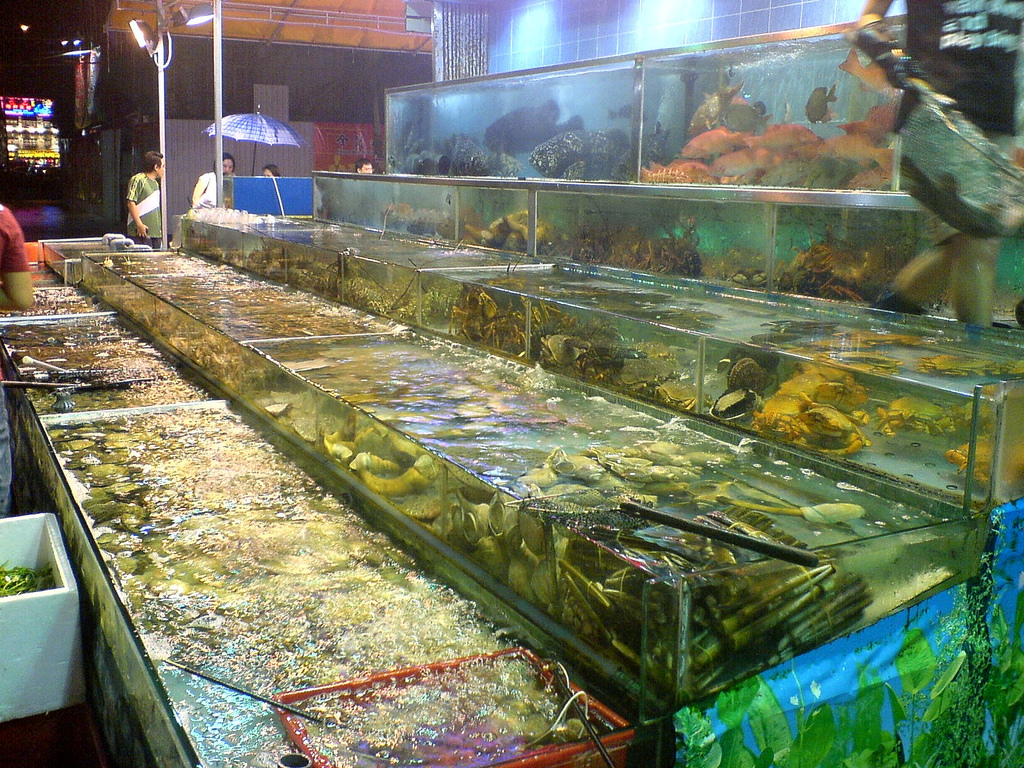
Due to Guangdong's location along the South China Sea coast, fresh seafood is prominent in Cantonese cuisine, and many Cantonese restaurants keep aquariums or seafood tanks on the premises. In Cantonese cuisine, as in cuisines from other parts of Asia, if seafood has a repugnant odour, strong spices and marinating juices are added; the freshest seafood is odourless and, in Cantonese culinary arts, is best cooked by steaming. For instance, in some recipes, only a small amount of soy sauce, ginger and spring onion is added to steamed fish. In Cantonese cuisine, the light seasoning is used only to bring out the natural sweetness of the seafood. As a rule of thumb, the spiciness of a dish is usually negatively correlated to the freshness of the ingredients.
| Image | English | Traditional Chinese | Simplified Chinese | Jyutping | Pinyin | |
|---|---|---|---|---|---|---|
| [[File:Ginger scallion lobster.jpg | 120px]] | Lobster with ginger and scallions | 薑蔥龍蝦 | 薑葱龙虾 | goeng1 cung1 lung4 haa1 | jiāngcōng lóngxiā |
| [[File:Lobster_with_soup_yi_fu_noodles.jpg | 121x121px]] | Lobster with e-fu noodles in soup / | 上湯龍蝦伊麵 / 芝士龍蝦伊麵 | 上汤龙虾伊面 / 芝士龙虾伊面 | soeng6 tong1 lung4 haa1 ji1 min6 / zi1 si2 lung4 haa1 ji1 min6 | Shàngtāng lóngxiā yīmiàn / Zhīshì lóngxiā yīmiàn |
| [[File:Shrimp Type Things Covered in Garlic (2891424375).jpg | 120px]] | Mantis shrimp | 攋尿蝦 | 濑尿虾 | laai6 niu6 haa1 | làniàoxiā |
| [[File:Orangesquid.jpg | 100px]] | Orange cuttlefish | 鹵水墨魚 | 卤水墨鱼 | lou5 seoi2 mak6 jyu4 | lǔshuǐ mòyú |
| [[File:Food 清蒸檸檬魚, 泰鄉雲餐廳, 台北 (17167116250).jpg | 120px]] | Steamed fish | 蒸魚 | 蒸鱼 | zing1 yu4 | zhēngyú |
| [[File:Minced garlic glass noodle scallops.jpg | 120px]] | Steamed scallops with ginger and garlic | 蒜茸蒸扇貝 | 蒜茸蒸扇贝 | syun3 jung4 zing1 sin3 bui3 | suànróng zhēng shànbèi |
| [[File:HK SYP food 晚餐 dinner 白灼蝦 February 2021 SS2 09.jpg | 120px]] | White boiled shrimp | 白灼蝦 | 白灼虾 | baak6 zoek3 haa1 | báizhuóxiā |
File:HK Hotpot foods Dec-2013 Ingredients 蟶子 Solenidae 蟹 Crabs 蝦 Prawn 雞肉腸仔 Sausage n 魚旦 Fishballs.jpg|Typical ingredients for Cantonese-style hotpot are razor shell (蟶子), crab (蟹), prawn (蝦), chicken sausage (雞肉腸仔) and dace fishball (魚旦).
Noodle dishes
Noodles are served either in soup broth or fried. These are available as home-cooked meals, on dim sum side menus, or as street food at dai pai dongs, where they can be served with a variety of toppings such as fish balls, beef balls, or fish slices.
| English | Image | Traditional Chinese | Simplified Chinese | Jyutping | Pinyin | Notes | |
|---|---|---|---|---|---|---|---|
| Beef brisket noodles | [[File:HK TKL 調景嶺 Tiu Keng Leng 新樂園魚蛋粉 Sun Lok Yuen Noodle Restaurant 將軍澳 Tseung Kwan O 常寧路 Sheung Ning Road food 牛腩湯麵 April 2019 SSG 03.jpg | 100px]] | 牛腩麵 | 牛腩面 | ngau4 laam5 min6 | niú nǎn miàn | May be served dry or in soup. |
| Beef chow fun | [[File:Beefchowfoon.jpg | 100px]] | 乾炒牛河 | 干炒牛河 | gon1 caau2 ngau4 ho2 | gān chǎo niú hé | Fried beef noodles made with hor-fun, typically chilli oil is also added. |
| Chow mein | [[File:Chow mein 1 by yuen.jpg | 100px]] | 炒麵 | 炒面 | caau2 min6 | chǎo miàn | A generic term for various stir-fried noodle dishes. Hong Kong-style chow mein is made from pan-fried thin crispy noodles. |
| Jook-sing noodles | 竹昇麵 | 竹升面 | zuk1 sing1 min6 | zhúshēngmiàn | Bamboo log pressed noodles. | ||
| Lo mein | [[File:Real lo mein.jpg | 100px]] | 撈麵 | 捞面 | lou1 min6 | lāo miàn | Boiled wheat noodles mixed with a sauce, or served with a sauce alongside. Traditionally not stir-fried. |
| Rice noodle roll | [[File:Cha siu choeng.jpg | 100px]] | 腸粉 | 肠粉 | coeng2 fan2 | chángfěn | Also known as chee cheong fun. |
| *Shahe fen* | [[File:Rice noodles (4681330292).jpg | 100px]] | 河粉 | ho4 fun2 | héfěn | Also known as hor-fun. | |
| Rice noodles | [[File:Rice_noodles_vermicelli_mie.jpg | 133x133px]] | 米粉 | mai5 fan2 | mǐfěn | Also known as rice vermicelli | |
| Silver needle noodles | [[File:Fried-Lao-Shu-Fen Fried-Lou-Syu-Fan Fried-Short-Rice-Noodles.jpg | 100px]] | 銀針粉 | 银针粉 | ngan4 zam1 fun2 | yín zhēn fěn | Also known as rat noodles (). |
| Yi mein | [[File:Lobster with E-Fu Noodle.jpg | 100px]] | 伊麵 | 伊面 | ji1 min6 | yī miàn | Also known as e-fu noodles. |
| Wonton noodles | [[File:HK Sai Ying Pun Centre Street 雲吞 Wonton noodle July-2012.JPG | 100px]] | 雲吞麵 | 云吞面 | wan4 tan1 min6 | yúntūn miàn | Sometimes spelled as wanton noodles. |
Siu mei
Main article: Siu mei
Siu mei () is essentially the Chinese rotisserie style of cooking. Unlike most other Cantonese dishes, siu mei solely consists of meat, with no vegetables.
All Cantonese-style cooked meats, including siu mei, lou mei and preserved meat can be classified as siu laap ().

| English | Image | Traditional Chinese | Simplified Chinese | Jyutping | Pinyin | |
|---|---|---|---|---|---|---|
| Char siu | [[File:HK Mongkok Maxims BBQ Meat Rice Lunch with Green vegetable.JPG | 100px]] | 叉燒 | 叉烧 | caa1 siu1 | chāshāo |
| Poached duck in master stock | 滷水鴨 | 卤水鸭 | lou5 seoi2 aap3 | lǔ shuǐ yā | ||
| Roast duck | [[File:Dry for 5 hours cropped.jpg | 100px]] | 燒鴨 | 烧鸭 | siu1 aap3 | shāoyā |
| Roast goose | [[File:Roastedgoose.jpg | 100px]] | 燒鵝 | 烧鹅 | siu1 ngo4 | shāo'é |
| Roast pigeon | [[File:Fried pigeon.jpeg | 100px]] | 燒乳鴿 | 烧乳鸽 | siu1 jyu5 gap3 | shāorǔgē |
| Siu laap platter | [[File:Siu lap platter.jpg | 100px]] | 燒臘拼盤 | 烧腊拼盘 | siu1 laap6 ping6 pun4 | shāolà pīnpán |
| Siu mei platter | [[File:HK food Kennedy Town New Chinese Rest BBQ Mix.jpg | 100px]] | 燒味拼盤 | 烧味拼盘 | siu1 mei6 ping6 poon4 | shāowèi pīnpán |
| Siu yuk | [[File:Hong Kong style roast pig (3946366822).jpg | 100px]] | 燒肉 | 烧肉 | siu1 yuk1 | shāoròu |
| Soy sauce chicken | [[File:Soy Sauce Chicken.jpg | 100px]] | 豉油雞 | 豉油鸡 | si6 jau4 gai1 | chǐ yóu jī |
| White cut chicken | [[File:BeiQieJi-WhiteCutChicken.jpg | 100px]] | 白切雞 | 白切鸡 | baak6 cit3 gai1 | bái qiè jī |
Lou mei
Main article: Lou mei
Lou mei () is the name given to dishes made from internal organs, entrails and other left-over parts of animals. It is widely available in southern Chinese regions.
| Image | English | Traditional Chinese | Simplified Chinese | Jyutping | Pinyin | |
|---|---|---|---|---|---|---|
| [[File:Niubaiye.jpg | 120px]] | Beef entrails | 牛雜 | 牛杂 | ngau4 zaap6 | niú zá |
| [[File:牛腩煲仔饭 Beef Brisket Hotpot Rice - Soup, Box Hill (2171826488).jpg | 120px]] | Beef brisket | 牛腩 | ngau4 laam5 | niú nǎn | |
| [[File:HK 灣仔 Wan Chai Lockhart Road Municipal Services Building 駱克道市政大廈 Lockhart Road Market 駱克道街市 Hung Kee Chiu Chow food Sept 2017 IX1 04.jpg | 120px]] | Chicken scraps | 雞雜 | 鸡杂 | gai1 zaap6 | jī zá |
| Duck gizzard | 鴨腎 | 鸭肾 | aap3 san6 | yā shèn | ||
| [[File:HK Sheung Wan 皇后大道中 329 Queen's Road Central 嘉寶大廈 Carbo Mansion shop 新園興記燒臘飯店 Sun Yuen Hing Kee Siu Mei Restaurant May 2023 Px3 06.jpg | 120px]] | Pig's tongue | 豬脷 | 猪脷 | zyu1 lei6 | zhū lì |
Meat and rice plates
A portion of meat, such as char siu, served on a bed of steamed white rice. A typical variant consists of half-and-half portions of two types of siu mei and lou mei (or sometimes more than two). A steamed vegetable (such as choy sum) is frequently, but not always included.
| English | Image | Traditional Chinese | Simplified Chinese | Jyutping | Pinyin | |
|---|---|---|---|---|---|---|
| Rice with char siu and siu yuk | [[File:HK_STT_石塘咀_Shek_Tong_Tsui_皇后大道西_Queen%27s_Road_West_BBQ_food_shop_唐順興_Tang%27s_Roast_BBQ_燒味肉_meat_n_choi_sum_vegetable_May_2021_SS2_01.jpg | 120px]] | 叉燒燒肉飯 | 叉烧烧肉饭 | caa1 siu1 siu1 juk6 faan6 | chāshāo shāo ròu fàn |
| Rice with Chinese sausage and char siu | 臘腸叉燒飯 | 腊肠叉烧饭 | laap6 ceung4 caa1 siu1 faan6 | làcháng chāshāo fàn | ||
| Rice with roast goose and goose intestines | 燒鵝鵝腸飯 | 烧鹅鹅肠饭 | siu1 ngo4 ngo4 coeng4 faan6 | shāo é é cháng fàn |
Little pot rice

Little pot rice () are dishes cooked and served in a flat-bottomed pot (as opposed to a round-bottomed wok). Usually this is a saucepan or braising pan (see clay pot cooking). Such dishes are cooked by covering and steaming, making the rice and ingredients very hot and soft. Usually the ingredients are layered on top of the rice with little or no mixing in between. Many standard combinations exist.
| English | Traditional Chinese | Simplified Chinese | Jyutping | Pinyin |
|---|---|---|---|---|
| Rice with Chinese sausage and preserved meat | 臘味煲仔飯 | 腊味煲仔饭 | laap6 coeng2 bou1 zai2 faan6 | làwèi bāozǎifàn |
| Rice with layered egg and beef | 窩蛋牛肉飯 | 窝蛋牛肉饭 | wo1 daan2 ngaw4 juk6 faan6 | wōdàn niúròu fàn |
| Rice with minced beef patty | 肉餅煲仔飯 | 肉饼煲仔饭 | juk6 beng2 bou1 zai2 faan6 | ròubǐng bāozǎifàn |
| Rice with spare ribs | 排骨煲仔飯 | 排骨煲仔饭 | paai4 gwat1 bou1 zai2 faan6 | páigǔ bāozǎifàn |
| Rice with steamed chicken | 蒸雞肉煲仔飯 | 蒸鸡肉煲仔饭 | zing1 gai1 juk6 bou1 zai2 faan6 | zhēng jīròu bāozǎifàn |
Banquet and dinner dishes
A number of dishes are traditionally served in Cantonese restaurants only at dinner time. Said banquets were typically served in the capital's famous tea houses. Guangzhou’s tea houses have historically served as meeting places for the public, where political movements could foment and lead to action. The main draw of these tea houses was to enjoy dim sum. While eating dim sum in tea houses grew in popularity during the nineteenth century, the different snacks and small bites that were enjoyed grew Guangzhou staples to encompassing culinary traditions from China’s numerous provinces. After the Qing’s defeat in the first Opium War, culinary influences outside of China found their way into the dim sum served at tea houses, with ingredients such as Worcestershire sauce and Ketchup becoming staple ingredients. Dim sum restaurants stop serving bamboo-basket dishes after the yum cha period (equivalent to afternoon tea) and begin offering an entirely different menu in the evening. Some dishes are standard while others are regional. Some are customised for special purposes such as Chinese marriages or banquets. Salt and pepper dishes are one of the few spicy dishes.
| English | Image | Traditional Chinese | Simplified Chinese | Jyutping | Pinyin | |
|---|---|---|---|---|---|---|
| Crispy fried chicken | [[File:Crispyfriedchicken.jpg | 100px]] | 炸子雞 | 炸子鸡 | zaa3 zi2 gai1 | zhá zǐ jī |
| Duck with taro | 陳皮芋頭鴨 | 陈皮芋头鸭 | can4 pei4 wu6 tau4 aap3 | chén pí yùtóu yā | ||
| Fried tofu with shrimp | [[File:CantoneseTofuwithShrimp.jpg | 100px]] | 蝦仁炒豆腐 | 虾仁炒豆腐 | haa1 joeng4 caau2 dau4 fu6 | xiārén chǎo dòufǔ |
| Pork chop with salt and pepper | [[File:Salt_and_Pepper_Pork_Chop_with_Rice_-_CK_Bistro.jpg | 100px]] | 椒鹽豬扒 | 椒盐猪扒 | ziu1 jim4 zyu1 paa2 | jiāo yán zhū pà |
| Roast pigeon | [[File:Chinese squab.jpg | 100px]] | 乳鴿 | 乳鸽 | jyu5 gap3 | rǔ gē |
| Roast suckling pig | [[File:Shaoruzhu.jpg | 100px]] | 燒乳豬 | 烧乳豬 | siu1 jyu5 zyu1 | shāo rǔ zhū |
| Seafood with bird's nest | [[File:Seafoodbirdsnest.jpg | 100px]] | 海鮮雀巢 | 海鮮雀巢 | hoi2 sin1 zoek3 caau4 | hǎixiān quècháo |
| Shrimp with salt and pepper | [[File:Pepper salt prawns.jpeg | 100px]] | 椒鹽蝦 | 椒盐虾 | ziu1 jim4 haa1 | jiāo yán xiā |
| Sour spare ribs | [[File:Spare ribs with Chinese barbecue sauce cropped.jpg | 100px]] | 生炒排骨 | 生炒排骨 | saang1 cau2 paai4 gwat1 | shēng chǎo páigǔ |
| Spare ribs with salt and pepper | [[File:Свиные рёбрышка.jpg | 100px]] | 椒鹽骨 | 椒盐骨 | ziu1 jim4 paai4 gwat1 | jiāo yán gǔ |
| Squid with salt and pepper | [[File:Fried baby squid.jpg | 100px]] | 椒鹽魷魚 | 椒盐鱿鱼 | ziu1 jim4 jau4 jyu2 | jiāo yán yóuyú |
| Yangzhou fried rice | [[File:Yeung Chow Fried Rice.jpg | 100px]] | 揚州炒飯 | 扬州炒饭 | Joeng4 zau1 cau2 faan6 | Yángzhōu chǎofàn |
Dessert
After the evening meal, most Cantonese restaurants offer tong sui (), a sweet soup. Many varieties of tong sui are also found in other Chinese cuisines. Some desserts are traditional, while others are recent innovations. The more expensive restaurants usually offer their specialty desserts. Sugar water is the general name of dessert in Guangdong province. It is cooked by adding water and sugar to some other cooking ingredients.
| English | Image | Traditional Chinese | Simplified Chinese | Jyutping | Pinyin | |
|---|---|---|---|---|---|---|
| Black sesame soup | [[File:BlacksesameSoup.jpg | 100px]] | 芝麻糊 | zi1 maa4 wu2 | zhīmahú | |
| Coconut pudding | [[File:Coconutbar.jpg | 100px]] | 椰汁糕 | je4 zap1 gou1 | yēzhīgāo | |
| Double skin milk | [[File:Shuangpi Nai.jpeg | 100px]] | 雙皮奶 | 双皮奶 | soeng1 pei4 naai5 | shuāngpínǎi |
| Mung bean soup | [[File:Food 綠豆湯, 冰糖銀耳, 阿猜嬤, 甜湯鹹圓, 台北 (17296663148).jpg | 100px]] | 綠豆沙 | 绿豆沙 | luk6 dau6 saa1 | lǜdòushā |
| Red bean soup | [[File:CantoneseHybridRedbeansoup.jpg | 100px]] | 紅豆沙 | 红豆沙 | hong4 dau6 saa1 | hóngdòushā |
| Sago soup | [[File:Tapioca pudding-2.jpg | 100px]] | 西米露 | sai1 mei5 lou6 | xīmǐlù | |
| Shaved ice | [[File:Bing guan cau mei.jpg | 100px]] | 刨冰 | paau4 bing1 | bǎobīng | |
| Steamed egg custard | 燉蛋 | 炖蛋 | dan6 daan2 | dùndàn | ||
| Steamed milk custard | 燉奶 | 炖奶 | dan6 naai5 | dùnnǎi | ||
| Sweet Chinese pastry | [[File:HK Sheung Wan 上環 Shun Tak Centre 信德中心 shop 聖安娜餅店 Saint Honore Cake Shop evening April-2012 Ip4.jpg | 100px]] | 糕點 | 糕点 | gou1 dim2 | gāodiǎn |
| Sweet potato soup | [[File:SweetpotatoTongsui.jpg | 100px]] | 番薯糖水 | faan1 syu4 tong4 seoi2 | fānshǔ tángshuǐ | |
| Tofu flower pudding | [[File:David enjoying Dòuhuā.jpg | 100px]] | 豆腐花 | dau6 fu6 faa1 | dòufǔhuā | |
| Tortoise Jelly | [[File:Guilinggao.jpg | 100px]] | 龜苓膏 | 龟苓膏 | gwai1 ling4 gou1 | guīlínggāo |
Delicacies
Certain Cantonese delicacies consist of parts taken from rare or endangered animals, which raises controversy over animal rights and environmental issues. This is often due to alleged health benefits of certain animal products. For example, the continued spreading of the idea that shark cartilage can cure cancer has led to decreased shark populations even though scientific research has found no evidence to support the credibility of shark cartilage as a cancer cure. Consumption of shark fin soup dates back to the Song dynasty, with the dish ultimately becoming ingrained into Cantonese food culture and Chinese food culture as a whole in the royal banquets of the Ming. Conservation efforts by the Chinese government and various NGOs have been historically difficult to implement. It can be difficult for fishermen who rely on the sale of shark fins to adopt alternative occupations, in addition to corruption at the local level impeding attempts at dismantling the shark fin trade.
| English | Image | Traditional Chinese | Simplified Chinese | Jyutping | Pinyin | |
|---|---|---|---|---|---|---|
| Bird's nest soup | [[File:Bird's-nest-soup-Miri-Malaysia.jpg | 100px]] | 燕窝 | jin1 wo1 | yànwō | |
| Braised abalone | [[File:Chineseabalonecuisine.jpg | 100px]] | 燜鮑魚 | 焖鲍鱼 | mun6 baau1 jyu4 | mèn bàoyú |
| Jellyfish | [[File:CantoneseJellyfish.jpg | 100px]] | 海蜇 | hoi2 zit3 | hǎizhé | |
| Sea cucumber | [[File:Seacucumbercuisine.jpg | 100px]] | 海参 | hoi2 saam1 | hǎishēn | |
| Shark fin soup | [[File:Chinese cuisine-Shark fin soup-04.jpg | 100px]] | 魚翅湯 | 鱼翅汤 | jyu4 ci3 tong1 | yúchì tāng |
References
References
- Hsiung, Deh-Ta. Simonds, Nina. Lowe, Jason. [2005] (2005). The food of China: a journey for food lovers. Bay Books. {{ISBN. 978-0-681-02584-4. p17.
- Klein, Jakob A.. (October 2007). "Redefining Cantonese cuisine in post-Mao Guangzhou". Bulletin of the School of Oriental and African Studies.
- (2011-03-23). "Cuisine and Culture: A History of Food and People". Wiley.
- Ching, May-bo. (2016). "The Flow of Turtle Soup from the Caribbean via Europe to Canton, and Its Modern American Fate". Gastronomica.
- young, grace. (2004-08-01). "Wok Hay: The Breath of a Wok". Gastronomica.
- Editorial Team of Hong Kong Economic Journal. (May 2021). "舌尖上的中國:八大菜系由來 [The Taste of China: The Origin of Eight Great Traditions]". Hong Kong Economic Journal.
- Klein, Jakob A.. (2007). "Redefining Cantonese Cuisine in Post-Mao Guangzhou". Bulletin of the School of Oriental and African Studies, University of London.
- L, Ellen. "Shunde Style Sashimi 順德魚生".
- Wordie, Jason. (2002). "Streets: Exploring Hong Kong Island". [[Hong Kong University Press]].
- Phillips, Carolyn. (2017). "Modern Chinese History as Reflected in a Teahouse Mirror". Gastronomica.
- Fabinyi, Michael. (2012). "Historical, cultural and social perspectives on luxury seafood consumption in China". Environmental Conservation.
- (1 December 2004). "Shark Cartilage, Cancer and the Growing Threat of Pseudoscience". Cancer Research.
- (2019-04-24). "Women’s Networking Center Offers Interactive Sessions, One-On-One Mentoring".
This article was imported from Wikipedia and is available under the Creative Commons Attribution-ShareAlike 4.0 License. Content has been adapted to SurfDoc format. Original contributors can be found on the article history page.
Ask Mako anything about Cantonese cuisine — get instant answers, deeper analysis, and related topics.
Research with MakoFree with your Surf account
Create a free account to save articles, ask Mako questions, and organize your research.
Sign up freeThis content may have been generated or modified by AI. CloudSurf Software LLC is not responsible for the accuracy, completeness, or reliability of AI-generated content. Always verify important information from primary sources.
Report