From Surf Wiki (app.surf) — the open knowledge base
Cannulated cow
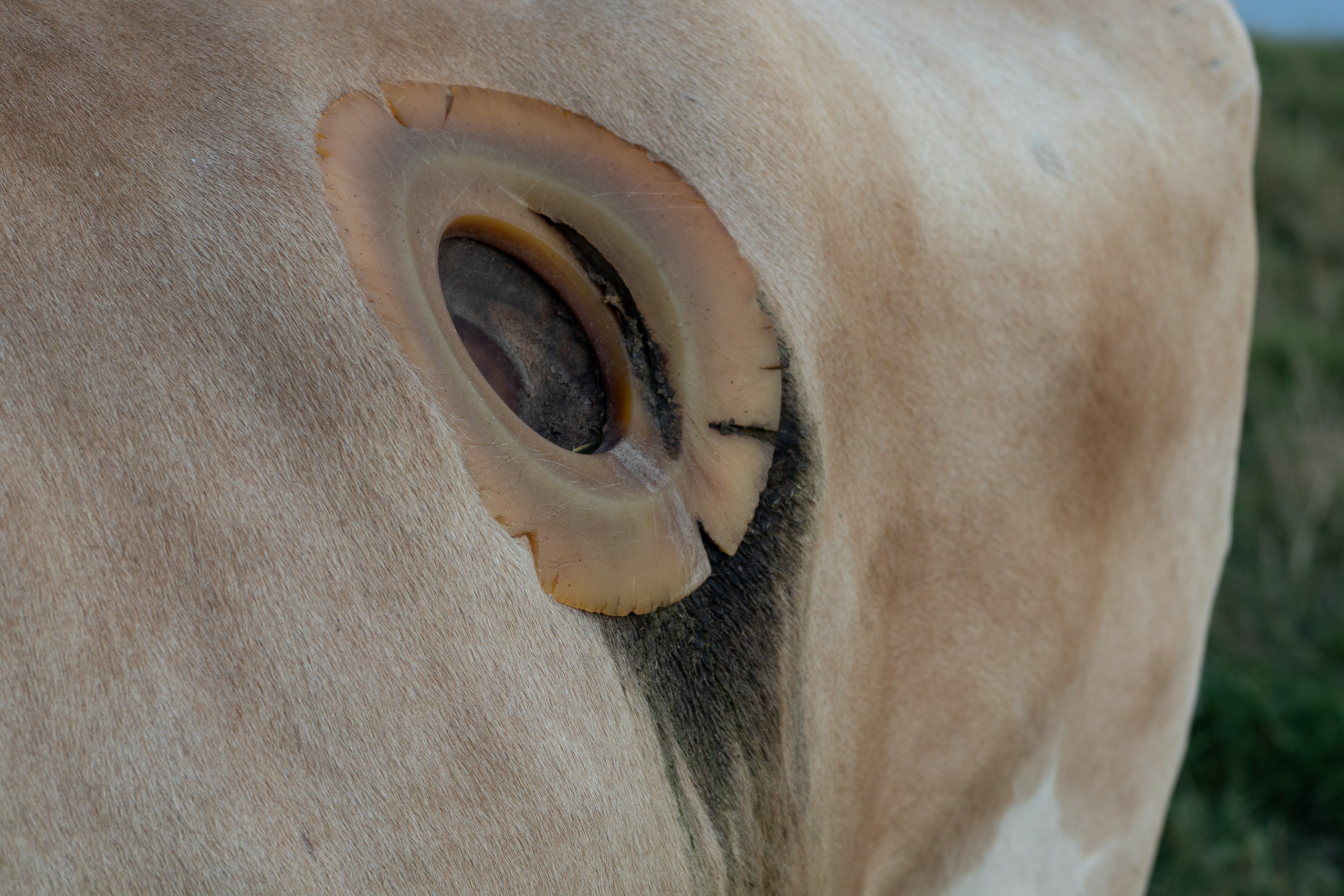
Cow surgically fitted with a cannula

Cow surgically fitted with a cannula
A cannulated cow or fistulated cow refers to a cow that has been surgically fitted with a cannula. A cannula acts as a porthole-like device that allows access to the rumen of a cow, to perform research and analysis of the digestive system and to allow veterinarians to transplant rumen contents from one cow to another.
The practice of rumen cannulation was first documented in 1928 by Arthur Frederick Schalk and R.S. Amadon of North Dakota Agricultural College.
Surgical implantation
Cannulation requires installing a flanged rubber cylinder in the side of a cow, behind its 13th rib. The cylinder typically is fitted with a plastic, rubber, or metal cap to keep the rumen anaerobic.
The rubber cannula is surgically implanted while the cow is standing and awake, with local anesthetic. The cow is made to fast and refrain from drinking water for 24 hours in advance of the surgery. Then the veterinarian excises a small piece of the cow's skin, makes an incision through the rumen, and stitches the open sides of the rumen to the edges of skin, to prevent the contents of the rumen from leaking into the rest of the abdominal cavity. Finally, the inner flange of the cannula is pushed inside the rumen and capped.
Reasons for cannulation
Cannulas are typically implanted in healthy cows to research cow digestion in a university setting, to analyze the nutritional quality of feed in an agricultural setting, or to improve the microbiome of a cow with digestive disturbance in a veterinary or agricultural setting.
Digestive research
By analyzing the chemical composition of a cow's rumen, researchers can determine the effects of different feeds and processes on bovine digestion. Many of the earliest documented reports of cannulated cows were made by researchers working to understand how feed is processed through cows. For instance, a 1939 study discovered via cannulated cows that the pH of rumen varies throughout the day, becoming most alkaline just prior to feeding. A 1956 study used cannulated cows to determine that a hay-only diet does not change the proportion of fatty acids in a cow's rumen, but every other type of feed measured does.
Forage analysis
Measuring the composition of a cow's rumen can also indicate the quality of its feed, a process called a forage analysis.
Once the cannula is surgically placed, the cow is then allowed to graze for a certain period of time—for example, 30 to 45 minutes, in a 1960 study at the University of Nevada, Reno. Researchers will then remove some or all of the ruminated material through the cannula. Analyzing rumen this way can indicate whether particular grasses on which cows are grazing are nutritionally adequate.
Transfaunation
Veterinary schools, veterinary hospitals, and bovine farming operations in North America often keep a healthy fistulated cow as a microbiota donor. Large animal veterinarians will pull the contents by hand from the healthy cow's rumen system to help repopulate the fauna in a sick cow's rumen. This process is called transfaunation, or a microbiota transplant.
In Europe, the fistulation of cows to provide rumen contents for transfaunation is considered unethical, and is not practised. Instead, rumen liquor is aspirated through a rumen-fluid collector, consisting of a Frick gag and a flexible hose with a perforated metal tip which serves as a filter. The hose and tip is passed through the gag and down the oesophagus to the rumen. It is normally possible to aspirate five litres of rumen liquor using this device.
Rumen contents from a fistulated cow can also help sheep and goats, which have similar digestive systems.
A 2014 review of rumen transfaunation research indicated that the procedure has been demonstrated to help correct indigestion resulting from illness, surgical correction of displaced abomasum, and ingestion of toxic plants.
Ethical implications
Though veterinarians and bovine farmers point to the effectiveness of transfaunation for treating digestive disease, many animal rights groups argue that the practice is unnecessarily harmful to the quality of life of the cannulated cow. Use of a rumen-fluid collector instead of fistulation is well tolerated by the donor cow. People for the Ethical Treatment of Animals points to the surgery's four- to six-week recovery period and suggests that arguments for the health benefits of cannulation obscure the profit motive of the dairy industry: "While some claim that this transfer can improve the health of cows, the procedure seems mostly to benefit the meat and dairy industries' bottom lines—optimizing food and digestion for animals who will ultimately be exploited and slaughtered." Similarly, The New Zealand Anti-Vivisection Society describes the practice as "cruel, insensitive and barbaric [...] the epitome of using cows as mere objects, like cars with gas tanks."
The fact-checking site Snopes has argued that the description of a circulating video of a cannulated cow as "abuse" is a "miscategorization," saying that cannulation "is neither a form of abuse nor a method to increase dairy production." However, rumen cannulation has long been used by the dairy industry to study methods that improve milk production. For instance, a 1940 study used cannulated cows to determine that a vitamin-rich diet makes for more antiscorbutic milk than a vitamin-poor diet, and a 2004 study used cannulated cows to evaluate treatments for a pH imbalance called subacute ruminal acidosis that is of concern to dairy farmers primarily because it damages milk production.
References
References
- (21 June 2019). "Why are portholes being used on cows?". [[BBC News]].
- (1928). "Physiology of the ruminant stomach (bovine)". Agricultural Experiment Station, North Dakota Agricultural College.
- (2008). "Rumen Cannulation: Procedure and Use of a Cannulated Bovine". Veterinary Clinics Food Animal Practice.
- (1 December 1939). "A Study of the pH Values of the Ingesta of the Bovine Rumen". Journal of Dairy Science.
- (1957). "Volatile fatty acids and lactic acid in the rumen of dairy cows receiving a variety of diets". British Journal of Nutrition.
- (1 May 1960). "Development of Techniques for Evaluating Grazed Forage1". Journal of Dairy Science.
- (1 October 2010). "Comparison of Forage Sampling Method to Determine Nutritive Value of Bahiagrass Pastures". The Professional Animal Scientist.
- (12 September 2014). "Holey Cow: The Wonderful World of a Fistulated Cow".
- "The Amazing and Wondrous Fistulated Cow".
- (1 December 2014). "Rumen transfaunation". Immunology Letters.
- (26 May 2016). "Why Do These Cows Have Holes Drilled Into Their Sides?".
- (12 March 2020). "Lincoln Uni cows used for 'cruel and barbaric' research".
- (18 April 2016). "FACT CHECK: Does a Video of a Fistulated Cow Document Abuse by the Dairy Industry?".
- (1 May 1940). "Destruction of Ascorbic Acid in the Rumen of the Dairy Cow.". Proceedings of the Society for Experimental Biology and Medicine.
- (1 January 2004). "Comparison of Techniques for Measurement of Rumen pH in Lactating Dairy Cows". Journal of Dairy Science.
This article was imported from Wikipedia and is available under the Creative Commons Attribution-ShareAlike 4.0 License. Content has been adapted to SurfDoc format. Original contributors can be found on the article history page.
Ask Mako anything about Cannulated cow — get instant answers, deeper analysis, and related topics.
Research with MakoFree with your Surf account
Create a free account to save articles, ask Mako questions, and organize your research.
Sign up freeThis content may have been generated or modified by AI. CloudSurf Software LLC is not responsible for the accuracy, completeness, or reliability of AI-generated content. Always verify important information from primary sources.
Report