From Surf Wiki (app.surf) — the open knowledge base
Bulgarian lev
Currency of Bulgaria from 1880 to 2025

Currency of Bulgaria from 1880 to 2025
| Field | Value |
|---|---|
| name | Bulgarian lev |
| local_name | български лев |
| image_1 | The First Bulgarian Banknote Frontside.png |
| image_title_1 | The first Bulgarian banknote, 1885 |
| image_title_2 | Bulgarian lev lv.1 banknote |
| iso_code | BGN |
| issuing_authority | Bulgarian National Bank |
| issuing_authority_website | |
| date_of_introduction | |
| date_of_withdrawal | 31 December 2025 |
| replaced_by_currency | Euro |
| using_countries | None, previously: |
| inflation_rate | 2.2% |
| inflation_method | Consumer price index (CPI) |
| ERM_since | 10 July 2020 |
| euro_replace_non_cash | 1 January 2026 |
| euro_replace_cash | 1 February 2026 |
| ERM_fixed_rate | BGN 1.95583 |
| ERM_band | 15.0% *de jure*; 0.0% *de facto* |
| pegged_with | Euro (€) = 1.95583 leva |
| subunit_ratio_1 | |
| subunit_name_1 | stotinka |
| symbol | |
| symbol_comment | The abbreviation лв. (lv.) is used |
| symbol_subunit_1 | ст. (st.) |
| nickname | *kint* |
| plural | levove, numeric: leva |
| plural_subunit_1 | stotinki |
| used_coins | 1, 2, 5, 10, 20, 50 st., 1 lev, 2 leva |
| used_banknotes | 5, 10, 20, 50, 100 leva |
| printer | Bulgarian National Bank |
| printer_website | https://www.bnbprint.com/en |
| mint | Bulgarian Mint, Sofia |
| mint_website | |
| obsolete | yes |
The lev (лев; plural: лева, левове; lev, leva, levove; ISO 4217 code: BGN) was the currency of Bulgaria from 1880 to 2025. The euro replaced the lev on 1 January 2026; during the cash changeover period (1–31 January 2026), the lev and the euro circulated in parallel for cash payments, and from 1 February 2026 the euro became the sole legal tender in Bulgaria.
The name lev derives from an archaic Bulgarian word meaning "lion" (modern лъв, lǎv, ). The lev was subdivided into 100 stotinki (стотинки; singular: стотинка, stotinka); the term is derived from the Bulgarian word for "hundred" (сто, sto) and is modelled on the French centime. On Bulgarian euro coinage, the denominations below one euro use the inscriptions СТОТИНКА / СТОТИНКИ as the Bulgarian equivalent of "cent".
Under a currency board introduced in 1997, the lev was initially pegged to the Deutsche Mark (1,000 BGL = 1 DEM). Since 1999, the peg was expressed against the euro at a fixed rate of 1 EUR = 1.95583 BGN. The lev joined the European Exchange Rate Mechanism (ERM II) on 10 July 2020 with the same central rate.
Etymology
The currency's name comes from the archaic Bulgarian word "lev", which meant lion, just like the Romanian leu. In both cases, the lion refers to the Dutch thaler (leeuwendaalder "lion thaler/dollar"). The Dutch leeuwendaalder was imitated in several German and Italian cities, and these coins circulated in Romania, Moldova and Bulgaria and gave their name to their respective currencies: the Romanian leu, the Moldovan leu and the Bulgarian lev.
Bulgarian national mythologising historiography has produced much content on the lion connection, presenting it as the national symbol of Bulgaria throughout centuries. Lions were common in the region until about 300 BC. In Bulgaria, the lion features in numerous historical monuments. The oldest images, found on slates in the city of Stara Zagora, date back to the 9th–10th century AD. A lion is depicted on The Madara Horseman – an impressive medieval rock relief carved into a towering rock plateau in north-eastern Bulgaria in the 7th or 8th century AD, which is on UNESCO's World Heritage List. In the Middle Ages, Bulgarian kings such as Ivan Shishman, one of the last rulers of the Second Bulgarian kingdom, celebrated the lion as a symbol of power.
In the time of Bulgarian national awakening in the years of Ottoman rule, the lion was considered and widely used as a major national symbol. Paisii of Hilendar, a discerning monk and a key Revival figure, mentioned in his ground-breaking tome Istorija Slavjanobolgarskaja that Bulgarians had a lion on their kings' royal seal: a symbol of the bravery, courage and invincibility of Bulgarian warriors, who fought "like lions."
Lion images on revolutionary flags, used in the 1876 April uprising, demonstrate that the lion continued to be considered as a national symbol. In the immediate period leading up to the revolt, revolutionary flags were made, featuring a golden lion rampant and the motto "Freedom or Death". Some of these flags, most often hand-made by local teachers or icon painters, have been preserved in Bulgarian museums to the present day. Most flags were made of green silk and had a painted or embroidered lion on them, in a heraldic posture and trampling over the Crescent – the symbol of the Ottoman Empire. The same image can be seen on other rebel-produced items such as hats and buttons. In Bulgarian folklore and Revival Literature, these lion depictions were called lion signs and associated with Bulgarian revolutionaries'.
History
{{anchor|1st}}{{anchor|BGJ}}First lev (1881–1952)
The lev was introduced as Bulgaria's currency in 1881 with a value equal to the French franc. The gold standard was suspended between 1899 and 1906 and suspended again in 1912. Until 1916, Bulgaria's silver and gold coins were issued to the same specifications as those of the Latin Monetary Union. Banknotes issued until 1928 were backed by gold (leva zlato / zlatni, лева злато / златни) or silver (leva srebro / srebarni, лева сребро / сребърни).
In 1928, a new gold standard of 1 lev = 10.86956 mg gold was established.
During World War II, in 1940, the lev was pegged to the German Reichsmark at a rate of 32.75 leva = 1 Reichsmark. With the Soviet occupation in September 1944, the lev was pegged to the Soviet ruble at 15 leva = 1 ruble. A series of pegs to the U.S. dollar followed: 120 leva = 1 dollar in October 1945, 286.50 leva in December 1945 and 143.25 leva in March 1947. No coins were issued after 1943; only banknotes were issued until the currency reform of 1952.
,_Bulgarije._1888_barcode_800000091795_(2).jpg)
Coins
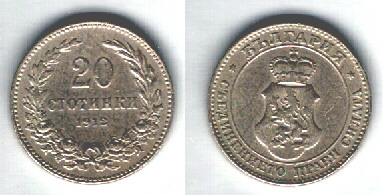
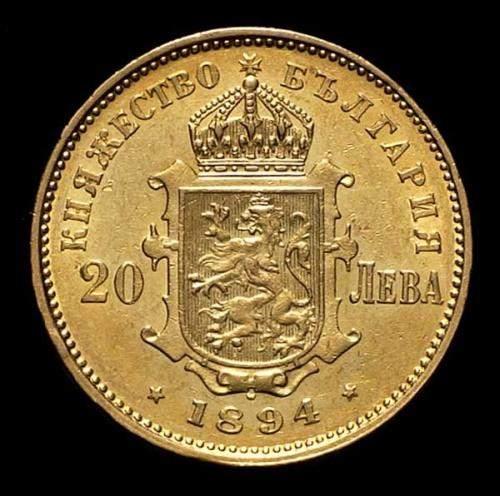
Between 1881 and 1884, bronze 2, 5, and 20 stotinki, and silver 50 stotinki, 1, 2, and 5 leva were introduced, followed, in 1888, by cupro-nickel , 5, 10, and 20 stotinki. Gold 10 and 20 leva were issued in 1894. Bronze 1 stotinka were introduced in 1901.
Production of silver coins ceased in 1916, with zinc replacing cupro-nickel in the 5, 10, and 20 stotinki in 1917. In 1923, aluminum 1 and 2 leva coins were introduced, followed by cupro-nickel pieces in 1925. In 1930, cupro-nickel 5 and 10 leva and silver 20, 50, and 100 leva were introduced, with silver coins issued until 1937, in which year aluminium-bronze 50 stotinki were issued.
In 1940, cupro-nickel 20 and 50 leva were issued, followed, in 1941, by iron 1, 2, 5, and 10 leva. In 1943, nickel-clad-steel 5, 10 and 50 leva were struck. These were the last coins issued for this version of the lev.
Banknotes

In 1885, the Bulgarian National Bank introduced notes for 20 and 50 gold leva, followed in 1887 by 100 gold leva and, in 1890, by 5 and 10 gold leva notes. In 1899, 5, 10 and 50 silver leva notes were issued, followed by 100 and 500 silver leva in 1906 and 1907, respectively. 500 gold leva notes were also introduced in 1907.

In 1916, 1 and 2 silver leva and 1000 gold leva notes were introduced, followed by 2500 and 10,000 gold leva notes in 1919. In 1924, 5000 leva notes were issued, the first to lack a metal designation. In 1928, a new series of notes (dated 1922 and 1925) was introduced which gave the denominations solely in leva. Denominations introduced were 5, 10, 20, 50, 100, 500, 1000 and 5000 leva. These were followed in 1929 by 200 and 250 leva.
In 1930, coins up to 100 leva replaced notes, although 20-lev notes were issued between 1943 and 1950. Between 1943 and 1945, State Treasury Bills for 1000 and 5000 leva were issued.
{{anchor|2nd}}{{anchor|BGK}}Second lev (1952–1962)
In 1952, following wartime inflation, a new lev replaced the original lev at a rate of 1 "new" lev = 100 "old" leva. However the rate for banking accounts was different, ranging from 100:3 to 200:1. Prices for goods were replaced at a rate of 25:1. The new lev was pegged to the U.S. dollar at a rate of 6.8 leva = 1 dollar, falling to 9.52 leva on July 29, 1957.
Coins
In 1952, coins (dated 1951) were introduced in denominations of 1, 3, 5, 10 and 25 stotinki, with the lower three denominations in brass and the higher two in cupro-nickel. Shortly after, cupro-nickel 20 stotinki coins dated 1952 were also issued, followed by 50 stotinki in 1959 and 1 lev in 1960 which replaced the 1 lev note (both also in cupro-nickel). All stotinki coins feature a head of wheat around denomination on the reverse and state emblem on the obverse, while the lev coin depicts an olive branch wreath around the denomination.
Banknotes
In 1952, state notes (dated 1951) were issued in 1, 3 and 5 leva, together with notes of the National Bank for 10, 25, 50, 100 and 200 leva. 500-lev notes were printed but not issued. 1 lev notes were withdrawn after the introduction of a coin in 1960. 1, 3, and 5 leva depict the state emblem, while all denominations 10 leva and up depict Georgi Dimitrov, who had a post-mortem cult of personality built up around him by that time period. The reverse side of 1 lev, 3 and 5 leva notes depict hands holding up the hammer and sickle, while higher denominations each depict workers at various trades.
{{anchor|3rd}}{{anchor|BGL}}Third lev (1962–1999)
In 1962, another redenomination took place at the rate of 10 to 1, setting the exchange rate at 1.17 leva = 1 U. S. dollar, with the tourist rate falling to 2 leva on February 1, 1964. The ISO 4217 code was ****. After this, the lev remained fairly stable for almost three decades. However, like other Communist countries' currencies, it was not freely convertible for Western funds. Consequently, black market rates were five to ten times higher than the official rate. During the period, until 1989 the lev was backed by gold, and the banknotes have the text stating: "The bank note is backed by gold and all assets of the bank" ().
After the fall of communism, Bulgaria experienced several episodes of drastic inflation and currency devaluation. In order to change this, in 1997, the lev was pegged to the Deutsche Mark, with 1,000 leva equal to 1 DM (one lev equal to 0.1 pfennig).
Since 1997, Bulgaria has been in a system of a currency board, and all Bulgarian currency in circulation has been completely backed by the foreign exchange reserves of the Bulgarian National Bank (BNB).
Coins
In 1962, aluminum-bronze 1, 2, and 5 stotinki, and nickel-brass 10, 20 and 50 stotinki and 1 lev were introduced. The coin series strongly resembles coinage from the Soviet Union during the same period, particularly in design and size.
The state emblem is depicted on the obverse of all coins, which went through several changes. The first change in 1962 with the introduction of the new coinage, and the second change in 1974, with the ribbons being the most noticeable change.
A number of commemorative 2 leva coins also circulated during this period, often released into circulation as they had relatively high production numbers and little collector's value. Higher denomination lev coins have also been introduced into circulation at an irregular basis with varying sizes and metallic compositions, including silver. Mostly due to an overstock of numismatic coins not getting sold to collectors. Similar occurrences to this can be seen with high denomination coins from East Germany and Poland during the same period.
| Image | Denomination | Diameter | Weight | Composition | Obverse | Reverse | Minted Year |
|---|---|---|---|---|---|---|---|
| 1 stotinka | 15.2 mm | 1 g | Brass | Coat of Arms | Denomination and date | 1951-1990 | |
| 2 stotinki | 18.1 mm | 2 g | |||||
| 3 stotinki | 19.8 mm | 2.4 g | |||||
| 5 stotinki | 22.35 mm | 3.1 g | |||||
| 10 stotinki | 17.1 mm | 1.8 g | Nickel-brass and copper-nickel | ||||
| 20 stotinki | 21.2 mm | 2.9 g | |||||
| 25 stotinki | 22 mm | 3.3 g | |||||
| 50 stotinki | 23.3 mm | 4.2 g | |||||
| 1 lev | 24 mm | 4.8 g |
Post-communist coins
In 1992, after the communist era, older coins were withdrawn and a new coinage was introduced in denominations of 10, 20 and 50 stotinki, 1, 2, 5 and 10 leva. All were struck in nickel-brass except for the cupro-nickel 10 leva. In 1997, nickel-brass 10, 20 and 50 leva were introduced.
Banknotes
In 1962, the National Bank issued notes for 1, 2, 5, 10 and 20 leva. A second series, in the same denominations, was issued in 1974. 50 leva notes were introduced in 1990. Again, denominations 10 leva and up featured Georgi Dimitrov, 1, 2, and 5 featured the state emblem. After the fall of the communist regime, new notes were introduced for 20, 50, 100 and 200 leva. These were followed by 500 leva notes in 1993, 1000 and 2000 leva in 1994, 5000 and 10,000 leva in 1996 (re-released with new design and look in 1997), and 50,000 leva in 1997. Furthermore, two new banknotes of 20,000 and 100,000 leva were scheduled to be introduced in 1997 and 1998, but their production was cancelled following the introduction of currency board in 1997.
{{anchor|4th}}{{anchor|BGN}}Fourth lev (1999–2025)
On 5 July 1999 the lev was redenominated at 1000:1 with 1 new lev equal to 1 Deutsche Mark. The ISO 4217 currency code for the new Bulgarian lev is BGN. The lev is pegged at €1 = 1.95583 leva (previously DEM 1 = BGN 1, continuing the fixed exchange rate from the third lev).
Coins
In 1999, coins in denominations of 1, 2, 5, 10, 20 and 50 stotinki were introduced. A 1 lev coin replaced the 1 lev banknote in 2002, and a 2 leva coin replaced the 2 leva banknote in 2015.
| Image | Value | Equivalent in euros | Technical Parameters | Description | Date of | Diameter | Mass | Composition | Edge | Obverse | Reverse | minting | Issue | Withdrawal | Lapse |
|---|---|---|---|---|---|---|---|---|---|---|---|---|---|---|---|
| [[File:Bulgaria 1 Stotinka 2000.jpg | 100px]] | 1 stotinka | €0.005 | 16 mm | 1.8g | 1999 - CuAlNi | |||||||||
| 2000 - Steel covered with bronze | Plain | Value, year, twelve stars as symbol of Europe. | Country name, Madara Rider | 1999 | |||||||||||
| 2000 | 5 July 1999 | 31 January 2026 | Indefinitely | ||||||||||||
| 2 stotinki | €0.010 | 18 mm | 2.5 g | ||||||||||||
| 5 stotinki | €0.025 | 20 mm | 3.5 g | ||||||||||||
| 10 stotinki | €0.051 | 18.5 mm | 3.0 g | CuNiZn | reeded | 1999 | |||||||||
| 20 stotinki | €0.102 | 20.5 mm | 4.0 g | ||||||||||||
| 50 stotinki | €0.255 | 22.5 mm | 5.0 g | ||||||||||||
| 1 lev | €0.511 | 24.5 mm | 7.0 g | Bimetallic: copper-nickel center in brass ring | Alternating smooth and reeded segments | Value, year, graphical pattern of two crossing lines. | Country name, saint Ivan Rilski | 2002 | 2 September 2002 | ||||||
| 2 leva | €1.022 | 26.5 mm | 9.0 g | Bimetallic: nickel brass center in copper-nickel ring | Segmented reeding | Country name, Paisius of Hilendar | 2015 | 7 December 2015 |
Commemorative coins
Main article: Commemorative coins of Bulgaria
In 2004, 2005, and 2007, commemorative circulation issues were struck of the 50 stotinki coin. In 2018, a commemorative circulation issue of the 2 leva coin was issued. These coins were not found in general circulation.
Many commercial commemorative coins have also been minted.
Banknotes
In 1999, banknotes were introduced in denominations of 1, 2, 5, 10, 20, and 50 leva. 100 leva notes were added in 2003. The 1 and 2 leva notes were later replaced by coins of similar value and withdrawn from circulation.
| Image | Value | Equivalent in euros | Dimensions | Description | Date of | Obverse | Reverse | Obverse | Reverse | Watermark | Printing | Issue | Withdrawal | Lapse |
|---|---|---|---|---|---|---|---|---|---|---|---|---|---|---|
| [http://banknote.ws/COLLECTION/countries/EUR/BUL/BUL0114.htm](http://banknote.ws/COLLECTION/countries/EUR/BUL/BUL0114.htm) | [http://banknote.ws/COLLECTION/countries/EUR/BUL/BUL0114.htm](http://banknote.ws/COLLECTION/countries/EUR/BUL/BUL0114.htm) | 1 lev | €0.511 | 112 × 60 mm | Ivan Rilski | Rila Monastery | Rampant lion | 1999 | 5 July 1999 | 1 January 2016 | Indefinitely | |||
| [http://banknote.ws/COLLECTION/countries/EUR/BUL/BUL0115.htm](http://banknote.ws/COLLECTION/countries/EUR/BUL/BUL0115.htm) | [http://banknote.ws/COLLECTION/countries/EUR/BUL/BUL0115.htm](http://banknote.ws/COLLECTION/countries/EUR/BUL/BUL0115.htm) | 2 leva | €1.022 | 116 × 64 mm | Paisiy Hilendarski | Istoriya Slavyanobolgarskaya | 1999 | |||||||
| 2005 | 1 January 2021 | |||||||||||||
| [http://banknote.ws/COLLECTION/countries/EUR/BUL/BUL0116.htm](http://banknote.ws/COLLECTION/countries/EUR/BUL/BUL0116.htm) | [http://banknote.ws/COLLECTION/countries/EUR/BUL/BUL0116.htm](http://banknote.ws/COLLECTION/countries/EUR/BUL/BUL0116.htm) | 5 leva | €2.556 | 121 × 67 mm | Ivan Milev | Paintings by Ivan Milev | Ivan Milev | 1999 | ||||||
| 2009 | ||||||||||||||
| 2020 | 31 January 2026 | |||||||||||||
| [http://banknote.ws/COLLECTION/countries/EUR/BUL/BUL0117.htm](http://banknote.ws/COLLECTION/countries/EUR/BUL/BUL0117.htm) | [http://banknote.ws/COLLECTION/countries/EUR/BUL/BUL0117.htm](http://banknote.ws/COLLECTION/countries/EUR/BUL/BUL0117.htm) | 10 leva | €5.112 | 126 × 70 mm | Petar Beron | Astronomical instruments | Petar Beron | 1999 | ||||||
| 2008 | ||||||||||||||
| 2020 | ||||||||||||||
| [http://banknote.ws/COLLECTION/countries/EUR/BUL/BUL0118.htm](http://banknote.ws/COLLECTION/countries/EUR/BUL/BUL0118.htm) | [http://banknote.ws/COLLECTION/countries/EUR/BUL/BUL0118.htm](http://banknote.ws/COLLECTION/countries/EUR/BUL/BUL0118.htm) | 20 leva | €10.225 | 131 × 73 mm | Stefan Stambolov | Orlov most, Lavov most | Stefan Stambolov | 1999 | ||||||
| 2005 | ||||||||||||||
| 2007 | ||||||||||||||
| 2020 | ||||||||||||||
| [http://banknote.ws/COLLECTION/countries/EUR/BUL/BUL0119.htm](http://banknote.ws/COLLECTION/countries/EUR/BUL/BUL0119.htm) | [http://banknote.ws/COLLECTION/countries/EUR/BUL/BUL0119.htm](http://banknote.ws/COLLECTION/countries/EUR/BUL/BUL0119.htm) | 50 leva | €25.564 | 136 × 76 mm | Pencho Slaveykov | Poems by Pencho Slaveykov | Pencho Slaveykov | 1999 | ||||||
| 2006 | ||||||||||||||
| 2019 | ||||||||||||||
| [http://banknote.ws/COLLECTION/countries/EUR/BUL/BUL0120.htm](http://banknote.ws/COLLECTION/countries/EUR/BUL/BUL0120.htm) | [http://banknote.ws/COLLECTION/countries/EUR/BUL/BUL0120.htm](http://banknote.ws/COLLECTION/countries/EUR/BUL/BUL0120.htm) | 100 leva | €51.129 | 141 × 79 mm | Aleko Konstantinov | Aleko Konstantinov; his work "Bay Ganyo" | Aleko Konstantinov | 2003 | ||||||
| 2018 | 8 December 2003 |
Euro adoption
Main article: Bulgaria and the euro
The euro officially replaced the Bulgarian lev on 1 January 2026, but the lev could be used for cash payments until 31 January 2026 alongside the euro. The Bulgarian National Bank (BNB) will continue to exchange free of charge any remaining lev banknotes and coins indefinitely.
Notes
References
- (1 January 2026). "Bulgaria celebrates entry into euro zone, lev currency banished into history".
- [https://web.archive.org/web/20250130115022/https://www.nsi.bg/sites/default/files/files/pressreleases/Inflation2024-12_VECD87X.pdf INFLATION AND CONSUMER PRICE INDICES FOR DECEMBER 2024. National Statistical Institute, December 2024]
- (10 July 2020). "Communiqué on Bulgaria".
- The nickname for ''lev'' can be both ''kint'' (masc) and ''kinta'' (fem), inflected accordingly for plurals and numerical values (''kinta, kinti''); ''stotinka'' – which literally simply means ''hundreth'' (diminutive) – is usually shortened to ''stinka''.
- (2012-08-31). "Lev". Merriam-Webster.
- "Bulgaria joins the euro area". European Central Bank.
- "Business clients: Information about euro adoption". DSK Bank.
- (2025-11-24). "Bulgaria: Staff Report for the 2025 Article IV Consultation". International Monetary Fund.
- (2020-07-10). "ERM II – the EU's Exchange Rate Mechanism". European Commission.
- "Elementary school Sesvetska Sopnica - Erasmus+ Internship - Bulgarian currency - lev (лев)".
- [http://bnr.ro/Euro-Exhibition---Opening-Speech-by-Mugur-Isarescu,-NBR-Governor--6613.aspx Euro Exhibition - Opening Speech by Mugur Isărescu, NBR Governor]{{Dead link. (February 2024)
- link. (29 November 2021 , BNR.ro)
- [http://www.oanda.com/currency/iso-currency-codes/RON Romanian New Leu], oanda.com
- "Online Etymology Dictionary".
- Trankova, Dimana. (2018-04-02). "LIONS OF BULGARIA".
- (2013). "Western European Quaternary lions: new working hypotheses". Biological Journal of the Linnean Society.
- Guggisberg, C. A. W.. (1975). "Wild Cats of the World". Taplinger Publishing.
- "Opening of the exhibition 'Lion – the Bulgarian national symbol of the Renaissance'".
- "Bulgaria".
- Bezovska, Albena. (2010-09-24). "Folk Studio – the Legendary Bulgarian Lion".
- "Нула = Нищо. А Три Нули?". Euro2001.net.
- (1952-05-12). "BULGARIA 500 LEVA 1951". Banknotesinfo.com.
- "Нова банкнота от 10 хил. лева влиза в употреба". Capital.bg.
- "НОМИНАЛИТЕ НА ДЕМОКРАЦИЯТА".
- "Prof. Dr. Ivan Angelov: Bulgaria needs a managed floating exchange rate".
- National Bank of Bulgaria. Annual Report 1999. Available at: http://www.bnb.bg/bnbweb/groups/public/documents/bnb_publication/p_anualreports_1999_en.pdf
- "Присъединяване към еврозоната - Въпроси и отговори".
- National Bank of Bulgaria. Annual Report 2002. Available at: http://www.bnb.bg/bnbweb/groups/public/documents/bnb_publication/p_anualreports_2002_en.pdf
- National Bank of Bulgaria. Press release: Today BNB presented a new circulation coin of 2 levs nominal value, issue 2015. Available at: https://www.bnb.bg/PressOffice/POPressReleases/POPRDate/PR_20151126_2LV_EN
- "(untitled)".
- Bulgarian national bank. Press release. Available at https://www.bnb.bg/PressOffice/POPressReleases/POPRDate/PR_20151212_EN
- Bulgarian national bank. Press release. Available at https://www.bnb.bg/PressOffice/POPressReleases/POPRDate/PR_20201229_EN
- National Bank of Bulgaria. Annual Report 2003. Available at: http://www.bnb.bg/bnbweb/groups/public/documents/bnb_publication/p_anualreports_2003_en.pdf
- "Bulgaria joins the euro area". European Central Bank.
This article was imported from Wikipedia and is available under the Creative Commons Attribution-ShareAlike 4.0 License. Content has been adapted to SurfDoc format. Original contributors can be found on the article history page.
Ask Mako anything about Bulgarian lev — get instant answers, deeper analysis, and related topics.
Research with MakoFree with your Surf account
Create a free account to save articles, ask Mako questions, and organize your research.
Sign up freeThis content may have been generated or modified by AI. CloudSurf Software LLC is not responsible for the accuracy, completeness, or reliability of AI-generated content. Always verify important information from primary sources.
Report