From Surf Wiki (app.surf) — the open knowledge base
Bukit Panjang LRT line
Light rail transit line in Singapore
Light rail transit line in Singapore
| Field | Value |
|---|---|
| box_width | width:12em; |
| name | Bukit Panjang LRT |
| color | |
| logo | BPLRT logo.svg |
| logo_width | 250px |
| image | File:BP1 Choa Chu Kang LRT Platform 1 20210217 155354.jpg |
| image_width | 280px |
| caption | C801A trains in a two-car formation on the Bukit Panjang LRT. |
| native_name | |
| 武吉班让轻轨线 | |
| status | Operational |
| owner | Land Transport Authority |
| locale | Singapore |
| start | Choa Chu Kang |
| end | Choa Chu Kang |
| stations | 13 |
| mapcolor | Grey (#) |
| type | Automated guideway transit |
| People mover | |
| system | Light Rail Transit (Singapore) |
| routes | 2 |
| operator | SMRT Trains Ltd (SMRT Corporation) |
| depot | Ten Mile Junction |
| stock | Bombardier Innovia APM 100 (C801A) |
| Bombardier Innovia APM 300R (C801B) | |
| daily_ridership | 64,781 (July 2020) |
| open | |
| linelength | 8 km |
| character | Fully elevated |
| gauge | 2642 mm central guideway with rubber tyres |
| electrification | 600 V 50 Hz 3-phase AC third rail |
| signalling | Current: Bombardier CITYFLO 550 fixed block ATC under ATO GoA 4 (UTO), with subsystems of ATP, ATS and CBI |
| Future: Alstom Cityflo 650 moving block CBTC ATC under ATO GoA 4 (UTO), with subsystems of ATP, ATS and CBI | |
| map_name | Route diagram |
| map | |
| map_state | hide |
the LRT line
武吉班让轻轨线
People mover Bombardier Innovia APM 300R (C801B) Future: Alstom Cityflo 650 moving block CBTC ATC under ATO GoA 4 (UTO), with subsystems of ATP, ATS and CBI
The Bukit Panjang LRT (abbreviation: BPLRT) is an 8 km automated guideway transit line in Bukit Panjang, Singapore. The BPLRT is currently the only Light Rail Transit (LRT) line operated by SMRT Trains. As the name suggests, it serves 13 stations in the neighbourhoods of Bukit Panjang and Choa Chu Kang in the north-west area of the country. The line was the first LRT line constructed in Singapore, having been opened on 6 November 1999 by then-Deputy Prime Minister Tony Tan.
It is a fully elevated and automated people mover system. The line currently uses the C801A and C801B rolling stock supplied by Bombardier (now Alstom), running in a two-car formation. With a 20-year design lifespan, a major overhaul of the system began in 2019 that is scheduled to complete in 2026, which include a new signalling system (Innovia APM 300R) and power rails system, as well as rolling stock.
History
Planning and construction
In November 1994, Communication Minister Mah Bow Tan announced that the Mass Rapid Transit Corporation (MRTC) was conducting studies on the feasibility of a Light Rail Transit (LRT) system in the estate of Bukit Panjang. Subsequently, Bukit Panjang was one of the two locations selected for the construction of the first LRT systems in Singapore in December 1994, the other being at Queenstown and linked to Buona Vista MRT station, the latter of which was eventually not built. The tender for the design and construction of the LRT system in Bukit Panjang were called in December 1994, receiving eight bids.
In February 1996, then-Prime Minister Goh Chok Tong announced that an LRT system in Bukit Panjang had been given the go-ahead, and was expected to be completed in three years. An exhibition about the system was organised by the Land Transport Authority (LTA) in April 1996, featuring models and maps of the stations on the line, and a booth at which visitors could vote for the colours of the rolling stock, and the shape of the station roofs. In the same month, the contract for the system's design and construction was awarded to a consortium consisting of Keppel Corporation, Gammon, and Adtranz for .
On 5 August 1997, the LTA awarded SMRT a license to operate the LRT due to its experience with the MRT system. Testing on the line was underway by December 1998 and it commenced operations on 6 November 1999.
Reliability issues
Upon opening, the system suffered from reliability issues, having 32 service disruptions in its first six months of operation. Safety concerns regarding the system were also raised in Parliament in the wake of a collision between two trains in November 2000 that injured five passengers. Most of these issues were rectified by September 2001, and, by May 2002, the system was able to attain the government's desired service levels.
However, a subsequent five-day service disruption in October 2002, caused by a loose guide wheel, led the LTA to conduct an audit on the maintenance procedures carried out for the line. The audit found that the training and procedures for maintenance were adequate, but the actual maintenance work was not properly done, and the LTA gave the line's operator, Singapore LRT, six months to rectify the lapses found in the audit.
To rectify the issues with the system, Singapore LRT spent to replace worn-out wires in the line's signalling system, from December 2003 to April 2004. Service levels on the line had improved to adequate standards by 2003, but a subsequent disruption of service in May 2004 led to the line's operator initiating an internal probe into the matter.
Besides the reliability issues, the line was doing poorly financially, with Singapore LRT making annual losses of around to . Ridership on the line was also low, with around 40,000 commuters daily, 10,000 less than needed to break even, and was not expected to increase further, given a development slowdown in Bukit Panjang.
Upgrades and capacity increases
By 2010, ridership on the line had increased significantly, to around 47,000 commuters daily, and was expected to increase further. As the trains on the line had limited capacity to meet the demand, in November 2010, SMRT announced that they were contemplating capacity increases on the line. These capacity increases, in the form of 13 additional train cars, and a supplementary bus service between heavily used stations on the line and Choa Chu Kang, were announced by then-Transport Minister Lui Tuck Yew in July 2011. In addition, SMRT contracted Bombardier to conduct a study on how to improve the line's reliability. The new trains entered service on the line in 2015.
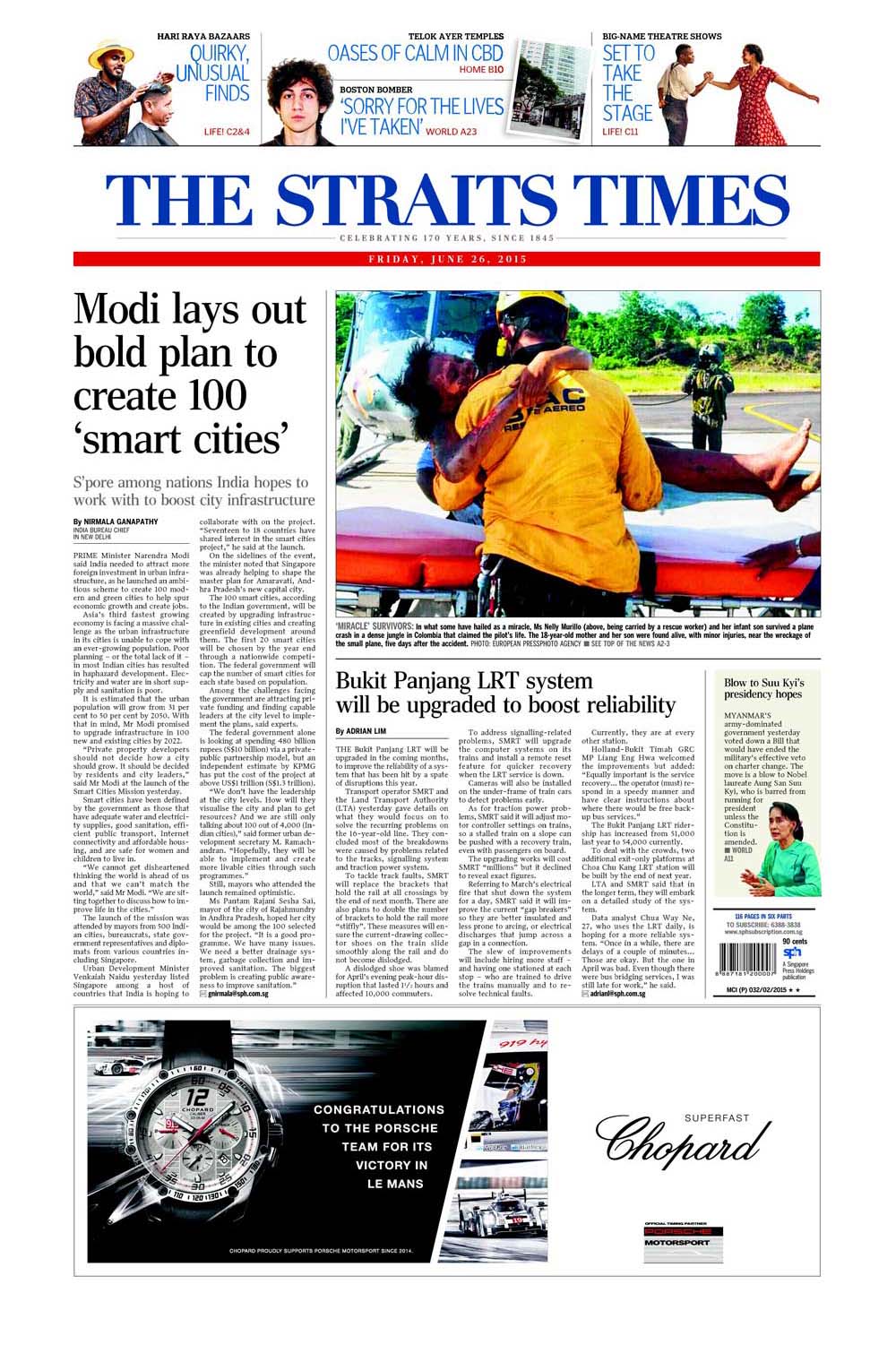
In a bid to further improve reliability, in June 2015, the LTA and SMRT announced upgrades to the track, signalling systems, and electrical systems along the line, as faults in these areas had caused most of the service disruptions on the line. Later that month, Lui elaborated that the upgrades would comprise a 12-month study period to identify issues to rectify, and a several years long period in which the upgrades would be implemented. Additional staff were also deployed to improve service recovery and platform barriers were installed at all stations along the line by 2017.
In October 2016, as the line was approaching its 20-year design lifespan, LTA and SMRT announced that they were considering several courses of action regarding the system. These comprised the renewal of the existing system, or its complete replacement, either with a new system or with buses. On 8 March 2017, it was announced that the system's power supply, signalling, rolling stock, track, and stations along with a new signalling system would be upgraded. The authorities ruled out scrapping the entire system or changing to automated guided vehicles drawn on self-power as it would cause major traffic congestion. On 3 October 2017, a tender for the revamp was called. To improve service reliability in the interim period, SMRT shortened operating hours on all Sundays from 12 November 2017 until the end of that year, which SMRT said allowed for additional time for maintenance.
On 7 March 2018, LTA awarded the contract for $344 million to Bombardier, the original supplier of the rolling stock, to fully upgrade the system. This includes overhauling the line's signalling system with a communications-based train control (CBTC) system for a tighter headway between each train and thus, reducing waiting time. The 19 first-generation trains will be removed from service and replaced while the 13 second-generation trains will be refurbished. These upgrades are slated to be completed by 2026.
Network and operations
Route
Covering a distance of 8 km, the fully elevated line has 13 stations, and connects Bukit Panjang with Choa Chu Kang MRT/LRT station. From Choa Chu Kang station, the line runs east along Choa Chu Kang Way and Choa Chu Kang Road, before making a loop around Bukit Panjang.
Services
There are two services currently operating on the line: A and B, both of which terminate at Choa Chu Kang. Since 30 December 2024, Service A resumed full day operation on the weekdays.{{cite news |last=Khan |first=Fatmah |date=16 December 2024 |url= https://www.straitstimes.com/singapore/bukit-panjang-lrt-to-resume-full-dual-loop-service-from-dec-30 |title=Bukit Panjang LRT to resume full dual-loop service on Dec 30 |work=The Straits Times |access-date=17 December 2024}}
| Currently operational | A | B | Defunct | C |
|---|---|---|---|---|
| Choa Chu Kang | Senja | Senja to Petir | ||
| Clockwise direction | ||||
| Choa Chu Kang | Petir | Petir to Senja | ||
| Anti-clockwise direction | ||||
| Ten Mile Junction | Senja | Clockwise direction |
Stations
All stations, except Choa Chu Kang, have two facing side platforms. Choa Chu Kang was originally an island platform until 2016, when two additional side platforms were constructed on the sides of existing tracks to form a Spanish solution, unique amongst Singapore MRT and LRT stations. An additional set of fare gates were also installed to ease crowding during peak hours.
All the stations on the LRT have half-height platform barriers, installed between 2016 and 2017. These platform barriers have fixed openings instead of platform doors, which the LTA attributed to insufficient space on the station platforms to install the equipment needed for platform doors.
The stations on the line sport a conventional barrel-roof design, which was chosen by the Bukit Panjang residents when the BPLRT was being constructed.
| Date | Description |
|---|---|
| 6 November 1999 | Opening of Bukit Panjang LRT (14 stations) |
| 10 December 2010 | Temporary closure of Ten Mile Junction |
| 30 December 2011 | Reopening of Ten Mile Junction |
| 13 January 2019 | Permanent closure of Ten Mile Junction |
List
| Singapore LRT | Bukit Panjang}}" | Station code | Singapore LRT | Bukit Panjang}}" | Name | Singapore LRT | Bukit Panjang}}" | Images | Singapore LRT | Bukit Panjang}}" | Interchange; |
|---|---|---|---|---|---|---|---|---|---|---|---|
| Adjacent transportation | Singapore LRT | Bukit Panjang}}" | Opening | Singapore LRT | Bukit Panjang}}" | Location(s) | |||||
| Choa Chu Kang | [[File:BP1 Choa Chu Kang LRT Platform 1 20210217 155354.jpg | 120px]] | |||||||||
| (2027) | |||||||||||
| ― | |||||||||||
| [[File:Bus-logo.svg | 15px | link=]]Choa Chu Kang | Choa Chu Kang | ||||||||
| South View | [[File:South View LRT Station, Singapore - 20120204.jpg | 120px]] | rowspan="4" | ||||||||
| Keat Hong | [[File:BP3 Keat Hong Platform 2.jpg | 120px]] | |||||||||
| Teck Whye | [[File:BP4 Teck Whye Station Platform 1.jpg | 120px]] | |||||||||
| Phoenix | [[File:BP5 Phoenix LRT Station exterior.jpg | 120px]] | |||||||||
| – | Bukit Panjang | [[File:BP6 Bukit Panjang LRT Platform 2.jpg | 120px]] | [[File:Barrier turnstile icon.svg | 15px | link=]] | |||||
| ― | |||||||||||
| [[File:Bus-logo.svg | 15px | link=]]Bukit Panjang | Bukit Panjang | ||||||||
| Petir | [[File:BP7 Petir LRT tracks.jpg | 120px]] | rowspan="7" | ||||||||
| Pending | [[File:BP8 Pending Platform.jpg | 120px]] | |||||||||
| Bangkit | [[File:BP9 Bangkit Station exterior.jpg | 120px]] | |||||||||
| Fajar | [[File:BP10 Fajar LRT Station Entrance.jpg | 120px]] | |||||||||
| Segar | [[File:BP11 Segar LRT Station Platform 2.jpg | 120px]] | |||||||||
| Jelapang | [[File:BP12 Jelapang LRT Platform 1.jpg | 120px]] | |||||||||
| Senja | [[File:Senja LRT Station, Singapore.jpg | 120px]] | |||||||||
| Ten Mile Junction | [[File:TenMileJunctionInterior2.JPG | 120px]] | Permanently closed since 13 January 2019 | Choa Chu Kang |
Rolling stock
The Bukit Panjang LRT operates on the Bombardier Innovia APM 100 rolling stock, similar to the ones used by the Changi Airport Skytrain until 2006. An initial 19 trainsets were delivered in 1999 under C801, which bear a cerulean livery. An additional 13 trainsets were delivered in 2014 under C801A, bearing SMRT's pixel livery and a slightly different exterior design. Each unit is 12.8 m long.
These trains, also known as automated people movers, are rubber-tyred for minimised operating noise within built-up areas and guided by a central guideway which also contains a power rail. They operate in both single-car and double-car arrangements, paired with a similar model (C801 and C801A trainsets are not cross-coupled). The trains are also equipped with windows that fog up automatically when the train runs near residential buildings.
19 Bombardier Innovia APM 300R trains have been procured under C801B as part of the Bukit Panjang LRT overhaul. These trains will be equipped with Communications Based Train Control (CBTC) signalling system and are replacing the first generation C801 trains.
Train formation
Between 1999 and 2015, the trains operated in one-car (M) formations throughout the day. Two-car formations were only operated during weekday peak hours to accommodate increased demand prior to the introduction of C801A trains in 2014. Service B used to operate 2-car sets only during weekday morning peak hours, while Service A mostly operated them during weekday evening peak hours.
From 2015 until 2019, the majority of trains operated in two-car (M-M) formations. Two-car formations were no longer limited to peak hours due to the increase in ridership and number of apartments in Bukit Panjang.
Since 2019, all of the trains are running in two-car (M-M) formations throughout the day. The units are limited to a two-car train formation because of station length. Coupling is usually done in Ten Mile Junction Depot and the trains are coupled with the same car type for passenger service, i.e. C801B trains can only be coupled with other C801B trains. Occasionally, units are mixed off-service for reasons such as train rescue operations or testing.
Train control
The line is equipped with Bombardier's CITYFLO 550 fixed block signalling system for automatic train control (ATC) under automatic train operation (ATO) GoA 4 (UTO). The subsystems consist of automatic train protection (ATP) to govern train speed, Automatic Train Supervision (ATS) to track and schedule trains, and a computer-based interlocking (CBI) system that prevents incorrect signal and track points settings.
The line is currently being upgraded to use Alstom’s Cityflo 650 moving block communications-based train control (CBTC) signalling system with the gradual rollout of Bombardier Innovia APM 300R C801B trains and retrofitting of Bombardier Innovia APM 100 C801A trains.
References
References
- "Land Transport DataMall".
- "Mass transit signalling".
- "Bombardier Projects in Mass-transit signalling".
- "Bukit Panjang LRT".
- "About SMRT: Business and Subsidiaries".
- Chan Teik, Leong. (2 November 1994). "Studies on more extensive train network soon". The Straits Times.
- Leong, Chan Teik. (4 December 1994). "Green light for Light Rail system". The Straits Times.
- . (29 June 1995). ["Keppel tie-up puts in lowest bids for LRT jobs"](https://eresources.nlb.gov.sg/newspapers/Digitised/Article/straitstimes19950629-1.2.58.8). *The Straits Times*.
- Lim, Yvonne. "Bukit Panjang LRT ready in 3 years". New Paper.
- . (7 April 1996). ["Bukit Panjang LRT Exhibition to prepare commuters"](https://eresources.nlb.gov.sg/newspapers/Digitised/Article/straitstimes19960407-1.2.33.8). *The Straits Times*.
- Leong, Chan Teik. (13 April 1996). "$285 m contract for LRT system signed". The Straits Times.
- Tan, Christopher. (6 August 1997). "SMRT to operate first light rail transit line in Bukit Panjang". Business Times.
- Fong, Tanya. (3 December 1998). "Here's a preview of the LRT". The New Paper.
- Kaur, Karamjit. (17 October 1999). "LRT all set to roll". The Straits Times.
- . (13 January 2001). "Light rail now more reliable, House told". *The Straits Times*.
- Koh, Leslie. (20 November 2000). "Three hurt in train collision". The Straits Times.
- . (18 May 2002). "Steps taken to tackle LRT faults". *The Straits Times*.
- Kaur, Karamjit. (22 November 2002). "Govt auditing maintenance system for LRT". The Straits Times.
- Kaur, Karamjit. (14 January 2003). "LRT procedures fine but staff not doing it right". The Straits Times.
- Kaur, Karamjit. (21 January 2003). "SLRT given 6 months to shape up at Bukit Panjang". The Straits Times.
- Goh, Chin Lian. (6 December 2003). "Shorter hours so LRT can be fixed". The Straits Times.
- . (30 May 2004). "LRT service probe". *The Straits Times*.
- Hooi, Alexis. (12 March 2003). "LRT's runaway losses - up to $3m a year". The Straits Times.
- . (6 December 2003). "Just not enough passengers". *The Straits Times*.
- Goh, Chin Lian. (17 November 2010). "More trains for Bukit Panjang LRT?". The Straits Times.
- Barker, Victoria. (29 July 2011). "Waiting times for Bt Panjang LRT to be cut / Bus service quality to be improved". My Paper.
- Sim, Royston. (17 January 2011). "Bt Panjang LRT to get reliability boost". The Straits Times.
- Tan, Christopher. (31 May 2022). "First of new trains for Bt Panjang LRT arrives, promising better reliability". The Straits Times.
- Lim, Adrian. (26 June 2015). "Bukit Panjang LRT system will be upgraded to boost reliability". The Straits Times.
- Lim, Yan Liang. (29 June 2015). "'Mid-life overhaul' for Bukit Panjang LRT". The Straits Times.
- Tan, Christopher. (21 October 2015). "Platform barriers at all LRT stations by 2018 to prevent falls". The Straits Times.
- Tan, Christopher. (7 October 2016). "SMRT looking at options for Bukit Panjang LRT". The Straits Times.
- (8 March 2017). "Bukit Panjang LRT to be Upgraded to a New Conventional and Reliable LRT line". [[The Straits Times]].
- (3 October 2017). "Tender to be called for Bukit Panjang LRT overhaul".
- Cheng, Kenneth. (23 October 2017). "BPLRT to start running later on Sundays from Nov 12 for renewal works". TODAY Online.
- (11 November 2017). "Bukit Panjang LRT to start at 7am every Sunday till year end".
- Land Transport Authority. (7 March 2018). "Awarding of contract to renew BPLRT".
- Lim, Adrian. (7 March 2018). "Parliament: $344m overhaul of Bukit Panjang LRT; smoother rides expected from 2022".
- Kaur, Karamjit. (26 July 1999). "Bukit Panjang LRT to begin operating on Nov 6". The Straits Times.
- (29 September 1996). "Bukit Panjang's light rail system brings residents together years before it is to run". The Straits Times.
- "First Light Rail Transit system {{!}} Infopedia".
- . (24 September 1997). ["Foggy windows"](https://eresources.nlb.gov.sg/newspapers/Digitised/Article/newpaper19970924-1.2.5.1). *The New Paper*.
- "CITYFLO 550 - Singapore".
This article was imported from Wikipedia and is available under the Creative Commons Attribution-ShareAlike 4.0 License. Content has been adapted to SurfDoc format. Original contributors can be found on the article history page.
Ask Mako anything about Bukit Panjang LRT line — get instant answers, deeper analysis, and related topics.
Research with MakoFree with your Surf account
Create a free account to save articles, ask Mako questions, and organize your research.
Sign up freeThis content may have been generated or modified by AI. CloudSurf Software LLC is not responsible for the accuracy, completeness, or reliability of AI-generated content. Always verify important information from primary sources.
Report