From Surf Wiki (app.surf) — the open knowledge base
Budipine
Pharmaceutical drug
Pharmaceutical drug
| Drugs.com =
| elimination_half-life =
Budipine (brand name Parkinsan) is an antiparkinson agent marketed for the treatment of Parkinson's disease.
While its exact mechanism of action is not well characterized, it is believed to be an NMDA receptor antagonist, but also promoting the synthesis of dopamine.
Because it provides additional benefits relative to existing treatments, it probably does not precisely mimic the mechanism of an existing known treatment.
It is an hERG blocker and can produce long QT syndrome as a side effect.
Analogues include prodipine and medipine.
Synthesis
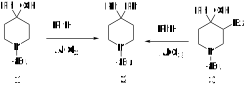
Budipine can be prepared from the 1-tert-butyl-4-piperidone [1465-76-5] directly by treatment with benzene in the presence triflic acid. This method of synthesis enables a 99% yield of product.
4-Phenyl-1-t-butyl-4-piperidinol, (1)
1-t-butyl-3-benzoyl-4-phenyl-4-piperidinol [81831-81-4] (3)
References
References
- (2007). "Martindale: The Complete Drug Reference.". Pharmaceutical Press.
- (October 2006). "Budipine in Parkinson's tremor". Journal of the Neurological Sciences.
- (1999). "Diagnosis and Treatment of Parkinson's Disease — State of the Art". Journal of Neural Transmission. Supplementum.
- "Budipine". Springer Nature Switzerland AG.
- (1995). "The antiparkinsonian drug budipine binds to NMDA and sigma receptors in postmortem human brain tissue". Journal of Neural Transmission. Supplementum.
- (September 2001). "Neuroprotection by NMDA receptor antagonists in a variety of neuropathologies". Current Drug Targets.
- (May 2002). "Budipine provides additional benefit in patients with Parkinson disease receiving a stable optimum dopaminergic drug regimen". Archives of Neurology.
- (October 2006). "Effects of amantadine and budipine on antidepressant drug-evoked changes in extracellular dopamine in the frontal cortex of freely moving rats". Brain Research.
- (November 2003). "Drug binding to aromatic residues in the HERG channel pore cavity as possible explanation for acquired Long QT syndrome by antiparkinsonian drug budipine". Naunyn Schmiedebergs Arch Pharmacol.
- (1986). "The interaction of 1-alkyl-4,4-diphenylpiperidines with the 1-methyl-4-phenyl-1,2,3,6-tetrahydropyridine receptor binding site". J Neural Transm.
- (October 1988). "Xenobiotic and endobiotic inhibitors of cytochrome P-450dbl function, the target of the debrisoquine/sparteine type polymorphism". Biochem Pharmacol.
- Klumpp, D. A., Garza, M., Jones, A., Mendoza, S. (1 September 1999). "Synthesis of Aryl-Substituted Piperidines by Superacid Activation of Piperidones". The Journal of Organic Chemistry. 64 (18): 6702–6705. doi:10.1021/jo990454i.
- (1984). "[Synthesis, physical-chemical properties and pharmacologically-oriented screening studies on budipine and related 4,4-diphenylpiperidines]". Arzneimittel-Forschung.
- "4-Phenyl-1-t-butyl-4-piperidinol". U.S. National Library of Medicine.
This article was imported from Wikipedia and is available under the Creative Commons Attribution-ShareAlike 4.0 License. Content has been adapted to SurfDoc format. Original contributors can be found on the article history page.
Ask Mako anything about Budipine — get instant answers, deeper analysis, and related topics.
Research with MakoFree with your Surf account
Create a free account to save articles, ask Mako questions, and organize your research.
Sign up freeThis content may have been generated or modified by AI. CloudSurf Software LLC is not responsible for the accuracy, completeness, or reliability of AI-generated content. Always verify important information from primary sources.
Report