From Surf Wiki (app.surf) — the open knowledge base
Brugmansia versicolor
Species of flowering plant
Species of flowering plant
Brugmansia versicolor is a species of plant in the family Solanaceae, commonly known as "angel's trumpets". They are endemic to Ecuador. Since March 2014, they have been listed as Extinct in the Wild by the IUCN.
Description
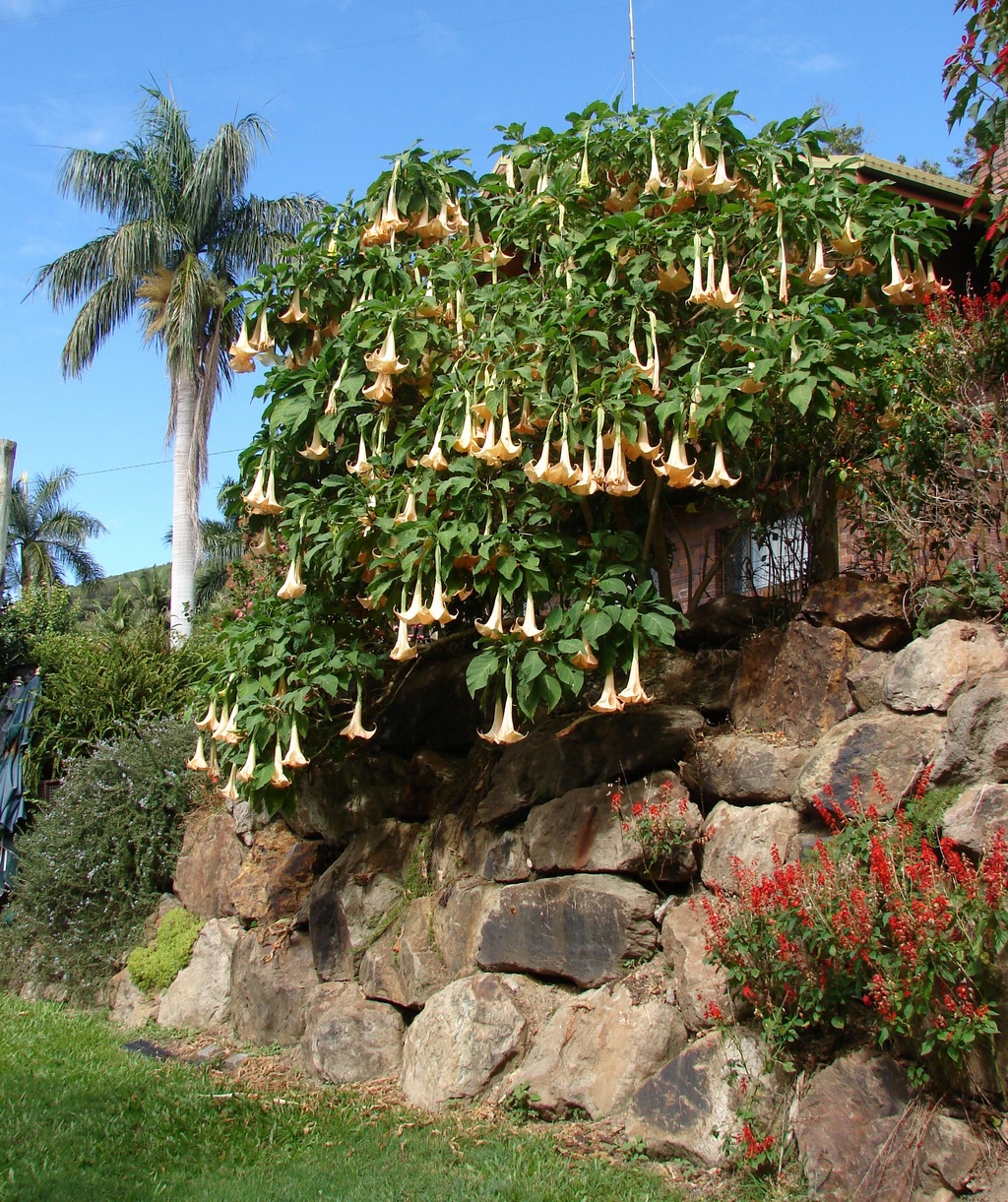
Brugmansia versicolor is a bush or small tree reaching 10 - in height. It has an alternate insertion of elliptic/oblong leaves that are entire with smooth edges. One of the most prominent characteristics of B. versicolor is the presence of giant drooping flowers which hang upside down, which is where it gets its common name of Angel's Trumpet. The flowers are the largest of all Brugmansia at 12 - in length. They open first white, but then may age to turn peach, pink, apricot or remain white.
Taxonomy
There are currently 7 distinct species of Brugmansia recognized, and they are very similar to their close relative Datura. For this reason the two genera were commonly mistaken for one another. "It was not until the discovery of the New World that Brugmansias appeared in the documented floras and later in gardens of the Old World. Initially Brugmansias were grouped with Daturas by the famous botanist Carl Linnaeus, who documented them in 1753 from a drawing and not from live plant material. In 1805, the South African taxonomist Christiaan Hendrik Persoon created a separate genus for Brugmansia, but it was not until 1973 that Tom E. Lockwood created a final division between the two genera.
The different genera of the family Solanaceae include many crop plants such as potatoes and tomatoes, as well as several other poisonous plants.
Distribution and habitat
Brugmansia species are native to the western part of South America, originating from Guayaquil Basin and south of the Gulf of Guayaquil in Ecuador. They are usually found growing in flat areas at elevations up to 2600 ft, but are also frequently cultivated at low elevations throughout the tropics.
Ecology
Brugmansia versicolor is a hermaphrodite that reproduces perennially. It has long, narrow, fusiform berries that are up to 21 cm in length. Brugmansia reproduce by the production of seeds. The major pollinators are thought to be various species of insects, though this has yet to be proven.
Culture

Brugmansia can withstand a wide range of temperatures including those that are slightly below freezing. A moderate frost will damage the plant in colder climates. Brugmansia will grow well if placed in a partially shaded or fully lit position. The plants tend to wilt in hot temperatures, but quickly recover in the evening as their flowers begin to open. They thrive in very fertile soils and average humidity. Clones can easily be made from stem cuttings, and Brugmansia grow readily from viable seeds, however the plant will not self pollinate.
Toxicity
According to Dr. Russell, of North Carolina State University, Brugmansia versicolor is exceptionally poisonous if ingested in large quantities. It contains various tropane alkaloids that have toxic properties which affect the mind and body. Some of these alkaloids include atropine, scopolamine, and hyoscyamine. No matter if swallowed or inhaled, the flowers, leaves, and seeds of Brugmansia will most likely cause symptoms of hallucinations, dry mouth, muscle weakness, increased blood pressure, increased pulse, fever, dilated pupils, temporary insanity, and paralysis, convulsions, difficulty breathing, illusions, paralysis, coma, and loss of memory.
References
Bibliography
- "Angel's trumpet, Brugmansia Versicolor - Shrubs - Solanaceae garden." Gardening.eu - home. 7 May 2009 https://web.archive.org/web/20070324194639/http://www.gardening.eu/plants/Shrubs/Brugmansia-versicolor/3226/.
- "Brugmansia Versicolor (PIER species info)." Hawaiian Ecosystems at Risk project (HEAR). 7 May 2009 https://web.archive.org/web/20081223024452/http://www.hear.org/Pier/species/brugmansia_versicolor.htm.
- "Brugmansia Versicolor Solanaceae Angel's Tears." EEB Greenhouse Home Page. 7 May 2009 http://florawww.eeb.uconn.edu/198500486.html.
References
- Hay, A.. (2014). "''Brugmansia versicolor''".
- (2002). "Brugmansia and Datura: Angel's Trumpets and Thorn Apples". Firefly Books.
- Lockwood TE. 1973 ''Generic recognition of Brugmansia''. Bot. Mus. Leafl. Harvard Univ. 23. (6): 273-284 (1973)
- Mahr, Susan.. "Angel's Trumpet, Brugmansia". University of Wisconsin-Madison.
- Russell, Alice B.. "Poisonous Plants: Brugmansia spp. (Datura spp.).". North Carolina State University.
- Abid Aqsa, Mushtaq Ahmad, Muhammad Zafar, Sadia Zafar, Mohamed Fawzy Ramadan, Ashwaq T. Althobaiti, Shazia Sultana, Omer Kilic, Trobjon Makhkamov, Akramjon Yuldashev, Oybek Mamarakhimov, Khislat Khaydarov, Afat O. Mammadova, Komiljon Komilov, and Salman Majeed. (December 2023). "Foliar epidermal and trichome micromorphological diversity among poisonous plants and their taxonomic significance". [[Folia Horticulturae]].
This article was imported from Wikipedia and is available under the Creative Commons Attribution-ShareAlike 4.0 License. Content has been adapted to SurfDoc format. Original contributors can be found on the article history page.
Ask Mako anything about Brugmansia versicolor — get instant answers, deeper analysis, and related topics.
Research with MakoFree with your Surf account
Create a free account to save articles, ask Mako questions, and organize your research.
Sign up freeThis content may have been generated or modified by AI. CloudSurf Software LLC is not responsible for the accuracy, completeness, or reliability of AI-generated content. Always verify important information from primary sources.
Report