From Surf Wiki (app.surf) — the open knowledge base
Brodie landing system
Method of launching and landing light aircraft
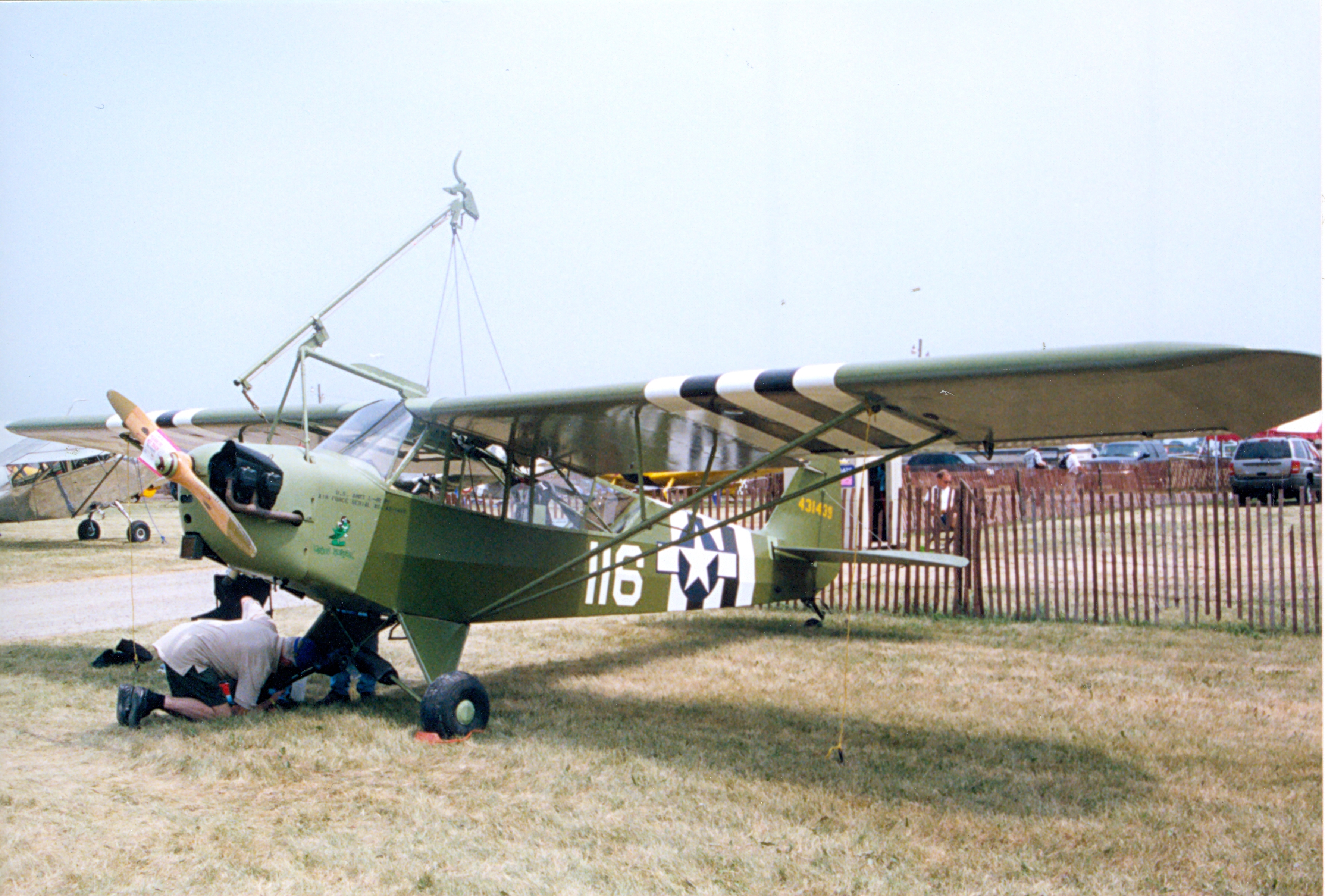
Method of launching and landing light aircraft
The Brodie landing system was a unique method of launching and landing light aircraft that was devised by Captain James H. Brodie, a member of the Transportation Corps who was later transferred to the United States Army Air Forces during World War II. The novel system involved catching an overhead hook attached to the plane with a sling, which itself was attached to a cable secured between towers and acted as an arresting gear. This system was originally envisioned to provide anti-submarine aircraft support for trans-Atlantic convoys, and for operating lightweight liaison aircraft in terrain normally unsuitable for runway construction, such as dense jungle or in the mountains. However, it was never employed in those environments due to its late adoption in the war. One of its perceived land-based qualities was that its small size would render it much harder to detect by the enemy than a conventional landing strip.
After a successful demonstration at Moisant Field (now New Orleans International Airport), the system was tested in September 1943 for shipboard use when it was installed on the motor ship . Staff Sergeant R. A. Gregory performed ten successful takeoffs and hookups without incident with a Stinson L-5 Sentinel, but those operations were conducted under ideal weather and sea conditions.
The Brodie device was designed to allowed cargo vessels to be inexpensively converted with relatively minor structural changes so that they could launch and recover planes at sea. The system was used by the Navy for launching Marine Corps OY-1 Sentinels (a Navy version of the L-5) at Iwo Jima and Army Piper L-4 Cubs at Okinawa from LST-776. While the invention achieved moderate success, several OY-1's were lost due to pitching and rolling of the ship at sea. Concluding that the device was better suited for fixed installations on land, the Navy program was terminated in favor of CVE escort aircraft carriers that were allocated to carry liaison planes during the planned invasion of Japan.
Brodie and test pilot Flight Officer Raymond Gregory were awarded the Legion of Merit for their work on the system in 1945. Brodie envisioned scaling the system up to capture planes as heavy as 7000 lbs. He was issued US Patent # 2,435,197, # 2,488,050, # 2,488,051, # 3,163,380 for variations of the landing system.
Operational history
- LST 776, LST 393, and LST 325 were outfitted with Brodie landing systems.
- The RAF used an L-5 for testing the Brodie system in India.
- One type of light aircraft which used the system was the Stinson L-5 Sentinel, an example of which is displayed in Brodie configuration at the Steven F. Udvar-Hazy Center museum in Dulles, Virginia.
References
Bibliography
- Brodie Aerofiles - A Runway on a Rope, Accessed 2 September 2005
References
- (December 1985). "Bax Seat: Hanging Out With the Brodies". CBS Magazines.
- (February 1946). "Nylon Airport". Popular Mechanics.
- "Brodie Landing System".
This article was imported from Wikipedia and is available under the Creative Commons Attribution-ShareAlike 4.0 License. Content has been adapted to SurfDoc format. Original contributors can be found on the article history page.
Ask Mako anything about Brodie landing system — get instant answers, deeper analysis, and related topics.
Research with MakoFree with your Surf account
Create a free account to save articles, ask Mako questions, and organize your research.
Sign up freeThis content may have been generated or modified by AI. CloudSurf Software LLC is not responsible for the accuracy, completeness, or reliability of AI-generated content. Always verify important information from primary sources.
Report