From Surf Wiki (app.surf) — the open knowledge base
Bourges
Commune in Centre-Val de Loire, France

Commune in Centre-Val de Loire, France
| Field | Value |
|---|---|
| name | Bourges |
| commune status | Prefecture and commune |
| image | {{multiple image |
| perrow | 1/2/ |
| border | infobox |
| total_width | 280 |
| image1 | Bourges.JPG |
| caption1 | View of Bourges |
| image2 | Kathedrale Bourges v2.jpg |
| caption2 | Bourges Cathedral |
| image3 | Bourges-Palais Jacques Coeur-112-2008-gje.jpg |
| caption3 | Palais Jacques Coeur |
| image flag | Flag of Bourges.svg |
| image coat of arms | Blason de Bourges.svg |
| arrondissement | Bourges |
| INSEE | 18033 |
| postal code | 18000 |
| demonym | Berruyers |
| mayor | Yann Galut |
| term | 2020–2026 |
| intercommunality | CA Bourges Plus |
| coordinates | |
| elevation m | 153 |
| elevation min m | 120 |
| elevation max m | 169 |
| area km2 | 68.74 |
| population | |
| population date | |
| population footnotes | |
| website | http://www.ville-bourges.fr/_en/site/introduction |
|image coat of arms = Blason de Bourges.svg
Bourges ( ; ; Borges in Berrichon) is a commune in central France on the river Yèvre. It is the capital of the department of Cher, and also was the capital city of the former province of Berry. It is part of the Centre-Val de Loire region of France.
History
The name of the commune derives either from the Bituriges, the name of the original inhabitants, or from the Germanic word Burg (French: bourg; Spanish: burgo; English, others: burgh, berg, or borough), for "hill" or "village". The Celts called it Avaricon; Latin-speakers: Avaricum. In the fourth century BC, as in the time of Caesar, the area around it was the center of a Gallic (Celtic) confederacy.
In 52 BC, the sixth year of the Gallic Wars, while the Gauls implemented a scorched-earth policy to try to deny Caesar's forces supplies, the inhabitants of Avaricum convinced the council not to have their town burned. It was temporarily spared due to its good defences provided by the surrounding marshes, by a river that nearly encircled it, and by a strong southern wall. Julius Caesar's forces, nevertheless, captured and destroyed the town, killing all but 800 of its inhabitants.
Rome reconstructed Avaricum as a Roman town, with a monumental gate, aqueducts, thermae and an amphitheatre; it reached a greater size than it would attain during the Middle Ages. The massive walls surrounding the late-Roman town, enclosing 40 hectares, were built in part with stone re-used from earlier public buildings.
The third-century AD Saint Ursinus, also known as Saint Ursin, is considered the first bishop of the town. Bourges functions as the seat of an archbishopric. During the 8th century Bourges lay on the northern fringes of the Duchy of Aquitaine and was therefore the first town to come under Frankish attacks when the Franks crossed the Loire. The Frankish Charles Martel captured the town in 731, but Duke Odo the Great of Aquitaine immediately re-took it. It remained under the rule of counts who pledged allegiance to the Aquitanian dukes up to the destructive siege by the Frankish King Pepin the Short in 762, when Basque troops are found defending the town along with its count.
During the Middle Ages, Bourges served as the capital of the Viscounty of Bourges until 1101. In the fourteenth century, it became the capital of the Duchy of Berry (established in 1360). The future king of France, Charles VII (), sought refuge there in the 1420s during the Hundred Years' War. His son, Louis XI, was born there in 1423. In 1438, Charles VII decreed the Pragmatic Sanction of Bourges. During this period, Bourges was a major centre of alchemy. In 1487, a third of Bourges was destroyed by fire, after which the economic decline of the city started.
The Gothic Cathedral of Saint Étienne, begun at the end of the twelfth century, ranks as a World Heritage Site. It is one of the earliest examples of the High Gothic style of the thirteenth century. http://www.destination360.com/europe/france/bourges Destination 360 (Accessed 7 October 2016) Cathedral one of the earliest examples of High Gothic.
Bourges has a long tradition of art and history. Apart from the cathedral, other sites of importance include the 15th-century Palais Jacques Cœur and a sixty-five-hectare district of half-timbered houses and fine town-houses.
Bourges became an important center of artillery production from the 1860s, when Napoleon III decided to relocate the École de pyrotechnie militaire, at the time located in Metz, far away from the Prussian border.
Population
| graph-pos = bottom |1793 |15964 |1800 |16330 |1806 |17552 |1821 |18910 |1831 |19730 |1836 |25324 |1841 |22826 |1846 |24799 |1851 |25037 |1856 |26799 |1861 |28064 |1866 |30119 |1872 |31312 |1876 |35785 |1881 |40217 |1886 |42829 |1891 |45342 |1896 |43587 |1901 |46551 |1906 |44133 |1911 |45735 |1921 |45942 |1926 |44245 |1931 |45067 |1936 |49263 |1946 |51040 |1954 |53879 |1962 |60632 |1968 |70814 |1975 |77300 |1982 |76432 |1990 |75609 |1999 |72480 |2007 |71155 |2012 |66666 |2017 |64551
Geography
Bourges sits at the river junction where the Auron flows into the Yèvre. The disused Canal de Berry follows alongside the course of the Auron through Bourges.
Climate
Bourges, located in the center of France, away from the Atlantic Ocean, features a typical degraded oceanic climate (Köppen: Cfb), characterized by colder, drier winters and warmer, wetter summers than the oceanic climate.
|Jan record high C = 17.6 |Feb record high C = 22.8 |Mar record high C = 29.4 |Apr record high C = 29.4 |May record high C = 32.1 |Jun record high C = 39.5 |Jul record high C = 41.7 |Aug record high C = 39.9 |Sep record high C = 36.4 |Oct record high C = 31.9 |Nov record high C = 23.4 |Dec record high C = 20.0 |year record high C = 41.7 |Jan record low C = -20.4 |Feb record low C = -16.4 |Mar record low C = -11.3 |Apr record low C = -3.8 |May record low C = -2.6 |Jun record low C = 3.4 |Jul record low C = 4.6 |Aug record low C = 4.6 |Sep record low C = 1.8 |Oct record low C = -5.0 |Nov record low C = -9.1 |Dec record low C = -14.0 |year record low C = -20.4 |access-date=21 November 2024}} | access-date = 30 December 2015}}
Industry
In 2025, one-sixth of the population worked in the defense industry, primarily in manufacturing arms. Notable local employers include KNDS France and MBDA.
Sights
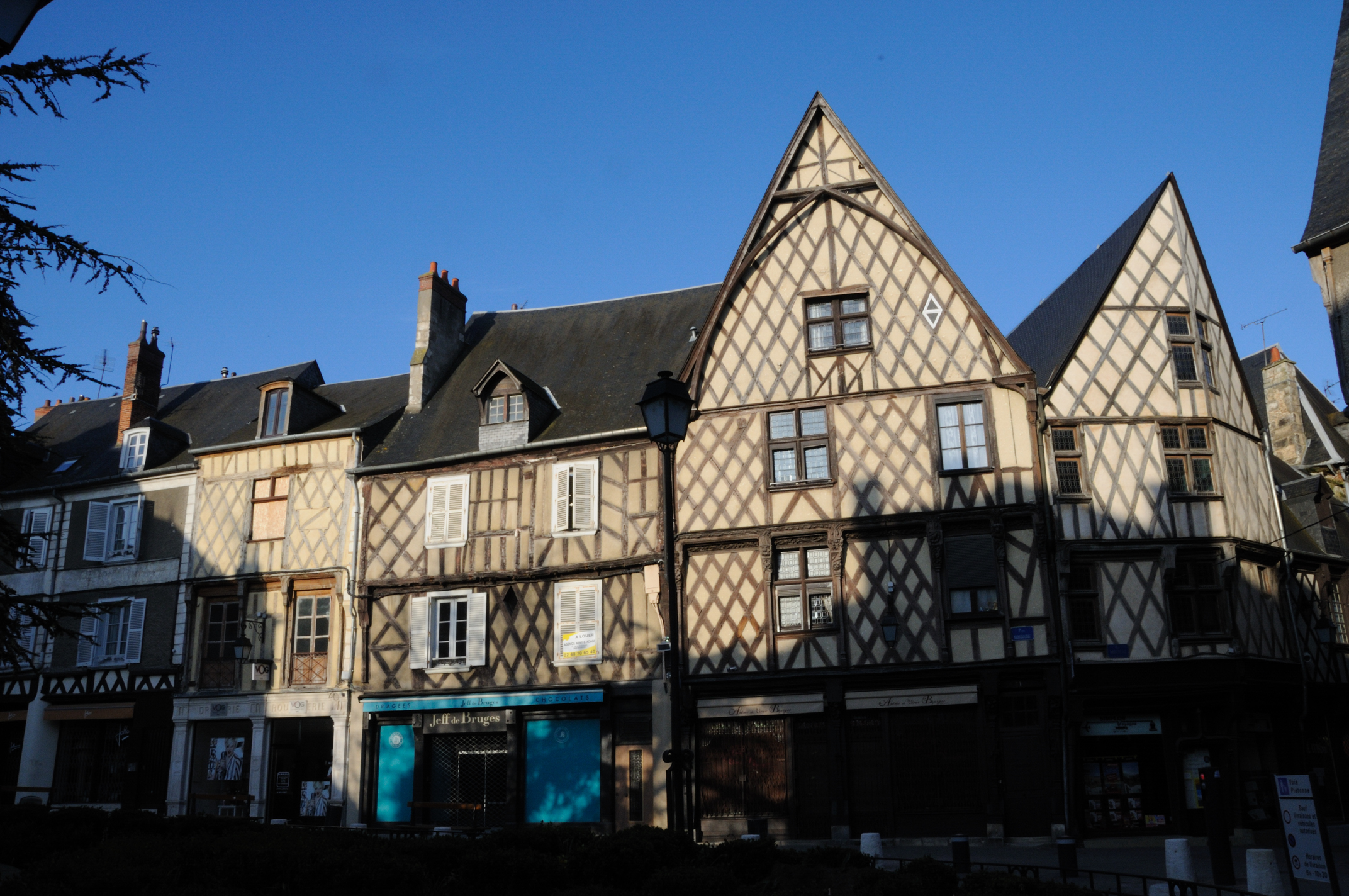


- Its Gothic cathedral (built 1195–1255) was added to the list of the World Heritage Sites by UNESCO in 1992
- Palais Jacques Cœur
- Lallemant's hotel, from the early French Renaissance
- The Berry museum, located in the Cujas' hotel
- The Estève museum, located in the so-called aldermen's hotel
- The marshes of the Yèvre and Voiselle rivers were listed in 2003 as a French Natural Monument or Site
- The ruins of the Gallo-Roman walls
- The Conservatoire national du Pélargonium
- The new Hôtel de Ville completed in 1992.
Events
The Printemps de Bourges music festival takes place in Bourges every year.
Every summer, and since 2002, Les mille univers hosts a writing workshop in collaboration with Oulipo.
Bourges was chosen as a European capital of culture for 2028.
Transport
The Bourges station offers direct railway connections to Orléans, Tours, Lyon, Paris, Nantes and several regional destinations. The A71 motorway connects Bourges with Orléans and Clermont-Ferrand. Bourges Airport is a small regional airport. The nearest major airports are Clermont-Ferrand Auvergne Airport, located 185 km south and Lyon–Saint-Exupéry Airport, located 319 km south east.
Sport and recreation
Bourges' principal football team was the now dissolved Bourges Football 18. It is also home to the women's basketball club CJM Bourges Basket, which has won multiple titles in domestic and European basketball. Bourges XV is a rugby team in the region, playing in French National Division, Federal 3.
Colleges and universities
- University of Bourges
- École des Beaux Arts
- École Nationale Supérieure d'Ingénieurs ENSI
Twin towns – sister cities
Bourges is twinned with:
- GER Augsburg, Germany
- POR Aveiro, Portugal
- ITA Forlì, Italy
- POL Koszalin, Poland
- ESP Palencia, Spain
- UK Peterborough, United Kingdom
- RUS Yoshkar-Ola, Russia
- UKR Korosten, Ukraine
Personalities
- 16th-century poet and translator Pierre Motin was born in Bourges.
- 17th-century composer and singer François Bourgoing was born in Bourges.
- The merchant Jacques Cœur was born in Bourges.
- The manuscript illuminator Jean Colombe maintained a workshop in Bourges.
- John Calvin was a student in the University of Bourges.
- The legal expert Jacques Cujas lived in Bourges during 1555-1557 and 1575–1590.
- Eustadiola (594–684) was a saint and abbess.
- The Impressionist painter Berthe Morisot was born in Bourges on 14 January 1841.
- The Art Nouveau sculptor Julien Caussé was born in Bourges in 1869.
- The philosopher Vladimir Jankélévitch (1903-1985) was born in Bourges.
- The writer and historian Jules Bertaut (1877–1959) was born in Bourges.
- Angèle Chevrin (1911–1998), communist politician
- Béatrice Vialle, aviator.
- Emmanuel Imorou, footballer.
- Émilienne Demougeot (1910–1994), historian, was born in Bourges.
- Marcel Bascoulard (1913-1978), artist, was born outside of Bourges and resided there for most of his life.
- The mother of fictional character Gabrielle Maple hailed from Bourges in The Petrified Forest (1936), endearingly mispronounced "Boorgs" by the actress playing the part, Bette Davis.
- François Jacques (1946–1992), historian, was born in Bourges.
- Arnaud Courlet de Vregille (1958-), painter, was born in Bourges.
- Belle du Berry (born Bénédicte Grimault) (1966-2020) lead singer of Paris Combo
- Patrice Gay (1973-), racing driver
- Geoffroy Tory (1480-1533), printer who introduced accents into French, was born in Bourges.
References
Bibliography
References
- (2 December 2020). "Répertoire national des élus: les maires".
- "Siege of Avaricum, 52 BC". historyofwar.org.
- Holmes, Robert C. L.. (2021-01-16). "The Gallic Wars: How Julius Caesar Conquered Gaul (Modern France)".
- "Bourges history". City of Bourges.
- Lorieux, Clarisse. (2020-05-13). "Ecole militaire de pyrotechnie, puis usine de produits explosifs (usine de munitions), actuellement usine d'armes Giat Industries". Ministère de la culture.
- {{Cassini-Ehess. 5289. Bourges
- [https://www.insee.fr/fr/statistiques/4515315?geo=COM-18033#ancre-POP_T1 Population en historique depuis 1968], INSEE
- Bonnefous, Bastien. (20 April 2025). "Bourges, bouleversée par le « réarmement » : « La ville est redevenue l'un des fers de lance de la défense française »". Le Monde.
- Jacques Cœur's palace, [http://www.bourges-tourisme.com/en/pages/palais-jacques-coeur-bourges/ visitor centre] {{Webarchive. link. (21 April 2013)
- Lallemant's hotel, [http://www.bourges-tourisme.com/en/pages/hotel-lallemant-bourges/ visitor centre] {{webarchive. link. (4 March 2016)
- Berry museum, [http://www.bourges-tourisme.com/en/pages/musee-du-berry-bourges/ visitor center] {{Webarchive. link. (7 May 2016)
- Estève museum, [http://www.bourges-tourisme.com/en/pages/musee-esteve-bourges/ visitor centre] {{Webarchive. link. (5 March 2016)
- Bourges' marshes, [http://www.bourges-tourisme.com/en/pages/les-marais/ visitor centre]
- "Les Hôtels de Ville". City of Bourges.
- "Les récréations à Bourges.".
- "Bourges, capitale européenne de la Culture en 2028".
- "ENSI".
- "Villes jumelles". Bourges.
This article was imported from Wikipedia and is available under the Creative Commons Attribution-ShareAlike 4.0 License. Content has been adapted to SurfDoc format. Original contributors can be found on the article history page.
Ask Mako anything about Bourges — get instant answers, deeper analysis, and related topics.
Research with MakoFree with your Surf account
Create a free account to save articles, ask Mako questions, and organize your research.
Sign up freeThis content may have been generated or modified by AI. CloudSurf Software LLC is not responsible for the accuracy, completeness, or reliability of AI-generated content. Always verify important information from primary sources.
Report