From Surf Wiki (app.surf) — the open knowledge base
Borough Market
Food market in Southwark, Central London, England

Food market in Southwark, Central London, England
| Field | Value |
|---|---|
| retail_market_name | Borough Market |
| image | London 2018 March IMG 0663.jpg |
| caption | Borough Market in 2018 |
| environment_type | Covered |
| goods_sold | Food |
| normal_market_days | Tuesday-Sunday (+ Mondays in December) |
| website |
Borough Market is a wholesale and retail market hall in Southwark, London, England. It is one of the largest and oldest food markets in London, with a market on the site dating back to at least the 12th century. The present buildings were built in the 1850s, and today the market mainly sells speciality foods to the general public.
History
The market itself claims to have existed since 1014 "and probably much earlier" as Snorri Sturluson, writing in Heimskringla, describes Southwark as a "great market town" in reference to an incident of 1014. A market that originally adjoined the end of London Bridge was first mentioned in 1276 and was subsequently moved south of St Margaret's church on the High Street. The City of London received a royal charter from Edward VI in 1550 to control all markets in Southwark (see Guildable Manor), which was confirmed by Charles II in 1671. However, the market caused such traffic congestion that, in 1754, it was abolished by an act of Parliament, the Southwark Market Act 1755 (28 Geo. 2. c. 9).
A second act that year, the Southwark Market (No. 2) Act 1755 (28 Geo. 2. c. 23), allowed for the local parishioners to set up another market on a new site, and in 1756, it began again on a 4.5-acre (18,000 m2) site in Rochester Yard. During the 19th century, it became one of London's most important food markets due to its strategic position near the riverside wharves of the Pool of London.
By the mid-1990s, the market had declined, and trustees decided to revive it as a retail rather than a wholesale market. In 1998 they invited Henrietta Green to hold a Food Lovers' Fair, which recruited several long-term traders for the market. From 1996 they let unused space to wholesale businesses such as Neal's Yard Dairy, Brindisa and Monmouth Coffee Company. The new tenants were encouraged to open their premises to retail customers.
In 2011, seven traders were expelled from the market for trading from their storage units at Maltby Street Market a mile away. In turn the traders criticised poor facilities at the market and a move to selling takeaway food.
In the 2017 London Bridge attack, three attackers drove a vehicle over London Bridge and then ran to the area, where they stabbed and killed eight people with knives before they were shot dead by armed police. The market was then closed for 11 days following the attack.
Information
Borough Market is located on Southwark Street and Borough High Street just south of Southwark Cathedral on the southern end of London Bridge.
The retail market operates six days per week; it is closed on Mondays.
Architecture
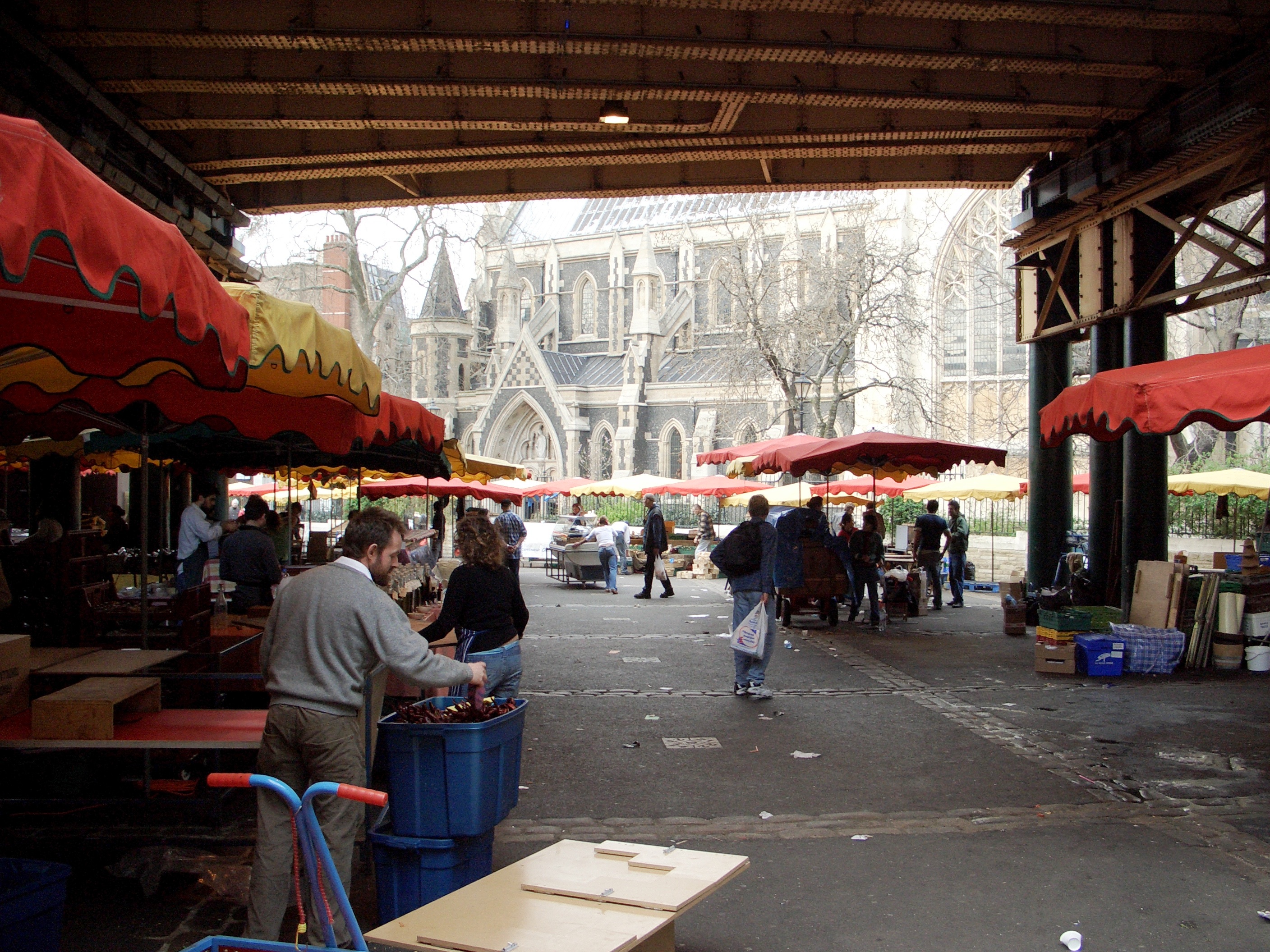
The present buildings were designed in 1851 by Henry Rose, with additions in the 1860s and an entrance designed in the Art Deco style added on Southwark Street in 1932. Significant changes to the buildings have been made over the years as a result of successive expansions to the nearby railway infrastructure; see "Railway viaducts and the Thameslink Programme".
A refurbishment began in 2001. The work includes the re-erection in 2004 of the South Portico from the Floral Hall, previously at Covent Garden, which was dismantled when the Royal Opera House was reconstructed in the 1990s.
File:Borough market c1860.jpg|Borough Market circa 1860 File:Art Deco 1930s entrance to Borough Market in Southwark.jpg|Art Deco 1932 Southwark Street entrance File:Borough Market - geograph.org.uk - 594018.jpg|South Portico from the Floral Hall (erected 2004)
Trade
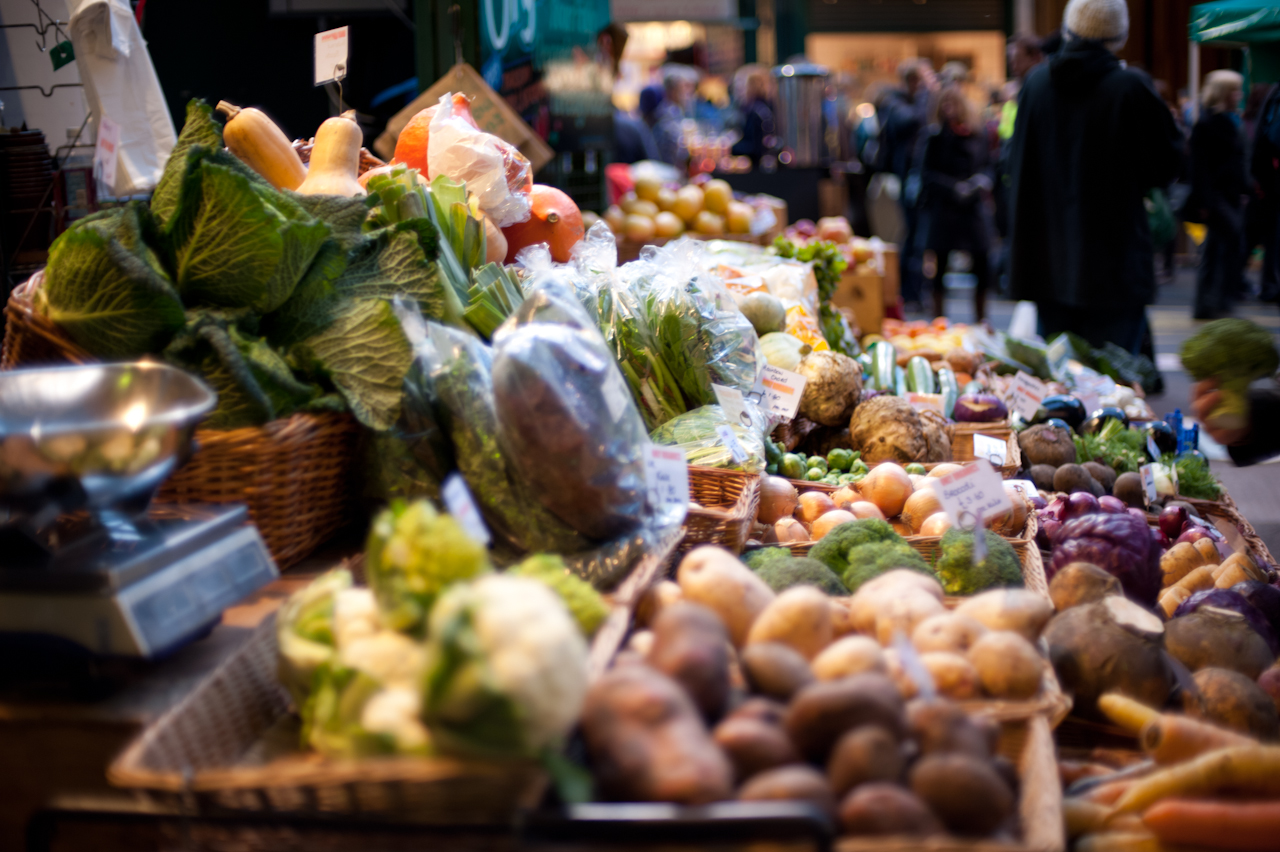
Today market stalls mainly sell specialty foods to the general public. However, in the 20th century Borough Market was essentially a wholesale market, selling produce in quantity to greengrocers. It was the main supplier, along with Covent Garden, of fruits and vegetables to retail greengrocers. Amongst the notable businesses trading in the Borough Market were Vitacress, the Lee Brothers, Manny Sugarman, AW Bourne and Eddy Robbins. JO Sims, the main importer for South African citrus fruit, were also located in the market. Stallholders come to trade at the market from different parts of the UK, and traditional European products are also imported and sold. Amongst the produce on sale are fresh fruit and vegetables, artisanal food, cheese, meat, game, baked bread, and pastry.
The market is a charitable trust in English law administered by a board of volunteer trustees, who have to live in the area.
Film location
Borough Market and the surrounding streets have been used as a film location for such features as Bridget Jones's Diary (2001), Lock, Stock and Two Smoking Barrels (1998) and Harry Potter and the Prisoner of Azkaban (2004). More recently some scenes in The Imaginarium of Doctor Parnassus (2009) were shot there. As reported by the London Evening Standard, the market is available to hire for private events.
Railway viaducts and the Thameslink Programme
Main article: Thameslink Programme
From 1860, the railway operating companies desired to extend services from London Bridge station into new stations at Cannon Street and Blackfriars in the City and link to the West End at Charing Cross Station. This required a viaduct, but legally, it was impossible by the Borough Market Act 1756 for the trustees to alienate their property. The compromise was that only a flying leasehold was given to the railway company for the permanent way, but only for as long as a railway operates on it. The market continues to trade underneath the arches of the viaduct. Each time there is a railway expansion requiring widening of the viaduct, the trustees receive a full compensation payment.

Most recently, as part of the Thameslink Programme, a large number of listed buildings in the Borough Market area have been altered or demolished. The market building on Bedale Street south-side has had its upper floors removed, as has the Wheatsheaf public house on Stoney Street, for the new railway bridge to cross over them. The remaining floors have been re-occupied. The old market glazed roof on Stoney Street has been re-instated and cleaned. A significant loss was the Smirke Terrace, Nos 16–26 Borough High Street, demolished in 2010.
Notes
References
References
- "Food markets in London". Visitlondon.com.
- Goldberg, Lina. (24 February 2013). "10 of the world's best fresh markets". CNN Travel.
- [http://www.boroughmarket.org.uk/page/3036/The+History+of+Borough+Market The History of Borough Market] {{webarchive. link. (8 August 2011 Borough Market website)
- (15 February 2019). "Secret Southwark and Blackfriars". Amberley Publishing.
- (7 December 2011). "Borough Market Tourist Info". London-traveltips.com.
- "About Us - History". Borough Market.
- (2012). "Market Place: Food Quarters, Design and Urban Renewal in London". Cambridge Scholars Publishing.
- (21 July 2011). "Rogue traders: How Maltby Street took on Borough Market".
- "BBC News Live".
- (14 June 2017). "Borough Market reopens 11 days after London Bridge attack".
- "Visit Borough Market".
- Museum Of London Archaeology. (2009). 1-13 Park Street, 8 Stoney Street, London SE1, London Borough of Southwark: standing building survey report [BVA08]. Archaeology Data Service. https://doi.org/10.5284/1018897
- The original Covent Garden building was [[Listed building. listed]] and the re-sited portico was Grade II listed in 2008.{{NHLE
- "About Us - The Trustees of The". Borough Market.
- Julian Clinton. "Location Information - Borough Market". Where Did They Film That.
- (2018-09-19). "17 London Airbnbs for under $150 a night - thelocalvibe Airbnb rankings". thelocalvibe.
- "Borough Market sets out its stall as a venue to get married". London Evening Standard.
- (1 April 2014). "Underneath the Arches: Celebrating Borough Market". History Today.
- "Save Borough Market Area Campaign: FAQ".
- (1 June 2006). "Borough High Street: Conservation area appraisal".
This article was imported from Wikipedia and is available under the Creative Commons Attribution-ShareAlike 4.0 License. Content has been adapted to SurfDoc format. Original contributors can be found on the article history page.
Ask Mako anything about Borough Market — get instant answers, deeper analysis, and related topics.
Research with MakoFree with your Surf account
Create a free account to save articles, ask Mako questions, and organize your research.
Sign up freeThis content may have been generated or modified by AI. CloudSurf Software LLC is not responsible for the accuracy, completeness, or reliability of AI-generated content. Always verify important information from primary sources.
Report