From Surf Wiki (app.surf) — the open knowledge base
Boreal kingdom
Floristic kingdom in northern Eurasia and the Americas
Floristic kingdom in northern Eurasia and the Americas
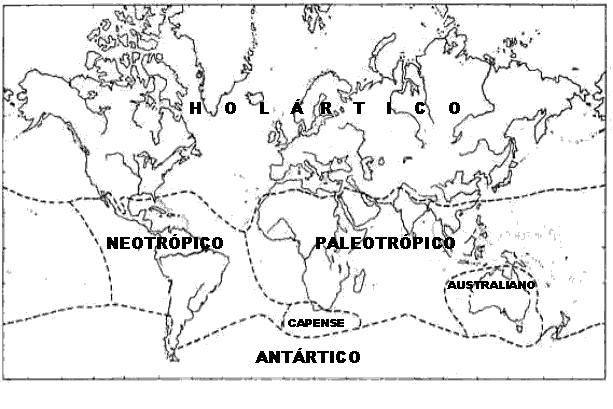
The Boreal kingdom or Holarctic kingdom (Holarctis) is a floristic kingdom identified (1947) by botanist Ronald Good (and later by Armen Takhtajan), which includes the temperate to Arctic portions of North America and Eurasia. Its flora is inherited from the ancient supercontinent of Laurasia. However, parts of the floristic kingdom (and most of its Circumboreal Region) were glaciated during the Pleistocene and as a consequence have a very young flora. Cenozoic relicts found refuge in the southern and mountainous parts of the kingdom, especially in the Eastern Asiatic Region and southern North American Atlantic Region.
Good noted that many plant species of temperate North America and Eurasia were very closely related, despite their separation by the Atlantic Ocean and the Bering Strait.
Millions of years ago, before the opening of the Atlantic Ocean, North America and Eurasia were joined as a single continent, Laurasia. After the opening of the Atlantic, the continents were connected to one another periodically via land bridges linking Alaska and Siberia. Until a few million years ago, the global climate was warmer than at present, especially at higher latitudes, and many temperate climate species were distributed across North America and Eurasia via Alaska and Siberia. The sharply cooler climate of the past few million years eliminated a temperate-zone connection between North America and Eurasia, but common Laurasian origins and a long history of temperate-climate land bridges account for the botanical similarities between the temperate floras on the two continents.
A floristic kingdom is the botanical analogue to an biogeographic realm, which takes into account the distribution of animal as well as plant species. Many biogeographers distinguish the Boreal kingdom as comprising two realms, the Nearctic (North America) and Palearctic (North Africa and Eurasia). Others, based on the distribution of related plant and animal families, include the Palearctic and Nearctic in a single Holarctic realm, which corresponds to Good's Boreal kingdom.
Flora
According to Takhtajan (1978), the following families are endemic to this kingdom: Ginkgoaceae, Cephalotaxaceae, Glaucidiaceae, Hydrastidaceae (Hydrastis), Trochodendraceae, Tetracentraceae, Cercidiphyllaceae, Euptelaceae (Euptelea), Platanaceae, Eucommiaceae, Rhoipteleaceae, Leitneriaceae, Paeoniaceae, Crossosomataceae, Stachyuraceae, Fouquieriaceae, Diapensiaceae, Simmondsiaceae, Pterostemonaceae, Penthoraceae, Bretschneideraceae, Limnanthaceae, Davidiaceae (Davidia), Toricelliaceae, Helwingiaceae, Theligonaceae, Dipentodontaceae, Cynomoriaceae, Adoxaceae, Trapellaceae (Trapella), Butomaceae, Scheuchzeriaceae, Aphyllanthaceae.
According to the same author, the following families are well represented: Magnoliaceae, Lauraceae, Ranunculaceae, Berberidaceae, Hamamelidaceae, Fagaceae, Betulaceae, Juglandaceae, Caryophyllaceae, Chenopodiaceae, Polygonaceae, Plumbaginaceae, Theaceae, Salicaceae, Brassicaceae, Ericaceae, Primulaceae, Malvaceae, Euphorbiaceae, Thymelaeaceae, Rosaceae, Fabaceae, Cornaceae, Araliaceae, Apiaceae, Rhamnaceae, Gentianaceae, Boraginaceae, Scrophulariaceae, Lamiaceae, Campanulaceae, Asteraceae, Liliaceae, Iridaceae, Orchidaceae, Juncaceae, Cyperaceae, Poaceae, Pinaceae, Cupressaceae, Aspleniaceae, Polypodiaceae.
Subdivisions
The kingdom is subdivided into three floristic subkingdoms and nine floristic regions.
Boreal subkingdom
- Circumboreal region
- Eastern Asiatic region
- North American Atlantic region
- Rocky Mountain region
Tethyan subkingdom
- Macaronesian region
- Mediterranean region
- Saharo-Arabian region
- Irano-Turanian region
Madrean floristic region
- Madrean region
References
References
- Good, R. (1947). ''The Geography of Flowering Plants''. Longmans, Green and Co, New York, [https://books.google.com/books?id=NrjPAAAAMAAJ]. 2nd ed., 1953, [https://web.archive.org/web/20161228140417/http://krishikosh.egranth.ac.in/bitstream/1/12312/1/41988.pdf].
- Тахтаджян А. Л. Флористические области Земли / Академия наук СССР. Ботанический институт им. В. Л. Комарова. — Л.: Наука, Ленинградское отделение, 1978. — 247 с. — 4000 экз. [http://herba.msu.ru/shipunov/school/books/takhtajan1978_flor_oblasti_zemli.djvu DjVu] {{Webarchive. link. (2018-10-05 , [https://books.google.com/books?id=9gylTK3CsScC Google Books].)
- Takhtajan, A. (1986). ''Floristic Regions of the World''. (translated by T.J. Crovello & A. Cronquist). University of California Press, Berkeley, [http://www.gbv.de/dms/bs/toc/024192430.pdf].
This article was imported from Wikipedia and is available under the Creative Commons Attribution-ShareAlike 4.0 License. Content has been adapted to SurfDoc format. Original contributors can be found on the article history page.
Ask Mako anything about Boreal kingdom — get instant answers, deeper analysis, and related topics.
Research with MakoFree with your Surf account
Create a free account to save articles, ask Mako questions, and organize your research.
Sign up freeThis content may have been generated or modified by AI. CloudSurf Software LLC is not responsible for the accuracy, completeness, or reliability of AI-generated content. Always verify important information from primary sources.
Report