From Surf Wiki (app.surf) — the open knowledge base
Boracay
Island in the Philippines

Island in the Philippines
| Field | Value |
|---|---|
| name | Boracay |
| image_name | Boracay White Beach.png |
| image_caption | Boracay Island white sand beach |
| map | Visayas#Philippines |
| map_caption | Location of Boracay |
| map_relief | yes |
| coordinates | |
| archipelago | Visayas |
| waterbody | |
| area_km2 | 10.32 |
| highest_mount | Mount Luho |
| elevation_ft | 302 |
| country | Philippines |
| country_admin_divisions_title | Region |
| country_admin_divisions | Western Visayas |
| country_largest_city | Manoc-Manoc |
| country_largest_city_population | 14,810 |
| country_admin_divisions_title_1 | Province |
| country_admin_divisions_1 | Aklan |
| country_admin_divisions_title_2 | Municipality |
| country_admin_divisions_2 | Malay |
| country_admin_divisions_title_3 | Barangays |
| country_admin_divisions_3 | |
| population | 37,802 |
| density_km2 | 3,663 |
| population_as_of | 2020 |
| ethnic_groups |
Boracay (; sometimes shortened by non-natives as Bora) is a resort island in the Western Visayas region of the Philippines, located 0.8 km off the northwest coast of Panay Island. It has a total land area of 10.32 km2, under the jurisdiction of three barangays in Malay, Aklan, and had a population of 37,802 in 2020.
Boracay was originally inhabited by the Panay Bukidnon and Ati people, but commercial development has led to their severe marginalization since the 1970s.
Apart from its white sand beaches, Boracay is also famous for being one of the world's top destinations for relaxation. , it was emerging among the top destinations for tranquility and nightlife.
International travel magazine Travel + Leisure ranked Boracay as the Best Island in the World in 2012. In 2014, the resort island was at the top of the "Best Islands in the World" list published by the international magazine Condé Nast Traveler. In 2016, Boracay headed the magazine's list of "Top 10 destinations to watch".
In April 2018, the Philippine government, under President Rodrigo Duterte, decreed a six-month closure of the island for tourists to undertake major renovation works, especially of the sewage system, which had become obsolete and insufficient. The island was administered by the Boracay Inter-agency Task Force during the closure. It reopened in October 2018, with a new set of rules meant to address a variety of issues, and help control tourist growth in the future. Under the new rules, the Boracay beachfront was cleared of masseuses, bonfires, beach vendors and sunset bonfires. Buildings were bulldozed and beach businesses set back to create a 30 metre buffer zone from the waterline.
The Boracay Ati-atihan in January 2024 witnessed a record-breaking number of tourists, with 36,741 people participating in the event. This festival, which celebrates the cultural heritage of the Ati indigenous people, has been a major draw for tourists and is set to be elevated as a major tourism attraction for the island starting in 2025.
Etymology
The name Boracay is attributed to different origins. The first one that came from the Ati people says that the name of the island came from the Inati words "bora", meaning bubbles, and "bocay", meaning white. Another theory suggests that the name is derived from the local word 'borac,' which means 'white cotton,' referencing the color and texture of Boracay's white, sugary, and powdery sand. Yet another version dating back to the Spanish era says the name is derived from "sagay", the word for a shell, and "boray", the word for seed.
The island is sometimes referred to as simply "Bora" by outsiders for convenience. However locals including tourism stakeholders have highly discouraged the use of the name which is widely considered to be derogatory or disrespectful. Among the reasons include to distinguish Boracay from the island of Bora Bora of the French Polynesia.
The municipal government of Malay passed an ordinance in February 2011, mandating its municipal licensing office to refuse licenses to businesses seeking to operate under a name including "Bora" rather than "Boracay". Usage of the diminutive is also prohibited in promotional materials and business activities.
History
Pre-colonial period
Before the Spanish colonization of the Philippines in the 16th century, Boracay was populated by Ati people. It was known to the Iberians as Buracay. At the time of contact with the Europeans, Buracay had a population of one hundred people, who cultivated rice on the island and augmented their income by raising goats.
The Tumandok people also established an indigenous presence on the island, although the identities of the two indigenous peoples is often conflated. A 1905 report by the Philippine Commission documented the continuing presence of both groups on the island. referred to there as "Buracay".
Contemporary period
As an agricultural island
Boracay was previously part of the province of Capiz. It was under the jurisdiction of the town of Buruanga until the municipality of Malay was established on June 15, 1949. The municipality, as well as the island, became part of Aklan, which became an independent province on April 25, 1956.{{cite web |url=http://www.admu.edu.ph/offices/mirlab/panublion/r6_aklantour.html |archive-url=https://web.archive.org/web/20110927162443/http://www.admu.edu.ph/offices/mirlab/panublion/r6_aklantour.html |archive-date=September 27, 2011|title=Aklan Tour |publisher=Panublion Heritage Site |access-date=June 12, 2007}}
Before the advent of tourism, Boracay was largely an agricultural community. Around 1910, Sofía Gonzáles Tirol and her husband Lamberto Hontiveros Tirol (a town judge on the Panay mainland) took ownership of substantial properties on the island. They planted coconuts, fruit trees and greenery. Others followed the Tirols, and cultivation and development of the island gradually spread. The production of copra and fishing were major industries in the island.
However, due to overharvesting by fishers and the destruction of coral reefs due to cyanide fishing, the fishing industry saw a decline. By the 1980s, the price of copra had declined, encouraging tourism as an alternative source of income for the island.
Dispossession from the Ati and other residents during Martial Law
Main article: Ati people, Martial law under Ferdinand Marcos, Human rights abuses of the Marcos dictatorship
On Nov. 10, 1978, six years after the declaration of Martial Law under Ferdinand Marcos, 65 Philippine islands including Boracay was declared "tourist zones and marine reserves" without any mention of the status of the Ati who were the original residents of the island. This de facto dispossession of Ati lands on Boracay by Marcos placed the islands under the control of the Philippine Tourism Authority, and marked the beginning of rapid development on the island. In turn, this resulted in the further marginalization of the Boracay Ati for decades.
Influx of tourism (1970s to 1997)
.jpg)
Tourism came to the island beginning sometime in the 1970s. In 1970, the movies Nam's Angels (released in the U.S. as The Losers) and Too Late the Hero used filming locations on Boracay and Caticlan.As a filming location
- Filming locations for Too Late the Hero (1971), Internet Movie Database. There was an influx of Western tourists after German writer Jens Peter called it "paradise on Earth" in his book about the Philippines in 1978. In the 1980s, the island became popular as a budget destination for backpackers. By the 1990s, Boracay's beaches were being acclaimed as the best in the world. However, in 1997, tourist arrivals to the resort island dropped 60 percent due to the increase of coliform bacteria from poor sewage and septic systems on the island.
1997 to 2018

The condition of Boracay in 1997 led to the installment of a potable water supply system, a sewage treatment plant and a solid waste disposal system, operated by the Philippine Tourism Authority (PTA). The connection of businesses and households to the system was not universal, and environmental problems persisted.
Then-president Gloria Macapagal Arroyo declared Boracay a Special Tourism Zone in 2005, and in April 2006 she gave the PTA administrative control over the island while mandating the agency to coordinate with the provincial government of Aklan.
In 2012, the Philippine Department of Tourism reported that Boracay had been named the world's second best beach after Providenciales in the Turks and Caicos Islands.
2018 closure and rehabilitation
Main article: 2018 Boracay closure and redevelopment

Due to worsening environmental conditions in Boracay, President Rodrigo Duterte in February 2018 said he planned to close the resort island, which he described as a "cesspool", on April 26, 2018, instructing Environment and Natural Resources Secretary Roy Cimatu to resolve the issue. In a cabinet meeting, President Duterte approved the full closure of the island for six months, effective April 26, 2018, to rehabilitate and resolve the environmental issues surrounding Boracay. On May 30, 2018, President Duterte declared that he planned to make the entire Boracay a land reform area and wanted to first prioritize the island's residents.
In April 2018, the Philippine Army's 301st Infantry Brigade confirmed that 200 soldiers were deployed to Boracay to secure the island during its shutdown starting April 26.
On October 26, 2018, Boracay was reopened to the public with work on the island's infrastructure still in progress. In April 2019, numerous Chinese-owned businesses were opened in Boracay, and additionally, there are about 300 mainland Chinese residents. In April 2019, Labor Secretary Silvestre Bello III said that the Department of Labor and Employment has no control over foreign businesses setting up shop on the island, but that it vows to ensure that no Chinese national could take jobs fit for Filipinos.
Efforts to maintain the pristine condition of the beaches and the introduction of environmentally-friendly practices such as the use of biodegradable products and electric tricycles have significantly contributed to the island's recovery. The absence of plastic and a renewed focus on sustainability were key highlights of introduced in 2023.
Following the Boracay cleanup, Duterte distributed 623 certificates of land-ownership awards covering 274 ha of land in Boracay and Aklan to the area's Ati inhabitants and other beneficiaries.
2020 COVID-19 pandemic
The municipality of Malay, including Boracay island, was closed to tourism effective March 19, 2020, in response to the COVID-19 pandemic. The island would eventually be re-opened to tourists with COVID-19 protocols implemented as a cautionary measure.
Revocation of Ati families' CLOA
Under the Bongbong Marcos administration in late March 2024, the Department of Agrarian Reform (DAR), upon the request of private land developers, cancelled the Certificates of Land Ownership Award (CLOA) of five lots in Boracay owned by Ati indigenous peoples. The lots, which were awarded by the Duterte administration to the Ati members in 2018, had been barricaded by armed men, who cited a March 5, 2024 decision by the DAR concluding that the land awarded was "not suitable for agriculture". The Boracay Ati Tribal Organization (BATO) later urged the Commission on Human Rights to intervene in the dispute, leading DAR Secretary Conrado Estrella III to order the distribution of land to the affected Ati members, albeit to a yet undisclosed location.
Geography
.jpg)
Boracay Island is located 0.8 km off the northwest corner of the mainland Panay and belongs to the province of Aklan in the Western Visayas region, or Region VI, of the Philippines. It is 50 km northwest of the provincial capital, Kalibo; 150 km northwest of the regional capital, Iloilo City; and 200 nmi southeast of the national capital, Manila. The island is approximately seven kilometers long, dog-bone shaped, with the narrowest spot being less than one kilometer wide, and has a total land area of 10.32 km2 and an approximate perimeter 23 kilometers (14.7 mi).
South-facing Cagban Beach is located across a small strait from the jetty port at Caticlan on Panay Island, and the Cagban jetty port serves as Boracay's main entry and exit point during most of the year. When wind and sea conditions dictate, east-facing Tambisaan Beach serves as an alternative entry and exit point. Boracay's two primary tourism beaches, White Beach and Bulabog Beach, are located on opposite sides of the island's narrow central area. White Beach faces westward and Bulabog Beach faces eastward. The island also has several other beaches.
White Beach, the main tourism beach, is about 4 km long and is lined with resorts, hotels, lodging houses, restaurants, and other tourism-related businesses. In the central portion, for about two kilometers, there is a footpath known as the Beachfront Path separating the beach itself from the establishments located along it. North and south of the Beachfront Path, beachfront establishments do literally front along the beach itself. Several roads and paths connect the Beachfront Path with Boracay's Main Road, a vehicular road which runs the length of the island. At the extreme northern end of White Beach, a footpath runs around the headland there and connects White Beach with Diniwid Beach.
Bulabog Beach, across the island from White Beach, is the second most popular tourism beach on the island and Boracay's main windsurfing and kiteboarding area.
Boracay is divided for land use and conservation purposes into 400 ha reserved forestland and 628.96 ha agricultural land.
Governance
The three barangays comprising Boracay island, Balabag, Manoc-Manoc, and Yapak, are part of the municipality of Malay in the province of Aklan.
Climate

Weather in Boracay is generally divided into two seasonal weather patterns known locally as the Amihan and Habagat seasons. In the Visayan language, Amihan means a cool northeast wind, and Habagat means west or southwest wind; southwest monsoon. The Amihan season is characterized by moderate temperatures, little or no rainfall, and a prevailing wind from the northeast. The Habagat season is characterized by hot and humid weather, frequent heavy rainfall, and a prevailing wind from the west.
On Boracay, the main indicator of the switch between the Amihan and Habagat seasonal patterns is the switch in wind direction. In most years this transition is abrupt and occurs overnight. In some years there is a period of perhaps a week or two where the wind will switch between Amihan and Habagat patterns several times before settling into the pattern for the new season. As a rule of thumb, Boracay will be in the Amihan weather pattern from sometime in October to sometime in March and in the Habagat weather pattern for the remainder of the year.
Temperatures in Malay municipality province generally ranged between 25 and in 2009–2019, with a low of 24 C in February 2014 and high of 31 C in October 2018, ranging more widely in 2019, with a low of 23 C in March and a high of 33 C in May. During Tropical storm periods, temperatures can fall below 30 C. Tropical storms can impact Boracay at any time of year, but are most likely to be seen during the Habagat season.
Environment
The rapid growth of tourism has caused environmental damage on the island. Condé Nast Traveler magazine called Boracay "the poster child for overtourism". The Daily Telegraph called Boracay an "island paradise ruined by tourism".
Fauna

At least three species of flying foxes have been recorded to inhabit Boracay namely the giant golden-crowned flying fox (Aceradon jubatus), the giant fruit bat (Pteropus vampyrus), and the small flying fox (Pteropus hypomelanus). Their population is concentrated on the northern side of the island in Barangay Yapak, where the hunting of bats was made illegal through a local ordinance.
According to the Coastal Ecosystem Conservation and Adaptive Management (CECAM), a study led by the Japan International Cooperation Agency conducted from 2010 to 2015 noted a 70.5 percent decrease of Boracay's coral cover from 1988 to 2011. The study attributed the increased drop in coral cover from 2008 to 2011 to the 38.4 percent increase of tourist arrivals combined with poorly monitored snorkeling activity in coral-rich areas. The Boracay Foundation Inc. (BFI) made efforts to remedy the situation by launching a "refurbishment" program for the corals. In 2017, the BFI claimed the number of corals in Boracay increased from 15 to 20 percent since 2015 due to its project.
Sanitation

Boracay has been experiencing an increased coliform bacteria population since the 1990s, which contributed to a 60 percent decline in tourist arrivals in 1997. Although a potable water supply system, a solid waste disposal system, as well as a sewage treatment plant which began operation in 2003 were installed to remedy the insufficient sewage and septic conditions in the island, environmental concerns regarding coliform bacteria persisted due to noncompliance of some business establishments in the island.
In 2004, only 51 percent of hotels and restaurants in Boracay and 25 percent of all households were connected to the island's central sewage system. In 2005, Boracay was declared a "special tourism zone". In April 2006, Arroyo gave the PTA administrative control over Boracay, to be exercised in coordination with the provincial government. In 2009, Boracay Island Water Co. (BIWC), won a contract to improve the supply of potable water and install an efficient sewerage system.
Boracay has experienced abnormally high algae growth since February 2015, due to sewage being dumped into the waters surrounding the islands. In early 2018, 50 to 60 percent of all establishments in Boracay were compliant to the Clean Water Act of 2004 according to the Department of Environment and Natural Resources.
Tourism
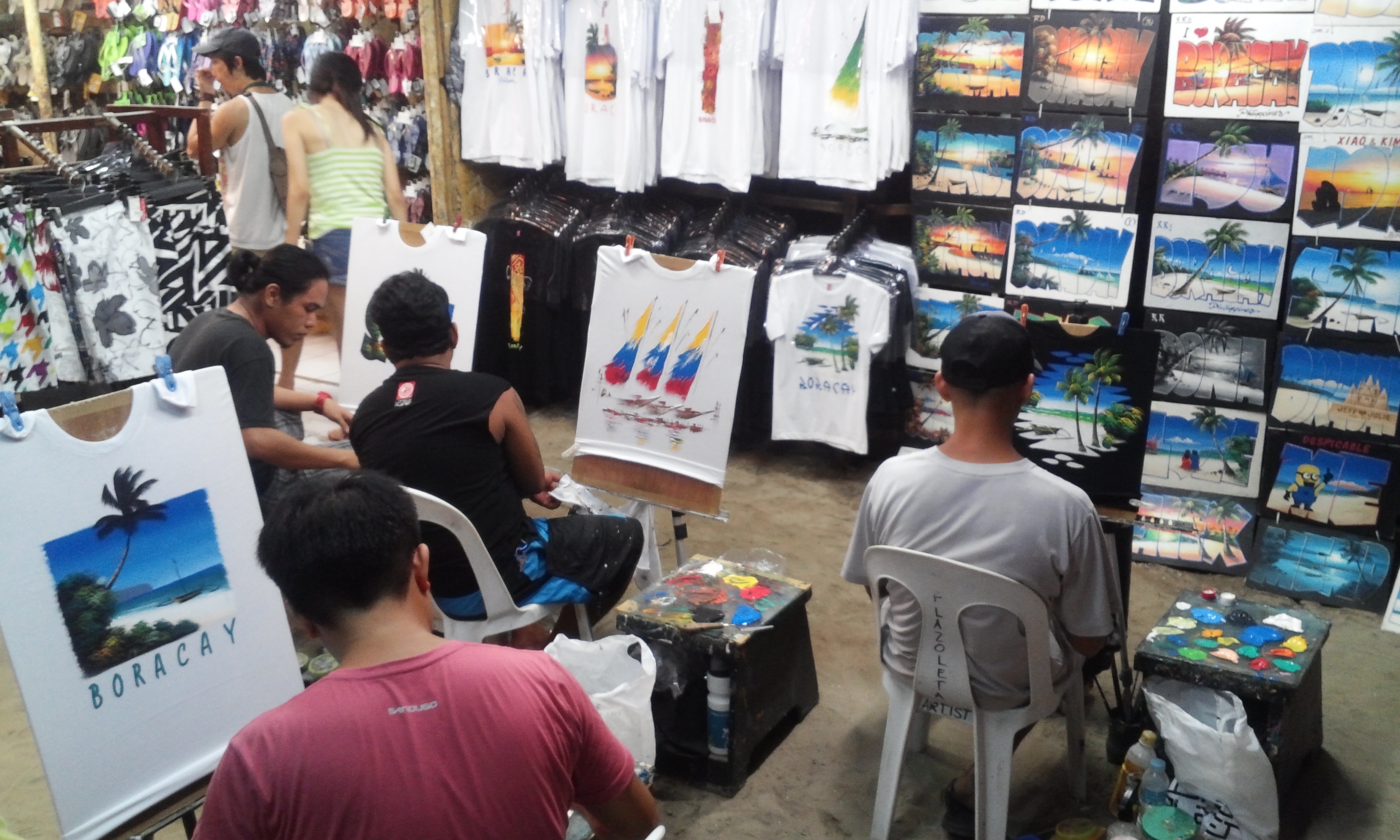
Partly because of its wind and weather patterns, tourism in Boracay is at its peak during the amihan season (which generally starts around the Christmas season and runs through February). During amihan, the prevailing wind blows from the east. Boracay's main tourism area, White Beach, is on the western side of the island and is sheltered from the wind. During the Amihan season, the water off White Beach is often glassy-smooth. On the eastern side of the island, hills on the northern and southern ends of the island channel the Amihan season wind from the east onshore, onto Bulabog Beach in the central part of the island's eastern side. This makes the reef-protected waters off that beach relatively safe and ideal for scuba diving, windsurfing, and kiteboarding / kitesurfing.
In June 2011, it was reported that Megaworld Corporation, a real estate development group led by Andrew Tan had earmarked to develop tourism estates in Boracay and Cavite. The planned Boracay project, Boracay Newcoast, involves four hotels with 1,500 rooms, a plaza and an entertainment center.
Other resorts in Boracay include Discovery Shores, a luxury five-star resort managed by a Filipino hospitality group called The Discovery Leisure Company Inc. and owned by Discovery World Corp. The building, with 88 suites, a spa, and four restaurants and bars, stands at Station One on the White Beach, and has been described as "more Miami chic than hidden oasis."
The island has the highest density of merchants that accept bitcoin outside of El Salvador. There is a movement to dub the island "Bitcoin Island" and bootstrap a circular economy similar to Bitcoin Beach.
Leisure activities
Leisure activities available on or near Boracay include horseback riding, scuba diving, helmet diving, snorkeling, windsurfing, kiteboarding, cliff diving, parasailing and banana boat.

Boracay is the site of an 18-hole par 72 golf course designed by Graham Marsh. In addition, , Boracay has in excess of 350 beach resorts offering more than 2,000 rooms ranging in quality from five-star to budget accommodation. In addition, Boracay offers a wide range of restaurants, bars, pubs, and nightclubs.

A landmark natural rock formation, Boracay's Rock, juts prominently directly in front of Willy's Beach Resort.
Statistics
According to the Malay Tourism office, they recorded 2,155,217 tourist arrivals to Boracay in 2025, a slight increase from 2024, which was 2,077,977 tourists. The Malay Tourism Office is aiming for 2.3 million tourist arrivals for 2026.
Marhaba Boracay
In September 2024, tourism secretary Christina Frasco launched Megaworld's 850 m2 Marhaba, a halal tourism cove in the Boracay Newcoast private beach in front of “Lapus-Lapus” rock formation.
Sports
Boracay has been a competitive venue for the Asian Windsurfing Tour, with the week-long Boracay International Funboard Cup competition usually held in January on Bulabog Beach. . CNNGo, a division of CNN focused on travel/lifestyle/entertainment, selected the Boracay International Funboard Competition on the weekend of January 22–24 as one of its 52 weekend recommendations for 2010.52 Weekends: Go somewhere different every week , CNN GO;
^ Estan Cabigas, January 22-24: Boracay International Funboard Cup , CNN Go, January 18, 2010.
Dragon boat races are held annually in Boracay under the auspices of the Philippine Dragon Boat Federation, with teams coming from around the Philippines and from other Asian nations to compete. The races usually take place sometime in April or May. The 2012 Boracay Edition of the PDBF International Club Crew Challenge was scheduled for April 26–28, 2012.
The Boracay Open Asian Beach Ultimate Tournament, an ultimate frisbee event, with players coming from around the Philippines and from other international nations, has been held annually since 2003, usually in March or April.
Asian Games Centennial Festival
Boracay was scheduled to host a special multi-sport event in 2013. At its 31st General Assembly in Macau, the Olympic Council of Asia (OCA) decided to create the Asian Games Centennial Festival in celebration of the 100th anniversary of the Oriental Games (later Far Eastern Championship Games). The OCA awarded the hosting rights to the Philippines as it had been the host of the first Far Eastern Championship Games held in Manila 100 years earlier. The festival was to be held on Boracay in November 2013. However, it had to be rescheduled and relocated because of Typhoon Haiyan, with the ceremony eventually taking place at the Sofitel Plaza in Manila on January 17, 2014. The 32nd OCA General Assembly was to be held in conjunction with the games.
Culture

The first settlers of Boracay were a Negrito people called the Ati, and who spoke a distinctive Philippine language called Inati.{{Cite book |access-date=June 25, 2014
The well-known Ati-Atihan Festival takes place each January in Kalibo on nearby Panay Island. A much smaller Ati-Atihan festival is celebrated in Boracay, usually in the second or third week of January.
Transportation
.jpg)
Boracay Island is separated from Panay Island by a narrow strait. The island is located opposite the barangay of Caticlan in the municipality of Malay, Aklan. Transportation across the strait is provided by boats operating from the Caticlan jetty port. Cagban Port serves as the primary sea transportation hub for passengers going into Boracay but the island lacks any formal seaport for cargo transport and waste disposal. Goods are delivered into Boracay through an informal port near the Cagban Port.
Boracay is served by two airports in Aklan: the Kalibo International Airport and Godofredo P. Ramos Airport (commonly referred to as Caticlan airport or Boracay airport).
The three main modes of transport are via motor-tricycles and electric-tricycles (e-trikes) along the main road, or by walking along the beaches. Pedicabs, known as sikads, are also available along the Beachfront Path. Other means of transportation include mountain bikes, quadbikes and motorbikes, all of which can be rented. It was reported in October 2018 that the island will see modern jeepneys, solar-powered shuttles, and hop-on hop-off buses serviced by Grab, and that the Department of Energy will donate 200 e-trikes to the Malay local government under a project funded by the Asian Development Bank.
, the municipal government of Malay was encouraging motorcycle operators to transition to e-trikes in their coordinated efforts to promote environment-friendly public transportation. Diesel-motor tricycles are expected to be phased out by August 2018.
In 2019, San Miguel Corporation proposed a 1.2 km limited-access bridge to connect the island of Boracay to the mainland of Panay. As of February 2024, the unsolicited project proposal is under negotiation and has been included in the Department of Public Works and Highways (DPWH) funding for Public-Private Partnership (PPP) infrastructure projects. Upon completion, travel time between Iloilo City and Boracay will be reduced to 2.5 hours from the current 6 to 7 hours through the bridge and the Iloilo–Capiz–Aklan Expressway, both of which are part of the DPWH's PPP infrastructure projects.
Awards and recognition
Boracay Island earned the eighth spot in the annual Condé Nast Traveler (CNT) readers' choice awards for top islands to visit in 2021.
Notes
References
References
- Resabal, Cooper. (October 27, 2018). "After cleanup, Atis in Boracay hope to reclaim land".
- "Municipality of Malay (2020)".
- Angan, Joseph. (June 21, 2013). "Beyond the beach: The untold story of Boracay's Ati tribe".
- "Boracay is top place for relaxation: poll". ABS-CBN News.
- "Boracay beats Asian favourites to take crown as top destination". Good News Pilipinas.
- "Relaxation, nightlife both more fun in Boracay". Yahoo! Philippines.
- "Boracay named 2012 worlds best island". ABS-CBN News.
- "BORACAY named 2012 No.1 World's Best Island". Boracay Beach Live.
- (October 20, 2014). "The Best Islands in the World". Conde Nast Traveler.
- "TOP 10 DESTINATIONS TO WATCH IN 2016". Conde Nast Traveler.
- "Philippines approves six-month closure of Boracay from April (VIDEO) - Malay Mail".
- (May 11, 2020). "Executive Order No. 115". Office of the President of the Philippines.
- (March 19, 2021). "Boracay task force seeks one-year extension". Philippine News Agency.
- (October 28, 2018). "The new-Boracay opens with a whole new set of rules".
- "PNP: ALL SYSTEMS GO FOR BORACAY REOPENING". League Online News.
- G, Herbie. (2024-01-19). "Boracay Ati-atihan 2024 sees record-breaking number of tourists".
- (February 26, 2018). "Paradise lost: Ati natives dread Boracay closure". ABS-CBN News.
- Historically Digitized, [https://www.academia.edu/1524192/etymology_boracay_island_Source Ro Isla it Buruanga].
- (12 June 2024). "Boracay groups frown on 'Bora' use in tourism campaigns". Rappler.
- (6 April 2018). "It's Boracay, not Bora, folk tell Roque". Philippine Daily Inquirer.
- (9 February 2023). "'Please, it's not Bora': Plea to call Boracay as it is resurfaces online". Interaksyon.
- (26 June 2011). "Aquino told: It's Boracay, not Bora". Philippine Daily Inquirer.
- Miguel de Loarca, Relacion de las Yslas Filipinas (Arevalo: June 1782) in BLAIR, Emma Helen & ROBERTSON, James Alexander, eds. (1903). The Philippine Islands, 1493–1803. Volume 05 of 55 (1582–1583). Historical introduction and additional notes by Edward Gaylord BOURNE. Cleveland, Ohio: Arthur H. Clark Company. {{ISBN. 978-0554259598. OCLC 769945704. "Explorations by early navigators, descriptions of the islands and their peoples, their history and records of the catholic missions, as related in contemporaneous books and manuscripts, showing the political, economic, commercial and religious conditions of those islands from their earliest relations with European nations to the beginning of the nineteenth century.", p. 75.
- (January 19, 2016). "The Ati & Tumandok People of Panay Island | Travel Photographer Jacob Maentz".
- (1906). "Report of the Philippine Commission to the Secretary of War". U.S. Government Printing Office.
- (June 15, 1949). "An Act Creating the Municipality of Malay in the Province of Capiz".
- [https://web.archive.org/web/20140529164859/http://aklan.gov.ph/aklan02_profile.php Our Province Aklan Historical Background] (archived from [ the original] on May 29, 2014), The Provincial Government of Aklan Official Website supports assertion that Boracay is part of Aklan and creation date of Aklan province -->
- (April 25, 1956). "An Act To Create the Province of Aklan".
- "Governance in Context: Boracay Island, Philippines".
- Nick I. Martevia=Archive.org. (November 1987). ["The Woman Behind the Greening of Boracay]"](https://ia803100.us.archive.org/27/items/SomeOldNewsclippingsAboutBoracay/Greener1.jpg).
- Burgos, Nestor P. Jr.. (2018). "Boracay rehab magnifies land ownership issue".
- (November 10, 1978). "Declaring certain islands, coves and peninsulas in the Philippines as tourist zones and marine reserve under the administration and control of the Philippine Tourism Authority".
- Neef, Andreas. (2021). "Tourism, land grabs and displacement: the darker side of the feel-good industry". Routledge.
- ANGAN, JOSEPH. (2013). "Beyond the beach: The untold story of Boracay's Ati tribe".
- "aroundgrandmasrockingchair.com".
- Grele, Dominique. (2004). "100 Resorts in the Philippines: Places with a Heart". Asiatype, Inc..
- de Guzman, Nicai. (June 6, 2017). "These Vintage Photos of Philippine Beaches Are a Trip Back in Time". Spot.
- Dela Paz, Chrisee. (April 10, 2018). "LIST: Planned developments in Boracay". Rappler.
- (February 16, 1990). "Boracay Tops World's Best Beaches". Internet Archive.
- (February 13, 2018). "WHAT WENT BEFORE: Boracay's environmental issues". Philippine Daily Inquirer.
- Mayen Jaymalin. (January 29, 2012). "Boracay named world's 2nd best beach". The Philippine Star.
- (February 10, 2018). "Duterte wants to shut down Boracay". Sun Star Manila.
- Placid, Dharel. (April 4, 2018). "Boracay closed for 6 months starting April 26, says Roque". [[ABS-CBN News]].
- (May 30, 2018). "Duterte puts entire Boracay Island under land reform". The Philippine Inquirer.
- (June 13, 2018). "Duterte: Original residents may sell awarded Boracay land to big businesses". ABS-CBN News.
- (April 24, 2018). "Soldiers sent to secure Boracay". Philippine Star.
- Rey, Aika. (October 25, 2018). "Boracay Island now open".
- "Chinese businesses pop up in Boracay after island reopens".
- "Local official confirms Chinese workers, businesses operating in Boracay".
- "Wala tayong magagawa: DOLE says no control over Chinese businesses in Boracay".
- (2023-01-01). "15 things to know before going to Boracay, Philippines — 2024".
- (November 8, 2018). "Duterte distributes land to Ati tribe in Boracay". [[ABS-CBN News]].
- (March 18, 2020). "Boracay bans tourists due to coronavirus fears". ABS-CBN News.
- "Department of Tourism-Philippines".
- "Guide for Tourists Going to Boracay Island | The Official Website of Aklan Province".
- Arnaldo, Ma Stella F.. (February 2, 2021). "Hue Boracay 'followed correct protocols' — hotel sources".
- (28 March 2024). "Ati families face forced eviction from disputed Boracay land". [[Philippine Daily Inquirer]].
- (27 March 2024). "DAR chief orders allocation of land to displaced Ati in Boracay". [[Rappler]].
- Boracay Island. Boracay's Official Tourism SiteBoracay Island
- (December 4, 2020). "Villar Opens Boracay Circumferential Road Phase 1, 2". Philippine Department of Public Works and Highways.
- [http://www.gmanews.tv/story/126064/Boracay-to-be-developed-as-forest-land--DENR-official Boracay to be developed as forest land – DENR official], gmanews.tv
- "G.R. No. 167707 and G.R. No. 173775, The Secretary of DENR vs. Mayor Jose Yap, Dr. Orlando Sacay vs. The Secretary of DENR, October 8, 2008".
- [http://newsinfo.inquirer.net/inquirerheadlines/regions/view/20081008-165365/SC-affirms-Proclamation-1064-on-Boracay SC affirms Proclamation 1064 on Boracay] {{webarchive. link. (October 10, 2008 , inquirer.net)
- Jay B. Rempillo, [https://www.academia.edu/1081059/Except_for_Titled_Properties_Boracay_is_owned_by_the_State], Supreme Court of the Philippines.
- (January 18, 2008). "Mandating the Secretary of Tourism to exercise the administration and control mandate of the Philippine Tourism Authority over Boracay Island and For Other Purposes".
- "Boracay establishments heed the call for voluntary redevelopment".
- "Habagat Amihan Northeast Southwest: What Is Monsoon Weather?". Puerto Galera Yacht Club.
- "Philippines : Weather". [[Lonely Planet]] (travel guidebook).
- "Malay Monthly Climate Averages".
- "Monthly Typhoon Tracking Charts". Digital Typhoon.
- (October 24, 2018). "Boracay's Big Tourism Problem". Condé Nast Traveler.
- (September 13, 2018). "What's happening in Boracay, the island paradise ruined by tourism?". The Telegraph.
- (September 2, 2011). "Boracay's other attraction: Flying foxes". Philippine Daily Inquirer.
- (June 4, 2015). "70% of Boracay coral reefs gone after 23 years–study". Business Mirror.
- (June 9, 2015). "Tourism activities damage 70 percent of Boracay corals—study". Philippine Daily Inquirer.
- (May 13, 2017). "Significant coral reef growth noted in Boracay". Manila Bulletin.
- (February 15, 2018). "DENR issues 51 notices of violation to erring Boracay establishments". CNN Philippines.
- (August 22, 2013). "'Amihan' and 'habagat'newspaper=The Philippine Daily Inquirer".
- (June 12, 2017). "Boracay Scuba Diving Emergency Action Plan". Boracay Scuba Diving Safety.
- (June 30, 2011). "Alliance Global unit to spend P20-B for tourism estates". ABS-CBN News.
- (January 19, 2018). "Discovery Shores Boracay, Discovery Primea win Condé Nast Johansens Awards for Excellence". Malaya.
- "Five star Boracay resorts reassure staff, clients ahead of 6-month shutdown". ABS-CBN News.
- (July 12, 2010). "Forgotten island the ultimate escape". Stuff.
- (June 29, 2017). "Big Fat Hotel Wrap". Travel Weekly.
- (January 5, 2018). "Island in the sun: Where to live large on Boracay". CNN Travel.
- "Pouch.ph · Get on the Lightning Network.".
- link. (August 17, 2009 .)
- (May 14, 2016). "Boracay Island Guide for First Time Travelers". exploreiloilo.com.
- Aguirre, Jun. (2026-01-06). "Boracay tourist arrivals up slightly in 2025 despite setbacks".
- (September 10, 2024). "PH unveils new Muslim white beach 'Marhaba Boracay'". [[Philippine News Agency]].
- [http://www.proteus-sports.com/products_awt.html The Asian Windsurfing Tour] {{webarchive. link. (June 1, 2010 , Proteus Sports.)
- "boracaywindsurfing.com - boracaywindsurfing Resources and Information.".
- link. (May 6, 2012 at [http://www.pdbf.com/ Official Website] {{Webarchive). link. (April 14, 2012 of the [[Philippine Dragon Boat Federation]].)
- The ''Boracay Open Asian Beach Ultimate Tournament'' is organized by the {{usurped
- "OCA General Assembly opens in Macau". OCA.
- (July 20, 2011). "Philippines to host 2013 Centennial Asian Games". Inquirer Sports.
- "OCA President describes Centennial Festival as symbol of solidarity". OCA.
- Pennoyer, Douglas F.. (1987). "Inati: the Hidden Negrito Language of Panay, Philippines". Philippine Journal of Linguistics.
- (September 22, 2018). "New port facility eyed in Boracay". Manila Bulletin.
- Rey, Aika. (October 15, 2018). "LOOK: E-trike, modern vehicles for the 'new' Boracay".
- Miraflores, Pia. (July 26, 2018). "Boracay shifts to e-tricycles by August".
- Amojelar, Darwin G.. (2019-09-19). "San Miguel pursuing plan on 1.2-km Boracay bridge".
- Department of Public Works and Highways (DPWH). "Boracay Bridge Project". Department of Public Works and Highways (DPWH).
- Guardian, Daily. (2024-08-02). "Boracay Bridge to get PPP funding in 2025 budget".
- [https://iloilocity.gov.ph/main/wp-content/uploads/2021/10/A-Framework-for-Delivering-PPPs-as-Part-of-a-Broader-Infrastructure-Iloilo-Report-final-clean-Feb-16.pdf A Framework for Delivering PPPs as Part of a Broader Infrastructure Strategy]. ''iloilocity.gov.ph''. Retrieved 2024-08-06.
- (2024-08-06). "Iloilo-Capiz-Aklan Expressway (ICAEx) {{!}} Department of Public Works and Highways".
- "Siargao, Palawan, Boracay win spot in Condé Nast awards".
This article was imported from Wikipedia and is available under the Creative Commons Attribution-ShareAlike 4.0 License. Content has been adapted to SurfDoc format. Original contributors can be found on the article history page.
Ask Mako anything about Boracay — get instant answers, deeper analysis, and related topics.
Research with MakoFree with your Surf account
Create a free account to save articles, ask Mako questions, and organize your research.
Sign up freeThis content may have been generated or modified by AI. CloudSurf Software LLC is not responsible for the accuracy, completeness, or reliability of AI-generated content. Always verify important information from primary sources.
Report