From Surf Wiki (app.surf) — the open knowledge base
Boko Haram insurgency
Insurgency in Sub-Saharan Africa

Insurgency in Sub-Saharan Africa
| Field | Value | |||||||||
|---|---|---|---|---|---|---|---|---|---|---|
| conflict | Boko Haram insurgency | |||||||||
| partof | the Religious violence in Nigeria, the War against the Islamic State, the War in the Sahel, and the war on terror | |||||||||
| image | {{Multiple image | |||||||||
| perrow | 2/2/2 | |||||||||
| total_width | 384 | |||||||||
| border | infobox | |||||||||
| image1 | Borno Insurgency.png | |||||||||
| image2 | Nigerian Helicopter - Sambisa Forest, 2017.png | |||||||||
| image3 | Boko Haram Amputation (removed watermark).png | |||||||||
| image4 | Boko_Haram_vehicles_destroyed_by_Cameroon_in_Dec._2018.jpg | |||||||||
| footer_align | center | |||||||||
| footer | **Clockwise from top left**: {{flatlist | |||||||||
| date | [26 July 2009](2009-boko-haram-uprising) – present | |||||||||
| () | ||||||||||
| place | Northern Nigeria | |||||||||
| Northern Cameroon (from 2012) | ||||||||||
| Southeast Niger (from 2014) | ||||||||||
| Western Chad (from 2014) | ||||||||||
| status | Ongoing (Map of the current military situation) | |||||||||
| * Expansion of conflict into neighboring Cameroon, Chad, Mali, and Niger<ref name | "CTC 2021"/ | |||||||||
| combatant1 | **** | |||||||||
| **** | ||||||||||
| **** | ||||||||||
| **** | ||||||||||
| **** | ||||||||||
| **** ([from 2025](2025-united-states-strikes-in-nigeria)) | ||||||||||
| {{Collapsible list | ||||||||||
| title | Supported by: | |||||||||
| <ref>{{cite web | url | https://www.aberfoylesecurity.com/?p=4419 | title=Nigeria Seeks Russian Military Aid in its War on Boko Haram | date=8 May 2019 | author=Andrew McGregor | website=Aberfoyle International Security | access-date=28 April 2019}} | |||
| <ref name | "The Guardian"/ | |||||||||
| <ref name | "The Guardian"/ | |||||||||
| <ref name | "The Guardian"[Kidnapped schoolgirls: British experts to fly to Nigeria 'as soon as possible'.](https://www.theguardian.com/world/2014/may/07/kidnapped-schoolgirls-british-experts-nigeria-boko-haram) theguardian.com, Wednesday 7 May 2014 17.33 BST. | |||||||||
| <ref>[http://mashable.com/2015/01/31/african-union-boko-haram-troops/ African Union agrees to send 7,500 troops to fight Boko Haram in Nigeria]. Mashable.com, 31 January 2015.</ref><ref name | "Medium"[The African Union Readies an Army to Fight Boko Haram](http://medium.com/war-is-boring/the-african-union-readies-an-army-to-beat-boko-haram-694150ba6ebb) , Medium.com. | |||||||||
| <ref>{{cite web | url | https://english.enabbaladi.net/archives/2024/05/turkey-recruits-syrians-to-fight-in-africa-under-supervision-of-sultan-murad-division/ | title=Turkey recruits Syrians to fight in Africa under supervision of Sultan Murad Division | work=Enab Baladi | author=Hassan Ibrahim | date=13 May 2024}} | ||||
| <ref>{{cite web | url | http://www.ibtimes.co.uk/nigeria-turns-east-russia-pakistan-now-selling-warplanes-help-boko-haram-fight-1594886 | title=Nigeria turns east: Russia and Pakistan now selling warplanes to help in Boko Haram fight | first=Ludovica | last=Iaccino | date=5 December 2016 | access-date=1 May 2018 | archive-url=https://web.archive.org/web/20180614044901/https://www.ibtimes.co.uk/nigeria-turns-east-russia-pakistan-now-selling-warplanes-help-boko-haram-fight-1594886 | archive-date=14 June 2018 | url-status=live}} |
| <ref name | "Global News"[Canada joins effort to free Nigerian schoolgirls.](http://globalnews.ca/news/1330088/canada-joins-effort-to-free-300-nigerian-schoolgirls/) 14 May 2014 3:23 pm Updated: 15 May 2014 7:01 pm. By Murray Brewster, The Canadian Press | |||||||||
| <ref name | "Channelst" | |||||||||
| <ref name | "The Jerusalem Post"[Israel sends experts to help hunt for Nigerian schoolgirls kidnapped by Islamists.](https://www.jpost.com/International/Israel-sends-experts-to-help-hunt-for-Nigerian-schoolgirls-kidnapped-by-Islamists-352822) *The Jerusalem Post*; 20 May 2014 18:03. | |||||||||
| <ref name | "editioncnn" | |||||||||
| <ref>{{cite web | url | http://www.premiumtimesng.com/news/top-news/191413-boko-haram-obasanjo-leads-colombian-security-experts-to-buhari.html | title=Boko Haram: Obasanjo leads Colombian security experts to Buhari – Premium Times Nigeria | date=12 October 2015 | access-date=1 May 2018 | archive-url=https://web.archive.org/web/20171010084724/https://www.premiumtimesng.com/news/top-news/191413-boko-haram-obasanjo-leads-colombian-security-experts-to-buhari.html | archive-date=10 October 2017 | url-status=live}} | ||
| <ref>[http://www.belvpo.com/ru/91354.html/ Беларусь попала в ТОП-20 мировых лидеров по экспорту вооружений] {{webarchive | url | https://web.archive.org/web/20181027190036/http://www.belvpo.com/ru/91354.html/ | date=27 October 2018}} – *Военно-политическое обозрение*, 1 марта 2017 | |||||||
| combatant2 | **Islamic State****al-Qaeda** | |||||||||
| **Supported by:** | ||||||||||
| al-Shabaab | ||||||||||
| al-Qaeda in the Islamic Maghreb | ||||||||||
| combatant3 | Islamic State **Boko Haram** | |||||||||
| commander1 | {{ubl | Nigeria Bola Tinubu | Nigeria Muhammadu Buhari | Nigeria Goodluck Jonathan | Nigeria Umaru Yar'Adua | |||||
| commander2 | **ISWAP:** | |||||||||
| Islamic State Abu Musab al-Barnawi | ||||||||||
| Islamic State Sani Shuwaram | ||||||||||
| Islamic State Ba Idrisa | ||||||||||
| Islamic State Bo Lawan ("Lawan Abubakar") | ||||||||||
| Islamic State of Iraq and the Levant Huozaifah Ibn Sadiq | ||||||||||
| Islamic State Ba’ana Gana | ||||||||||
| commander3 | **Boko Haram:** | |||||||||
| Islamic State Mohammed Yusuf | ||||||||||
| Islamic State Abubakar Shekau | ||||||||||
| Islamic State Bakura Doro | ||||||||||
| Islamic State Hassan Buduma | ||||||||||
| Islamic State Mohd Hassan | ||||||||||
| strength1 | Nigerian Army: | |||||||||
| 130,000 active frontline personnel; | ||||||||||
| 32,000 active reserve personnel | ||||||||||
| Nigeria Police Force: 371,800 | ||||||||||
| MNJTF: 7,500 | ||||||||||
| (excluding Cameroon and Nigeria)Cameroonian Armed Forces: | ||||||||||
| 20,000 active personnel | ||||||||||
| 300 U.S. advisersMilitias and vigilantes: Unknown, several tens of thousands | ||||||||||
| strength2 | Fluctuating; thousands to tens of thousands on average | |||||||||
| casualties1 | Tens of thousands killed | |||||||||
| casualties2 | Thousands killed, captured, or surrendered | |||||||||
| casualties4 | 350,000 deaths total, of which 35,000 direct | |||||||||
| 2,400,000 internally displaced | ||||||||||
| units2 | ||||||||||
| ** Boko Haram2016<ref name | "Britannica2"}} | |||||||||
| ** ISWAP{{efn | from 2016, originally Barnawi faction of Boko Haram<ref>{{cite web | url | https://www.360nobs.com/2016/08/shekau-resurfaces-accuses-new-boko-haram-leader-al-barnawi-of-attempted-coup/ | title=Shekau Resurfaces, Accuses New Boko Haram Leader al-Barnawi of Attempted Coup | work=360nobs | date=4 August 2016 | access-date=16 July 2018 | archive-url=https://web.archive.org/web/20180717012857/https://www.360nobs.com/2016/08/shekau-resurfaces-accuses-new-boko-haram-leader-al-barnawi-of-attempted-coup/ | archive-date=17 July 2018 | url-status=live}} |
| *** Buhaira Wilaya<ref name | "unidir.org"https://unidir.org/wp-content/uploads/2024/09/UNIDIR_Boko-Haram_Mapping_an_Evolving_Armed_Constellation.pdf | |||||||||
| *** Faruq Wilaya<ref name | "unidir.org"https://unidir.org/wp-content/uploads/2024/09/UNIDIR_Boko-Haram_Mapping_an_Evolving_Armed_Constellation.pdf | |||||||||
| *** 'Nigeria Wilaya'{{efn | Official name is unknown<ref name | "unidir.org"https://unidir.org/wp-content/uploads/2024/09/UNIDIR_Boko-Haram_Mapping_an_Evolving_Armed_Constellation.pdf }} | ||||||||
| *** Hizbah police<ref name | "reubenabati.com.ng" | |||||||||
| *** Lakurawa (2023present)<ref>{{cite news | title | Everything We Know About Lakurawa, the New Terrorist Group in Nigeria | url=https://www.zikoko.com/citizen/everything-we-know-about-lakurawa-the-new-terror-group-in-nigeria/ | date=9 November 2024}} | ||||||
| * Al-Qaeda{{sfn | ICG | 2014 | pp | 22–24, 27}} | ||||||
| ** Ansaru (2012present){{efn | name | Ansaru | The exact origin of Ansaru is unclear, but it had already existed as Boko Haram faction before officially announcing its foundation as separate group on 1 January 2012. The group had no known military presence in Nigeria from 2015, but several of its members appear to be still active. The group appear allied with rag-tag factions in the Nigerian bandit conflict and were recently behind the Abuja–Kaduna train attack}} | |||||||
| units3 | ||||||||||
| ** Boko Haram (20092015, 2016present){{efn | name | factions | Following Mohammed Yusuf's death, Boko Haram splintered into numerous factions which no longer operated under a unified leadership. Though Abubakar Shekau eventually became the preeminent commander of the movement, he never really controlled all Boko Haram groups. Instead, the factions were loosely allied, but also occasionally clashed with each other. This situation changed in 2015 when Shekau pledged allegiance to ISIL. The leadership of ISIL eventually decided to replace Shekau as a local commander with Yusuf's son Abu Musab al-Barnawi, whereupon the movement split completely. Shekau no longer recognized the authority of ISIL's central command, and his loyalists started to openly fight the followers of al-Barnawi. Regardless, Shekau did never officially renounce his pledge of allegiance to ISIL as a whole; his forces are thus occasionally regarded as "second branch of ISWAP". Overall, the relation of Shekau with ISIL remains confused and ambiguous. In the Battle of Sambisa Forest of 2021 ISWAP fighters killed Shekau and al-Barnawi nominally remains head of ISWAP}} | |||||||
| *** Shekau faction<ref>{{cite news | title | Behind Boko Haram's Split: A Leader Too Radical for Islamic State | url=https://www.wsj.com/articles/behind-boko-haram-s-split-a-leader-too-radical-for-islamic-state-1473931827 | access-date=2 October 2016 | work=The Wall Street Journal | date=15 September 2016 | archive-url=https://archive.today/20201207063709/https://www.wsj.com/articles/behind-boko-haram-s-split-a-leader-too-radical-for-islamic-state-1473931827 | archive-date=7 December 2020 | url-status=live | url-access=subscription}} |
| *** Njimiya camp dissidents{{efn | Njimiya camp dissidents was a faction of Boko Haram led by four commanders of the Njimiya camp, that rebelled and waged a low-level anti-ISIS guerrilla campaign in Sambisa Forest following the Battle of Sambisa in 2022. The dissidents eventually surrendered to security forces in December 2022, having been defeated by the Islamic State.<ref>{{cite news | url | https://saharareporters.com/2022/12/17/four-boko-haram-commanders-surrender-nigerian-army-borno-after-years-sambisa-forest | title=Four Boko Haram Commanders Surrender To Nigerian Army In Borno After Years In Sambisa Forest | work=Sahara Reporters | date=17 December 2022 | access-date=10 January 2023 }}}} | |||
| *** Several minor factions{{sfnp | TRADOC G-2 | 2015 | pp | 4, 19}} | ||||||
| units1 | ||||||||||
| ** Multinational Joint Task Force<ref name | "reuters.com"[Faced with Boko Haram, Cameroon weighs death penalty for terrorism.](https://www.reuters.com/article/us-cameroon-deathpenalty-idUSKCN0JH1LS20141203) By Tansa Musa, Reuters. YAOUNDE Wed 3 December 2014 9:56 am EST. | |||||||||
| *** Local militias and vigilantes<ref>{{cite news | url | https://www.voanews.com/a/vigilantes-settle-local-scores-with-boko-haram/2644375.html | title=Vigilantes Settle Local Scores With Boko Haram | work=Voice of America | date=15 February 2015 | access-date=15 February 2015 | archive-url=https://web.archive.org/web/20150215195504/http://www.voanews.com/media/video/vigilantes-settle-local-scores-with-boko-haram/2644375.html | archive-date=15 February 2015 | url-status=live}} | |
| **** Comités de vigilance (Chad, Cameroon){{sfnp | ICG | 2018 | pp | i, 3, 7}} | ||||||
| **** Dan banga (Niger){{sfnp | ICG | 2018 | p | 3}} | ||||||
| ** Foreign mercenaries<ref name | "mercenaries" | |||||||||
| *** Sultan Murad Division (from 2024)<ref>{{Cite web | url | https://www.france24.com/en/live-news/20240516-pro-turkey-syria-mercenaries-head-to-niger-to-earn-cash | title=Pro-Turkey Syria mercenaries head to Niger to earn cash | work=Agence France-Presse | date=16 May 2024}} | |||||
| *** STTEP<ref name | "South African" |
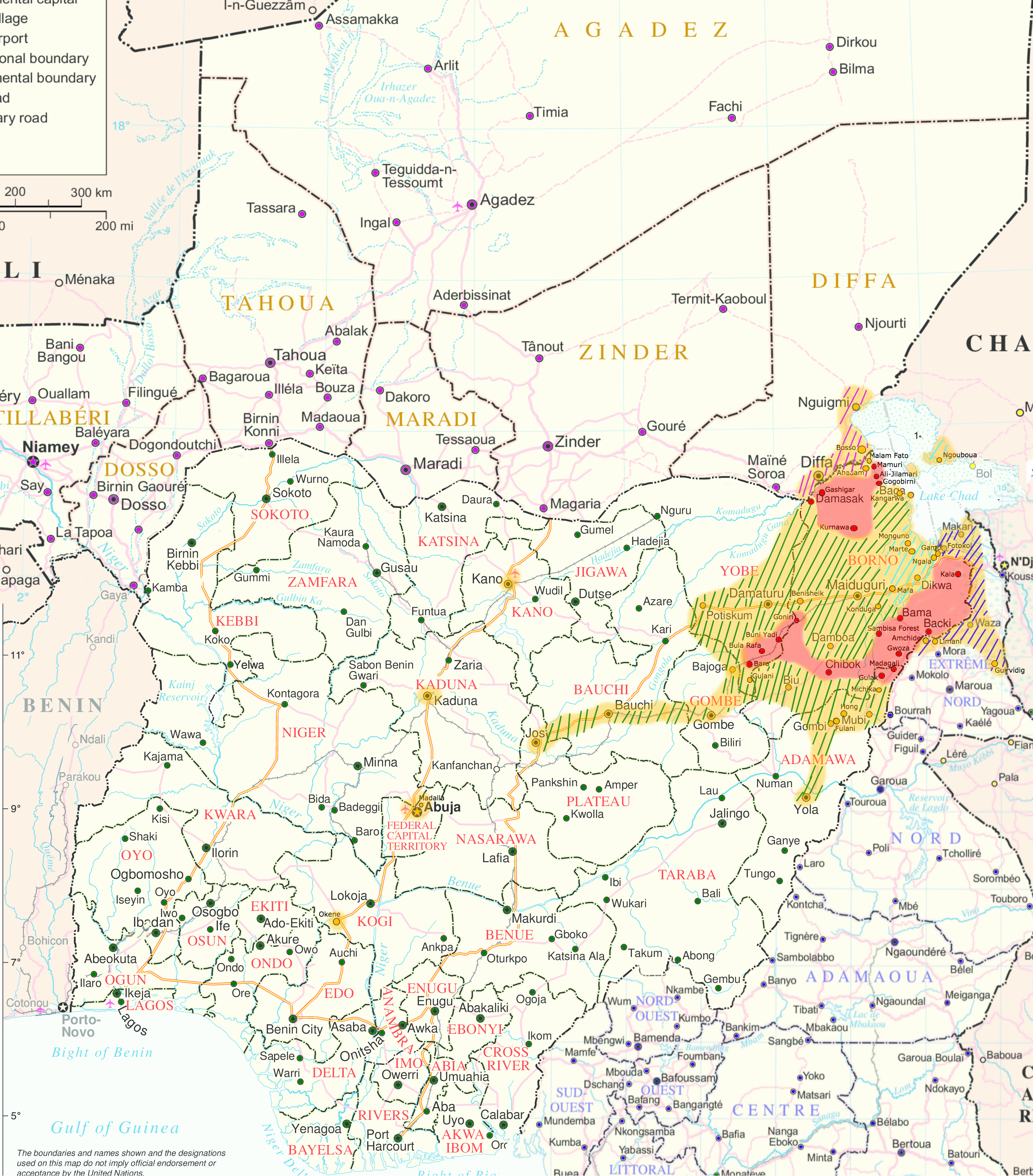
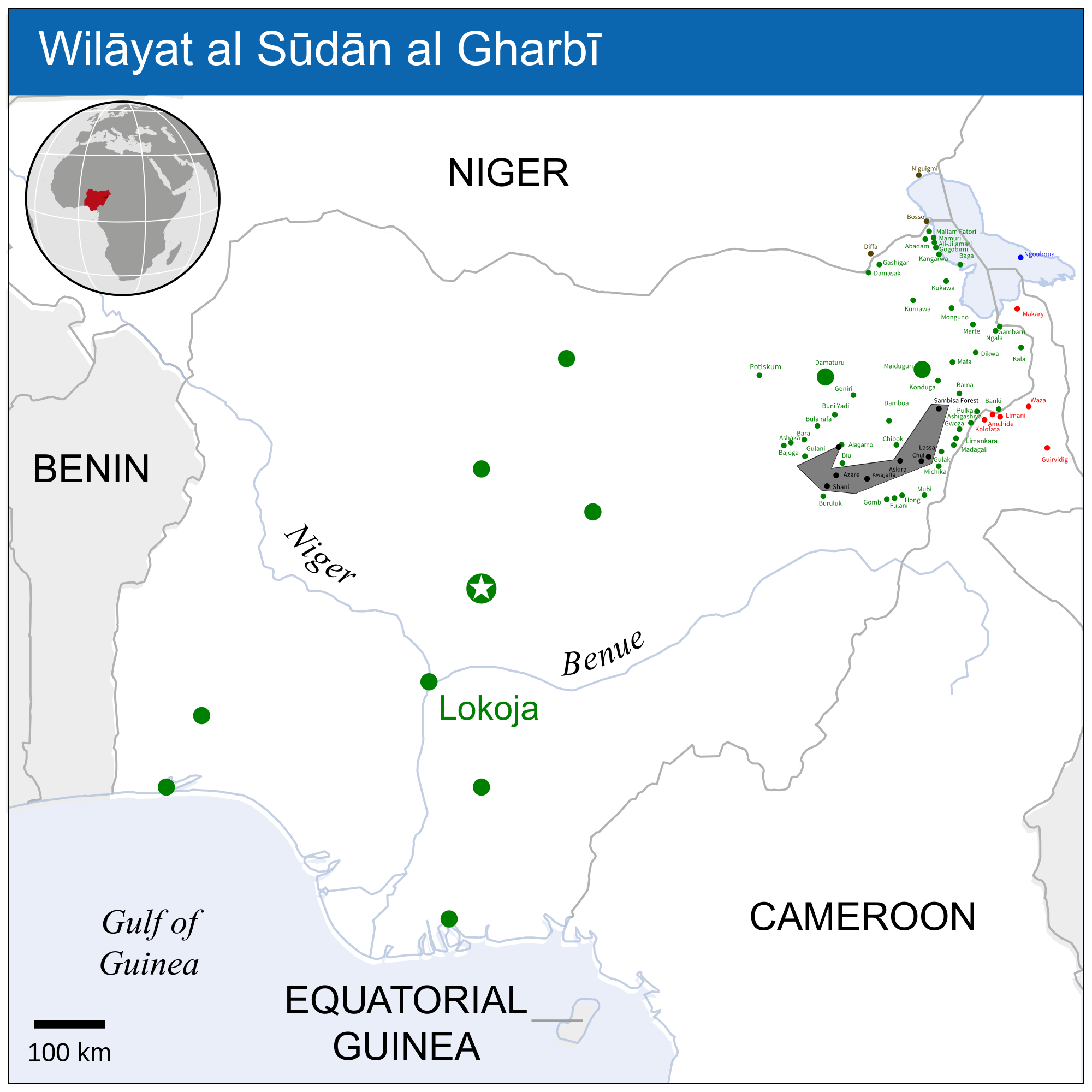
- Military situation as of 2026
- Nigerian troops conduct military drills in Sambisa Forest, 2017
- Boko Haram vehicles destroyed by Cameroonian forces, 2018
- Boko Haram cutting the hand of a man, 2017
- Militants during the battle of Lake chad, 2025. () Northern Cameroon (from 2012) Southeast Niger (from 2014) Western Chad (from 2014)
- Expansion of conflict into neighboring Cameroon, Chad, Mali, and Niger
- Turkish forces and Syrian mercenaries deployed to Niger
- Coalition offensive in 2015 forces Boko Haram to retreat into the Sambisa Forest
- Abubakar Shekau killed on 19 May 2021 amid ISWAP's capture of Sambisa Forest
- Boko Haram largely dissolves and rise of ISWAP
**** (from 2025) {{Collapsible list | | | | | African Union | | | | Egypt | | European Union | | | Supported by: al-Shabaab al-Qaeda in the Islamic Maghreb Nigeria Christopher Musa|Nigeria Lucky Irabor|Nigeria Abayomi Olonisakin|Nigeria Alex Badeh|
Nigeria Nuhu Ribadu|Nigeria Babagana Monguno|Nigeria Sambo Dasuki|Nigeria Owoye Andrew Azazi|
Nigeria Hasan Abubakar|Nigeria Isiaka Oladayo Amao|Nigeria Sadique Abubakar|
Nigeria Olufemi Oluyede|Nigeria Taoreed Lagbaja |Nigeria Faruk Yahaya|Nigeria Ibrahim Attahiru| Nigeria Tukur Buratai|Nigeria Kenneth Minimah|Nigeria Azubuike Ihejirika |Nigeria Abdulrahman Dambazau|
Niger Abdourahamane Tchiani}}Niger Mohamed Bazoum
Niger Mahamadou Issoufou
Chad Mahamat Déby Itno
Chad Idriss Déby
Cameroon Paul Biya
Islamic State Abu Musab al-Barnawi
Islamic State Sani Shuwaram
Islamic State Ba Idrisa
Islamic State Bo Lawan ("Lawan Abubakar")
Islamic State of Iraq and the Levant Huozaifah Ibn Sadiq
Islamic State Ba’ana Gana
Islamic State Mohammed Yusuf
Islamic State Abubakar Shekau
Islamic State Bakura Doro
Islamic State Hassan Buduma
Islamic State Mohd Hassan
130,000 active frontline personnel;
32,000 active reserve personnel
Nigeria Police Force: 371,800
MNJTF: 7,500
(excluding Cameroon and Nigeria)Cameroonian Armed Forces:
20,000 active personnel
300 U.S. advisersMilitias and vigilantes: Unknown, several tens of thousands
2,400,000 internally displaced
- Islamic State
- Islamic State of Iraq and the Levant Boko Haram
- Islamic State of Iraq and the Levant ISWAP{{efn|from 2016, originally Barnawi faction of Boko Haram
- Buhaira Wilaya
- Buhaira Mantiqa
- Tunbuma Mantqa
- Banki Mantiqa
- Faruq Wilaya
- Faruq Mantiqa
- Sambisa Mantiqa
- 'Nigeria Wilaya'
- Amniyya
- Hizbah police
- Buhaira Wilaya
- Islamic State of Iraq and the Levant ISSP
- Flag of Jihad.svg Lakurawa (2023present)
- Flag of Jihad.svg Al-Qaeda
- ISIS JNIM (2025present)
- Nigerian Brigade
- Flag of Ansaru.svg Ansaru (2012present)
- ISIS JNIM (2025present)
- Islamic StateVariant_flag_of_the_Islamic_State.svg Daular Musulunci
- Islamic State of Iraq and the Levant Boko Haram (20092015, 2016present)
- Islamic State Shekau faction
- Islamic State Njimiya camp dissidents
- Islamic State Several minor factions
- Islamic State of Iraq and the Levant Boko Haram (20092015, 2016present)
- Nigeria and allies
- Multinational Joint Task Force
- Civilian Joint Task Force
- Local militias and vigilantes
- Comités de vigilance (Chad, Cameroon)
- Dan banga (Niger)
- Local militias and vigilantes
- Foreign mercenaries
- Flag of the Sultan Murad Brigade.png Sultan Murad Division (from 2024)
- STTEP
The Boko Haram insurgency began in July 2009, when the militant Islamist and jihadist rebel group Boko Haram started an armed rebellion against the government of Nigeria. The conflict is taking place within the context of long-standing issues of religious violence between Nigeria's Muslim and Christian communities, and the insurgents' ultimate aim is to establish an Islamic state in the region.
Boko Haram's initial uprising failed, and its leader Mohammed Yusuf was killed by the Nigerian government. He began the group in the year 2002, with a view of opposing western education with his followers. The movement consequently fractured into autonomous groups and started an insurgency, though rebel commander Abubakar Shekau managed to achieve a kind of primacy among the insurgents. Though challenged by internal rivals, such as Abu Usmatul al-Ansari's Salafist conservative faction and the Ansaru faction, Shekau became the insurgency's de facto leader and mostly kept the different Boko Haram factions from fighting each other, instead focusing on overthrowing the Nigerian government. Supported by other jihadist organizations including al-Qaeda and al-Shabaab, Shekau's tactics were marked by extreme brutality and explicit targeting of civilians.
After years of fighting, the insurgents became increasingly aggressive and began to seize large areas in northeastern Nigeria. The violence escalated dramatically in 2014 with 10,849 deaths, while Boko Haram drastically expanded its territories. At the same time, the insurgency spread to neighboring Cameroon, Chad, Mali, and Niger, thus becoming a major regional conflict in Sub-Saharan Africa. Meanwhile, Shekau attempted to improve his international standing among jihadists by tacitly aligning with the Islamic State in March 2015, with Boko Haram becoming the "Islamic State's West Africa Province" (ISWAP).
The insurgents were driven back during the 2015 West African offensive by a Nigeria-led coalition of African and Western countries, forcing the Islamists to retreat into Sambisa Forest and bases at Lake Chad. Discontent about various issues consequently grew among Boko Haram. Dissidents among the movement allied themselves with IS' central command and challenged Shekau's leadership, resulting in a violent split of the insurgents. Since then, Shekau and his group are generally referred to as "Boko Haram", whereas the dissidents continued to operate as ISWAP under Abu Musab al-Barnawi. The two factions consequently fought against each other while waging insurgencies against the local governments. After a period of reversals, Boko Haram and ISWAP launched new offensives in 2018 and 2019, again growing in strength.
When Boko Haram's insurgency was at its peak in the mid-2010s, it was the world's deadliest terrorist organization in terms of the number of people it killed. In a bid to ensure dialog between government and the deadly sect, the President Jonathan administration set up a committee to grant an amnesty to Boko Haram. Some details of the amnesty includes granting of pardons to Boko Haram fighters and also listening to different ethnic groups under the sect with a bid to ending violence. This amnesty was rejected by the sect in an audio broadcast that was sent by its leader on the grounds that they are fighting to create an Islamic state in Nigeria's predominantly Muslim north and that it is the government that is committing atrocities against Muslims.
In May 2021, ISWAP attacked and overran Boko Haram militants in the Sambisa Forest and the leader of Boko Haram Shekau was killed during the fighting, reportedly using a suicide vest. In August, Abu Musab al-Barnawi, the leading commander of ISWAP, was killed. After Shekau's death masses of Boko Haram militants surrendered while others defected to ISWAP. According to the Nigerian Defence Forces, as of April 5, 2022, a total of 51,114 rebels and families, consisting of 11,398 men, 15,381 women, and 24,335 children, have surrendered. This number has risen to over 100,000 in July 2023. A commander of the Joint Task Force expressed optimism that the Boko Haram crisis would end very soon, while advising the troops not to rest or give the terrorists a chance to recuperate, reorganise and start carrying out attacks, saying, "We are almost there, so let's maintain the momentum."
Background
Nigerian statehood
Britain amalgamated both the Northern and Southern protectorate in 1914, about a decade after the defeat of the Sokoto Caliphate and other Islamic states by the British which were to constitute much of Northern Nigeria. Sir Frederick Lugard assumed office as governor of both protectorates in 1912. The aftermath of the First World War saw Germany lose its colonies, one of which was Cameroon, to French, Belgian and British mandates. Cameroon was divided in French and British parts, the latter of which was further subdivided into southern and northern parts. Following a plebiscite in 1961, the Southern Cameroons elected to rejoin French Cameroon, while the Northern Cameroons opted to join Nigeria, a move which added to Nigeria's already large Northern Muslim population. The territory made up much of what is now Northeastern Nigeria, and a large part of the areas affected by the insurgency.
Early religious conflict in Nigeria
Main article: Religious violence in Nigeria
Religious conflict in Nigeria dates as far back as 1953, and in the case of the town of Tafawa Balewa, to 1948. The Igbo massacre of 1966 in the North that followed the counter-coup of the same year had as a dual cause the Igbo officers' coup and pre-existing (sectarian) tensions between the Igbos and the local Muslims. This was a major factor in the Biafran secession and the resulting Nigerian Civil War.
Maitatsine
Main article: Maitatsine, Yan Tatsine
In the late 1970s and early 1980s, there was a major Islamic uprising led by Maitatsine (Mohammed Marwa) and his followers, Yan Tatsine that led to several thousand deaths. After Maitatsine's death in 1980, the movement continued some five years more.
In the same decade the erstwhile military ruler of Nigeria, General Ibrahim Babangida enrolled Nigeria in the Organisation of the Islamic Conference. This was a move which aggravated religious tensions in the country, particularly among the Christian community. In response, some in the Muslim community pointed out that certain other African member states have smaller proportions of Muslims, as well as Nigeria's diplomatic relations with the Holy See.
Establishment of Sharia
]]
Since the return of democracy to Nigeria in 1999, Sharia has been instituted as a main body of civil and criminal law in 9 Muslim-majority and in some parts of 3 Muslim-plurality states, when then-Zamfara State governor Ahmad Rufai Sani began the push for the institution of Sharia at the state level of government. This was followed by controversy as to the would-be legal status of the non-Muslims in the Sharia system. A spate of Muslim-Christian riots soon emerged.
In the primarily Islamic northern states of Nigeria, a variety of Muslim groups and populations exist, who favour the nationwide introduction of Sharia Law. The demands of these populations have been at least partially upheld by the Nigerian Federal Government in 12 states, firstly in Zamfara State in 1999. The implementation has been widely attributed as being due to the insistence of Zamfara State governor Ahmad Rufai Sani.
The death sentences of Amina Lawal and Safiya Hussaini attracted international attention to what many saw as the harsh regime of these laws. These sentences were later overturned; the first execution was carried out in 2002.
Blasphemy and apostasy
Main article: Blasphemy law in Nigeria
Twelve out of Nigeria's thirty-six states have Sunni Islam as the dominant religion. In 1999, those states chose to have Sharia courts as well as customary courts. A Sharia court may treat blasphemy as deserving of several punishments up to, and including, execution. In many predominantly Muslim states, conversion from Islam to another religion is illegal and often a capital offence.
Demographic balance
According to a Nigerian study on demographics and religion, Muslims make up 50.5% of the population. Muslims mainly live in the north of the country; the majority of Nigerian Muslims are Sunnis. Christians are the second-largest religious group and make up 48.2% of the population. They predominate in the central and southern parts of the country.
For reasons of avoiding political controversy, questions of religion were forgone in the 2006 Nigerian census.
History
Main article: Timeline of the Boko Haram insurgency
2009 Boko Haram uprising
Main article: 2009 Boko Haram uprising
Boko Haram conducted its operations more or less peacefully during the first seven years of its existence. That changed in 2009 when the Nigerian government launched an investigation into the group's activities following reports that its members were arming themselves. Prior to that the government reportedly repeatedly ignored warnings about the increasingly militant character of the organisation, including that of a military officer.
Boko Haram's initial uprising failed, and its leader Mohammed Yusuf was killed by the Nigerian government. He began the group in the year 2002, with a view of opposing western education with his followers. He was arrested at his parent inlaws' house by the Nigerian Military and subsequently handed over to the Nigerian police. He was survived by four wives and 12 children one of which was Abu Musab al-Barnawi who in the year 2016 wanted to lead the group. The movement consequently fractured into autonomous groups and started an insurgency, though rebel commander Abubakar Shekau managed to achieve a kind of primacy among the insurgents. Though challenged by internal rivals, such as Abu Usmatul al-Ansari's Salafist conservative faction and the Ansaru faction, Shekau became the insurgency's de facto leader and mostly kept the different Boko Haram factions from fighting each other, instead focusing on overthrowing the Nigerian government. Supported by other jihadist organizations including al-Qaeda and al-Shabaab, Shekau's tactics were marked by extreme brutality and explicit targeting of civilians.
When the government came into action, several members of the group were arrested in Bauchi, sparking deadly clashes with Nigerian security forces in Bauchi, Maiduguri in Borno State, Potiskum in Yobe State and Wudil in Kano State – which led to the deaths of an estimated 700 people. During the fighting with the security forces Boko Haram fighters reportedly "used fuel-laden motorcycles" and "bows with poison arrows" to attack a police station. The group's founder and then leader Mohammed Yusuf was also killed during this time while still in police custody. After Yusuf's killing, Abubakar Shekau became the leader and held this position in January 2015.
2010 resurgence
Nearly six months after the killing of Yusuf, the group carried out its first terrorist attack in Borno in January, killing four people. During the following few years, the violence escalated in terms of both frequency and intensity. On 7 September, a prison break in Bauchi freed more than 700 Boko Haram militants, replenishing their force. On 24 December, Boko Haram used four bombs to kill 32 people in Jos, Plateau State. On the same day, they killed six people in attacks against churches in Maiduguri.
2011
On 29 May, a few hours after Goodluck Jonathan was sworn in as president, several bombings purportedly by Boko Haram killed 15 and injured 55. On 16 June, Boko Haram claimed responsibility for the Abuja police headquarters bombing, the first known suicide attack in Nigeria. Two months later the United Nations building in Abuja was bombed, signifying the first time that Boko Haram attacked an international organisation. On 4 November, it carried out attacks in Damaturu in Yobe and in Maiduguri, killing over a hundred people, and on 22 and 23 December clashing with security forces, resulting in at least 68 deaths. On 25 December, Boko Haram attacked several churches with bombings and shootings.
15 June marked the start of a Federal Government-sanctioned military effort to counter the growing threat of Boko Haram's insurgency. With 21 Armoured Brigade (21 Bde) of the Nigerian Army as its nucleus, Joint Task Force Operation Restore Order (JTF ORO 1) marked the start of the Army's lengthy counter-insurgency (COIN) campaign against Boko Haram. The campaign has gone through several phases and has greatly escalated in scale, capacity, components and stakeholders, since that time. Results, however, have sometimes been mixed and the Army has been criticised for being too kinetic in its COIN.
2012
In January in Nigeria, Boko Haram attacked Mubi, Yola and Gombi – all in Adamawa State – in addition to Maiduguri and Kano. During the same month, Abubakar Shekau, a former deputy to Yusuf, appeared in a video posted on YouTube. According to Reuters, Shekau took control of the group after Yusuf's death in 2009. Authorities had previously believed that Shekau died during the 2009 uprising. By early 2012, the group was responsible for over 900 deaths. On 8 March, a small Special Boat Service team and the Nigerian Army attempted to rescue two hostages, Briton Chris McManus and Italian Franco Lamolinara, being held in Sokoto, by members of the Boko Haram terrorist organisation loyal to al-Qaeda. Both hostages were killed by their captors before or during the rescue attempt. All the hostage takers were reportedly killed. On 8 April, at least 38 people were killed by a suicide car bomber in Kaduna. On 24 June, about 40 inmates escaped during a prison break in Damaturu. On 17 June, at least 12 people were killed by three bombings of churches in Kaduna State. On 7 August, 19 people were killed in a mass shooting in Kogi State. On 1–2 November, at least 25 men were killed at the Federal Polytechnic, Mubi. On 25 December, six people were killed in Potiskum and another six in Maiduguri. On 28 December, fifteen people were killed in a village in northeastern Nigeria.
2013
Government offensive
In May, Nigerian government forces launched an offensive in the Borno region in an attempt to dislodge Boko Haram fighters after a state of emergency was called on 14 May. The state of emergency – which was still in force in May 2014 – applied to the states of Borno, Yobe, and Adamawa in northeastern Nigeria. The offensive had initial success, but the Boko Haram rebels were able to regain their strength. Several authors have cited the frailty of the Nigerian security system and corruption in the management of the military as some of the factors that allowed allowed Boko Haram to regain their strenghth during this period.
Attacks
On 8 February, gunmen killed at least nine polio vaccinators in Kano. On 18 March, a suicide car bomber rammed a bus in Kano, killing over 20 people. On 16 and 17 April, dozens of civilians were killed during a battle in Baga, Borno, between Boko Haram and the Nigerian Army. On 6 July, Boko Haram massacred 42 students in Yobe, bringing the school year to an early end in the state. On 5 August, Boko Haram launched dual attacks on Bama and Malam Fatori, leaving 35 dead. On 11 August, Boko Haram killed 44 people in a mass shooting at a mosque in Konduga, Borno. On 6 October, the Nigerian Army won a battle against Boko Haram in Damboa, Borno. On 2 November in Borno, gunmen attacked a convoy returning from a wedding, killing over 30 people.
2014
Chibok kidnapping and ambush
On 15 April, Boko Haram terrorists abducted about 276 teenage female pupils from a secondary school in Chibok in Borno. The abduction was widely attributed to Boko Haram. It was reported that the group had taken the girls to neighbouring Cameroon and Chad where they were to be sold into marriages at a price below a dollar each. The abduction of another eight girls was reported later. These kidnappings raised public protests, with some protesters holding placards bearing the Twitter tag #BringBackOurGirls, which had caught international attention. The Guardian reported that the British Royal Air Force conducted Operation Turus in Nigeria in April in response to the Chibok kidnapping. A source involved with the operation told The Observer that "The girls were located in the first few weeks of the RAF mission", and that "We [RAF] offered to rescue them, but the Nigerian government declined", this was because it viewed any action to be taken as a "national issue", and for it to be resolved by Nigerian intelligence and security services, the source added that the girls were then tracked by the aircraft as they were dispersed into progressively smaller groups over the following months. Several countries pledged support to the Nigerian government and to help their military with intelligence gathering on the whereabouts of the girls and the operational camps of Boko Haram.
On 13–14 May, Boko Haram ambushed Nigerian soldiers who were searching for the kidnapped girls.
Jos bombings
On 20 May, two bombs in the city of Jos, Plateau State, Nigeria, were detonated, killing at least 118 people and injuring more than 56 others. The bombs exploded 30 minutes apart, one at a local marketplace at approximately 3:00 and the second in a parking lot next to a hospital at approximately 3:30, where rescuers responding to the first accident were killed. Though no group or individual has claimed responsibility, the attacks have been attributed to Boko Haram.
First responders were unable to reach the scenes of the accidents, as "thousands of people were fleeing the scene in the opposite direction". The bombs had been positioned to kill as many people as possible, regardless of religion, which differed from previous attacks in which non-Muslims were targeted. The bombers were reported to have used a "back-to-back blast" tactic, in which an initial bomb explodes at a central location, and another explodes a short time later with intent to kill people working to rescuing the wounded.
Maiduguri bombings
In 2014, Boko Haram militants increased their attacks on cities and towns in northern Nigeria and captured part of the country's northeast. These attacks included bombings in Maiduguri in January, July and November.
Escalation in fighting

The increasing intensity of the insurgency prompted the Nigerian government to launch an offensive, and with the help of Chad, Niger, and Cameroon, they recaptured many areas that were formerly under the control of Boko Haram.
In late 2014, Boko Haram seized control of Bama, Borno, according to the town's residents. In December, it was reported that "people too elderly to flee Gwoza Local Government Area were being rounded up and taken to two schools where the militants opened fire on them." Over 50 elderly people in Bama were killed. | access-date=8 January 2015 | archive-url=https://web.archive.org/web/20150103110443/http://allafrica.com/stories/201412222101.html | archive-date=3 January 2015 | url-status=live A "gory" video was released of insurgents shooting over a hundred civilians in a school dormitory in the town of Bama. | access-date=8 January 2015 | archive-url=https://web.archive.org/web/20150609031156/http://allafrica.com/stories/201412220231.html | archive-date=9 June 2015 | url-status=live
2015
Baga massacre
Between 3 and 7 January, Boko Haram attacked the town of Baga and killed up to 2,000 people, perhaps the largest massacre by Boko Haram.
Maiduguri bombing
On 10 January, 19 people were killed in a suicide bombing at a market in Maiduguri. The city is at the heart of the Boko Haram insurgency. On 12 January, Boko Haram carried out an unsuccessful attack on a Cameroonian Army base.
Counter-offensive against Boko Haram
On 23 January, a coalition of military forces from Nigeria, Chad, Cameroon, and Niger began a counter-insurgency campaign against Boko Haram. In the early hours of 25 January, Boko Haram launched a major assault on the city. On 26 January, CNN reported that the attack on Maiduguri by "hundreds of gunmen" had been repelled, but the nearby town of Monguno was captured by Boko Haram. | name-list-style=amp | access-date=29 January 2015 | archive-url=https://web.archive.org/web/20150419125107/http://www.cnn.com/2015/01/26/africa/nigeria-boko-haram/ | archive-date=19 April 2015 | url-status=live The Nigerian Army said they repelled another attack on Maiduguri on 31 January. | access-date=1 February 2015 | archive-url=https://web.archive.org/web/20180106002603/http://www.bbc.com/news/world-africa-31080368 | archive-date=6 January 2018 | url-status=live
On 4 February, the Chad Army killed over 200 Boko Haram militants. On 4 and 5 February, Boko Haram carried out a massacre in Fotokol, Far North Region, Cameroon, killing 81 civilians, 13 Chadian soldiers and 6 Cameroonian soldiers. On 6 February, Boko Haram attacked Bosso and Diffa in Niger. On 15 February, a suicide bombing occurred in Damaturu. On 17 February, the Nigerian military retook Monguno in a coordinated air and ground assault. On 22 February, a suicide bombing occurred in Potiskum. On 24 February, suicide bombings occurred in Potiskum and Kano. On 2 March, the Nigerian Armed Forces defeated Boko Haram in the Battle of Konduga.
On 7 March, Boko Haram's leader Abubakar Shekau pledged allegiance to the Islamic State (IS) via an audio message posted on the organisation's Twitter account. Nigerian Army spokesperson Sami Usman Kukasheka said the pledge was a sign of weakness and that Shekau was like a "drowning man". That same day, five suicide bomb blasts left 54 dead and 143 wounded. On 12 March, ISIL's spokesman Abu Mohammad al-Adnani released an audiotape in which he welcomed the pledge of allegiance, and described it as an expansion of the group's caliphate to West Africa.
Following its declaration of loyalty to ISIL, Boko Haram was designated as the group's "West Africa Province" (Islamic State West Africa Province, or ISWAP) while Shekau was appointed as its first vali (governor). Furthermore, ISIL started to support Boko Haram, but also began to interfere in its internal matters. For example, ISIL's central leadership attempted to reduce Boko Haram's brutality toward civilians and internal critics, as Shekau's ideology was "too extreme even for the Islamic State".
On 24 March, residents of Damasak, Borno, said that Boko Haram had taken more than 400 women and children from the town as they fled from coalition forces who retook the area and found a mass grave of Boko Haram victims. On 27 March, the Nigerian army captured Gwoza, which was believed to be the location of Boko Haram headquarters. On election day, 28 March, Boko Haram extremists killed 41 people, including a legislator, to discourage hundreds from voting.
In March, Boko Haram lost control of the Borno towns of Bama and Gwoza (believed to be their headquarters) Boko Haram forces were believed to have retreated to the Mandara Mountains, along the Cameroon–Nigeria border. On 16 March, the Nigerian Army said that it had recaptured Bama. On 27 March, the day before the Nigerian presidential election, the Nigerian Army announced that it had recaptured the town of Gwoza from Boko Haram.
By April, the Nigerian military was reported to have retaken most of the areas previously controlled by Boko Haram in Northeastern Nigeria, except for Sambisa Forest in Borno.
In May, the Nigerian military announced that they had released about 700 women from camps in Sambisa Forest.
On 12 July, two female suicide bombers wearing burqas killed 13 people in Fotokol. In response, the governor of Cameroon's Far North banned the Islamic veil and burqa.
In August, it was reported that over a thousand deaths had occurred since the inauguration of the new administration.
On 10 October, suicide bombers attacked a market and refugee camp in Baga Sola, Lac, Chad.
On 28 October, it was announced that Nigerian troops had rescued 338 people from Boko Haram near the group's Sambisa Forest stronghold. Of those rescued, 192 were children and 138 were women.
In December, Muhammadu Buhari, the President of Nigeria, claimed that Boko Haram was "technically defeated" and it was reported that 1,000 women had been rescued from Boko Haram in January 2016. On 5 December, four female suicide bombers attacked a market on the Chadian side of Lake Chad. On 28 December, female suicide bombers killed over 55 people in Madagali in Adamawa and Maiduguri.
American military support
In early October 2015, the United States military deployed 300 troops to Cameroon, with the approval of the Cameroonian government, with the primary mission of providing intelligence support to local forces and conducting reconnaissance flights.
The troops also oversaw a program to transfer American military vehicles to the Cameroonian Army to aid in their fight against Islamist militants.
As of May 2016, U.S. personnel were involved in drone operations from Garoua, Far North Region, Cameroon, to help provide intelligence in the region to assist local forces. There were additional drone operations based out of Niger. U.S. Army soldiers in Cameroon are also providing IED awareness training to the country's infantry forces.
2016
Bodo bombings
On 25 January, four Boko Haram suicide bombers killed over 30 people in Bodo, Far North, Cameroon.
Dalori, Dikwa and Maiduguri attacks
On 30 January, at least 86 people were killed by Boko Haram in Dalori, Borno. On 9 February, two young female suicide bombers killed at least 60 people at an internally displaced persons' camp in Dikwa, Borno. On 16 March, two female suicide bombers killed 22 people on the outskirts of Maiduguri.
Boko Haram-IS infighting and loss of territory
In March, Boko Haram was reported to have used islands in Lake Chad as bases.
As Boko Haram's power waned, Shekau's leadership was increasingly criticised among Boko Haram and ISIL's central command. These elements repeatedly attempted to convince Shekau to change his tactics or his extreme ideas (such as considering everyone an apostate who has not openly sided with him, including all Muslims). Shekau refused to budge, and openly disobeyed ISIL's "Caliph" Abu Bakr al-Baghdadi in regard to various matters. ISIL and parts of Boko Haram eventually came to the conclusion that this was no longer tolerable, whereupon Shekau was removed from his position as vali of ISIL's West Africa Province in August. Abu Musab al-Barnawi, a son of Boko Haram founder Mohammed Yusuf was appointed as his successor. This event resulted in an open split among the Nigerian insurgents. Shekau refused to accept his dismissal, rallied a large number of supporters and violently opposed Barnawi and ISIL's central command. In turn, Barnawi and those who were loyal to him declared Shekau's group Khawarij. The two insurgent factions subsequently became fully separate organizations, with Shekau's followers re-adopting their old name "Jamā'at Ahl as-Sunnah lid-Da'wah wa'l-Jihād" (outsiders refer to this faction as "Boko Haram"), whereas Barnawi's forces continued to operate as "Islamic State's West Africa Province" (ISWAP). The two groups are generally hostile and fight each other, though it is possible that they occasionally cooperate against their common enemies.
On 31 August, Major General Lucky Irabor stated that the militants now only controlled a few villages and towns near Lake Chad and in Sambisa Forest. He further stated that the military expected recapturing the final strongholds of the group within weeks.
On 24 December, President Muhammadu Buhari said that Boko Haram had been ousted from their last stronghold in the Sambisa Forest, effectively reducing Boko Haram to an insurgent force. This victory left Boko Haram without any territorial holdings; however, Boko Haram still maintains an extensive ability to carry out attacks.
2017

On 7 January, a group of Boko Haram militants attacked a Nigerian Army base in Yobe, killing five soldiers. In response, the Nigerian Army launched retaliatory strikes and killed 15 militants.
On 17 January, a Nigerian Air Force jet mistakenly bombed an IDP camp near the Cameroonian border in Rann, Borno, mistaking it for a Boko Haram encampment. The airstrike left 115 people dead.
On 22 March, at least six people were killed and 16 wounded when four female suicide bombers blew themselves up on the outskirts of Maiduguri city.
On 22 March, the Nigerian Department of State Services (DSS) announced that a suspected member of Boko Haram had been arrested in northeastern Yobe State. The suspect confessed details of a plot to attack the American and British embassies, and other western targets in Abuja. The DSS also later announced that between 25 and 26 March, five suspected members of Boko Haram had been arrested, thus thwarting the plot.
On 2 April, the Nigerian military began what it said was its "final offensive" to retake Boko Haram's last strongholds.
On 17 May, the Nigerian Army reported that it had arrested about 126 suspected Boko Haram terrorists at the Internally Displaced Persons (IDPs) camp in Damboa, Borno.
In September, Boko Haram militants kidnapped about 40 young adults, women and children and killed 18 in the town of Banki, 130 km southeast of Maiduguri, Borno State, on the border of Nigeria and Cameroon. Boko Haram was reported to have killed 380 people between April and September in the Lake Chad area. About 57% of all schools in Borno state were closed due to the Boko Haram insurgency, affecting the education of about 3 million children.
On 21 November, a suicide bomber killed 50 people in a mosque in Mubi.
In December, fighters who were believed to belong to ISWAP attacked a patrol of US Army Special Forces and Nigerian soldiers in the Lake Chad Basin Region in Niger. The coalition troops managed to repel the assault without suffering any casualties.
2018
On 16 February, three suicide bombers killed about 20 people in Konduga.
On 19 February, Boko Haram kidnapped 110 schoolgirls from Dapchi, Yobe.
By March, two main insurgent factions were still active, and continued to wage an insurgency campaign against the government: The followers of Abubakar Shekau (Boko Haram) operated mainly in southern Borno, while the faction of Abu Musab al-Barnawi (ISWAP) was mostly located around Lake Chad.
On 26 April, Boko Haram bombers killed at least four civilians in the outskirts of Maiduguri, the largest city in Borno. A subsequent gun battle and tear gas launched by security forces repelled the attackers, but left two officers wounded and several others injured.
On 1 May, two suicide bombers killed dozens of people in Mubi.
On 15 July, hundreds of Nigerian soldiers went missing after ISWAP forces led by Abu Musab al-Barnawi overran a Nigerian Army base in the northeastern part of Nigeria. Less than 100 Nigerian soldiers returned after the attack, the attack came 24 hours after ISIL ambushed a military convoy in neighbouring Borno. The attack on the base resulted in a battle that lasted over an hour, it is unknown if there were any casualties in the assault, a local pro-government militia said the military had sustained some casualties, this attack marks Boko Haram's first major gain since 2015.
On 8 September, ISWAP fighters managed to capture the town of Gudumbali in central Borno, marking their first major gain in nearly two years. The next day, ISIL's West Africa Province released a video showing footage from combat with the Nigerian Army in the area. In late December, ISWAP launched another offensive and captured Baga in northeastern Borno State.
In November, fighting in and around Lake Chad intensified, beginning the Chad Basin campaign, which lasted until February 2020. On 18 November, ISWAP fighters attacked a military base in Metele, Borno, killing at least 118 soldiers while at least 153 others were missing after the attack, the militants also seized tanks, armored vehicles, artillery, weapons, and ammunition.
2019

Barnawi's ISWAP launched a major offensive in January, attacking several Nigerian military bases, including those at Magumeri and Gajiram. Insurgents also overran and destroyed the IDP town of Rann, displacing its inhabitants yet again. The destruction of Rann was initially attributed to ISWAP, but Shekau's Boko Haram later claimed responsibility.
Three Boko Haram suicide bombers killed 30 people in Konduga, Borno, on 16 June. Boko Haram shot dead at least 65 people in Nganzai, Borno, who were walking home from a funeral on 27 July.
2020
The first half of 2020 was relatively calm. On 6 January, Boko Haram bombed a market in Gamboru, Borno, killing at least 38 people. On 9 February, they killed at least 30 people in Auno, Borno. On 15 March they attacked a military post in Toumour, injuring a soldier and during which 50 insurgents were killed. On 23 March, they carried out massacres against the Chadian and Nigerian armies. The Chadian Defense Minister, Mahamat Abali Salah, announced on 31 March the launch of "Operation Boma's Wrath", in response to Boko the 23 March massacres. The operation's target is to wipe out the Boko Haram remnants around Lake Chad, the operation is named after the island where Boko Haram launched a seven-hour assault, that Chadian President Idriss Déby said, was the worst the country's military had ever suffered. On 9 June, Boko Haram killed 81 villagers in a mass shooting in Gubio, Borno. On 13 June, Boko Haram killed at least 20 soldiers in Monguno and more than 40 civilians in Nganzai. On 29 July, the convoy of the Borno governor, Babagana Zulum was attacked by Boko Haram. Five people were killed in fighting, including three policemen. The governor was not hurt. On 2 August, Boko Haram killed at least 18 people in a grenade attack on an IDP camp in Far North, Cameroon. On 9 August, ISWAP killed six French aid workers and two Nigerien civilians in Kouré, Tillabéri Region, Niger. On 19 August, Islamic State militants took hundreds of people hostage in Borno.
September saw a rise in attacks. On 6 September, Boko Haram raided a village of Kurmari, where they killed four civilians in their sleep. They also raided two villages at outskirts of Maiduguri, six civilians were killed in this raid. Nigerian military carried out an operation against Boko Haram in Hamdaga Makaranta town in Gwoza local government area. Five insurgents were killed and seven hostages were rescued, several insurgents were wounded but managed to escape. On 17 September, Boko Haram raided a village in Lake Chad region in Chad, several civilians were abducted. On 18 September, Nigerian military carried out an air operation against Boko Haram in Kassa Kura in Maiduguri. Sixteen insurgents were killed, 38 were arrested, their ammunition was seized. Several insurgents escaped with wounds. On 19 September, Chadian military attacked Boko Haram in the village of Barkalam near the border with Nigeria, 15 Boko Haram fighters were killed in the fighting, 12 hostages were rescued. Boko Haram and Chadian military later clashed at Bilabrim where five insurgents were killed and two Chadian soldiers were wounded. On 20 September, Boko Haram ambushed a military convoy, killing 3 soldiers at the place and fatally wounding Colonel Dahiru Bako. On 25 September, Boko Haram ambushed a military convoy accompanying government officials near Monguno town, killing 15; Eight policemen, three soldiers, and four Civilian Joint Task Force members. On 26 September, Babagana Zulum and his convoy were attacked by Boko Haram near Baga. Zulum was unhurt but 30 people were killed in the attack; twelve policemen, five soldiers, four members of a government-backed militia and nine civilians. Many others were injured. On 27 September, Islamic State militants attacked a convoy in Borno, killing 18 people. On 29 September, Babagana Zulum's convoy noticed a donkey on the road and shot at it. After the donkey exploded, insurgents who planted a bomb on it came out of hiding and fired at them. Several of Boko Haram insurgents were killed in following shootout, while no one from Zulum's convoy was injured or killed. Vehicles of the convoy sustained bullet damage.
Violence resurged in November. On 1 November, Boko Haram raided Takulashi village near Chibok; they came from Sambisa Forest. Anti-jihadist militia from Chibok mobilised in two trucks and attempted to defend the village but were outnumbered by insurgents who managed to seize one of their trucks. Twelve people were killed and seven civilians abducted. On 9 November, Nigerian military carried out two operations against Boko Haram. In village of Buni Gari 5 Boko Haram insurgents were killed and several others were injured. Nigerian military also rescued four hostages held by Boko Haram in another operation. On 21 November, Boko Haram ambushed a Nigerian military convoy between Jagiran and Monguno. Six soldiers were killed and 26 were injured in an ambush, several soldiers also went missing. On 22 November, Convoy belonging to governor of Borno, Babagana Zulum was attacked while he was traveling to meet with government officials in Baga. Seven soldiers and two civilians were killed in this ambush, but the governor was unhurt. His appointment was cancelled. On 26 November, Boko Haram staged an attack on mainly Christian village of Gabass in Far North, Cameroon. Three civilians were killed and one was kidnapped. Boko Haram also attacked village of Guidi also in Far North region where they set five homes ablaze. On 28 November, Boko Haram massacred about 110 farmers in Koshebe, Borno.
December saw a rash of kidnappings, as well as violence focused around Christmas. On 11 December, Boko Haram abducted more than 330 secondary school students in Kankara, Katsina State. On 12 December, around 70 Boko Haram militants attacked village of Toumour in Niger at around 17:45 GMT. At least 27 people were killed, and several others are missing or wounded. During the attack between 800 and 1000 houses, the central market and various vehicles were burnt down. According to a local elected official nearly 60% of the village was destroyed by the attack which lasted 3 hours. On 24 December, Boko Haram attacked the Christian village of Pemi in Borno. The attackers burnt 10 homes and looted food supplies that were meant to be distributed to residents to celebrate Christmas; they also took medical supplies from the village. Security officials warned that an attack on a Christian holiday is likely, so many residents managed to escape the attack. Nevertheless 11 civilians were killed including a Christian priest. Also on Christmas Boko Haram kidnapped around 40 loggers in Wulgo forest; three loggers were killed while trying to escape. Loggers from the village of Shehuri in Borno went to the forest but they did not return on the evening as they usually do. Next day local anti-jihadist militia leader mobilised a search party which went deep into the forest and recovered three bodies. On 26 December, Boko Haram raided villages of Shafa, Azare, and Tashan Alade in Borno. Ten people were killed during the raids, seven of them being civilians, two policemen, and one CJTF militiaman. Houses, shops, churches and one police station were burnt down during the raids. On 28 December, A landmine planted by Boko Haram in Larothe Gomani village killed four Nigerian soldiers. On 29 December, Seven hunters were killed and nine other were injured after their vehicle hit a landmine planted by Boko Haram near the village of Kayamla. They were recruited by the government to help fight against the jihadist groups, when their vehicle hit a landmine they were pursuing Boko Haram insurgents.
2021
Violence was mostly restricted to the first half of 2021.
January saw a rash of attacks. On 3 January, Multinational Joint Task Force carried a sweep around Kolofata, during the fighting three Boko Haram insurgents were killed and two were captured. Operation Tuka Takaibango was announced by Nigeria's military in early January. On 4 January, at around 4 am three members of a local vigilance committee were shot dead by Boko Haram in Mayo Moskota area. A civilian was killed by Boko Haram in Kolofata area the same morning. On 6 January, Boko Haram infiltrated in the town of Geidam, Yobe. Insurgents were sighted at outskirts of Geidam at 1 pm. A rumour about insurgents spread through town soon and it caused regular activities to be disrupted for an hour and a half, after nothing happened people continued with their regular activities. Boko Haram insurgents gathered at strategic locations such as Geidam market with a coordinated plan at 5:30 pm, soon after they positioned at those locations they attacked the town. The insurgents abducted the District Head, injured several civilians and stole food and medical supplies. Police of the district later found two bodies in a burnt vehicle who they believe are members of Boko Haram. On 7 January, Operation Tuka Takaibango was officially launched. On 8 January, Boko Haram attacked village of Mozogo in Cameroon, many civilians tried to escape into a nearby forest. A female suicide bomber detonated herself during the attack, killing at least 14 civilians eight of those being children. On 9 January, At least 28 Boko Haram insurgents were killed during clashes with Nigerian Army in Gujba, while several other insurgents escaped, one Nigerian soldier was killed and one was injured, according to military spokesman of Nigeria. On 11 January, ISWAP ambushed Nigerian military convoy in Gazagana village, killing 13 and injuring several others. On 13 January, an ISWAP suicide bomber killed six Nigerian soldiers as they conducted a raid in the village of Talala, Borno. On 14 January, ISWAP militants attacked Garin Gada village in Yobe, killing at least two civilians, whilst also raiding and looting food from the village. On 17 January, seven IEDs were activated against a Nigerian Army convoy of APCs and other vehicles, escorted by a foot patrol in Gorgi, Borno. Over 30 soldiers were killed. Three vehicles were destroyed, and an armored vehicle, weapons and ammunition were seized. On 18 January, ISIS operatives exchanged fire and activated several IEDs against Nigerian soldiers in Matari, about 50 km west of Maiduguri, the capital of Borno State. At least 20 soldiers were killed. Two ATVs were destroyed. In addition, two ATVs, an APC, weapons and ammunition were seized. On 22 January, IS operatives ambushed and fired machine guns at a Nigerian Army patrol in Borno. Seven soldiers were killed and others were wounded. In addition, an ATV, weapons and ammunition were seized. On 31 January, two attacks took place in northern Nigeria. One in the village of Chabal, leaving two policemen dead and two abducted. The second attack occurred in Dikwa, resulting in the deaths of 2 soldiers and leaving two female police officers abducted.
February saw increased action with government forces. On 5 February, it was reported that Nigerian troops backed by jets overran several camps of Boko Haram in the Timbuktu triangle, including the Dole camp. They also liberated Talala, which was seized in 2013 by militants and became their second largest camp, right behind the Lake Chad region. Besides Talala they also liberated Buk, Gorgi and overran camps in Kidari, Argude, Takwala, Chowalta and Galdekore. Two high-profile ISWAP commanders, Modu Sulum and Ameer Modu Borzogo, fled along with some fighters during intense fighting but several other commanders and fighters have been killed and many abducted hostages were rescued. On 5 February, ISWAP operatives ambushed Nigerian soldiers in the Goniri region, near the Niger-Nigeria border. The two sides exchanged fire. Six soldiers were killed and a few others were wounded. The other soldiers fled. ISIS operatives seized vehicles, weapons and ammunition. On 7 February, 'bandits' raided two villages in northwest Nigeria's Kaduna State, leading to the deaths of 19 people, according to the Nigerian government. On 8 February, ISWAP operatives attacked a Nigerian Army checkpoint in Monguno, about 70 km from the Nigeria-Chad-Cameroon tri-border area. There was an exchange of fire. Three soldiers were killed and several others were wounded. ISIS operatives seized vehicles, weapons and ammunition. On 9 February, a group of Nigerian soldiers was attacked between Jakana and Mainok, about 30 km west of Maiduguri. There was an exchange of fire. Seven soldiers were killed. In addition, two Nigerian Army vehicles were destroyed. ISIS operatives seized weapons left at the site. On February 9, a Nigerian Army checkpoint was attacked in Geidam, Yobe, about 30 km from the Nigeria-Niger border. The sides exchanged fire. Four soldiers were killed, three were taken prisoner and the rest fled. ISIS operatives seized weapons left at the site and set fire to a Nigerian army vehicle. On 11 February, Nigerian soldiers were ambushed in the suburbs of Monguno. An IED was activated against the soldiers, followed by an exchange of fire. Three soldiers were killed and several others were wounded. The rest fled. ISWAP operatives seized an ATV and weapons. On 12 February, a force of a militia supporting the Nigerian Army was attacked in the village of Gur, about 150 km south of Maiduguri in northeastern Nigeria. There was an exchange of fire. Four militia fighters were killed. The ISWAP operatives set fire to four vehicles and houses belonging to the fighters. On 15 February, a Nigerian Army compound was attacked in Marte, Borno, about 40 km east of the Nigeria-Cameroon border, in northeastern Nigeria. Ten soldiers were killed in the exchange of fire and several others were wounded. The other soldiers fled. ISIS operatives set fire to the compound, two tanks and a Nigerian army vehicle. They also seized three vehicles, weapons and ammunition.
The second half of February was similarly violent. On 16 February, a group of Nigerian soldiers was attacked in a village in Borno. There was an exchange of fire. Four soldiers were killed and several others were wounded. The other soldiers fled. ISIS operatives seized weapons and ammunition. Four policemen and seven civilians were killed during an ISWAP attack on the village of Bayamari village in Yobe. An attack was carried out against the headquarters of a militia supporting the Nigerian Army in Gubio, Borno. There was an exchange of fire. Three soldiers were killed and several others were wounded. The other soldiers fled. ISIS operatives seized weapons and ammunition and set fire to vehicles. On 17 February, a Nigerian Army convoy was ambushed and targeted by gunfire in the Karito region, near Lake Chad. Three soldiers were killed and several others were wounded in the exchange of fire. ISWAP operatives seized weapons and ammunition, and set fire to three vehicles. On 19 February, an attack was carried out against a Nigerian Army camp in Dikwa, about 50 km from the Nigeria-Cameroon border in Borno State. A total of 15 soldiers were killed in the exchange of fire and several others were wounded. The remaining soldiers fled, and ISWAP operatives seized four vehicles, weapons and ammunition. ISIS operatives set fire to the camp and to other vehicles. The camp taken over by ISWAP operatives is one of the largest Nigerian Army camps and that many residents left the area in the wake of the attack. On 21 February, Boko Haram militants beheaded five people in an IDP camp in Borno. On 23 February, Boko Haram militants stormed Maiduguri, killing at 10 people, firing rocket-propelled grenades in the city. This is the first attack of its kind there in years. On 25 February, Gunmen on motorcycles stormed into several villages in Igabi and Chikun districts of Kaduna State, leaving at least 18 people dead. On 26 February, a midnight attack on a secondary school in Zamfara resulted in at least 279 schoolgirls being kidnapped. On 28 February, ISWAP ambushed the convoy of the Commandant of Nigeria's counterinsurgency operation, Farouq Yahaya, killing at least two soldiers.
The second half of the year was relatively peaceful. On 1 March, ISWAP took over the town of Dikwa for several hours after forcing government forces out of the settlement. Whilst in Dikwa, the militants attacked a Nigerian Army base killing six soldiers. The returned the next day killing another two soldiers. ISWAP took over the town of Bukarti, Yobe. IS militants also attacked a Nigerian Army convoy near Geidam, Yobe. The attack left two Nigerian soldiers dead. On 6 March, Boko Haram invaded Rumirgo community of Askira Uba local government area of Borno, killing two civilians and a security personnel and stole a tanker vehicle loaded with petrol. On 25 April, 31 Nigerian soldiers were killed in Mainok, Borno. On 19 – 20 May, ISWAP attacked and overran Boko Haram militants in the Sambisa Forest, Borno, and eventually captured the forest. The leader of Boko Haram Abubakar Shekau was killed during the fighting, reportedly using a suicide vest. The remaining Boko Haram loyalists rallied under Sahalaba who declared that they were not yet defeated.
On 24 June, the United Nations Development Program released a report saying that the insurgency in Nigeria, as of the end of 2020, had killed around 350,000 people, by direct and indirect means. On 4 July, ISWAP named new commanders and governors, including personnel in charge of taxation. On 29 October it was reported that Nigeria's army it had killed the new leader of ISWAP, Malam Bako, in a military operation this month, two weeks after announcing the death of the group's former head Abu Musab al-Barnawi.{{cite news|title=Nigerian army says Islamic State West Africa's new leader killed in military operation
2022

2022 saw gains for Nigerian forces, including capturing or killing several top leaders.
Spring saw Nigerian forces kill a succession of insurgent leaders. On 18 February it was reported that Nigerian aircraft eliminated some terrorist kingpins including ISWAP Commander Mallam Buba Danfulani during a raid on Boko Haram/ISWAP terrorist's strongholds around the Tumbuns area in Lake Chad and Sambisa Forests surroundings. Five other commanders by the names of: Musa Amir Jaish, Mahd Maluma, Abu-Ubaida, Abu-Hamza and Abu-Nura umarun Leni were also killed. On 16 March the leader of Jamā’at Ahl as-Sunnah lid-Da’wah wa’l-Jihād, a Boko Haram splinter group, Alhaji Ari-Difinoma, surrendered to troops. On March 20 the new leader of ISWAP, Sani Shuwaram, and other terrorists were killed in airstrikes. On 9 April ISWAP commander Abubakar Dan-Buduma and other terrorists were killed in Operations by the MNJTF. On May 14 it was reported that MNJTF airstrikes killed two prominent ISWAP leaders, Bako Gorgore and Aba-Ibrahim in Lake Chad. On May 15 it was reported that Boko Haram commander Abubakar Sarki and several terrorists were killed during a clash with the Nigerian army in the Sambisa Forest. On May 23 Boko Haram fighters killed around 40 farmers. On May 30 the MNJTF troops from Nigeria and Chad, alongside Operation HADIN KAI, stormed the general area of Tumbun Rago, Tumbun Dilla and Jamina settlements and succeeded in eliminating over 25 terrorists. The troops also recovered one AK-47 rifle, one anti-aircraft gun, and hundreds of assorted ammunition.
In June, a group of hunters ambushed and killed a Boko Haram commander and his deputy while wounding several of their escaping fighters. On 1 June a rivalry clash between ISWAP and the Jamā’at Ahl as-Sunnah lid-Da’wah wa’l-Jihād led to the killing of a commander by the name Ummate Ma, and scores of his fighters. On 5 June members of the Islamic State West Africa Province (ISWAP) attacked St Francis Xavier Catholic Church in Owo town in Ondo State, Nigeria, (located 345 kilometres (215 miles) east of Lagos) killing at least 50 parishioners and injuring a further 87 congregants. On 7 June it was reported that the MNJTF said it killed 805 jihadis on Lake Chad's islands and neighboring areas between March 28 and June 4.
August saw further successes against insurgents. On 3 August it was reported that military airstrikes killed Boko Haram commander Alhaji Modu and 27 other terrorists on Mandara Mountain in Gwoza local government area of Borno State. On 6 August Abdulkarim Faca-Faca, who was among the masterminds of the attack on President Muhammadu Buhari's advance convoy to Katsina, was killed along with eight of his gang members by air strikes. On 10 August it was reported that bombardments by two Nigerian Air Force fighter jets had killed many terrorists, among them a terrorist leader, operating in Kaduna State, Alhaji Shanono. According to a military source, the terrorists were caught off guard during a battle between ISWAP and Boko Haram. On 16 August the Chadian army said it killed ten Boko Haram terrorists during clashes around Bol in the Lake Chad area. On 23 August troops of the Nigerian Air Force bombarded the enclave of an ISWAP leader, Fiya Ba Yuram, in the Sambisa forest. The airstrikes hit some specific targets in the Tunbuns and Sambisa, reportedly killing scores of terrorists hiding in the enclaves. On 26 August it was reported that terrorists commander Uzaifa was killed in an air raid on criminal enclaves in Sambisa Forest and the Tumbuns in Borno State. Between 30 and 31 August Nigerian fighter jets reportedly killed 49 Boko Haram fighters in separate camps.
On 1 September 70 suspected Boko Haram members drowned in a river while trying to escape air bombardment in Sheruri village, Borno state. On 5 September it was reported that Nigerian troops and aircraft killed 200 Boko Haram terrorists including five commanders by the names of Abou Hauwa, Amir Shettima, Akura Buri, Abou Zainab and Abou Idris. On September 12 top Boko Haram commander and chief executioner, Bashir Bulabuduwaye, surrendered to the Nigerian army. On November 23, dozens of soldiers were reportedly killed near Lake Chad.
2023
2023 was relatively quiet, seeing limited insurgent activity.
On 28 March it was reported that Boko Haram's chief bomb maker, Awana Gaidam, was killed by his own IED.
On 18 September it was reported that a group of terrorists held peace talks with people from the Fankama village in Katsina state.
Two attacks on 30 and 31 October in the Geidam district of the Yobe State killed at least 37 people. The first attack was a shooting that killed 17. The second attack was executed with a land mine, which killed at least 20 people attending the burials of the victims of the shooting.
On 1 November and 3 November, in Operation Hadarin Daji, the Nigerian air force carried out numerous airstrikes against Boko Haram hideouts, destroying two bases and killing several terrorists.
2024
In the beginning of 2024, the Islamic State announced the beginning of a campaign called "kill them wherever you find them". This campaign lasted from January 1 until January 10 and saw a rise of attacks claimed by ISWAP on Nigerian territory.
On February 3, Islamic State – West Africa Province killed 4 policemen at Nganzai Local Government Area of Borno State. A security spokesperson who witnessed the massacre commented on the event saying "Some of the police officers were also lucky to have survived the onslaught of the terror attack, but the unfortunate four officers paid the supreme price while on active duty". The terrorists left the area before the Nigerian military could arrive.
On June 29, at least 32 people were killed in attacks thought to have been carried out by female suicide bombers in the northeast Nigerian town of Gwoza.
On July 31, at least 19 people were killed in a suicide attack by Boko Haram at a market in Konduga, Borno State. On August 22, suspected Boko Haram gunmen killed 13 farmers in Shirore.
Open Doors estimates that 4,118 Christians were killed for their faith in Nigeria in 2024, the highest number globally.
2025
On June 21, 2025, a suspected female suicide bomber killed at least 12 people and injured 30 others at a Friday night fish market in Borno state.
On September 5, 2025, 63 people are killed, including seven soldiers, and others are reported missing in attacks by Boko Haram jihadists in Darul Jamal, Borno State, Nigeria.
In October 2025, Boko Haram seized the Nigerian border town of Kirawa in Borno State, burning the district head's palace, a military barracks and dozens of homes and forcing more than 5,000 people to flee into neighbouring Cameroon. Residents described Kirawa as deserted and under insurgent control, an attack that followed recent overruns of army positions in the region and prompted calls for urgent military reinforcements.
Between November 5 and 8, 2025, Boko Haram fighters launched a naval invasion against ISWAP bases across the various islands in Lake Chad. The attacks were led by Hassan Buduma and Mohd Hassan. Clashes have left at least 4 Boko Haram attackers dead and 200 ISWAP members killed.
On 25 December 2025, the United States carried out a strike against the Islamic State in northwest Nigeria. U.S. President Donald Trump, claimed the U.S. struck in order to protect Christians from perceived religious violence in northern Nigeria, the U.S. strike is the first direct foreign military intervention in the insurgency.
Other issues
Possible causes
The North was made up of Sahelian states distinguished by a deep-rooted Islamic tradition that had shaped their cultural and political identity for centuries. These were feudal and conservative, with rigid caste and class systems and large slave populations. Furthermore, the North failed until 1936 to outlaw slavery. Possibly due to geographical factors, many (but not necessarily all) southern tribes, particularly those on the coast, had made contact with Europeans – unlike the North, which was engaged mainly with the Arab world and not Europe. Due to the system of indirect rule, the British were happy to pursue a limited course of engagement with the Emirs.
While traditionalist elites in the North remained wary of Western education, their Southern counterparts frequently embraced it—often sending their sons overseas to study. In time, a considerable developmental and educational gap grew between the South and the North. Even in 2014, Northern states still lagged behind in literacy, school attendance and educational achievement.
Chris Kwaja, a Nigerian university lecturer and researcher, asserted in 2011 that "religious dimensions of the conflict have been misconstrued as the primary driver of violence when, in fact, disenfranchisement and inequality are the root causes". Nigeria, he pointed out, has laws giving regional political leaders the power to qualify people as 'indigenes' (original inhabitants) or not. It determines whether citizens can participate in politics, own land, obtain a job, or attend school. The system is abused widely to ensure political support and to exclude others. Muslims have often been denied indigene-ship certificates disproportionately.
Nigerian opposition leader Buba Galadima said in 2012: "What is really a group engaged in class warfare is being portrayed in government propaganda as terrorists in order to win counter-terrorism assistance from the West."
Human rights
Main article: Human rights in Nigeria
The conflict has seen numerous human rights abuses conducted by the Nigerian security forces, in an effort to control the violence, as well as their encouragement of the formation of numerous vigilante groups (for example, the Civilian Joint Task Force).
Amnesty International accused the Nigerian government of human rights abuses after 950 suspected Boko Harām militants died in detention facilities run by Nigeria's military Joint Task Force in the first half of 2013. As of early 2016, according to Amnesty International, at least 8,000 detainees have died in detention facilities operated by the security services. Furthermore, the Nigerian government has been accused of incompetence and supplying misinformation about events in more remote areas.
Boko Haram has kidnapped large numbers of children on several occasions. This has led to Boko Haram members physically, psychologically and sexually abusing them, using and selling them as sex slaves and/or brides of forced marriages with their fighters. – the most famous example being the Chibok kidnapping in 2014. In addition to kidnapping child brides, Human Rights Watch has stated that Boko Haram uses child soldiers. According to an anonymous source working on peace talks with the group, up to 40 percent of the fighters in the group are underage soldiers. The group has forcibly converted non-Muslims to Islam, and is also known to assign non-Kanuris on suicide missions.
Rehabilitation of insurgents
Cameroon has planned to construct rehab centers for Boko Haram fighters which are supposed to teach them useful skills to get jobs, and to de-radicalise them. However, as of February 2019, no such centers had been built due to a lack of funding.
In Nigeria, victims and affected communities accuse the government of prioritising perpetrators over survivors as several groups of captured insurgents have gone through the government's deradicalization, reorientation and reintegration (DRR) program. For example in March and April 2025 respectively, 600 and 390 "repentant Boko Haram members" publicly graduated after undergoing a 6-12month process including vocational training upon which they received cash and startup equipment for the trade of their choice. Some have even been recruited into the security services. Meanwhile, no solid long term evaluation of the effectiveness of these problems are available. There is doubt in the sincerity of the former insurgents and fears of them acting as spies or reverting to militancy, especially if they again become disgruntled, disaffected or ostracized.
This remains a major problem faced by local governments as the ex-militants are generally suspected by officials and civilians to still hold connections to the rebels and pose a security risk. As a result, ex-rebels are often ostracized by the community, which in turn increases the risk of them rejoining the insurgency.
Cholera outbreak
In June 2024, the Nigeria Centre for Disease Control (NCDC) announced a total of 1,141 suspected and 65 confirmed cases of cholera with 30 deaths from 96 Local Government Areas (LGAs) in 30 states of the country.
International context
Main article: War on terror
The insurgence can be seen in the context of other conflicts nearby, for example in the North of Mali. The Boko Harām leadership has international connections to Al-Qaeda in the Islamic Maghreb, Al-Shabaab, the Movement for Unity and Jihad in West Africa (MUJAO), Mokhtar Belmokhtar's factions, and other militant groups outside Nigeria. In 2014, Nigerian President, Goodluck Jonathan even went so far as calling Boko Harām "al-Qaeda in West Africa". By 2012, attacks by Nigerian Islamist militias on targets beyond Nigeria's borders were still limited, and should not be confused with the activities of other groups (for example, the responsibility of AQIM for most attacks in Niger). Despite this, there were concerns that conflict could spread to Nigeria's neighbours, especially Cameroon, where it existed at a relatively low level until 2014, subsequently escalating considerably. It should also be noted there are combatants from neighboring Chad and Niger. In 2015, Boko Haram swore allegiance to IS.
On 17 May 2014, the presidents of Benin, Chad, Cameroon, Nigeria and Niger met for a summit in Paris and agreed to combat Boko Harām on a coordinated basis, sharing in particular surveillance and intelligence gathering. Goodluck Jonathan and Chadian counterpart, Idriss Deby have both declared total war on Boko Harām. Western nations, including Britain, France, Israel, and the United States had also pledged support including technical expertise and training. The New York Times reported in March 2015 that hundreds of private military contractors from South Africa and other countries are playing a decisive role in Nigeria's military campaign, operating attack helicopters and armored personnel carriers and assisting in the planning of operations.
Notes
References
Works cited
- , Democratization and Islamic Law: The Sharia Conflict in Nigeria (Frankfurt am Main 2008). Campus Verlag.
References
- (8 September 2021). "Twenty Years After 9/11: The Threat in Africa—The New Epicenter of Global Jihadi Terror". [[Combating Terrorism Center]].
- The Christian Science Monitor. (13 February 2015). "Boko Haram escalates battle with bold move into Chad". The Christian Science Monitor.
- Dowd, Caitriona. (December 2015). "Grievances, governance, and Islamist violence in sub-Saharan Africa". [[Cambridge University Press]].
- [https://www.reuters.com/article/us-cameroon-deathpenalty-idUSKCN0JH1LS20141203 Faced with Boko Haram, Cameroon weighs death penalty for terrorism.] {{webarchive. link. (24 September 2015 By Tansa Musa, Reuters. YAOUNDE Wed 3 December 2014 9:56 am EST.)
- [https://news.yahoo.com/chad-votes-send-troops-cameroon-nigeria-fight-boko-111630189.html Chad armoured column heads for Cameroon to fight Boko Haram.] {{webarchive. link. (4 March 2016 AFP for Yahoo! News, 16 January 2015 4:54 PM.)
- [https://news.yahoo.com/boko-haram-west-africas-al-qaeda-says-nigerian-150951065.html West Africa leaders vow to wage 'total war' on Boko Haram] {{webarchive. link. (3 March 2016 By John Irish and Elizabeth Pineau. 17 May 2014 2:19 PM.)
- [https://www.voanews.com/a/africa_african-troops-free-dozens-boko-haram-victims/6204399.html African Troops Free Dozens of Boko Haram Victims], Voice of America, Apr 10, 2021. Accessed April 11, 2021.
- (25 December 2025). "US launches strike against Islamic State militants in northwest Nigeria". Reuters.
- Andrew McGregor. (8 May 2019). "Nigeria Seeks Russian Military Aid in its War on Boko Haram".
- [https://www.theguardian.com/world/2014/may/07/kidnapped-schoolgirls-british-experts-nigeria-boko-haram Kidnapped schoolgirls: British experts to fly to Nigeria 'as soon as possible'.] {{webarchive. link. (8 January 2017 theguardian.com, Wednesday 7 May 2014 17.33 BST.)
- (20 December 2014). "British troops to help fight against Boko Haram as SAS target Isil". the Telegraph.
- [http://mashable.com/2015/01/31/african-union-boko-haram-troops/ African Union agrees to send 7,500 troops to fight Boko Haram in Nigeria]. [[Mashable.com]], 31 January 2015.
- [http://medium.com/war-is-boring/the-african-union-readies-an-army-to-beat-boko-haram-694150ba6ebb The African Union Readies an Army to Fight Boko Haram] {{webarchive. link. (3 July 2015, Medium.com.)
- Hassan Ibrahim. (13 May 2024). "Turkey recruits Syrians to fight in Africa under supervision of Sultan Murad Division". [[Enab Baladi]].
- (5 May 2024). "Consisting of 250 members.. Turkish intelligence is preparing the second batch of Syrian mercenaries to be sent to Niger". Syrian Observatory for Human Rights.
- Iaccino, Ludovica. (5 December 2016). "Nigeria turns east: Russia and Pakistan now selling warplanes to help in Boko Haram fight".
- (8 June 2017). "Nigerian Special Forces battalion completes training course in Pakistan".
- [http://globalnews.ca/news/1330088/canada-joins-effort-to-free-300-nigerian-schoolgirls/ Canada joins effort to free Nigerian schoolgirls.] {{webarchive. link. (1 July 2014 14 May 2014 3:23 pm Updated: 15 May 2014 7:01 pm. By Murray Brewster, The Canadian Press)
- (30 May 2015). "Egypt Pledges To Support Nigeria in Fight Against Boko Haram • Channels Television".
- (20 October 2015). "Boko Haram: Egypt assures Nigeria of support – The Nation Nigeria". [[The Nation (Nigeria).
- [https://www.jpost.com/International/Israel-sends-experts-to-help-hunt-for-Nigerian-schoolgirls-kidnapped-by-Islamists-352822 Israel sends experts to help hunt for Nigerian schoolgirls kidnapped by Islamists.] {{webarchive. link. (10 September 2018 ''[[The Jerusalem Post]]''; 20 May 2014 18:03.)
- (27 February 2015). "Feeling the heat: West combats extremists' advance in Africa's deserts". CNN.
- (12 October 2015). "Boko Haram: Obasanjo leads Colombian security experts to Buhari – Premium Times Nigeria".
- (25 January 2016). "In Pictures: Lt. General Buratai visits Colombia". The NEWS.
- [http://www.belvpo.com/ru/91354.html/ Беларусь попала в ТОП-20 мировых лидеров по экспорту вооружений] {{webarchive. link. (27 October 2018 – ''Военно-политическое обозрение'', 1 марта 2017)
- (20 January 2013). "Islamists Ansaru claim attack on Mali-bound Nigeria troops: paper".
- (15 September 2021). "Vicious ISWAP leader, Al-Barnawi, killed". Daily Trust.
- (15 September 2021). "Notorious Boko Haram, Islamic State Leader, Al-Barnawi Killed In Borno". Sahara Reporters.
- (20 March 2022). "Air force allegedly kill ISWAP leader, Sani Shuwaram, others".
- AFP. (6 March 2019). "ISIS-backed Boko Haram faction may have new chief". News24.
- (21 September 2021). "Boko Haram appoints deputy leader as ISWAP redeploys commanders". [[Daily Post (Nigeria).
- "Chaos as Boko Haram/ISWAP executes its own 'governor of Lake Chad' in power struggle".
- (15 June 2021). "Abubakar Shekau's Boko Haram Faction Confirms Death Of Leader, Issues Fresh Threats". Sahara Reporters.
- (9 November 2025). "Boko Haram, ISWAP in fierce battle for control of Borno's Lake Chad islands". [[Daily Post (Nigeria).
- (2 February 2015). "How Big Is Boko Haram?".
- (12 February 2019). "Islamic Militants' Deadly Resurgence Threatens Nigeria Polls". Voice of America.
- Jacob Zenn. (10 December 2018). "Is Boko Haram's notorious leader about to return from the dead again?". African Arguments.
- (24 April 2019). "IS Down But Still a Threat in Many Countries". Voice of America.
- (25 September 2014). "Boko Haram 'fighters' surrender as alleged chief killed". BBC.
- (25 September 2015). "Nigerian military claims surrender of 200 Boko Haram fighters". Yahoo.
- (2 March 2016). "76 starving Boko Haram members surrender to Nigerian military". Fox News.
- (28 September 2014). "300 Boko Haram members surrender in Cameroon". Vanguard.
- (7 April 2016). "800 Boko Haram militants surrender to Nigeria, General claims". The Independent.
- (1 June 2016). "Nigerian troops 'rescue 157 captives as 77 Boko Haram members surrender'". Premium Times.
- [https://www.reuters.com/world/africa/northeast-nigeria-insurgency-has-killed-almost-350000-un-2021-06-24/ Northeast Nigeria insurgency has killed almost 350,000 – UN], Reuters, 24 June 2021
- "ACLED Version 5 (1997–2014)". Armed Conflict Location & Event Data Project.
- "Nigeria IDP Figures Analysis".
- (15 April 2016). "IOM Highlights Humanitarian Needs of 2.4 Million Displaced in Northeast Nigeria". International Organisation of Migration.
- "Boko Haram Nigerian Islamic group".
- (Summer 2017). "How much Takfir is too much Takfir? The Evolution of Boko Haram's Factionalization.". Journal for Deradicalization.
- (7 March 2015). "Nigeria's Boko Haram pledges allegiance to Islamic State".
- (4 August 2016). "Shekau Resurfaces, Accuses New Boko Haram Leader al-Barnawi of Attempted Coup". 360nobs.
- Yinka Ibukun. (26 March 2018). "Nigeria Turns to Dialogue to End 9-Year Islamist Insurgency". [[Bloomberg News]].
- https://unidir.org/wp-content/uploads/2024/09/UNIDIR_Boko-Haram_Mapping_an_Evolving_Armed_Constellation.pdf {{Bare URL PDF. (January 2026)
- (9 November 2024). "Everything We Know About Lakurawa, the New Terrorist Group in Nigeria".
- https://emergencydigest.com/2025/10/31/qaeda-affiliate-jnim-claims/
- Sudarsan Raghavan. (31 May 2013). "Nigerian Islamist militants return from Mali with weapons, skills". The Washington Post.
- Steve White. (13 March 2013). "Nigerian hostage deaths: British hostage executed in error". [[Daily Mirror]].
- Jacob Zenn. (9 December 2017). "Electronic Jihad in Nigeria: How Boko Haram Is Using Social Media". [[Jamestown Foundation]].
- (15 September 2016). "Behind Boko Haram's Split: A Leader Too Radical for Islamic State". [[The Wall Street Journal]].
- (2 August 2017). "Boko Haram Split Creates Two Deadly Forces". [[Voice of America]].
- (17 December 2022). "Four Boko Haram Commanders Surrender To Nigerian Army In Borno After Years In Sambisa Forest". Sahara Reporters.
- (15 February 2015). "Vigilantes Settle Local Scores With Boko Haram". Voice of America.
- Adama Nossiter. (12 March 2015). "Mercenaries Join Nigeria's Military Campaign Against Boko Haram". [[The New York Times]].
- Colin Freeman. (10 May 2015). "South African mercenaries' secret war on Boko Haram". [[The Daily Telegraph]].
- (16 May 2024). "Pro-Turkey Syria mercenaries head to Niger to earn cash". [[Agence France-Presse]].
- (27 January 2024). "After Libya and Azerbaijan. Turkey leads a new "mercenary" campaign for Syrians in an African country in exchange for great financial temptations". Syrian Observatory for Human Rights.
- Colin Freeman. (10 May 2015). "South African mercenaries' secret war on Boko Haram". [[The Daily Telegraph]].
- "Act of insurgency is unislamic, says Sultan – P.M. News".
- (17 June 2011). "Who are Nigeria's Boko Haram Islamists?". BBC News.
- Adama Nossiter. (27 July 2009). "Scores Die as Fighters Battle Nigerian Police". [[The New York Times]].
- (2016-02-04). "Join us or die: the birth of Boko Haram".
- (2018-07-31). "Lessons learned, missed in Yusuf's death nine years after".
- (2018-07-16). "Boko Haram in Nigeria: Split emerges over leadership". BBC News.
- John Campbell. "Nigeria Security Tracker".
- (8 May 2014). "Boko Haram's four-year reign of terror". Channel 4 News.
- (30 December 2014). "Boko Haram's Bloodiest Year Yet: Over 9,000 Killed, 1.5 Million Displaced, 800 Schools Destroyed in 2014". Christian Post.
- Monica Mark. (6 January 2015). "Thousands flee as Boko Haram seizes military base on Nigeria border". the Guardian.
- (5 April 2021). "Cameroon: Boko Haram Attacks Escalate in Far North".
- ADF. (2023-03-14). "Boko Haram, ISWAP Turn on One Another as Security Forces Make Gains".
- (19 November 2015). "Boko Haram overtakes ISIS as world's deadliest terror group, report says". CNN.
- (November 2015). "Global Terrorism Index 2015". Institute for Economics and Peace.
- (2013-04-04). "BOKO HARAM: Jonathan sets up Amnesty committee".
- "Could offering an amnesty to Boko Haram stop violence in Nigeria?".
- (2013-04-11). "Nigeria's Boko Haram rejects Jonathan's amnesty idea". BBC News.
- (2021-05-20). "Boko Haram leader tried to kill himself during clash with rivals, officials claim". The Guardian.
- (2021-10-15). "Key Leader of West African Terrorist Group Is Dead, Nigerian Army Says". The New York Times.
- (14 July 2023). "Eight Boko Haram fighters surrender to Nigerian troops".
- (14 July 2023). "8 Boko Haram Fighters Surrendered To Troops".
- "The State of Africa: A History of Fifty Years of Independence". The Free Press.
- Augustine adah. (2013-07-23). "Will relocation of Tafawa Balewa LG headquarters guarantee peace?". Hallmark.
- Holman, Michael (24 February 1986) "Nigeria, Politics; Religious Differences Intensify", ''Financial Times'',
- Ostien & Dekker, 575 (25)
- Olawale, Abdul-Gafar. "Course Lecture: Muslim Groups in Nigeria". Unilorin.
- (20 May 2014). "Nigerian Sharia architect defends law". BBC.
- (8 January 2002). "Nigeria: First Execution under Sharia Condemned". [[Human Rights Watch]].
- (2008). "Nigeria: International Religious Freedom Report 2008". U.S. Department of State.
- link. (22 March 2011)
- Amnesty International. [http://thereport.amnesty.org/en/regions/middle-east-north-africa/saudi-arabia Amnesty International Report on Saudi Arabia 2009] {{webarchive. link. (15 January 2010. [https://web.archive.org/web/20091007005925/http://thereport.amnesty.org/en/regions/middle-east-north-africa/saudi-arabia Archived from the original].)
- [http://www.refworld.org/docid/50068bbf2.html Nigeria: Recent reports regarding the treatment of persons who convert from Islam to Christianity. Recent reports on Sharia law in relation to religious conversion] {{webarchive. link. (19 April 2014, Ireland: Refugee Documentation Centre, 26 June 2012, Q15539; available at: [http://www.refworld.org/docid/50068bbf2.html]. Accessed 18 July 2014.)
- link. (21 April 2010. The [[Pew Forum]], 2010.. [https://web.archive.org/web/20100421200729/http://pewforum.org/world-affairs/countries/?CountryID=150 Copied archive from original], (archive dated 21 April 2010).)
- [http://www.prb.org/Publications/Articles/2006/IntheNewsTheNigerianCensus.aspx In the News: The Nigerian Census] {{webarchive. link. (15 July 2014, Robert Lalasz. (April 2006))
- [http://grandioseparlor.blogspot.com/2006/01/nigeria-2006-census.html The Nigeria 2006 Census.] {{webarchive. link. (12 August 2014 Thursday, 5 January 2006.)
- Cook, David. (26 September 2011). "The Rise of Boko Haram in Nigeria". Combating Terrorism Centre.
- (2 August 2009). "Nigeria accused of ignoring sect warnings before wave of killings". The Guardian.
- (27 July 2009). "Nigerian Islamist attacks spread". BBC.
- (27 July 2009). "Over 100 dead in Nigerian clashes". [[RTÉ]].
- "Nigeria killings caught on video".
- Bartolotta, Christopher. (19 September 2011). "Terrorism in Nigeria: the Rise of Boko Haram". The World Policy Institute.
- [http://www.tribune.com.ng/index.php/front-page-news/16402-boko-haram-strikes-again-in-borno-kills-4 Boko Haram strikes again in Borno, kills 4] {{webarchive. link. (14 March 2012. Nigerian Tribune, Thursday, 20 January 2011. [https://web.archive.org/web/20120314062201/http://www.tribune.com.ng/index.php/front-page-news/16402-boko-haram-strikes-again-in-borno-kills-4 Archived from the original].)
- Omeni, Akali. 2017. Counter-insurgency in Nigeria: The Military and Operations against Boko Haram, 2011–17. Abingdon, Oxon: Routledge
- Brock, Joe. (12 January 2012). "Nigeria sect leader defends killings in video". Thomson Reuters.
- Jacinto, Leela. (13 January 2012). "The Boko Haram terror chief who came back from the dead". France 24.
- Adam Nossiter. (25 February 2012). "In Nigeria, a Deadly Group's Rage Has Local Roots". [[The New York Times]].
- (8 March 2012). "British and Italian hostages killed in Nigeria". [[The Guardian]].
- (31 May 2013). "Civilians among dead in Nigeria offensive". Al Jazeera.
- (2020). "Challenges and Prospects in the Counter Terrorism Approach to Boko Haram: 2009 – 2018". Global Politics Review.
- (2013-02-08). "Nigeria polio vaccinators shot dead in Kano". BBC News.
- McElroy, Damien. (6 July 2013). "Extremist attack in Nigeria kills 42 at boarding school". [[The Daily Telegraph]].
- [https://www.reuters.com/article/nigeria-bokoharam-idUSL6N0G620B20130805 Clashes between Nigerian army, Boko Haram kill 35] {{webarchive. link. (24 September 2015. Reuters. Retrieved on 14 August 2013.)
- (13 August 2013). "Nigeria unrest: 'Boko Haram' gunmen kill 44 at mosque". BBC News.
- Maclean, Ruth (3 May 2014) [https://www.thetimes.com/article/nigerian-school-says-329-girl-pupils-missing-ssl6jkmcclw Nigerian school says 329 girl pupils missing] The Times, (the online version may need a subscription), Retrieved 10 May 2014
- "Boko Haram Militants abduct 100+ Teenage Girls in Nigeria". news.biharprabha.com.
- Collins, Matt (9 May 2014) [https://www.theguardian.com/voluntary-sector-network/2014/may/09/bringbackourgirls-power-of-social-media #BringBackOurGirls: the power of a social media campaign] {{webarchive. link. (15 November 2016 The Guardian, Retrieved 11 May 2014)
- (4 March 2017). "Nigeria rejected British offer to rescue seized Chibok schoolgirls". the Guardian.
- (20 May 2014). "2 explosions hit bus station in central Nigeria city". Fox News.
- (21 May 2014). "Nigeria violence: 'Boko Haram' kill 27 in village attacks". BBC.
- (20 May 2014). "Bombings kill at least 118 in Nigerian city of Jos". Reuters.
- (8 March 2015). "Boko Haram conflict: Nigerian allies launch offensive". BBC.
- (9 March 2015). "Boko Haram conflict: Nigerian allies 'retake Damasak'". BBC.
- (2 September 2014). "Nigeria's Boko Haram 'seize' Bama town in Borno". BBC News.
- (12 January 2015). "Nigeria's ignored massacre: 2,000 slaughtered by Boko Haram, 30,000 flee their homes – BelfastTelegraph.co.uk". BelfastTelegraph.co.uk.
- (9 January 2015). "Nigeria: Massacre possibly deadliest in Boko Haram's history". [[Amnesty International]].
- (10 January 2015). "Bomb strapped to girl 'about 10 years old' kills 19 in Nigeria". Reuters.
- (10 January 2015). "In Nigeria, New Boko Haram Suicide Bomber Tactic: "It's a Little Girl"". The New York Times.
- (7 February 2015). "Nigeria postpones elections, focuses on major offensive against Boko Haram". The Christian Science Monitor.
- (25 January 2015). "Nigerian City Under Attack from Suspected Boko Haram Militants". The Guardian.
- "NYT".
- (5 February 2015). "Chadian jets bomb Nigerian town in anti-Boko Haram raid". [[News24 (website).
- (17 February 2015). "African allies claim gains against Boko Haram". BBC News.
- (8 March 2015). "Boko Haram swears formal allegiance to ISIS". Fox News.
- (7 March 2015). "Nigeria's Boko Haram pledges allegiance to Islamic State". BBC.
- Adam Chandler. (9 March 2015). "The Islamic State of Boko Haram?: The terrorist group has pledged its allegiance to ISIS. But what does that really mean?". The Atlantic.
- (7 March 2015). "5 suicide bomb blasts rock Maiduguri city in northeast Nigeria, 54 dead, 143 wounded: official".
- (12 March 2015). "IS welcomes Boko Haram allegiance: tape". AFP.
- Aymenn Jawad Al-Tamimi. (5 August 2018). "The Islamic State West Africa Province vs. Abu Bakr Shekau: Full Text, Translation and Analysis".
- Penney, Joe. (24 March 2015). "Boko Haram kidnapped hundreds in northern Nigeria town: residents". Reuters.
- (27 March 2015). "Boko Haram HQ Gwoza in Nigeria 'retaken'". BBC News.
- (28 March 2015). "Boko Haram kills 41 as millions of Nigerians vote in close presidential election".
- Ewokor, Chris (21 March 2015) [https://www.bbc.co.uk/news/science-environment-31911641 Is the tide turning against Boko Haram?] {{webarchive. link. (24 November 2018 BBC News, Africa, Retrieved 29 April 2015)
- link. (28 November 2018 BBC News, Africa, Retrieved 29 April 2015)
- (14 April 2015) [https://www.bbc.co.uk/news/world-africa-32292854 Nigeria's Chibok girls 'seen with Boko Haram in Gwoza'] {{webarchive. link. (1 December 2018 BBC News, Africa, Retrieved 29 April 2015)
- Julia Payne. (16 March 2015). "Nigeria military says Bama city recaptured from Boko Haram". Reuters.
- Corones, Mike. (5 May 2015). "Mapping Boko Haram's decline in Nigeria". Reuters.
- (2 May 2015). "Nigeria frees more children and women from Boko Haram". AlJazeera.
- Faul, Michelle (6 May 2015) [https://abcnews.go.com/International/wireStory/nigerian-troops-save-25-kids-women-boko-haram-30836807 Nigerian Troops Save 25 More Kids, Women From Boko Haram] {{webarchive. link. (18 May 2015 ABC News, Retrieved 7 May 2015)
- [http://www.thejonathanian.com/News/news/newsDetails/53_Over-1,059-persons-killed-in-75-major-attacks-by-Boko-Haram-since-Buhari%E2%80%99s-inauguration Over 1,059 persons killed in 75 major attacks by Boko Haram since Buhari's inauguration.] {{webarchive. link. (8 September 2015 By Methuselah Brozz. Posted: 22 August 2015 13:04 pm [[West Africa Time). WAT]].
- (28 October 2015). "Boko Haram: Nigerian army rescues 338 captives". BBC News.
- (24 December 2015). "Nigeria Boko Haram: Militants 'technically defeated' – Buhari". BBC News.
- (11 February 2016). "Nigeria Vexed by Boko Haram's Use of Women as Suicide Bombers". The New York Times.
- (20 March 2016). "A fight for the soul of the world". Sunday Times.
- (2015-12-28). "Nigeria suicide bombers attack Maiduguri and Madagali". BBC News.
- (2015-12-29). "Boko Haram attacks in Nigeria kill 52".
- (20 October 2015). "US Sending Troops, Vehicles To Cameroon To Combat Boko Haram". Defensenews.com.
- (12 May 2016). "U.S. special forces wage secretive 'small wars' against terrorists". CNN.
- (31 May 2016). "U.S. soldiers help African armies detect and defeat IEDs". Army times.
- Kouagheu, Josiane. (26 January 2016). "Suicide bombers kill 32, wound dozens in northern Cameroon". Reuters.
- (25 March 2016). "Boko Haram militants 'took my children' in Chad". BBC News Africa.
- (17 January 2019). "Thousands flee Islamic State West Africa offensive in northeast Nigeria". Long War Journal.
- (1 September 2016). "Nigerian Army Commander: Only Weeks Left for Boko Haram". Asharq al-Awsat.
- (24 December 2016). "Boko Haram 'ousted from Sambisa forest bastion'". BBC News.
- (24 December 2016). "Boko Haram 'crushed' by Nigerian army in final forest stronghold". The Independent.
- "Buhari: Last Boko Haram base taken in Sambisa Forest".
- "Boko Haram War Not Yet Over". [[Leadership (newspaper).
- (9 January 2017). "5 Nigerian soldiers, 15 attackers killed in Boko Haram attack on army base in Yobe state". International Business Times UK.
- (17 January 2017). "Nigeria air strike error kills up to 100 in refugee camp". BBC News.
- "Nigeria air force jet mistakenly bombs refugees, aid workers". CBC News.
- "Nigerian military 'mistake' kills at least 50 in attack on safe-haven town". The Washington Post.
- (24 January 2017). "Nigeria air strike dead 'rises to 115' in Rann". BBC News Online.
- "6 killed in Nigeria as teenage girls detonate explosives". The Washington Post.
- (12 April 2017). "Nigeria says thwarts Boko Haram plans to attack British and U.S. embassies". Reuters.
- (2 April 2017). "Nigerian army in 'final push' to remove Boko Haram". al Jazeera.
- "Army arrests 126 Boko Haram suspects in Borno IDPs camp".
- (8 September 2017). "Boko Haram kidnaps dozens and kills 18 in brutal raid". [[The Times]].
- (29 September 2017). "Over half of schools remain closed in epicentre of Boko Haram crisis in Nigeria – UNICEF".
- Choi, David. "US Special Forces troops killed 11 ISIS fighters in an undisclosed firefight in Niger".
- (2020-04-08). "Correction to: A decade of Boko Haram activities: the attacks, responses and challenges ahead". Security Journal.
- "Boko Haram bomb attacks kill four civilians in Nigeria". Shiitenews.com.
- (15 July 2018). "Hundreds of Nigerian troops missing after Boko Haram overruns base".
- (9 September 2018). "Boko Haram captures Gudumbali after troop attack". Daily Nation.
- "New video message from the Islamic State: "Disperse by [Means Of] Them – Wilāyat Gharb Ifrīqīyyah"".
- "Metele Boko Haram Attack: Soldiers' death toll rises to 118; over 150 missing". premiumtimesng.com.
- "Militants kill around 100 Nigerian soldiers in attack on army base: sources". Reuters.
- "Boko Haram attacks leave 53 dead in pre-election show of force". yahoo.com.
- "Many soldiers killed, dozens injured as insurgents invade base in Borno". dailytrust.com.ng.
- Fergus Kelly. (17 January 2019). "Shekau Boko Haram faction claims attack in Rann, Nigeria". Defense Post.
- (10 February 2020). "Nigeria militants burn to death motorists as they sleep in their cars". BBC News.
- [https://abcnews.go.com/International/wireStory/niger-army-kills-50-boko-haram-extremists-attack-69638184 Niger says army kills 50 boko Haram extremists after attack]
- (2020-07-29). "BREAKING: Boko Haram Attacks Convoy Of Borno Governor, Zulum, In Baga".
- (2 August 2020). "Suspected Boko Haram militants kill 16 in northern Cameroon". Reuters (www.reuters.com).
- (2 August 2020). "Cameroon: 18 civilians killed in Boko Haram attack". AA News Broadcasting System (HAS).
- Baloch, Babar. "UNHCR outraged by attack on camp hosting displaced people in Cameroon, at least 18 people killed". United Nations High Commissioner for Refugees.
- (17 September 2020). "Islamic State claims killing of French aid workers in Niger". Reuters.
- (2020-08-19). "ISWAP terrorists take hundreds hostage in Nigerian town: sources".
- (2020-09-08). "Boko Haram Kill 10 Civilians in Northeast Nigeria".
- "5 Boko Haram militants killed in Nigerian military's operation – Xinhua {{!}} English.news.cn".
- AFP, French Press Agency-. (2020-09-25). "Chadian forces kill 20 Boko Haram fighters, free hostages".
- "16 Boko Haram militants killed in NE Nigeria – Xinhua {{!}} English.news.cn".
- (24 September 2020). "Nigerian Military Leader, Fatally Wounded in Boko Haram Ambush, Remembered as Hero".
- (September 2025). "At least 15 Nigerian security personnel killed in ambush by Boko Haram: media – Xinhua {{!}} English.news.cn".
- (2020-09-26). "Dozens killed in jihadist attack on Nigeria governor's convoy".
- (2020-09-27). "Nigerian soldiers and police killed in IS ambush in Borno state". BBC News.
- (2020-09-28). "Nigeria's Boko Haram crisis: 'Bomb on donkey' used to ambush Borno governor". BBC News.
- (2020-11-02). "Boko Haram 'kills 12' in raid near Nigeria's Chibok ---".
- "Nigerian troops kill five Boko Haram militants, rescue four hostages – Xinhua {{!}} English.news.cn".
- (2020-11-23). "Boko Haram Kills Fifteen over Two Days in Borno State".
- (27 November 2020). "Three people killed, one abducted in Boko Haram attack on Christian village in Cameroon".
- [https://www.reuters.com/world/gunmen-kill-28-burn-800-houses-niger-attack-blamed-boko-haram-2020-12-14/ Gunmen kill 28, burn 800 houses in Niger attack blamed on Boko Haram]
- (2020-12-14). "At Least 27 Killed in Niger in Boko Haram Attack".
- (2020-12-25). "Boko Haram kill villagers in Christmas Eve attack". BBC News.
- France-Press, Agence. (2020-12-26). "Boko Haram kidnaps 40 loggers and kills three in north-east Nigeria".
- (2020-12-28). "At Least 10 Dead in Boko Haram Attack in Nigeria's Borno State".
- (29 December 2020). "Boko Haram Landmines Kill 11 Nigerian Security Personnel".
- Forku and Kum, Rodrigue and Peter. (4 January 2021). "Cameroon: 4 civilians dead in Boko Haram attacks". Anadolu Agency.
- (2021-01-08). "How Boko Haram attacked Geidam – Police {{!}} Premium Times Nigeria".
- AfricaNews. (2021-01-08). "Cameroon: At least 14 killed in Boko Haram attack".
- (2021-01-08). "Jihadist Attack Kills 13 in Northern Cameroon".
- (2021-01-10). "Nigerian soldiers confront Boko Haram in Gujba, kill 28 – Official".
- (2021-01-11). "ISWAP Jihadists Kill 13 Soldiers in Northeast Nigeria".
- (13 January 2021). "ISWAP Suicide Bomber Kills Six Nigerian Troops in Borno: Military".
- Maina, Maina. (14 January 2021). "Boko Haram: Terrorists kill 2 in Yobe". [[Daily Post (Nigeria).
- (21 January 2021). "Spotlight on Global Jihad (January 14–20, 2021)".
- (28 January 2021). "Spotlight on Global Jihad (January 27–21, 2021)".
- Adegun, Aanu. (1 February 2021). "Boko Haram disrespects service chiefs, strikes during their visit to Maiduguri".
- (31 January 2021). "Insurgents kill soldiers, abduct two female cops in Borno – Report".
- Sobowale, Rasheed. (2021-02-05). "Two ISWAP senior commanders escape, as troops overrun camps".
- (11 February 2021). "Spotlight on Global Jihad (February 4–10, 2021)".
- "Gunmen kill 19 in village raids in northwest Nigeria".
- (18 February 2021). "Spotlight on Global Jihad (February 11–17, 2021)".
- (17 February 2021). "After Fleeing Military Onslaught, Terrorists Attack Police, Villagers in Bayamari, Yobe".
- (25 February 2021). "Spotlight on Global Jihad (February 18–24, 2021)".
- Abiola, Oladipo. (22 February 2021). "Boko Haram Beheads 5 Persons In Borno IDP Camp, Others Missing".
- (23 February 2021). "Boko Haram Storm Borno Capital, Kill Dozens Before Retreating". HumAngle.
- (25 February 2021). "Gangs Kill 18 Villagers in Northern Nigeria".
- "Gunmen kidnap over 300 girls in Nigeria school raid: Police".
- (1 March 2021). "ISWAP Terrorists Ambush Nigeria's Counter-Insurgency Chief". HumAngle Media Limited.
- (4 March 2021). "Spotlight on Global Jihad (February 25 – March 3, 2021)".
- (6 March 2021). "Boko Haram kills security personnel, two Civilians in Borno".
- Ahmad Salkida. (5 June 2021). "ISWAP Confirms Shekau's Death, Says Its Fighters Were Following ISIS Orders". Humangle.
- (25 June 2021). "How 350,000 people have been killed due to Boko Haram scourge in Nigeria".
- Odunsi, Wale. (4 July 2021). "ISWAP names new commanders, governors, imposes tax on Nigerians". [[Daily Post (Nigeria).
- (11 November 2021). "Spotlight of Global Jihad (November 4–10, 2021)". The Meir Amit Intelligence and Terrorism Information Center.
- (14 November 2021). "Nigerian army general, troops killed in ISWAP attack". Reuters.
- Ola, Lanre. (2021-12-31). "Six Nigerian, Niger troops killed by Islamic State, security forces say". Reuters.
- (18 February 2022). "Nigerian Air Force Kills Another Top Boko Haram Commander, Others".
- (18 May 2022). "Boko Haram Preacher Ari-Difinoma Surrenders To Troops".
- (17 May 2022). "Prominent Boko Haram radical preacher, Alhaji Ari-Difinoma surrenders to Nigerian Army".
- Daily, The Nigeria. "JUST IN: ISWAP Leader Killed By Nigerian Military Airstrikes, Replacement Nominated".
- (9 April 2022). "Nigerian military kills 23 extremist militants in counterterrorism ops".
- (15 May 2022). "Top Boko Haram Commander, Scores Killed In Offensive Military Operation".
- (24 May 2022). "Tears Flow As Boko Haram Slaughters 40 Farmers in Northeast Nigeria".
- (30 May 2022). "Boko Haram Terrorists Escaping From Multinational Joint Task Force Troops Abandon 5-year-old Boy".
- (1 June 2022). "Hunters, vigilantes kill Boko Haram commander, deputy in Borno".
- (4 June 2022). "ISWAP Kills Wanted Top Terror Kingpin, Ummate Ma, Scores Of Fighters". [[Leadership (newspaper).
- Obiezu, Timothy. (10 June 2022). "Nigerian Officials Say Terror Group ISWAP Behind Church Massacre". VOA News.
- Asadu, Chinedu. (7 June 2022). "Nigeria church: 38 killed in attack during Sunday service". [[ABC News (United States).
- (6 June 2022). "Nigeria church attack: What, where and why?". [[Al Jazeera English.
- (3 August 2022). "Military Airstrikes Kill Notorious Boko Haram Leader, Alhaji Modu, 27 Others". [[Leadership (newspaper).
- (10 August 2022). "NAF Kills Top Terrorists' Leader Who Masterminded Attack on Buhari's Convoy During Salah Holliday".
- (10 August 2022). "Military Kills Terror Lord 'Shanono' in Kaduna, other Terrorists During Boko Haram-ISWAP Infighting in Borno".
- (16 August 2022). "Chadian Troops Kill 10 Boko Haram Terrorists".
- (23 August 2022). "Military Kill Scores, Destroy ISWAP Leader Fiya Ba Yuram's Camp In Sambisa Raid".
- (26 August 2022). "DHQ confirms death of terrorists' commander, Uzaifa, in air strike".
- (1 September 2022). "Nigerian Fighter Jets Reportedly Kill 49 Boko Haram Fighters In Separate Camps".
- (4 September 2022). "Boko Haram Suffers Heavy Blow, Over 70 Terrorists Drown While Running From Military Fire, 5 Commanders Killed".
- (1 September 2022). "Military airstrikes kill five Boko Haram commanders, 195 others in Borno".
- (17 September 2022). "Boko Haram Chief Executioner, Family Surrender To Nigerian Troops".
- (2022-11-23). "Ten soldiers killed in Boko Haram attack in western Chad".
- (28 March 2023). "Chief Boko Haram Bomb Maker, Awana Gaidam, Killed By Own IED". [[Leadership (newspaper).
- (18 September 2023). "Terrorists hold peace talks with community in Katsina".
- "Extremists kill 37 villagers in latest attack in Nigeria's hard-hit northeast".
- (6 November 2023). "NAF's airstrikes thwart terrorists' regrouping".
- Van Ostaeyen, Pieter. (12 January 2024). "The Islamic State published an overview of its attacks worldwide since the start of the campaign".
- Agbana, Rotimi. (2024-02-03). "ISWAP fighters attack Borno police station, kill four cops".
- (July 2024). "Suspected female suicide bombers death toll rises to more than 30 in Nigeria".
- (2024-07-01). "Nigeria weekend suicide bomb attack toll climbs to 32".
- (2024-07-31). "Suicide bomber kills many in Borno market".
- (2024-08-22). "Suspected Boko Haram Gunmen Kill 13 Farmers In Nigeria".
- (2024-12-12). "Nigeria · World Watch List 2025".
- (21 June 2025). "Suspected suicide bomber kills 12 in Nigeria's Borno state". Reuters.
- (2025-09-06). "Boko Haram kills dozens in 'house to house' attack in Nigeria's northeast, residents say". Reuters.
- (2025-10-03). "Thousands flee to Cameroon as Boko Haram seizes Nigerian border town". Reuters.
- Onje, Ojochenemi. (2025-11-10). "Boko Haram, ISWAP in fierce battle over Lake Chad Islands".
- "TRT Afrika – Clashes between rival terrorist groups in Nigeria leave at least 200 dead: Media reports".
- Kevin Shillington (2005). ''[[Encyclopedia of African History]]''. Michigan University Press. p. 1401. {{ISBN. 1-57958-455-1
- "The end of slavery". BBC News.
- Dr. Aliyu U. Tilde. [http://www.gamji.com/tilde/tilde99.htm "An in-house Survey into the Cultural Origins of Boko Haram Movement in Nigeria"] {{webarchive. link. (26 December 2014. Discourse 261, MONDAY DISCOURSE WITH DR. ALIYU U. TILDE. Retrieved 24 July 2014.)
- Will Ross. [https://www.bbc.com/news/world-africa-27658382 "Nigeria schools walk line between Islamic and Western traditions".] [[Kano, Nigeria]]; 2 June 2014. [[BBC News]].
- [http://www.megatchad.net/publications/Newman-2013-Etymology-of-Hausa-boko.pdf "The Etymology of Hausa 'boko'."] {{webarchive. link. (27 April 2014 Paul Newman, 2013. Mega-Chad Research Network / Réseau Méga-Tchad.)
- Martin Meredith. (2011). "The State of Africa: A History of the Continent Since Independence". Simon and Schuster.
- [https://www.bbc.com/news/world-africa-16510922#over4 Nigeria: A nation divided. Chart 4: Literacy.] {{webarchive. link. (7 April 2018 BBC World News website, 11 January 2012; accessed 5 July 2014.)
- Chris Kwaja. (July 2011). "Nigeria's Pernicious Drivers of Ethno-Religious Conflict". Africa Center for Strategic Studies.
- (21 January 2012). "Boko Haram's Rise in Nigeria Sparks Civil War Fears". Voice of America.
- (24 November 2011). "Civilians killed in Nigerian military's fight with Boko Haram, claim rights groups".
- (15 October 2013). "Nigeria: Deaths of hundreds of Boko Haram suspects in custody requires investigation". Amnesty International.
- (5 February 2016). "Another brutal attack by Boko Haram highlights the weakness of Nigeria's military". [[The Economist]].
- "[http://www.premiumtimesng.com/news/155894-group-asks-nigerian-government-to-rescue-20-kidnapped-female-students-in-borno.html Group asks Nigerian government to rescue 20 'kidnapped' female students in Borno]". ''Premium Times Nigeria''; 27 February 2014. {{webarchive. link. (14 July 2014.)
- (29 November 2013). "Nigeria's Boko Haram 'uses child soldiers' – Africa". Al Jazeera.
- Sotubo, 'Jola. "Boko Haram: Terrorist Group Has 60,000 Fighters – Report".
- (17 November 2013). "Nigeria – reports of forced conversion and marriage of Christians by Boko Haram | Africa – News and Analysis". Africajournalismtheworld.com.
- (29 January 1970). "Genesis, Training And Changing Tactics of Boko Haram Revealed".
- Moki Edwin Kindzeka. (18 February 2019). "Cameroon Yet to Build Planned Rehab Centers for ex-Boko Haram Fighters". Voice of America.
- (14 October 2025). "Nigeria's Boko Haram rehabilitation efforts ignore the emotional trauma of soldiers: Why this matters".
- (17 April 2025). "390 Ex-insurgents Graduate from De-radicalisation Programme in Gombe - News Agency of Nigeria".
- Ileyemi, Mariam. (18 June 2024). "As cholera ravages Lagos, other Nigerian states, here is what you need to know".
- [https://www.bbc.com/news/world-africa-27529566 "UN committee imposes sanctions on Nigeria's Boko Haram".] {{webarchive. link. (22 December 2018 BBC News online, 23 May 2014. Last updated at 15:59 GMT.)
- (23 May 2014). "West's help fuels Boko Haram's jihad – The Star". IOL.co.za.
- Walker, Andrew (June 2012). [http://www.usip.org/sites/default/files/resources/SR308.pdf "What is Boko Haram?" (PDF)] {{webarchive. link. (9 August 2014. US Institute of Peace. Retrieved 2 October 2013.)
- [http://news.bbc.co.uk/2/hi/africa/8174399.stm Captives freed in Nigerian city] {{webarchive. link. (28 August 2014, BBC News online, 2009-Jul-29.)
- link. (7 November 2014). Kuramo News, 30 May 2014.
- [http://www.nigeriannews.net/index.php/sid/222083321/scat/8db1f72cde37faf3/ht/Boko-Haram-to-be-fought-on-all-sides "Boko Haram to be fought on all sides".] {{webarchive. link. (30 July 2014 Nigerian News.Net. Retrieved 18 May 2014.)
- [http://jcpa.org/article/boko-haram-and-the-future-of-nigeria/ Boko Haram and the Future of Nigeria] {{webarchive. link. (30 June 2014, by Dr. Jacques Neriah Jerusalem Center for Public Affairs.)
This article was imported from Wikipedia and is available under the Creative Commons Attribution-ShareAlike 4.0 License. Content has been adapted to SurfDoc format. Original contributors can be found on the article history page.
Ask Mako anything about Boko Haram insurgency — get instant answers, deeper analysis, and related topics.
Research with MakoFree with your Surf account
Create a free account to save articles, ask Mako questions, and organize your research.
Sign up freeThis content may have been generated or modified by AI. CloudSurf Software LLC is not responsible for the accuracy, completeness, or reliability of AI-generated content. Always verify important information from primary sources.
Report