From Surf Wiki (app.surf) — the open knowledge base
Boer republics
Former countries in southern Africa
Former countries in southern Africa
Background

The Dutch East India Company (VOC) first issued land to the Free Burghers in 1657. The Free Burghers established two colonies at the Liesbeeck River near Rondebosch in the Western Cape. Following an application process, the Free Burghers formed two groups, the first group named their settlement Harman's Colony and the second group named theirs Stephen's Colony. By 1670, the VOC decided to grant additional land to the Free Burghers in order to increase grain production for the purpose of sustainability since grain had to be imported. The Free Burgher settlements gradually expanded towards the interior of South Africa.
The United Kingdom took over from the Netherlands as the colonial power at the Cape of Good Hope in 1806, replacing the Dutch Cape Colony with its own colony of the same name. Subsequently, a number of its Dutch-speaking inhabitants trekked (moved) inland, first in smaller numbers, then in groups as large as almost a hundred people, after 1834 in groups of hundreds. There were many reasons why the Boers left the Cape Colony; among the initial reasons were the language laws. The British had proclaimed the English language as the only language of the Cape Colony and prohibited the use of the Dutch language. As the Bible, churches, schools and culture of many of the settlers were Dutch, this caused a lot of friction. Britain abolished slavery in 1834 and allocated the sum of 1,200,000 British pounds as recompense for the Dutch settlers' slaves. The Dutch settlers disputed the requirement that they had to lodge their claims in Britain and objected that the value of the slaves was many times the allocated amount. This caused further dissatisfaction among the Dutch settlers.
Boer migrants were referred to as the Voortrekkers during this time. Several mass movements occurred during the 1830s–1840 period. On 22 January 1837 Piet Retief addressed a letter to the British Colonial Administration in which he concluded "We quit this colony under the full assurance that the English Government has nothing more to require of us, and will allow us to govern ourselves without its interference in future".
Republic of Swellendam

Main article: Republic of Swellendam
By 1795 the dissatisfaction towards the Dutch East India Company caused the burghers of Swellendam to revolt, and on 17 June 1795 they declared themselves a Republic. Hermanus Steyn was appointed as President of the Republic of Swellendam. The burghers of Swellendam started to call themselves "national burghers" – after the style of the French Revolution. However, the Republic was short-lived and was ended on 4 November 1795 when the Cape was occupied by the Kingdom of Great Britain.
Republic of the Graaff-Reinet

Main article: Republic of Graaff-Reinet
Public farmers and the government authorities could not agree on policies with regards to the frontier resulting in the 'Cape Frontier Rebellion' of 1795 where after the Boers declared Graaff-Reinet an independent republic, called the Republic of Graaff-Reinet. Following the Invasion of the Cape Colony in 1795, the British took possession of the area which led to another revolt in 1799, the uprising were suppressed by British troops that same year.
South African Republic

Main article: South African Republic
Louis Tregardt and Jan van Rensburg split off from Hendrik Potgieter's group, and continued on to establish Zoutpansberg. Potgieter's group remained at the Vet river and founded a town called Winburg.

The establishment of the South African Republic had its origins in 1837 when the commandos of Potgieter and Piet Uys defeated a Matabele raiding party of Mzilikazi and drove them back over the Limpopo river. Potgieter declared the lands north and south of the Vaal river as Boer lands. Boers started settling on both sides of the Vaal river and in March 1838, Potgieter, Uys and the men of their commando provided relief to Gerrit Maritz, and early in April 1838, Uys and his son were killed. During April 1838 Potgieter returned to the area north of the Vaal river and founded the town of Potchefstroom. At this time, this new country included the area north (Potchefstroom) and south (Winburg) of the Vaal river.
In 1848 the British Governor of the Cape, Sir Harry Smith, issued a proclamation declaring British sovereignty over all the lands to the north and to the south of the Vaal river. Commandant-General Andries Pretorius led the commandos against the British forces later that year, leading to the Battle of Boomplaats on 29 August 1848, in which the British emerged victorious. The Volksraad from Winburg was transferred to Potchefstroom and the South African Republic (Dutch: Zuid-Afrikaansche Republiek; the ZAR) was established as the name of the new country.
The Boer Republics were predominately Calvinist Protestant due to their Dutch heritage, and this played a significant role in their culture. The ZAR national constitution did not provide separation between church and state, disallowing the franchise (citizenship) to anyone not a member of the Dutch Reformed Church. In 1858, these clauses were altered in the constitution to allow for the Volksraad to approve other Dutch Calvinist churches that separated from the Dutch Reformed Church in the wake of a number of splits. Members of the Roman Catholic Church and other Christian churches were not allowed to become citizens of the ZAR.
Zoutpansberg

The Zoutpansberg Boers came in 1835, settling along the Limpopo River, where they learnt goldworking from the natives. The white settlers in Zoutpansberg had a reputation of lawlessness, often being called typical "Back-veldt Boers". In 1864, they were inevitably incorporated into the South African Republic (Transvaal) after the Transvaal Civil War. As a district in the Republic, they had the largest native population in the South African Republic.
Natalia Republic

Main article: Natalia Republic
In April 1837, a party under leadership of Piet Retief arrived in Thabanchu. In June 1837, in Winburg, the newly elected Boer Volksraad appointed Piet Retief as Commandant-General. An argument between Maritz and Potgieter, both elected to the Volksraad, led to a split. Maritz and Piet Retief decided to secede from the Potgieter- and Uys-led Boer country. The Boers under the leadership of Piet Retief obtained a treaty from Zulu King Dingane to settle part of the lands the Zulus administered or held sway over, but Dingane later betrayed the treaty and slaughtered Retief and 70 members of his delegation. Dingane's impis (Zulu warriors) then killed almost 300 Boers who had settled in the Natal region.
After Pretorius was recruited to fill the leadership vacuum created by the deaths of Piet Retief and Maritz, he offered to negotiate for peace with Dingane if he were to restore the land he had offered to Retief. Dingane responded by attacking the Voortrekkers; on 16 December 1838 the battle of Ncome River (later named the Battle of Blood River) occurred, during which 300 Voortrekkers survived and won a decisive battle against thousands of Dingane's impis.
The Natalia Republic was established in 1839 by the local Boers after Pretorius entered into an alliance with Mpande, the new Zulu king.
Orange Free State

Main article: Orange Free State
In June 1852 a public meeting was held in Bloemfontein where all the European people voted on a resolution whether to pursue independence or remain under British rule. The vast majority of people voted to remain under British rule. Sir Harry Smith, however, had instructions to hand the country over to the Boers. In 1853, Sir George Clerk was sent as special commissioner to give up the land and to establish self-rule. 16,000 people sent a delegation of representatives to inform Clerk that the people wished to remain governed by Britain. Clerk however had clear instructions to establish self-rule, and with a minority Boers represented by J.H. Hofmann, agreed to a convention of independence.
Goosen (Goshen)
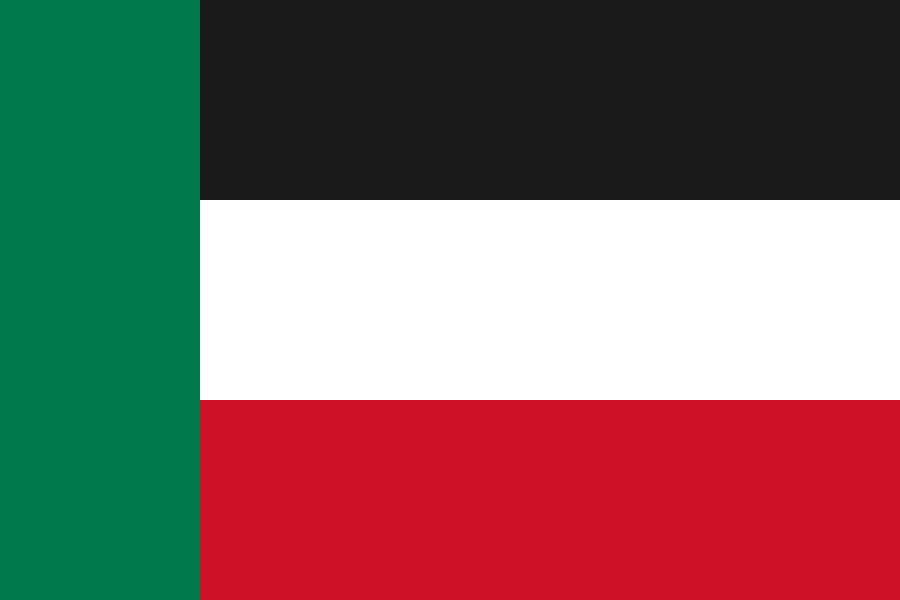
Main article: State of Goshen
The State of Goosen was founded by a group of Boer mercenaries led by Nicolaas Claudius Gey van Pittius in November 1882. It unified with Stellaland on 6 August 1883.
Stellaland
Main article: Stellaland
West of the Transvaal 400 Boers allied with David Massouw, leader of the Koranna Khoisan tribe, when they invaded and took a piece of land, which they declared the Republic of Stellaland. The first president was Gerrit Jacobus van Niekerk and the town of Vryburg was founded and declared its capital. In 1883, The Republic of Stellaland united with The State of Goshen to form the United States of Stellaland.
New Republic
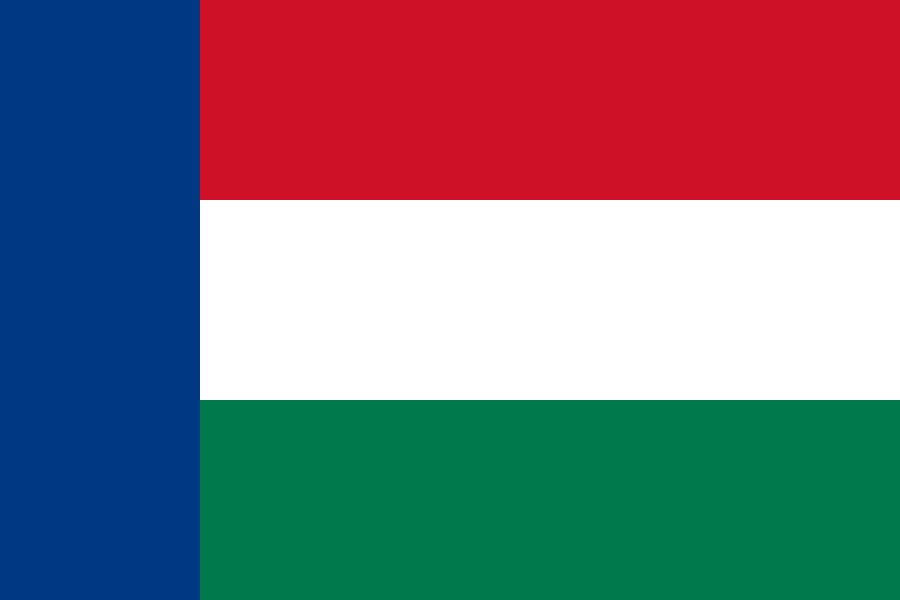
Main article: Nieuwe Republiek
The New Republic (comprising the town of Vryheid) was established in 1884 on land given to the local Boers by the Zulu King Dinuzulu, the son of Cetshwayo, after he recruited local Boers to fight on his side. The Boers were promised and granted land for their services and were led by Louis Botha who would go on to prominence during the second Anglo-Boer War. This republic was later absorbed into the Transvaal/South African Republic.
Griqualand
Main article: Griqualand
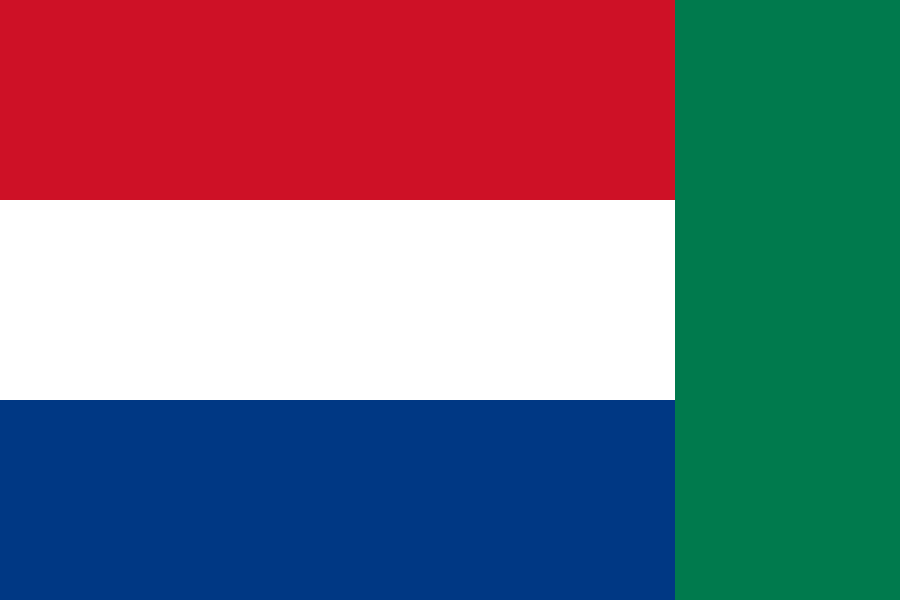
States were also established by other population groups, most notably the Griqua, a subgroup of South Africa's heterogeneous and multiracial Coloured people. Most notable among these were Griqualand West and Griqualand East.
International recognition
Main article: Boer Wars
The people north of the Vaal River in the South African Republic were recognised as an independent country by the United Kingdom with the signing of the Sand River Convention on 17 January 1852.
The Orange Free State was recognised by the UK on 17 February 1854. The Orange Free State became independent on 23 February 1854 with the signing of the Bloemfontein or Orange River Convention. The Orange Free State was nicknamed "the model republic".
The Transvaal and the Orange Free State developed into successful independent countries which were recognized by the Netherlands, France, Germany, Belgium, the United States, and Britain. These two countries continued to exist for several decades, despite the First Boer War with Britain. However, later developments, including the discovery of diamonds and gold in these states, led to the Second Boer War. In this war, the Transvaal and Orange Free State were defeated and annexed by the overwhelmingly larger British forces, ceasing to exist on 31 May 1902, with the signing of the Treaty of Vereeniging. A new British dominion, the Union of South Africa, was established under the South Africa Act 1909, in which the Transvaal and the Orange Free State became provinces along with the Cape and Natal.
2014 land claim
On 24 April 2014, political party Front Nasionaal (FN) submitted a land claim to the Land Claims Commissioner in Pretoria on behalf of the Afrikaner nation. The claim pertains to the land described in National Archives of South Africa R117/1846: "From Ohrigstad to the north till the Olifantsrivier, then downwards to the Delagoa Bay line; to the south till the Crocodile River; to the west to Elandspruit till the 26 degrees line; east till where the Crocodile River joins the Komati River." FN states that the sale of said land was between King Masous (representative of the Zulu) as seller; and Commandant SJZR Burg (representative of the Dutch South African nation) as buyer. A copy of the agreement is filed in the Government Archives under file R117/46. FN further states that the land was legally bought and paid for on 25 July 1846 as an ethnic group and not as individual landowners and was only in custodianship of the pre-1994 government as they were regarded as descendants of the ethnic group. There was therefore no legal right to hand this land over to a "foreign" government in April 1994 and away from the original ethnic group. Description of document R117/46: "GEWAARMERKTE KOPIE MET EEN DAARAAN GEHECHT NIETGEWAARMERKT AFSCHRIFT EN ENGELSCHE VERTALING VAN EEN VERKOOPBEWIJS, WAARBIJ DE KONING DER SOELAS VERKLAART AAN DE HOLL. ZUID AFRIK. NATIE VOOR ALTOOS TE HEBBEN AFGESTAAN ZEKERE DOOR ZIJN VADER SEPOESA VEROVERDE GRONDEN, DIE THANS ZIJN WETTIG EIGENDOM ZIJN, EN WEL VOOR EEN GETAL VAN 100 AANTEELBEESTEN, IN TWEE TERMIJNEN TE WORDEN GELEVERD. ONDER AAN HET VERKOOPBEWIJS IS GESCHREVEN DE KWITANTIE DER KOOPSOM, GEDATEERD 5 JANUARI 1860."
The new land claims process has not yet been finalised however.
List of states and republics
Boer republics
- Prinsenvlag.svg Freeburgher Colonies (1656–1795)
- Flag of the Netherlands.svg Republic of Swellendam (1795)
- Flag of the Netherlands.svg Republic of Graaff-Reinet (1795–1796)
- South African Burgers Flag.svg Republic of Zoutpansberg (1835–1864)
- Voortrekker Flag.svg Winburg (1836–1844)
- South African Burgers Flag.svg Potchefstroom (1837–1844)
- Natalia Republic (1839–1843)
- South African Burgers Flag.svg Winburg-Potchefstroom (1844–1848)
- Flag of Natalia Republic.svg Republic of Klip River (1847–1848)
- Flag of the Netherlands.svg Republic of Lydenburg (1849–1860)
- Flag of the Netherlands.svg Utrecht Republic (1852–1858)
- South African Republic (1852–1877, 1881–1902)
- Orange Free State (1854–1902)
- Flag of Klein Vrystaat.svg Klein Vrystaat (1886–1891)
- Flag of the Republic of Goshen.svg State of Goshen (1882–1883)
- Flag of Stellaland (early 1883).svg Republic of Stellaland (1882–1883)
- Flag of Stellaland (1883-5).svg United States of Stellaland (1883–1885)
- Flag of Nieuwe Republiek.svg New Republic (1884–1888)
- Flag of the German Empire.svg Republic of Upingtonia/Lijdensrust (1885–1887)
Griqua states
- Griqualand East (1862–1879)
- Griqualand West (1870–1871)
- Philippolis/Adam Kok's Land (1826–1861)
- Waterboer's Land (1813–1871)
References
References
- Precis of the Archives of the Cape of Good Hope, January 1656 – December 1658, Riebeeck's Journal &c, H.C.V Leibrandt, Part II, Cape Town 1897.
- D. Fairbridge. (1918). "History of South Africa".
- (2009). "The Handbook of World Englishes". John Wiley & Sons.
- History of the Emigrant Boers in South Africa, 2nd ed, G.M. Theal, London 1888.
- "The Swellendam Republic accepts British rule". South African History Online.
- A short chronicle of warfare in South Africa, Compiled by the Military Information Bureau, Published: Scientia Militaria: South African Journal of Military Studies Vol 16 Nr 13, 1986
- Eybers. (1917). "Select_constitutional_documents_illustrating_South_African_history_1795-1910".
- link. (February 10, 2003)
- (24 May 2010). "Flag of The United States of Stellaland".
- "Stellaland (South Africa)".
- Dietz, Ton. (January 2017). "African Postal Heritage: Stellaland and British Bechuanaland".
- (2015-06-10). "The United States of…Belgium?".
- [https://web.archive.org/web/20010307024437/http://www.outspan.com/books/boers/boers04.htm The Story of the Boers. C. W. Van Der Hoogt. Chapter: A Century of Injustice. p. 96.]
- "Land claim submission for old Boer Republic land-rights 24 April 2014".
- [http://southafricatoday.net/south-africa-news/largest-land-claim-south-africa-the-boer-republic/ Largest Land Claim in South Africa: old Boer Republic]
- [http://www.national.archsrch.gov.za/sm300cv/smws/sm300gi?20140514115342FCDFAF69%26DB%3DTABE National Archives Repository (Public Records of former Transvaal Province and its predecessors as well as of magistrates and local authorities)]
- (25 February 2014). "Land restitution bill passed after heated debate". News24.
- (25 April 2014). "Front Nasionaal hands in massive land claim". SABC Digital News.
- (15 May 2014). "Party is upfront about its land claim". Steelburger.
This article was imported from Wikipedia and is available under the Creative Commons Attribution-ShareAlike 4.0 License. Content has been adapted to SurfDoc format. Original contributors can be found on the article history page.
Ask Mako anything about Boer republics — get instant answers, deeper analysis, and related topics.
Research with MakoFree with your Surf account
Create a free account to save articles, ask Mako questions, and organize your research.
Sign up freeThis content may have been generated or modified by AI. CloudSurf Software LLC is not responsible for the accuracy, completeness, or reliability of AI-generated content. Always verify important information from primary sources.
Report