From Surf Wiki (app.surf) — the open knowledge base
Boeing F/A-18E/F Super Hornet
Series of carrier-based multirole combat aircraft

Series of carrier-based multirole combat aircraft
| Field | Value |
|---|---|
| name | F/A-18E/F Super Hornet |
| image | File:US Navy 071203-N-8923M-074 An F-A-18F Super Hornet, from the Red Rippers of Strike Fighter Squadron (VFA) 11, makes a sharp turn above the flight deck aboard the Nimitz-class nuclear-powered aircraft carrier USS Harry S. Truman.jpg |
| caption | U.S. Navy F/A-18F Super Hornet |
| alt | Top view of gray jet fighter banks toward camera |
| type | Carrier-based multirole fighter |
| manufacturer | McDonnell Douglas (1995–1997) |
| Boeing Defense, Space & Security (1997–present) | |
| national_origin | United States |
| first_flight | |
| introduction | 1999 |
| 2001 (Initial operating capability, IOC) | |
| number_built | ≥632 as of April 2020 |
| status | In service |
| primary_user | United States Navy |
| more_users | Royal Australian Air Force |
| Kuwait Air Force | |
| produced | 1995–present |
| developed_from | McDonnell Douglas F/A-18 Hornet |
| variants | Boeing EA-18G Growler |
Boeing Defense, Space & Security (1997–present) 2001 (Initial operating capability, IOC) Kuwait Air Force
The Boeing F/A-18E and F/A-18F Super Hornet are a series of American supersonic twin-engine, carrier-capable, multirole fighter aircraft derived from the McDonnell Douglas F/A-18 Hornet. The Super Hornet is in service with the armed forces of the United States, Australia, and Kuwait. The F/A-18E single-seat and F tandem-seat variants are larger and more advanced versions of the F/A-18C and D Hornet, respectively.
A strike fighter capable of air-to-air and air-to-ground/surface missions, the Super Hornet has an internal 20 mm M61A2 rotary cannon and can carry air-to-air missiles, air-to-surface missiles, and a variety of other weapons. Additional fuel can be carried in up to five external fuel tanks and the aircraft can be configured as an airborne tanker by adding an external air-to-air refueling system. Designed and initially produced by McDonnell Douglas, the Super Hornet first flew in 1995. Low-rate production began in early 1997, reaching full-rate production in September 1997, after the merger of McDonnell Douglas and Boeing the previous month. An electronic warfare variant, the EA-18G Growler, was also developed. Although officially named "Super Hornet", it is commonly referred to as "Rhino" within the United States Navy.
The Super Hornet entered fleet service with the U.S. Navy in 1999, supplanting the Grumman F-14 Tomcat, which was retired in 2006; the Super Hornet has served alongside the original Hornet as well. The F/A-18E/F became the backbone of U.S. carrier aviation since the 2000s and has been used extensively in combat operations in the Middle East, including the wars in Afghanistan and Iraq, and against the Islamic State and Assad-aligned forces in Syria. The Royal Australian Air Force (RAAF), which operated the F/A-18A as its main fighter since 1984, ordered the F/A-18F in 2007 to replace its aging General Dynamics F-111C fleet with the RAAF Super Hornets entering service in December 2010. The Super Hornet is planned to be replaced by the F/A-XX in U.S. Navy service starting in the 2030s.
Development
Origins
Main article: Northrop YF-17, McDonnell Douglas F/A-18 Hornet
The Super Hornet is an enlarged redesign of the McDonnell Douglas F/A-18 Hornet. The wing and tail configuration trace its origin to a Northrop prototype aircraft, the P-530, , which began as a rework of the lightweight Northrop F-5E (with a larger wing, twin tail fins and a distinctive leading edge root extension, or LERX). Later flying as the Northrop YF-17 "Cobra", it competed in the United States Air Force's Lightweight Fighter (LWF) program to produce a smaller and simpler fighter to complement the larger McDonnell Douglas F-15 Eagle; the YF-17 lost the competition to the YF-16 for the Air Force's LWF, but the Navy found the twin-engine YF-17 design to be more suitable for carrier operations for the service's Navy Air Combat Fighter (NACF) and selected it over the competing naval YF-16 derivative proposal.
After selecting the YF-17, the Navy directed that it be redesigned into the larger F/A-18 Hornet to meet a requirement for a multi-role fighter (VFAX) to complement the larger and more expensive Grumman F-14 Tomcat serving in fleet defense interceptor and air superiority roles. Northrop teamed with McDonnell Douglas to navalize the design, with the latter eventually becoming the prime contractor. The Hornet proved to be effective but limited in combat radius. The concept of an enlarged Hornet was first proposed in the 1980s, which was marketed by McDonnell Douglas as "Hornet 2000". The "Hornet 2000" concept was an advanced F/A-18 with a larger wing and a longer fuselage to carry more fuel and more powerful engines.
The end of the Cold War led to a period of military budget cuts and considerable restructuring. At the same time, U.S. Naval Aviation faced a number of problems. The McDonnell Douglas A-12 Avenger II Advanced Tactical Aircraft (ATA) was canceled in 1991 after the program ran into serious problems; it was intended to replace the obsolete Grumman A-6 Intruder. The Navy then embarked on another attack aircraft program called the Advanced-Attack (A-X), but also considered updating an existing design for an interim capability until A-X could be fielded. Meanwhile, McDonnell Douglas had proposed the "Super Hornet" (initially "Hornet II" and later "Hornet 2000" in the 1980s), which could serve as an alternate replacement for the A-6 Intruder or an interim aircraft for A-X; The next-generation Hornet design proved more attractive than Grumman's Quick Strike upgrade to the F-14 Tomcat, which was regarded as an insufficient technological leap over existing F-14s and was opposed by the Secretary of Defense Dick Cheney. Furthermore, the A-X, which had evolved into the A/F-X (Advanced Attack/Fighter) due to added fighter capabilities, was canceled in the 1993 Bottom-Up Review as the Super Hornet was viewed as a more attractive low-risk approach to a clean-sheet design due to post-Cold War budget reductions.
At the time, the Grumman F-14 Tomcat was the Navy's primary air superiority fighter and fleet defense interceptor. Cheney described the F-14 as 1960s technology, and drastically cut back F-14D procurement in 1989 before cancelling production altogether in 1991, in favor of the updated F/A-18E/F. The decision to replace the Tomcat with an all-Hornet Carrier Air Wing was controversial; Vietnam War ace and Congressman Duke Cunningham criticized the Super Hornet as an unproven design that compromised air superiority. Between 1991 and 1992, the Navy gradually canceled the Navy Advanced Tactical Fighter (NATF), which would have been a navalized variant of the Air Force's Lockheed Martin F-22 Raptor to complement the A-12, due to escalating costs.
Testing and production
.jpg)
The Super Hornet was first ordered by the U.S. Navy in 1992, and the total Engineering and Manufacturing Development (EMD) cost was capped at $4.88 billion in FY 1990 dollars (~$ in ). The Navy retained the F/A-18 designation to help sell the program to Congress as a low-risk "derivative", though the Super Hornet is largely a new aircraft. To some extent, the design of the F/A-18E/F was driven by a more cautious development approach favoring incremental improvements over the F/A-18C/D, affordability, and reliability at the expense of raw performance. The Hornet and Super Hornet share many characteristics, including avionics, ejection seats, radar, armament, mission computer software, and maintenance/operating procedures. The Super Hornet's F414 engines were derived from the Hornet's F404 while also incorporating advances developed for the A-12's F412. The initial F/A-18E/F retained most of the avionics systems from the F/A-18C/D's configuration at the time to reduce upfront development costs.
The Super Hornet first flew on 29 November 1995. with full production beginning in September 1997. Testing continued through 1999, finishing with sea trials and aerial refueling demonstrations, as well as design modifications to resolve "wing drop" and possible stores release interference. Testing involved 3,100 test flights covering 4,600 flight hours. and was approved in February 2000.
Following the retirement of the F-14 in 2006, all of the Navy's combat jets were Hornet variants until the F-35C Lightning II entered service. The F/A-18E single-seat and F/A-18F two-seat aircraft took the place of the F-14 Tomcat, A-6 Intruder, Lockheed S-3 Viking, and KA-6D aircraft. An electronic warfare variant, the EA-18G Growler, replaced the EA-6B Prowler. The Navy calls this reduction in aircraft types a "neck-down". During the Vietnam War era, the Super Hornet's roles were performed by a combination of the A-1/A-4/A-7 (light attack), A-6 (medium attack), F-8/F-4 (fighter), RA-5C (recon), KA-3/KA-6 (tanker), and EA-6 (electronic warfare). It was anticipated that $1 billion in fleetwide annual savings would result from replacing other types with the Super Hornet. The Navy considers the Super Hornet's acquisition a success, meeting cost, schedule, and weight (400 lb, 181 kg) below requirement threshold limits.
The total Super Hornet procurement number would fluctuate considerably throughout its production run. The 1997 Department of Defense (DoD) Quadrennial Defense Review cut the originally planned number of around 1,000 by nearly half. By October 2008, Boeing had delivered 367 Super Hornets to the U.S. Navy, but the service was still experiencing a strike fighter shortfall as older aircraft types retired and the procurement rate was not sufficient to replenish the carrier air wings, especially with ongoing combat operations in Iraq and Afghanistan as well as substantial delays with the F-35 program. In 2006, the Navy was 60 fighters below its validated requirement. The FY2010 budget bill authorized a multiyear purchase agreement for additional Super Hornets, finalized on 28 September 2010, that reportedly saved $600 million over individual yearly contracts. This contract for 66 Super Hornets and 58 Growlers was intended to mitigate a four-year delay in the F-35 program. In 2019, Boeing received a $4 billion contract to deliver 78 Block III Super Hornets for the Navy through fiscal 2021. The Navy plans to sign year-to-year contracts to convert all of its Block II aircraft to Block III variants through 2033. As the F-35 began entering service, Boeing announced plans to end Super Hornet production in 2025, later extended to 2027 with an additional 17 orders from the U.S. Navy.
Improvements and changes
The Block II Super Hornet incorporates an improved active electronically scanned array (AESA) radar, larger displays, the joint helmet mounted cueing system, and several other avionics replacements. New-build aircraft received the APG-79 AESA radar beginning in 2005. In January 2008, it was announced that 135 earlier production aircraft were to be retrofitted with AESA radars.
In 2008, Boeing discussed the development of a Super Hornet Block III with the U.S. and Australian military, featuring additional stealth capabilities and extended range. The airframe is strengthened to increase service life to 10,000 flight hours, and some Block II aircraft can be modified to achieve this as well. In 2010, Boeing offered prospective Super Hornet customers the "International Roadmap", which included conformal fuel tanks, enhanced engines, an enclosed weapons pod (EWP), a next-generation cockpit, a new missile warning system, and an internal infrared search and track (IRST) system; the IRST was later mounted on the centerline external tank. The EWP has four internal stations for munitions, a single aircraft can carry a total of three EWPs, housing up to 12 AMRAAMs and 2 Sidewinders. The next-generation cockpit features a 19 x 11-inch touch-sensitive display. In 2011, Boeing received a US Navy contract to develop a new mission computer.
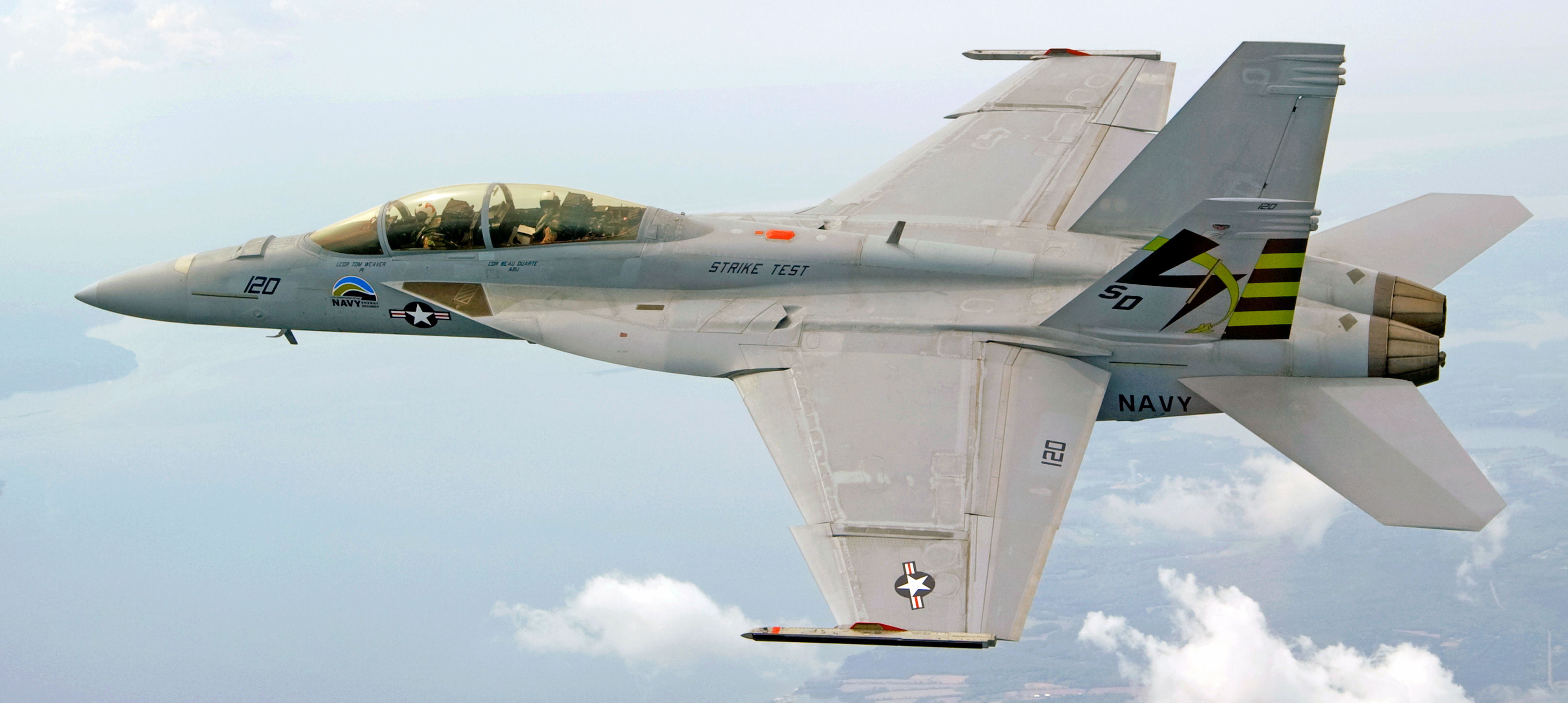
In 2007, Boeing stated that a passive Infrared Search and Track (IRST) sensor would be an available future option. The sensor, mounted in a modified centerline fuel tank, detects long wave IR emissions to spot and track targets such as aircraft; combat using the IRST and AIM-9X Sidewinder missiles is immune to radar jamming. In May 2009, Lockheed Martin announced its selection by Boeing for the IRST's technology development phase, and a contract followed in November 2011. , a basic IRST would be fielded in 2016 and a longer-range Block II version in 2019. The sensor would be designated the AN/ASG-34(V) IRST21. An F/A-18F performed a flight equipped with the IRST system in February 2014, and Milestone C approval authorizing low-rate initial production (LRIP) was granted in December 2014. The sequestration cuts in 2013 would cause years of delay, and the Navy chose to skip the basic version and transition directly to the Block II IRST for operational service. After initial production quality issues, the IRST became operational in January 2025.
Advanced Super Hornet
Boeing and Northrop Grumman self-funded a prototype of the Advanced Super Hornet. The prototype features a 50% reduction in frontal radar cross-section (RCS), conformal fuel tanks (CFT), and an enclosed weapons pod. Features could also be integrated onto the EA-18G Growler: using CFTs on the EA-18G fleet was speculated as useful for relieving underwing space and lowering the drag margin for the Next Generation Jammer. Flight tests of the Advanced Super Hornet began on 5 August 2013 and continued for three weeks, testing the performance of CFTs, the enclosed weapons pod (EWP), and signature enhancements. The U.S. Navy was reportedly pleased with the Advanced Super Hornet's flight test results, and hopes it will provide future procurement options. Although the Advanced Super Hornet was not pursued, many elements would be transferred to the Block III.
In 2013, the U.S. Navy was considering the widespread adoption of CFTs, which would allow the Super Hornet to carry 3500 lb of additional fuel. Budgetary pressures from the F-35C Lightning II and Pacific region operations were cited as reasons supporting the use of CFTs. Flight testing demonstrated CFTs could slightly reduce drag while expanding the combat range by 260 nmi. The prototype CFT weighed 1500 lb, while production CFTs are expected to weigh 870 lb. Boeing stated that the CFTs do not add any cruise drag but acknowledged a negative impact imposed on transonic acceleration due to increased wave drag. General Electric's enhanced performance engine (EPE), increasing the F414-GE-400's power output by 20%, was suggested as a mitigating measure. In 2021, the U.S. Navy halted plans to fit CFTs as standard on all Block III Super Hornets due to cost, schedule, and performance issues.
In 2009, development commenced on several engine improvements, including greater resistance to foreign object damage, reduced fuel burn rate, and potentially increased thrust of up to 20%. In 2014, Boeing revealed a Super Hornet hybrid concept, equipped with the EA-18G Growler's electronic signal detection capabilities to allow for targets engagement using the receiver; the concept did not include the ALQ-99 jamming pod. Growth capabilities could include the addition of a long-range infrared search and track sensor and new air-to-air tracking modes.
Design
Overview
The Super Hornet is largely a new aircraft at about 20% larger, 7000 lb heavier empty weight, and 15000 lb heavier maximum weight than the original Hornet. The Super Hornet carries 33% more internal fuel, increasing mission range by 41% and endurance by 50% over the "Legacy" Hornet. The empty weight of the Super Hornet is about 11000 lb less than that of the F-14 Tomcat which it replaced, while approaching, but not matching, the F-14's payload and range. Although lacking some of the F-14's raw performance, the F/A-18E/F has much better handling characteristics and controllability and was also significantly more reliable and affordable to operate. With the Super Hornet being significantly heavier than the legacy Hornet, the catapult and arresting systems must be set differently. To aid safe flight operations and prevent confusion in radio calls, the Super Hornet is informally referred to as the "Rhino" to distinguish it from earlier Hornets partly because of the AN/APX-111 "pizza box" IFF antenna protruding on top of the nose. (The "Rhino" nickname was previously applied to the McDonnell Douglas F-4 Phantom II, which was retired from US Navy combat use in 1987.)
The Super Hornet, unlike the previous Hornet, can be equipped with an aerial refueling system (ARS) or "buddy store" for the refueling of other aircraft, filling the tactical airborne tanker role the Navy had lost with the retirement of the KA-6D and Lockheed S-3B Viking tankers. The ARS includes an external 330 USgal tank with hose reel on the centerline, along with four external 480 USgal tanks and internal tanks, for a total of 29000 lb of fuel on the aircraft. On typical missions a fifth of the air wing is dedicated to the tanker role, which consumes aircraft fatigue life expectancy faster than other missions. It most commonly uses JP-5 jet fuel.
Airframe changes
The forward fuselage is unchanged, but the remainder of the aircraft shares little with earlier F/A-18C/D models. The fuselage was stretched by 34 in to make room for fuel and future avionics upgrades and increased the wing area by 25%, yet the Super Hornet has 42% fewer structural parts than the original Hornet. The wings have a dogtooth extension and a strip of porous surface at the folding joint to mitigate "wing drop". The General Electric F414 engine, developed from the Hornet's F404, has 35% additional thrust over most of the flight envelope and is rated at 22000 lbf in afterburner. The Super Hornet can return to an aircraft carrier with a larger load of unspent fuel and munitions than the Hornet; this ability is known as "bringback", which for the Super Hornet is in excess of 9000 lb.
Other differences include larger rectangular caret inlets with fixed ramps for the more powerful engines and two extra wing hard points for payload (for a total of 11), retaining previous hardpoints on the bottom centerline, wingtips, and two conformal fuselage positions. Among the most significant aerodynamic changes are the enlarged leading edge extensions (LEX) that provide improved vortex lifting characteristics in high angle of attack maneuvers, and reduce the static stability margin to enhance pitching characteristics. This modification results in pitch rates in excess of 40 degrees per second, and high resistance to departure from controlled flight. Due to concerns over released stores potentially striking the airframe from early wind tunnel testing, all underwing pylons are canted outwards slightly; although this was later determined to be unnecessary, production tooling had already been adjusted so the canted pylons remained to save development costs and avoid revalidating all flight testing. While the effects are marginal for cruise drag, they are more substantial for transonic and supersonic drag.
Radar signature reduction measures
Survivability is a key feature of the Super Hornet. The U.S. Navy took a "balanced approach" to survivability in its design. It does not rely primarily on low-observability technology, but rather adopts improvements to its radar signature alongside other innovations; incorporating more advanced electronic warfare capabilities, reduced ballistic vulnerability, and greater employment of standoff weapons to collectively enhance crew and aircraft safety. While the F/A-18E/F is not a stealth fighter like the F-22, it does have a frontal radar cross-section (RCS) an order of magnitude smaller than prior generation fighters.
The F/A-18E/F's RCS is reduced greatly from some aspects, mainly the front and rear. The Super Hornet also makes considerable use of panel joint serration and edge alignment to direct reflected waves away from the aircraft in uniformly narrow angles. Considerable attention is paid to the removal or filling of unnecessary surface join gaps and resonant cavities. Where the F/A-18A-D used grilles to cover various accessory exhaust and inlet ducts, the F/A-18E/F uses perforated panels that appear opaque to radar waves at the frequencies used.
Avionics
Initially, the Super Hornet's avionics and software had a 90% commonality with that of the F/A-18C/D fleet at the time, with further upgraded avionics introduced in successive Blocks. as well as a digital flight-control system that detects and corrects for battle damage. Initial production models used the APG-73 radar, later replaced by the AN/APG-79 active electronically scanned array (AESA). and a MIDS-JTRS low volume terminal for HAVE QUICK, SINCGARS and Link 16 connectivity.
The defensive countermeasures of Block I aircraft includes the AN/ALR-67(V)3 radar warning receiver, the AN/ALE-47 countermeasures dispenser, the AN/ALE-50 towed decoy and the AN/ALQ-165 Airborne Self-Protect Jammer (ASPJ). Block II aircraft replace the ALQ-165 with the AN/ALQ-214 Integrated Defensive Countermeasures (IDECM) system, consisting of internally mounted threat receivers and optional self-protection jammers. Interior and exterior lighting on the Block II was changed to allow the use of night vision devices. The older ALE-50 decoys are being replaced by ALE-55 towed decoys, which can transmit jamming signals based on data received from the IDECM.
Beginning in 2005, Block II aircraft were fitted with the AN/APG-79 AESA radar, capable of executing simultaneous air-to-air and air-to-ground attacks, and providing higher quality high-resolution ground mapping at long standoff ranges. The AESA radar can also detect smaller targets, such as inbound missiles and can track air targets beyond the range of the aircraft's air-to-air missiles. VFA-213, the first squadron to fly AESA-equipped Super Hornets, became "safe for flight" (independently fly and maintain the F/A-18F) on 27 October 2006. The first Super Hornet upgraded with the Joint Helmet Mounted Cueing System (JHMCS) was delivered to VFA-213 on 18 May 2007. The JHMCS provides multi-purpose situational awareness, which includes high-off-boresight missile cuing. The Shared Reconnaissance Pod (SHARP) is a high-resolution, digital tactical aerial reconnaissance system that features advanced day/night and all-weather capability. The Multifunctional Information Distribution System low volume communication terminal is being upgraded with the MIDS-JTRS system, which will allow a tenfold increase in bandwidth as well as compatibility with the Joint Tactical Radio System standards.
The avionics of Block III aircraft, first delivered in 2021, incorporates an improved cockpit with all MFDs replaced by a large-area 10 x touchscreen display, updated integration and targeting networks, an updated processor, and an open mission systems architecture. Block II aircraft can be upgraded to the Block III configuration. For passive infrared detection and targeting, the aircraft can carry the AN/ASG-34(V)1 IRST21 sensor contained in a modified centerline FPU-13 external fuel tank; the sensor occupies the forward portion of the tank, reducing its capacity to 340 gallons. The ATFLIR is planned to be replaced by the AN/AAQ-28(V) Litening targeting pod.
Operational history
United States Navy
_flight_ops_CVN-72_2002-10-04.jpg)
In 1999, the Super Hornet entered fleet service with the U.S. Navy. It achieved initial operating capability (IOC) in September 2001 with the U.S. Navy's Strike Fighter Squadron 115 (VFA-115) at Naval Air Station Lemoore, California.
In support of Operation Iraqi Freedom (Iraq War), VFA-14, VFA-41 and VFA-115 flew close air support, strike, escort, SEAD and aerial refueling sorties. Two F/A-18Es from VFA-14 and two F/A-18Fs from VFA-41 were forward deployed to . The VFA-14 aircraft flew mostly as aerial refuelers and the VFA-41 fighters as Forward Air Controller (Airborne) or FAC(A)s. On 6 April 2005, VFA-154 and VFA-147 (the latter squadron then still operating F/A-18Cs) dropped two 500 lb laser-guided bombs on an enemy insurgent location east of Baghdad. On 8 September 2006, VFA-211 F/A-18Fs expended GBU-12 and GBU-38 bombs against Taliban fighters and Taliban fortifications west and northwest of Kandahar as part of Operations Medusa and Enduring Freedom. This was the first time the unit had participated in an active combat capacity using the Super Hornet.
During the 2006–2007 cruise with , VFA-103 and VFA-143 supported Operations Iraqi Freedom, Enduring Freedom and operations off the Somali coast. Alongside "Legacy Hornet" squadrons, VFA-131 and VFA-83, they dropped 140 precision guided weapons and performed nearly 70 strafing runs. The Super Hornet can operate from the French aircraft carrier .

On 7 August 2014, U.S. defense officials announced they had been authorized to launch bombing missions upon Islamic State (IS) forces in northern Iraq. The decision to take direct action was made to protect U.S. personnel in the city of Irbil and to ensure the safety of transport aircraft making airdrops to Yazidi civilians. Early on 8 August, two Super Hornets took off from and dropped 500 lb laser-guided bombs on a "mobile artillery piece" the militants had been using to shell Kurdish forces defending the city. Later that day, four more aircraft struck a seven-vehicle convoy and a mortar position.
On 18 June 2017, a U.S. Navy F/A-18E shot down a Syrian Air Force Su-22 fighter-bomber that allegedly had bombed a position held by U.S.-supported Syrian Democratic Forces (SDF) near Tabqa; the Syrian government claimed the Su-22 was bombing an IS position. This was the first aerial kill of a crewed aircraft by an American fighter since 1999, the first by the Navy since the 1991 Persian Gulf War, the first kill by a Super Hornet, and the third kill by an F/A-18. An E-3 Sentry issued several warnings to the Su-22 and, after it dropped bombs near SDF fighters, the F/A-18E, piloted by Lieutenant Commander Michael "MOB" Tremel, a pilot assigned to Strike Fighter Squadron 87 aboard the carrier George H.W. Bush, independently chose to shoot it down based on established rules of engagement. The F/A-18E first missed with an AIM-9X Sidewinder, then hit the Su-22 with an AIM-120 AMRAAM; the encounter lasted eight minutes.
In 2018, Boeing was awarded a contract to convert nine single-seat F/A-18E Super Hornets and two F/A-18F two-seaters for Blue Angels use; these were to be completed by 2021.
On 26 December 2023, Super Hornets from USS Dwight D. Eisenhower, along with the accompanying destroyer , destroyed 12 attack drones, three anti-ship missiles and two ground attack cruise missiles fired by Houthi forces in the southern Red Sea. Around 2:30 AM local time on 12 January 2024, Houthi targets were struck by U.S. Navy, USAF, and RAF forces in response to Houthi attacks against commercial shipping in the Red Sea. Super Hornets from Dwight D. Eisenhower took part in the strikes, which in total hit 60 targets at 16 locations using over 100 PGMs of various types. On 22 December 2024, an F/A-18F Super Hornet from VFA-11 was shot down by in a friendly fire incident. Both crewmembers of the aircraft survived. On 28 April 2025 while under attack by missiles and drones from the Houthis, Harry S. Truman made a hard turn and a F/A-18E Super Hornet from VFA-136, which was being towed in the hangar, fell overboard as a result. The plane was lost at sea. On 6 May 2025 a second Super Hornet was lost when arresting gear failed to catch the plane during landing.
Royal Australian Air Force
On 3 May 2007, the Australian Government signed a $2.9 billion contract to acquire 24 F/A-18Fs as an interim replacement for the Royal Australian Air Force's (RAAF) aging F-111s. It was reported that the order would also address any difficulties that might be caused by a need to quickly replace the RAAF's existing fleet of classic F/A-18A/B Hornets in the event of delays to the F-35 program. The total cost of the purchase, with training and support over 10 years, was expected to be A$6 billion (US$4.6 billion).

The order was controversial; Air Vice Marshal (retired) Peter Criss, said that he was "absolutely astounded" that $6 billion would be spent on an interim aircraft, and cited the US Senate Armed Services Committee, to the effect that the "excess power" of the Block I Super Hornet was inferior to that of the MiG-29 and Su-30, both of which were being operated by, or were on order for, air forces in South East Asia. Another former senior RAAF officer, Air Commodore (ret.) Ted Bushell stated that the F/A-18F could not perform the strategic deterrent/strike role of the F-111C and the latter could continue to operate until 2020 at least. On 31 December 2007, the new Australian Labor government announced a review of the RAAF's aircraft procurement plans citing suitability concerns, the lack of a proper review process, and beliefs that an interim fighter was not needed.
On 17 March 2008, the Government announced that it would proceed to acquire 24 F/A-18Fs. Defence Minister Joel Fitzgibbon called the Super Hornet an "excellent aircraft", and indicated that costs and logistical factors contributed to the decision: the F-111's retirement was "irreversible"; "only" the F/A-18F could meet the timeframe and that termination involved "significant financial penalties and create understandable tensions between the contract partners." The Block II aircraft offered include installed engines and six spares, APG-79 AESA radars, Link 16 connectivity, LAU-127 guided missile launchers, AN/ALE-55 fiber optic towed decoys and other equipment. On 27 February 2009, Fitzgibbon announced that 12 of the 24 F/A-18Fs would be wired on the production line for future modification as Boeing EA-18G Growlers at an additional cost of A$35 million. The final decision on the EA-18G conversion, at a cost of A$300 million, would be made in 2012.

The first RAAF F/A-18F made its first flight from Boeing's factory in St. Louis, Missouri, on 21 July 2009. RAAF crews began training in the U.S. in 2009. The first five F/A-18Fs arrived at their home base, RAAF Base Amberley in Queensland, on 26 March 2010; and were joined by six more aircraft on 7 July 2010. After four more aircraft arrived in December 2010, the first RAAF F/A-18F squadron was declared operational on 9 December 2010.
In 2008, U.S. export approval was sought for EA-18G Growlers. In December 2012, Australia sought cost information on acquiring a further 24 F/A-18Fs, which may be bought to avoid a capability gap due to F-35 delays. In February 2013, the U.S. Defense Security Cooperation Agency notified Congress of a possible Foreign Military Sale to Australia for up to 12 F/A-18E/Fs and 12 EA-18Gs with associated equipment, training and logistical support. In May 2013, Australia announced the order of 12 new EA-18Gs instead of converting any F/A-18Fs. In June 2014, Boeing received a contract for 12 EA-18Gs; the first was rolled out on 29 July 2015.
On 24 September 2014, eight RAAF F/A-18Fs, along with a KC-30A tanker, an early warning aircraft, and 400 personnel arrived in the United Arab Emirates to take part in operations against Islamic State (IS) militants. On 5 October 2014, the RAAF officially started combat missions over Iraq using a pair of F/A-18Fs armed with GPS guided bombs, they returned safely to base without attacking targets. On 8 October 2014, an RAAF F/A-18F conducted its first attack, dropping two bombs on an ISIL facility in northern Iraq. In 2017, EA-18Gs replaced No. 6 Squadron RAAF's F/A-18Fs, which were then transferred to No. 1 Squadron RAAF.
On 8 December 2020, F/A-18F A44-223 rolled into a ditch while attempting to take off at RAAF Base Amberley, the crew ejected. An eyewitness reportedly observed smoke from one of the engines. A day after the incident, the RAAF grounded the fleet of 24 Super Hornets and 11 Growlers while the incident was investigated. The cause was determined to be pilot error. The Super Hornet was repaired, and returned to service in mid-2021.
Kuwait Air Force
In May 2015, the Kuwait Air Force was reportedly planning to order 28 F/A-18E/Fs with options for an additional 12. However, in June 2015, it was reported that Kuwait was considering a split purchase between the Eurofighter Typhoon and the F/A-18E/F. On 11 September 2015, Kuwait signed an agreement for 28 Eurofighters. In November 2016, a proposed Kuwaiti sale of 32 F/A-18E and 8 F/A-18F fighters, armaments, and associated equipment was approved by the U.S. State Department.
In June 2018, the Kuwaiti Government ordered 22 F/A-18Es and 6 F/A-18Fs via a US$1.5 billion contract. The aircraft were scheduled to be delivered by January 2021, but were rescheduled to be delivered later due to the COVID-19 pandemic.
Potential operators
Boeing has pitched the F/A-18E/F to numerous countries, particularly those that operate the legacy Hornet as it was supposed to be a "logical progression from the Hornet to the [Super Hornet], with its logistics, weaponry and training commonalities". So far only the US Navy, Australia, and Kuwait have ordered and received the Super Hornet.
Malaysia
Boeing offered Malaysia Super Hornets as part of a buy-back package for its existing Hornets in 2002. However, the procurement was halted in 2007 after the government decided to purchase the Sukhoi Su-30MKM instead; Chief Gen. Datuk Nik Ismail Nik Mohamaed of the Royal Malaysian Air Force (RMAF) indicated that the air force had not planned to end the Super Hornet buy, stating that such fighters were needed. Separately, the Super Hornet is a contender for the MRCA program, under which the RMAF seek to equip three squadrons with 36 to 40 new fighters with an estimated budget of RM6 billion to RM8 billion (US$1.84 billion to US$2.46 billion). Other competitors are the Eurofighter Typhoon, Dassault Rafale and Saab JAS 39 Gripen.
Failed bids
Belgium
Main article: Lockheed Martin F-35 Lightning II procurement#Belgium
On 12 March 2014, Belgian newspaper De Morgen reported that Boeing was in talks with the Belgian Ministry of Defence about the Super Hornet as a candidate to replace Belgium's aging F-16 fleet. In April 2017, Boeing announced it would not compete in the competition, citing it "does not see an opportunity to compete on a truly level playing field". On 25 October 2018, Belgium officially selected the offer for 34 F-35As to replace its fleet of around 54 F-16s.
Brazil
Main article: Saab JAS 39 Gripen#Brazil
Boeing proposed the Super Hornet to the Brazilian government in response to an initial requirement for 36 aircraft, with a potential total purchase of 120. In October 2008, the Super Hornet was reportedly selected as one of three finalists in Brazil's fighter competition. However, news of National Security Agency spying on Brazilian leaders caused animosity between Brazil and the US. Brazil eventually dropped the Super Hornet from its final list and selected the Saab JAS 39 Gripen in December 2013.
Canada
Main article: Lockheed Martin F-35 Lightning II Canadian procurement
The Super Hornet was a contender to replace the CF-18 Hornet, a version of the F/A-18A and B models, operated by the Royal Canadian Air Force. Like the older Hornet, the Super Hornet's design is well-suited to Northern Canada's rugged forward operational airfields, while its extended range removes its predecessor's main deficiency while commonalities enable a straightforward transition. In 2010, Canada decided on sole source selection of the F-35A. Boeing claimed that Canada had ignored the Super Hornet's radar cross-section characteristics during evaluation. By April 2012, Canada was reportedly reviewing its F-35 procurement. In September 2013, Boeing provided Canada with data on its Advanced Super Hornet, suggesting that 65 aircraft would cost $1.7 billion less than an F-35 fleet. The US Navy buys Super Hornets for $52 million per aircraft, while the advanced model costs $6–$10 million more per aircraft, dependent on options selected.
The Liberal government elected in 2015 indicated that it would launch a competition to replace the CF-18 fleet. During the election, Liberal Leader Justin Trudeau stated that his government would not buy the F-35. On 22 November 2016, the government announced its intention to acquire 18 Super Hornets on an interim basis. In September 2017, the U.S. State Department granted Canada permission to buy 10 F/A-18Es and 8 F/A-18Fs (or EA-18Gs) along with supporting equipment, spares, and armaments; the agreed cost totaled CA$1.5 billion, or about CA$83.3 million per aircraft, adding the supporting equipment, training, spares, and weapons increased the acquisition cost to CA$6.3 billion. However, Canadian Prime Minister Justin Trudeau warned that the pending Super Hornet sale, along with a possible sale of another 70, was adversely affected by Boeing's actions against Bombardier Aerospace, such as a complaint to the US government over the sale of CSeries airliners to Delta Air Lines at unduly low prices; in September 2017, the U.S. Department of Commerce proposed a 219% tariff on CSeries imported into the US. In January 2018, the USITC commissioners unanimously ruled against Boeing that the U.S. industry is not threatened and no duties will be imposed.
In late 2017, the Canadian Government agreed with Australia to purchase 18 used F/A-18 Hornets as an interim measure. Boeing confirmed its bid for the Advanced Fighter Program, likely offering a mix of 88 F/A-18E/F Advanced Super Hornets (Block III) and Boeing EA-18G Growlers. On 25 November 2021, Reuters reported that Boeing is out of the competition since its fighter proposal does not meet requirements with the F-35 and Saab JAS 39 Gripen remaining in competition.
Denmark
Main article: Lockheed Martin F-35 Lightning II procurement#Denmark
In 2008, the Royal Danish Air Force was offered the F/A-18E/F Super Hornet as one of three fighters in a Danish competition to replace 48 F-16AM/BMs. The other contenders were the F-35A Joint Strike Fighter and the Eurofighter Typhoon. Denmark is a level-3 partner in the JSF program. The final selection was originally planned for mid-2015 where 24 to 30 fighters were expected. In April 2014, the Danish Ministry of Defence handed over a Request for Binding Information (RBI) that specifically listed the F/A-18F two-seat variant. In December 2015, the decision was postponed to 2016, with the final order's details pending negotiations. In May 2016, the Danish government recommended to parliament that 27 F-35As should be procured instead of 38 Super Hornets.
In September 2016, Boeing indicated that they would take legal action against the Danish F-35A buy, indicating that flawed data was used. In March 2018, Boeing lost the case with the court stating "The court has found that the authorities' decisions on refusal of access to the documents are legal and valid."
Finland
Main article: Lockheed Martin F-35 Lightning II procurement#Finland
In June 2015, a working group set up by the Finnish MoD proposed starting the HX Fighter Program to replace the Finnish Air Force's current fleet of F/A-18C/D Hornets, which will reach the end of their service life by the end of the 2020s. The group recognised five potential types: Boeing F/A-18E/F Advanced Super Hornet, Dassault Rafale, Eurofighter Typhoon, Lockheed Martin F-35 Lightning II and Saab JAS 39 Gripen. In May 2016, the DOD announced that Boeing (with the Super Hornet) and Lockheed Martin (with the F-35) would respond to the information request. This request was sent in early 2016 with five responses received in November 2016. A call for tender will be sent in spring 2018 and the buying decision is scheduled to take place in 2021.
In February 2020, three Super Hornets (a single-seat F/A-18E, a twin-seat F/A-18F and an EA-18G) arrived at the Tampere-Pirkkala Airbase in Finland for final flight evaluations. The evaluations concluded on 28 February 2020. The Finnish newspaper Iltalehti reported that several foreign and security policy sources had confirmed the Finnish Defense Forces recommendation of the F-35, citing its capability and expected long lifespan as key reasons. Finland ordered the F-35 in February 2022.
Germany
Main article: Lockheed Martin F-35 Lightning II procurement#Germany
Germany requires a replacement for its aging Panavia Tornado fleet, including both Tornado IDS (interdictor/strike) and ECR (Electronic Combat/Reconnaissance) variants. Germany considered ordering the Lockheed Martin F-35, Eurofighter Typhoon, and the Boeing F/A-18E/F Super Hornet and EA-18G Growler. In April 2020, Germany's defense secretary announced a replacement plan for a split purchase of 30 Super Hornets, 15 EA-18Gs and 55 Typhoons. However, the Defense Ministry states this is not finalized and it is being debated. As of March 2020, the Super Hornet was not certified for the B61 nuclear bombs, but Dan Gillian, Super Hornet program head, previously stated that "We certainly think that we, working with the U.S. government, can meet the German requirements..."
With increased tensions in Europe, due to the Russian invasion of Ukraine beginning 24 February 2022, Germany scrambled to accelerate defense spending priorities. Newly elected Chancellor Olaf Scholz pledged a €100 billion military upgrade, which included selecting the F-35 instead of the Super Hornet for the nuclear role and Eurofighter ECR/SEAD instead of the Growler.
India
Indian Air Force
Main article: Indian MRCA competition
For India's MMRCA competition, Boeing offered a customized variant called F/A-18IN, which included Raytheon's APG-79 AESA radar. In August 2008, Boeing submitted an industrial participation proposal detailing partnerships with companies in India. The Indian Air Force (IAF) extensively evaluated the Super Hornet, including field trials in August 2009. However, in April 2011, the IAF eliminated the F/A-18IN from the competition which was eventually won by the Dassault Rafale.
.jpg)
In October 2016, India reportedly received three unsolicited bids, including one from Boeing for the Super Hornet, to replace its MiG-21 and MiG-27 aircraft. The aircraft is now competing with six others in a fresh tender, referred as MMRCA 2.0, for the procurement of 114 multi-role combat aircraft for the IAF.
Indian Navy
The Rafale was chosen over the Super Hornet due to their commonality with the Rafale aircraft operated by the Indian Air Force, as well as availability to integrate Indian origin systems into the aircraft. The aircraft would complement the existing fleet of Navy Mikoyan MiG-29K aircraft, to be later joined by the Indian built Twin Engine Deck Based Fighter. The aircraft would be operated on the Indian aircraft carriers INS Vikramaditya and INS Vikrant.
The deal was officially signed with France on 28 April 2025.
Poland
Main article: Lockheed Martin F-35 Lightning II procurement#Poland
During the 2010s, Poland sought to purchase 64 multirole combat aircraft from 2021 to replace the Polish Air Force's fleet of Sukhoi Su-22M4 ground attack aircraft and Mikoyan MiG-29 fighters. In November 2017, the Armament Inspectorate launched the acquisition process. On 22 December 2017, five entities expressed interest in participating in the market analysis phase of the procurement, referred to as "Harpia" (harpy eagle); they included Saab (Gripen NG), Lockheed Martin (F-35), Boeing (F/A-18), Leonardo (Eurofighter Typhoon) and Fights-On Logistics (second-hand F-16). On 28 May 2019, the Polish Defense Ministry formally requested to buy 32 F-35As.
Switzerland
Main article: Lockheed Martin F-35 Lightning II procurement#Switzerland
Boeing first offered the Super Hornet to the Swiss Air Force as a replacement for Swiss F-5E Tigers before withdrawing from the competition on 30 April 2008. The Swiss Air Force was at one point intending to buy the rival Saab Gripen, but this was blocked by Swiss voters in 2014. In March 2018, Swiss officials named contenders in its Air 2030 program: The Saab Gripen, Dassault Rafale, Eurofighter Typhoon, Boeing F/A-18E/F Super Hornet and Lockheed Martin F-35. The program has a budget of but includes not only combat aircraft but also ground-based air defense systems. In October 2018, it was reported by Jane's that the Swiss Air Force may be limited to purchasing a single-engine fighter due to cost. The F/A-18E/F performed demonstrations for Swiss personnel at Payerne Air Base in April 2019, which was contrasted to flights performed by other bidders.
On 30 June 2021, the Swiss Federal Council proposed buying 36 F-35As to Parliament at a cost of up to 6 billion Swiss francs (US$6.5 billion), citing the aircraft's cost and combat effectiveness. The anti-military group GSoA intended to contest the purchase in another national referendum supported by the Green Party of Switzerland and the Social Democratic Party of Switzerland (which previously acted to block the Gripen). In August 2022, they registered the initiative, with 120,000 people having signed in less than a year (with 100,000 required). On 26 November 2021, it was announced that Armasuisse had agreed terms with the US government for 36 F-35As for CHF 6.035 billion. The order was then subject to parliamentary approval and the popular initiative not proceeding or failing. A parliamentary inquiry found the purchase worrisome but legal. The government did not wait for the popular initiative to proceed, which was legally permitted. On 15 September 2022, the Swiss National council gave the Federal council permission to sign the purchase deal. The deal to buy 36 F-35A was signed on 19 September 2022, with deliveries to commence in 2027 and conclude by 2030.
Spain
By 2018, Spain sought 68-72 fighters to replace its F/A-18A/B Hornets; tender participants included the Eurofighter Typhoon, Dassault Rafale, Boeing F/A-18 E/F Advanced Super Hornet, and Lockheed F-35 Lightning II. On 22 June 2022, Spain ordered 20 Tranche 4 Typhoons to replace the 20 ex-USN F/A-18s based at the Canary Islands.
United States Marine Corps
The United States Marine Corps (USMC) avoided the Super Hornet program over fears that any purchased F/A-18s would be at the cost of the F-35B STOVL fighters that they intend to operate from amphibious ships. Resistance is so high that they would rather fly former Navy F/A-18Cs. In 2011, the USMC agreed to eventually equip five Marine fighter-attack squadrons (VMFA) with the F-35C carrier variant to continue to augment Navy carrier air wings as they do with the F/A-18C.
Others
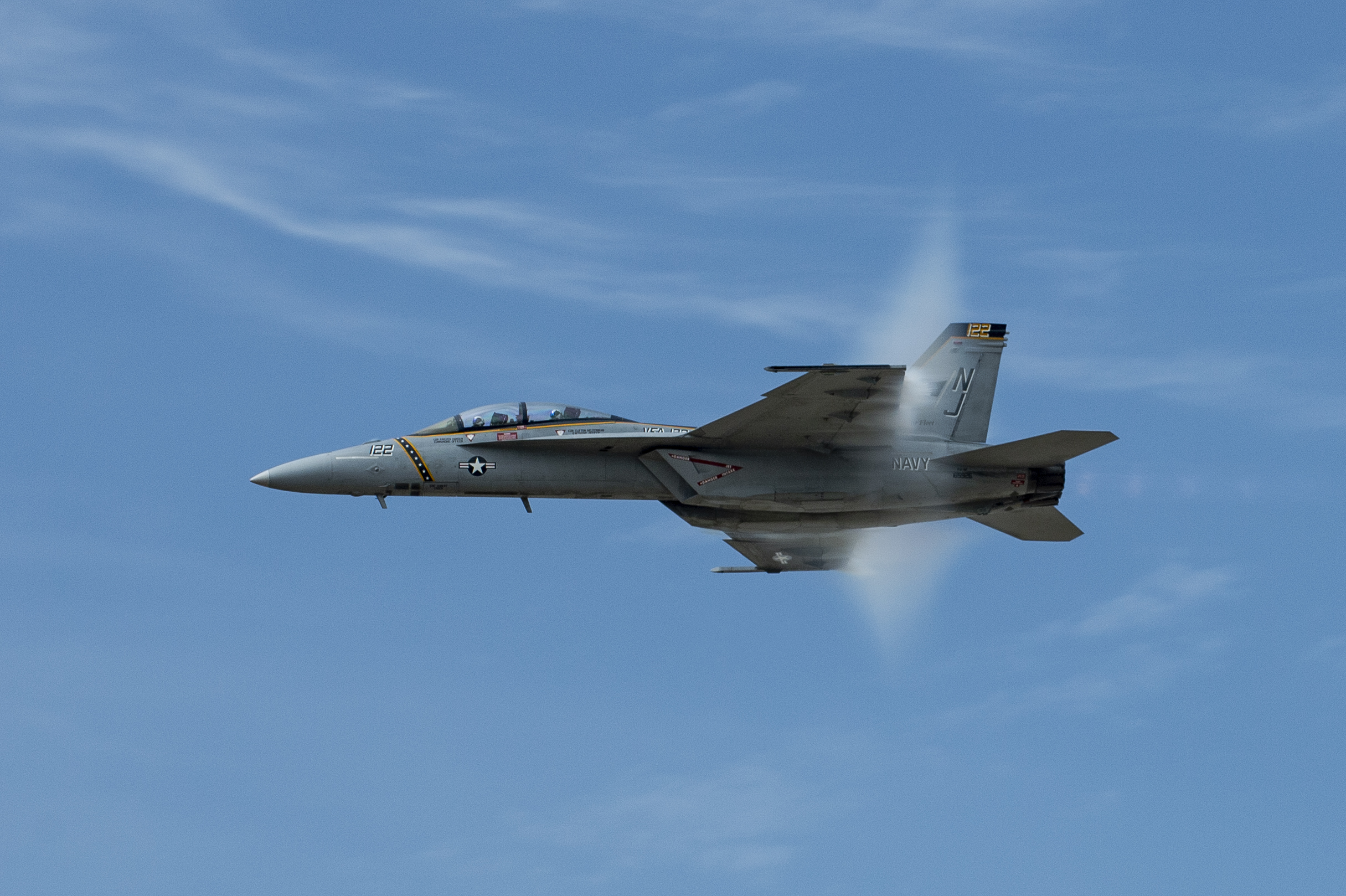
On 10 March 2009, Boeing offered the Super Hornet for Greece's Next-Generation Fighter Program.
On 1 August 2010, The Sunday Times reported that the British government was considering canceling orders for the F-35B and buying the Super Hornet instead for its s, claiming a saving of around £10 billion as a result. An industry source claimed that the Super Hornet could be ski jump launched without catapults. In the end, the UK opted for a STOVL aircraft carrier equipped with F-35Bs.
The United Arab Emirates was reported to have asked for information on the Super Hornet in 2010.
In early 2011, Bulgaria was considering the F/A-18 as a replacement for its MiG-21 fleet. After initially selecting the Saab Gripen, the newly elected governing coalition restarted the program and indicated that the Super Hornet is again under consideration. The decision is expected by July 2018. In December 2018, the Bulgarian Ministry of Defence selected the offer for 8 F-16V from the United States for an estimated 1.8 billion lev ($1.05 billion) as the preferred option, and recommended the government to start talks with the US.
In 2012, Norway received an offer for at least one squadron of F/A-18s, noting its suitability to Northern Norwegian conditions.
In 2014, Boeing worked with Korean Airlines to offer the Advanced Super Hornet to the Republic of Korea Air Force as an alternative to their KF-X fighter program. Although a fighter based on the Super Hornet would save money, downgrading the program would not give South Korean industry as much knowledge as it would from developing a new fighter.
Variants
;F/A-18E :Single seat variant ;F/A-18F :Two-seat variant ;NEA-18G :Two F/A-18Fs modified as prototypes of the EA-18G Growler. ;EA-18G Growler :Electronic warfare variant of the F/A-18F to replace the U.S. Navy's Grumman EA-6B Prowler. ;Advanced Super Hornet :Variant of the F/A-18E/F Super Hornet with Conformal Fuel Tanks (CFT) and has a further reduced radar cross section (RCS), with the option of a stealthy enclosed weapons pod and built-in IRST21 sensor system. Not pursued by US Navy, but some elements such as the IRST sensor, although integrated into a fuel tank, became standalone upgrades while others like the enhanced cockpit were incorporated into the Block III. However, the Conformal Fuel Tanks and reduced RCS are still stated to be of interest to the RAAF.
Operators
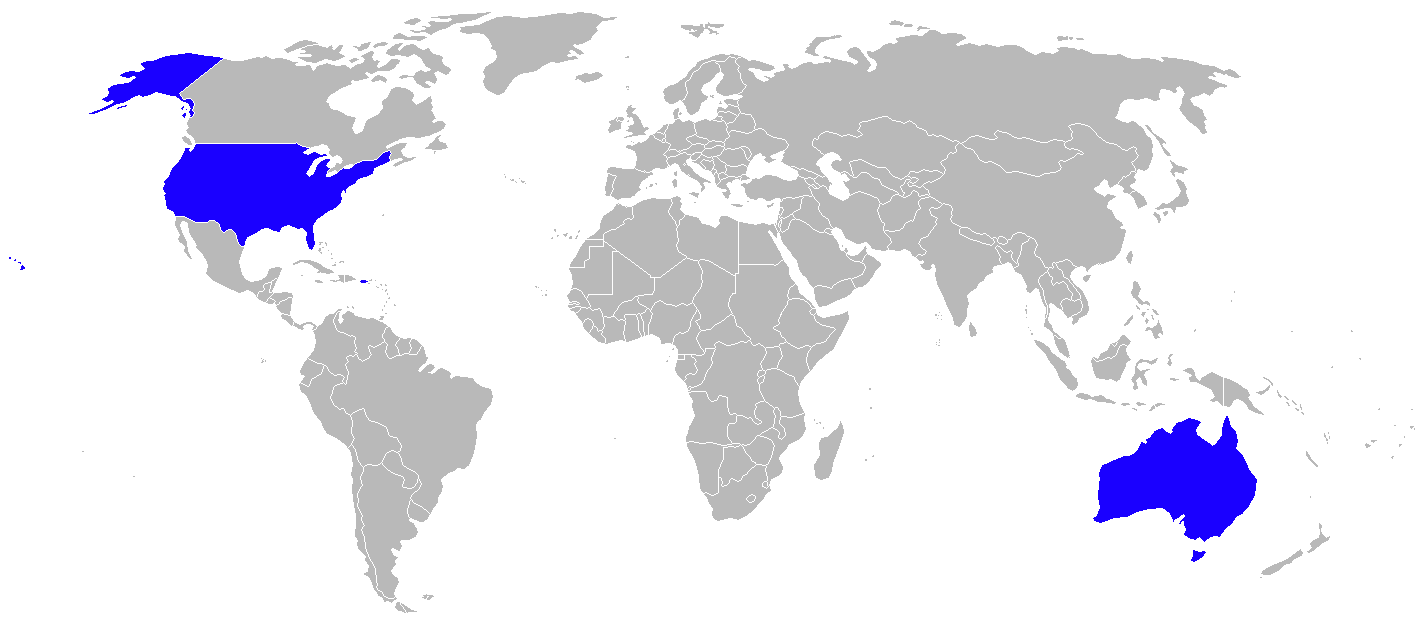


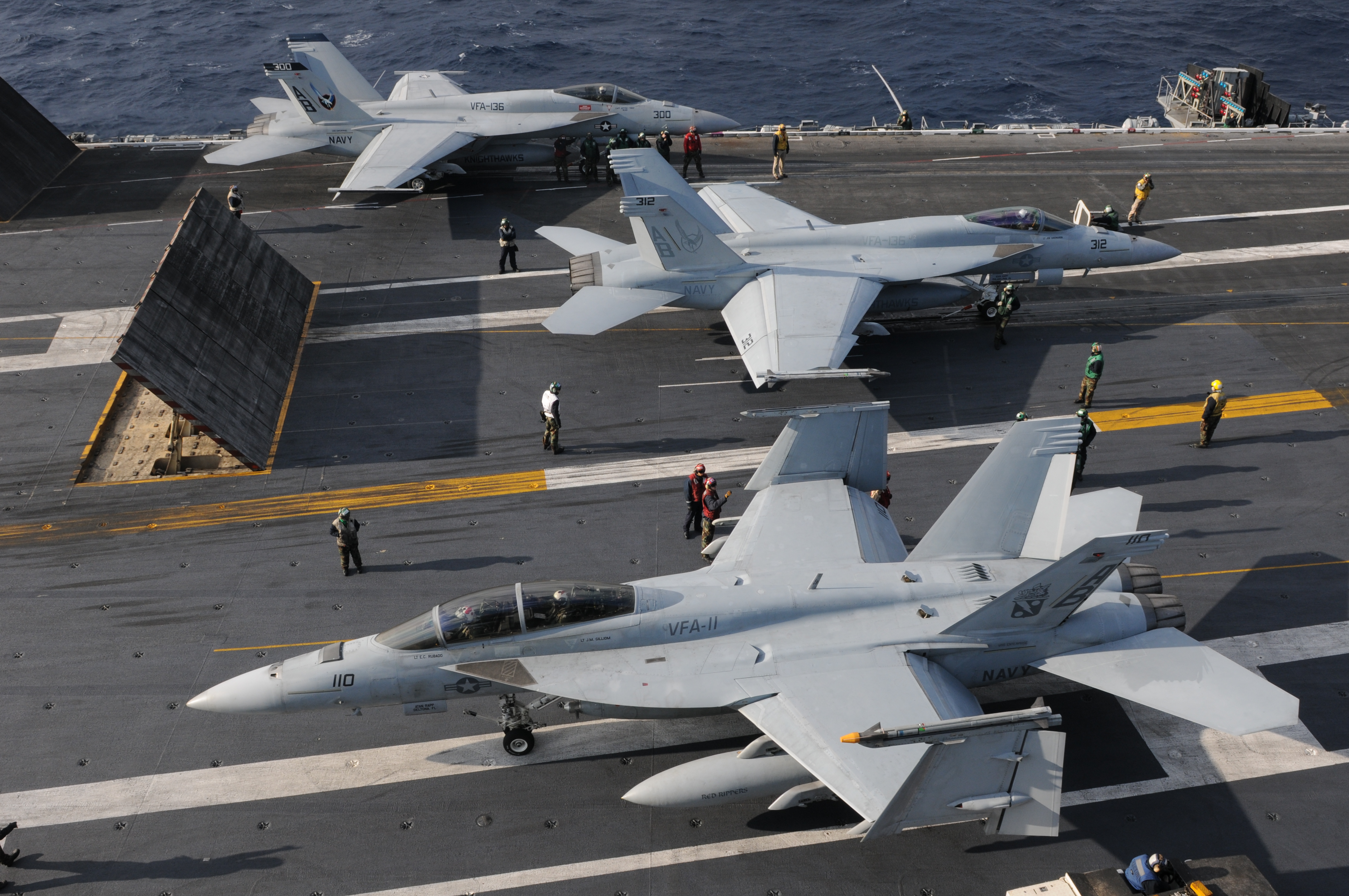
;AUS Australia
- Royal Australian Air Force – 24 F/A-18Fs in service
- RAAF Base Amberley, Queensland
- No. 1 Squadron (F/A-18F)
- No. 82 Wing Training Flight (F/A-18F)
- RAAF Base Amberley, Queensland
;Kuwait Kuwait
- Kuwait Air Force – 22 single-seat F/A-18Es and 6 twin-seat F/A-18Fs
;USA United States
- United States Navy – 416 F/A-18E/Fs in service plus 93 on order as of 2025
- Pacific Fleet squadrons
- VFA-2 "Bounty Hunters" (F/A-18F)
- VFA-14 "Tophatters" (F/A-18E)
- VFA-22 "Fighting Redcocks" (F/A-18F)
- VFA-25 "Fist of the Fleet" (F/A-18E)
- VFA-27 "Royal Maces" (F/A-18E)
- VFA-41 "Black Aces" (F/A-18F)
- VFA-94 "Mighty Shrikes" (F/A-18E)
- VFA-102 "Diamondbacks" (F/A-18F)
- VFA-113 "Stingers" (F/A-18E)
- VFA-122 "Flying Eagles" (Fleet Replacement Squadron, operates F/A-18E/F)
- VFA-136 "Knighthawks" (F/A-18E)
- VFA-137 "Kestrels" (F/A-18E)
- VFA-146 "Blue Diamonds" (F/A-18E)
- VFA-151 "Vigilantes" (F/A-18E)
- VFA-154 "Black Knights" (F/A-18F)
- VFA-192 "Golden Dragons" (F/A-18E)
- VFA-195 "Dambusters" (F/A-18E)
- Atlantic Fleet squadrons
- VFA-11 "Red Rippers" (F/A-18F)
- VFA-31 "Tomcatters" (F/A-18E)
- VFA-32 "Swordsmen" (F/A-18F)
- VFA-34 "Blue Blasters" (F/A-18E)
- VFA-37 "Ragin Bulls" (F/A-18E)
- VFA-81 "Sunliners" (F/A-18E)
- VFA-83 "Rampagers" (F/A-18E)
- VFA-87 "Golden Warriors" (F/A-18E)
- VFA-103 "Jolly Rogers" (F/A-18F)
- VFA-105 "Gunslingers" (F/A-18E)
- VFA-106 "Gladiators" (Fleet Replacement Squadron, operates F/A-18E/F)
- VFA-131 "Wildcats" (F/A-18E)
- VFA-143 "Pukin' Dogs" (F/A-18E)
- VFA-211 "Fighting Checkmates" (F/A-18E)
- VFA-213 "Black Lions" (F/A-18F)
- Test and Evaluation squadrons
- VX-9 "Vampires" (Air Test and Evaluation Squadron, operates F/A-18E/F and other aircraft)
- VX-23 "Salty Dogs" (Air Test and Evaluation Squadron, operates F/A-18E/F and other aircraft)
- VX-31 "Dust Devils" (Air Test and Evaluation Squadron, operates F/A-18E/F and other aircraft)
- Warfighting Development Centers
- NAWDC (Naval Aviation Warfighting Development Center, operates F/A-18E/F and other aircraft)
- Flight Demonstration squadrons
- U.S. Navy Flight Demonstration Squadron (Blue Angels) (F/A-18E/F)
- Pacific Fleet squadrons
Each U.S. Navy deployable "Fleet" VFA squadron has a standard unit establishment of 12 aircraft.
Notable accidents
- On 6 April 2011, a U.S. Navy F/A-18F from VFA-122 Tactical Demonstration team crashed, killing both crew members. The crash occurred when the crew attempted to perform a loaded roll with too much speed and insufficient angle-of-attack. The loaded roll has since been removed from the Navy's F/A-18F flight demonstration routine.
- On 31 July 2019, a U.S. Navy F/A-18E from VFA-151 crashed into the side of "Star Wars Canyon" in California, killing the pilot and injuring seven French civilian sightseers at the Father Crowley Vista Point 40 ft above the impact point. The crash was attributed to flying "too fast and too low with respect to the surrounding terrain". Military training within the canyon was suspended, with standing instructions to stay above the rim of the canyon.
- On 3 June 2022, a U.S. Navy F/A-18E from VFA-113 crashed near NWS China Lake, killing the pilot.
- On 22 December 2024, a U.S. Navy F/A-18F took off from the aircraft carrier operating in the Red Sea and was hit by friendly SM-2 surface-to-air missile fired from operating in the same area. The two pilots onboard ejected with minor injuries and were rescued.
- On 28 April 2025, a F/A-18E Super Hornet fell off an elevator of the USS Harry Truman after the carrier turned sharply to evade Houthi fire. The driver of the tractor and the pilot both escaped without major injuries. The carrier was operating in the Red Sea during the incident.
- On 6 May 2025, a U.S. Navy F/A-18F fell overboard on the USS Harry Truman after a failure with the carrier's arresting gear. The pilot and weapons systems officer ejected safely and were recovered.
- On 20 August 2025, a U.S. Navy F/A-18E Super Hornet crashed into ocean waters off the coast of Virginia. The pilot of the aircraft belonging to Strike Fighter Squadron 83 ejected from the Super Hornet during a routine training flight, according to a statement from Navy spokesperson Lt. Jackie Parashar. Strike Fighter Squadron 83 is based out of Naval Air Station Oceana in Virginia Beach. As of 21 August 2025, the crashed jet was yet to be recovered from the water and the cause of the crash was under investigation.
- On 26 October 2025 an F/A-18F was lost serving in the South China Sea aboard .
Specifications (F/A-18E/F)
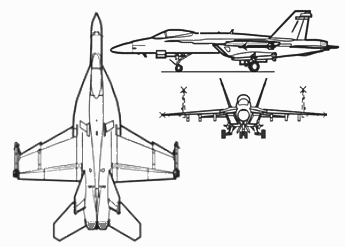

| prime units? = kts | max takeoff weight lb = 66,000 | max takeoff weight kg = 29,937
- External fuel capacity: Up to 4 × 480 usgal tanks, totaling 13040 lb, option for 2 x 515 usgal conformal fuel tanks totaling an additional 7000 lb on Block III
| eng1 lbf-ab = 22,000
| eng1 kn-ab = 97.9
-
Mach 1.06, 700 knots at sea level
-
Mach 1.62, 932 knots at 36,000 ft, air-to-air loadout (2× AIM-120, 2× AIM-9, internal fuel only)
-
404 nmi fighter escort with 2× AIM-120, 2× AIM-9, internal fuel only
-
201 nmi deck launched intercept with 2× AIM-120, 2× AIM-9, 1× drop tank
-
388 nmi interdiction mission with 4× Mark 83 bombs, 2× AIM-9, 2× drop tanks | wing loading lb/sqft = 94.0 | wing loading kg/m2 = 459 | thrust/weight = 0.931.1 with loaded weight & 50% internal fuel
-
Air-to-air missiles
- Fighter escort: 7× AIM-120 AMRAAM and 2× AIM-9 Sidewinder or
- 5x AIM-120 and 4× AIM-9 or
- 4× AIM-174B, 3× AIM-120, and 2× AIM-9 or
- 4× AIM-7 Sparrow and 2× AIM-9
- maximum of 2× AIM-9 and:
- 12× AIM-120 AMRAAM or 8× AIM-7 Sparrow
-
Air-to-surface missiles
- AGM-65E/F Maverick
- AGM-84H/K SLAM-ER
- AGM-88 HARM
- AGM-88G AARGM-ER [being integrated]
- AGM-158 JASSM
- AGM-154 Joint Standoff Weapon (JSOW) - glide bomb
- AGM-84 Harpoon
- AGM-158C LRASM
- Joint Strike Missile (JSM) (to be integrated)
-
JDAM bombs (up to 10× GBU-32/35/38/54 or 4× GBU-31)
-
Paveway series of laser-guided bombs
-
Mk 80 series unguided bombs
-
CBU-78 Gator mine system
-
Mk 20 Rockeye II cluster bomb
-
Mk-62/63/65 Quick Strike Naval mine
-
SUU-42A/A Flares/infrared decoy dispenser pod and chaff pod
-
AN/ALE-50 towed decoy system pod
-
up to 4× 480 usgal drop tanks and 1× A/A42R-1 Aerial Refueling Store pod for aerial refueling.
-
12× ADM-141C TALD decoys
-
AWW-13 Advanced data link pod
-
-
- Northrop Grumman/ITT ALQ-165 self-protection jammer system or L3Harris AN/ALQ-214 integrated defensive electronic countermeasures system
- Raytheon AN/ALE-50 or BAE Systems AN/ALE-55 towed decoy
- Raytheon AN/ALR-67(V)3 radar warning receiver
- Lockheed Martin AN/ASG-34(V)1 IRST21 infrared search and track (mounted on centerline external tank)
- Raytheon AN/ASQ-228 ATFLIR or Northrop Grumman AN/AAQ-28(V) Litening targeting pod
- MIDS LVT or MIDS JTRS datalink transceiver
References
Notes
Citations
Bibliography
- Donald, David. "Boeing F/A-18E/F Super Hornet", Warplanes of the Fleet. London: AIRtime Publishing Inc, 2004. .
- Elward, Brad. Boeing F/A-18 Hornet (WarbirdTech, Vol. 31). North Branch, Minnesota: Specialty Press, 2001. .
- Elward, Brad. The Boeing F/A-18E/F Super Hornet & EA-18G Growler: A Developmental and Operational History. Atglen, Pennsylvania: Schiffer Publishing, Ltd. 2013. .
- Holmes, Tony. US Navy Hornet Units of Operation Iraqi Freedom. London: Osprey Publishing, 2004. .
- Jenkins, Dennis R. F/A-18 Hornet: A Navy Success Story. New York: McGraw-Hill, 2000. .
- Winchester, Jim. The Encyclopedia of Modern Aircraft. San Diego: Thunder Bay Press, 2006. .
References
- Burgess, Rick. (March–April 1999). "Flying Eagles Return to Fly Super Hornets".
- Kaas, Harrison. (24 November 2025). "What Makes America's F/A-18 "Super Hornet" So Super?". The National Interest.
- Eckstein, Megan. (4 February 2019). "Navy's Last F-18 Hornet Squadron Sundowns Ahead of Transition to Super Hornet".
- (23 April 2020). "Navy takes delivery of final Block II Super Hornet, looks ahead to Block III". Naval Air Systems Command, U.S. Navy.
- Baugher, Joe. (20 July 2009). "Northrop YF-17 Cobra".
- Jenkins, Dennis R. ''F/A-18 Hornet: A Navy Success Story''. New York: McGraw-Hill, 2000. {{ISBN. 0-07-134696-1.
- [http://www.boeing.com/defense-space/military/fa18ef/fa18efmilestones.htm "F/A-18E/F Super Hornet."] {{Webarchive. link. (11 April 2007 ''Boeing''. Retrieved: 25 July 2011.)
- Donald 2004, p. 45.
- (1998). "Advanced Tactical Fighter to F-22 Raptor: Origins of the 21st Century Air Dominance Fighter". American Institute of Aeronautics and Astronautics.
- the design would also address some of the limitations of the previous F/A-18 models, such as insufficient bringback capability, or the ability to recover unused weapons aboard aircraft carriers.Elward 2001, p. 73.
- Rogoway, Tyler. (13 May 2014). "TOP GUN Day Special: The Super Tomcat That Was Never Built". jalopnik.com.
- "F-14 Tomcat - Military Aircraft".
- Donald, David. "Northrop Grumman F-14 Tomcat, U.S. Navy today". ''Warplanes of the Fleet''. London: AIRtime Publishing Inc, 2004. {{ISBN. 1-880588-81-1.
- "FUTURE OF NAVAL AVIATION -- HON.RANDY'DUKE'CUNNINGHAM (Extension of Remarks - May 07, 1991)".
- As a cheaper alternative to NATF, Grumman proposed substantial improvements to the F-14 beyond Quick Strike, but Congress rejected them as too costly and reaffirmed its commitment to the less expensive F/A-18E/F. Originally viewed as an interim for A-X or A/F-X, the Super Hornet would become the mainstay of the Carrier Air Wing.Donald 2004, pp. 13, 15.
- (1998). "7th AIAA/USAF/NASA/ISSMO Symposium on Multidisciplinary Analysis and Optimization". American Institute of Aeronautics and Astronautics.
- (2005). "Lessons Learned from the F/A–22 and F/A–18E/F Development Programs". RAND Corporation.
- Frost, Patricia. (22 September 1997). "F/A-18E/F Super Hornet Enters Production at Boeing".
- link. (8 June 2011 ''Defenselink.mil,'' 15 September 2000. Retrieved: 8 July 2011.)
- (4 July 2008). "The F/A-18E/F Super Hornet: Tomorrow's Air Power Today".
- link. (11 January 2014 ''U.S. Navy,'' 13 October 2006. Retrieved: 25 July 2011.)
- Trimble, Stephen. (23 July 2007). "US Navy Super Hornet deal could cut JSF numbers".
- (1 October 2008). "Boeing F/A-18E/F Super Hornet a Finalist in Brazil Fighter Aircraft Competition". Boeing.
- (29 May 2009). "Navy F/A-18E/F and EA-18G Aircraft Procurement and Strike Fighter Shortfall: Background and Issues for Congress".
- (6 April 2009). "DoD News Briefing With Secretary Gates From The Pentagon". United States Department of Defense.
- Tilghman, Andrew. (8 June 2006). "Gates: Fighter gap ignores real-world demand". Navy Times.
- Shalal-Esa, Andrea. (January 2022). "US defense compromise authorizes F/A-18 multiyear deal". Forbes.
- Tilghman, Andrew. (25 June 2009). "Bill would give go-ahead to buy Super Hornets". Navy Times.
- Leiser, Ken. (29 September 2010). "Boeing lands $5.3 billion fighter jet contract with Navy". St. Louis Post-Dispatch.
- Wolfe, Frank. (11 February 2020). "Boeing Super Hornets Receiving Block III Avionics Upgrades".
- Cameron, Doug. "Boeing to End Production of Super Hornet Combat Jet, Co-Star of 'Top Gun: Maverick'".
- Finnerty, Ryan. (20 March 2024). "Boeing extends Super Hornet production to 2027 with final new-build order from USA".
- link. (9 January 2012 ''DoD Buzz'', 16 December 2011.)
- Ozburn, Marguerite. [http://www.boeing.com/news/frontiers/archive/2005/june/i_ids8.html "F/A-18E/F Block II upgrades add to Super Hornet's potent arsenal."] {{Webarchive. link. (12 October 2007 ''Boeing Frontiers'', June 2005. Retrieved: 25 July 2011.)
- link. (14 July 2011 ''Raytheon'', 23 January 2008. Retrieved: 25 July 2011.)
- (8 May 2020). "Block III Super Hornet".
- Fulghum, David. A. [https://aviationweek.com/boeing-plans-sixth-generation-fighteralong-block-3-super-hornet "Boeing Plans Sixth Generation Fighter With Block 3 Super Hornet"] {{Subscription required. ''[[Aviation Week]]'', 30 January 2008. Retrieved: 17 February 2008.
- Eckstein, Megan. (27 September 2021). "Boeing delivers first Block III Super Hornets to the US Navy". Defense News.
- Tournade, Sara. [http://www.boeing.com/Features/2011/06/bds_pas_future_strike_mkt_06_21_11.html "Boeing well positioned for future strike-fighter market."] {{webarchive. link. (26 January 2012 ''Boeing'', 21 June 2011. Retrieved: 18 December 2011.)
- (January 2025)
- (June 2016)
- (June 2016)
- [http://www.flightglobal.com/articles/2011/07/12/359262/testing-the-next-generation-super-hornet.html "Testing the next-generation Super Hornet."] {{Webarchive. link. (15 July 2011 ''Flight International'', 12 July 2011. Retrieved: 25 July 2011.)
- [http://www.spacewar.com/reports/Boeing_Receives_US_Navy_Contract_to_Develop_New_Mission_Computer_for_Super_Hornet_and_Growler_999.html "Boeing Receives US Navy Contract to Develop New Mission Computer for Super Hornet and Growler."] {{Webarchive. link. (18 November 2011 ''Space Media Network'', 15 November 2011.)
- Frost, Patricia. [http://boeing.mediaroom.com/2007-07-02-Boeing-Selects-Supplier-for-Super-Hornet-Block-II-Infrared-Search-and-Track-Capability "Boeing Selects Supplier for Super Hornet Block II Infrared Search and Track Capability."] {{Webarchive. link. (23 September 2013 Boeing, 2 July 2007.)
- Greenert, Admiral Jonathan. (18 September 2013). "Statement Before The House Armed Services Committee On Planning For Sequestration In FY 2014 And Perspectives Of The Military Services On The Strategic Choices And Management Review". US House of Representatives.
- Kelly, Heather. (18 May 2009). "Lockheed Martin Awarded Technology Development Contract for F/A-18E/F Infrared Search and Track Program".
- Hilliard, Melissa. (22 November 2011). "Lockheed Martin Awarded U.S. Navy F/A-18 E/F IRST Sensor System EMD Contract".
- (9 June 2023). "F/A-18's Infrared Search And Track System Plagued By Delays". The War Zone.
- West, Lisa. (7 February 2025). "New infrared sensors cleared for F/A-18 Super Hornet". UK Defense Journal.
- Andrea Shalal-Esa. "Boeing aims to keep building F/A-18 jets through 2020". Fox Business.
- "Boeing: Advanced Super Hornet makes its debut".
- [http://www.flightglobal.com/news/articles/boeing-to-demo-super-hornet-enhancements-in-summer-384367/ Boeing to demo Super Hornet enhancements in summer] {{Webarchive. link. (10 September 2013 Flightglobal.com, 9 April 2013)
- "Boeing Pushing Airframe Envelope". Defense News.
- [http://www.flightglobal.com/news/articles/boeing-shows-off-advanced-super-hornet-demonstrator-389930/ "Boeing shows off advanced Super Hornet demonstrator."] {{Webarchive. link. (3 September 2013 ''Flight International'', 28 August 2013.)
- [http://www.deagel.com/news/Advanced-Super-Hornet-Demonstrates-Significant-Stealth-Range-Improvements_n000011848.aspx "Advanced Super Hornet Demonstrates Significant Stealth, Range Improvements."] {{Webarchive. link. (1 September 2013 ''Deagel'', 28 August 2013.)
- [http://www.flightglobal.com/news/articles/navy-pleased-with-quotadvancedquot-super-hornet-tests-wants-more-397927/ "Navy pleased with "Advanced" Super Hornet tests, wants more Growlers."] {{Webarchive. link. (8 April 2014 ''Flight International'', 7 April 2014.)
- Insinna, Valerie. (8 April 2018). "How stealthy is Boeing's new Super Hornet?". Defense News.
- (July 2024)
- [http://www.flightglobal.com/news/articles/us-navy-may-add-conformal-fuel-tanks-to-fa-18ef-super-hornet-fleet-383701/ US Navy may add conformal fuel tanks to F/A-18E/F Super Hornet fleet] {{Webarchive. link. (10 September 2013 Flightglobal.com, 20 March 2013.)
- (26 August 2021). "The Navy suspends plans to give its Super Hornet a conformal fuel tank".
- (June 2016)
- Trimble, Stephen. [http://www.flightglobal.com/articles/2009/05/12/326376/boeings-super-hornet-seeks-export-sale-to-launch-20-thrust.html "Boeing's Super Hornet seeks export sale to launch 20% thrust upgrade."] {{Webarchive. link. (15 May 2009 ''Flight International'', 12 May 2009.)
- [http://www.flightglobal.com/news/articles/boeing-plots-hybrid-super-hornetgrowler-future-400766/ "Boeing plots hybrid Super Hornet/Growler future."] {{Webarchive. link. (29 June 2014 ''Flight International'', 25 June 2014.)
- (February 2002). "F-14D Tomcat vs. F/18 E/F Super Hornet". Flight Journal Magazine.
- (14 June 2005). "The F-18 Super Hornet is also called the "Rhino" because of a rhino-like protrusion on the front part of the aircraft's radome.". Defense Logistics Agency.
- (14 April 1999). "Boeing Super Hornet Demonstrates Aerial Refueling Capability".
- Donald 2004, p. 76.
- (1 April 2014). "UCLASS Could Be Used as Tanker for Carrier Air Wing". U.S. NAVAL INSTITUTE.
- "DGC International".
- Donald 2004, pp. 49–52.
- [http://www.naval-technology.com/projects/fa18-super-hornet/ "F/A-18E/F Super Hornet – maritime strike attack aircraft."] {{Webarchive. link. (11 August 2011 ''naval-technology.com''. Retrieved: 9 September 2011.)
- Elward 2001, p. 77.
- Peterson, Donald. (June 2002). "Ready On Arrival: Super Hornet Joins The Fleet: An Evolutionary Design Delivers Revolutionary Capabilities". Navy League.
- Elward 2001, pp. 74–75.
- [http://www.boeing.com/defense-space/military/fa18ef/index.htm "F/A-18E/F Super Hornet."] {{Webarchive. link. (16 January 2007 Boeing. Retrieved: 16 August 2010.)
- Niewoehner, Robert "Knockers". (20 February 2023). "Super Hornet Chief Test Pilot". Authentic Media.
- Gaddis, Capt. "BD". [http://www.dtic.mil/ndia/2007psa_apr/gaddis.pdf "F/A-18 & EF-18G Program brief."] {{webarchive. link. (28 May 2008 ''U.S. Navy,'' 24 April 2007.)
- [http://www.navy.mil/navydata/aircraft/fa18/shornet.html "F/A-18-E/F Super Hornet... Leading Naval Aviation into the 21st Century."] {{Webarchive. link. (26 February 2011 ''U.S. Navy,'' 17 August 2009.)
- "USN looking at adding conformal fuel tanks on F/A-18E/F--also a look at Super Hornet RCS reduction measures". The DEW Line.
- Differences include an up-front [[touchscreen]] control display; a large multipurpose color [[liquid-crystal display]]; and a fuel display. The Super Hornet has a quadruplex digital [[fly-by-wire]] system,Winchester 2006, p. 166.
- Fulghum, David A.. (25 February 2007). "Navy Details New Super Hornet Capabilities". Aviation Week and Space Technology.
- [http://www.defenseindustrydaily.com/new-apg79-aesa-radars-for-super-hornets-0411/ "New APG-79 AESA Radars for Super Hornets."] {{Webarchive. link. (7 June 2011 ''Defense Industry Daily'', 26 April 2005. Retrieved: 8 July 2011.)
- "New U.S. Navy Radar Detects Cruise Missiles." ''Aviation Week and Space Technology,'' 30 April 2007.
- Cormier, Nicolette. (8 July 2002). "F/A-18 AESA – New Technology Revolutionizes Radar Benefits".
- Boeing. (8 January 2007). "Boeing F/A-18E/F Block 2 Super Hornets Flying at Naval Air Station Oceana".
- link. (21 December 2007 ''defense-aerospace.com''. Retrieved 16 August 2010.)
- link. (14 July 2011 ''Raytheon'', 4 October 2006.)
- Rosenberg-Macaulay, Barry. [http://defensesystems.com/microsites/2010-jtrs/mids.aspx "MIDS JTRS systems poised to bring IP networking to the aerial tier."] {{Webarchive. link. (15 December 2010 defensesystems.com, 2011. Retrieved: 12 February 2011.)
- (September 2010). "JTRS Update: MIDS Blazes JTRS Trail". Military Information Technology.
- Ben Werner. (4 April 2019). "Navy's Next-Generation Fighter Analysis Due Out this Summer". USNI News.
- D'Urso, Stefan. (19 July 2023). "Boeing Begins Block III Upgrades On U.S. Navy's Super Hornets". The Aviationist.
- Helfrich, Emma. (7 September 2022). "LITENING Targeting Pod Tested On F/A-18 Super Hornet For First Time".
- (1 November 2024). "F/A-18E/F completes initial Litening pod testing". Australian Defence Magazine.
- VFA-115 was also the first unit to take their F/A-18s into combat. On 6 November 2002, two F/A-18Es conducted a "Response Option" strike in support of [[Operation Southern Watch]] on two [[surface-to-air missile]] launchers at [[Al Kut]], [[Iraq]] and an air defense command and control bunker at [[Tallil]] air base. One of the pilots dropped {{convert. 2000. lb. kg
- (9 November 2006). "Strikes Continue: ISAF Air Component Commander Visits Big E.". United States Navy.
- Svan, Jennifer H.. (13 October 2006). "USS Enterprise aircraft deliver lethal sting of bombs to enemy in Afghanistan". Stars and Stripes.
- Moore, Shannon. (22 May 2007). "CVW-7 Sailors Complete an Eight-Month Deployment". United States Navy.
- Cenciotti, David. (20 January 2014). "U.S. F/A-18E Hornet operates from French Aircraft Carrier". The Aviationist.
- [http://www.militarytimes.com/article/20140807/NEWS08/308070083/U-S-fighters-pound-militants-northern-Iraq U.S. fighters pound militants in northern Iraq] {{Webarchive. link. (8 August 2014 - Militarytimes.com, 7 August 2014)
- [http://www.flightglobal.com/news/articles/usn-carries-out-air-strike-on-iraqi-militants-402536/ USN carries out air strike on Iraqi militants] {{Webarchive. link. (9 August 2014 - Flightglobal.com, 8 August 2014)
- {{usurped
- link. (18 June 2017. Military.com, 18 June 2017.)
- link. (1 August 2017 - Military.com, 31 July 2017)
- Garrett Reim. (15 August 2018). "Boeing to convert F/A-18 E/Fs into Blue Angels". flightglobal.com.
- LaGrone, Sam. (26 December 2023). "U.S Destroyer, Super Hornets Splash Red Sea Attack Drones and Missiles". USNI News.
- [https://news.usni.org/2024/01/11/us-strikes-houthi-targets-in-yemen-from-air-surface-and-subsurface U.S. Hits Houthi Targets in Yemen with Strike Fighters, Warships and Submarines]. ''[[USNI News]]''. 11 January 2024.
- [https://news.usni.org/2024/01/12/ikes-carrier-air-wing-3-uss-gravely-uss-philippine-sea-and-uss-mason-struck-houthi-targets Ike’s Carrier Air Wing 3, USS Gravely, USS Philippine Sea and USS Mason Struck Houthi Targets]. ''[[USNI News]]''. 12 January 2024.
- [https://www.airandspaceforces.com/us-uk-strike-houthis-yemen/ US, UK Strike Houthis in Yemen Following Ship Attacks]. ''Air & Space Forces Magazine''. 11 January 2024.
- (22 December 2024). "Two US Navy pilots eject safely over Red Sea after fighter jet shot down in apparent friendly fire incident". CNN.
- (29 April 2025). "US Navy loses $60 million jet at sea after it fell overboard from aircraft carrier". CNN.
- (6 May 2025). "Second fighter jet crashes into the sea after landing failure on USS Harry S. Truman". NBC News.
- [https://archive.today/20120802173822/http://www.defence.gov.au/media/DepartmentalTpl.cfm?CurrentId=6619 "Super Hornet Acquisition Contract Signed."] ''defence.gov.au,'' 5 March 2007. Retrieved: 16 August 2010.
- Baker, Richard. [http://www.theage.com.au/news/in-depth/the-hornets-nest/2007/07/08/1183833340924.html "The Hornet's nest."] {{Webarchive. link. (12 July 2007 ''The Age'', 9 July 2007.)
- (6 March 2007). "Australia to Acquire 24 F/A-18F Super Hornets".
- [http://www.defence.gov.au/media/download/2010/Feb/20100226b/index.htm "Acceptance for Super Hornets A44-202 and A44-204."]{{Webarchive. link. (2 August 2012 ''Defence.gov.au'', 26 February 2010. Retrieved: 16 June 2011.)
- [http://www.abc.net.au/7.30/content/2007/s1873007.htm "The 7.30 Report: Nelson stands by fighter jet decision."] {{Webarchive. link. (12 October 2007 ''Australian Broadcasting Corporation (ABC)'', 15 March 2007.)
- link. (12 October 2007 ''The Sydney Morning Herald'', 15 March 2007. Retrieved: 9 May 2007.)
- Allard, Tom. [https://www.smh.com.au/news/national/axe-to-fall-on-fighter-jets/2007/12/30/1198949675365.html "Axe set to fall on Nelson's fighters."] {{Webarchive. link. (2 January 2008 ''The Sydney Morning Herald'', 31 December 2007.)
- [http://news.theage.com.au/national/govt-to-keep-super-hornets-20080317-1zwr.html "Govt to keep Super Hornets."] {{Webarchive. link. (6 July 2011 ''The Age'', 17 March 2008.)
- [http://www.theage.com.au/news/national/government-clears-super-hornets-deal/2008/03/17/1205602284435.html "Government clears Super Hornets deal."] {{Webarchive. link. (3 May 2014 ''The Age'', 17 March 2008.)
- Dunlop, Tim. [http://blogs.news.com.au/news/blogocracy/index.php/news/comments/super_hornets_are_go/ "Super Hornets are go."] {{webarchive. link. (1 December 2008 ''news.com.au,'' 18 March 2008.)
- (6 February 2007). "Australia – F/A-18E/F Super Hornet Aircraft".
- link. (23 March 2012 ''Department of Defence'', 27 February 2009. Retrieved: 9 September 2011.)
- link. (25 July 2011 Boeing, 21 July 2009.)
- [http://www.abc.net.au/news/2010-03-26/super-hornets-arrive-in-south-east-queensland/381726 "Super Hornets arrive in south-east Queensland."] {{Webarchive. link. (13 November 2012 ''ABC News'', 26 March 2010. Retrieved: 15 July 2011.)
- Hurst, Daniel. [http://www.brisbanetimes.com.au/technology/pilots-buzzing-as-super-hornets-arrive-20100706-zyhk.html "Pilots buzzing as Super Hornets arrive."] {{Webarchive. link. (9 July 2010 ''The Brisbane Times'', 6 July 2010.)
- Waldron, Greg. [http://www.flightglobal.com/articles/2010/12/09/350707/picture-australias-first-fa-18f-squadron-declared-operational.html "Australia’s first F/A-18F squadron declared operational."] {{Webarchive. link. (12 December 2010 ''Flight International'', 9 December 2010.)
- Dodd, Mark. (15 August 2008). "RAAF likes the sound of the Growler". The Australian.
- [http://www.minister.defence.gov.au/2012/12/13/minister-for-defence-and-minister-for-defence-materiel-joint-media-release-australias-future-air-combat-capability/ "Joint Media Release: Australia’s future Air Combat Capability."] {{webarchive. link. (12 March 2013 ''Minister for Defence and Minister for Defence Materiel'' (Australian Government Department of Defence), 13 December 2012.)
- Taylor, Charles and Paul Ebner. [http://www.dsca.mil/sites/default/files/mas/australia_13-05_0.pdf "F/A-18E/F Super Hornet and EA-18G Growler Aircraft".] {{Webarchive. link. (14 July 2015 ''Defense Security Cooperation Agency'', 28 February 2013.)
- [http://washingtonexaminer.com/australia-plans-to-buy-12-ea-18g-growler-aircraft/article/feed/2095246 "Australia plans to buy 12 EA-18G Growlers."] {{webarchive. link. (21 October 2013 ''Washingtonexaminer.com'', 3 May 2013.)
- "Boeing: Boeing Australia — RAAF EA-18G Growler Rollout". Boeing.
- "Boeing Unveils First Royal Australian Air Force Growler". Boeing.
- (24 September 2022). "Australian fighter jets and air force personnel arrive in Middle East". The Guardian.
- (5 October 2014). "Australian Super Hornet fighter jets complete first armed mission over Iraq". ABC News (Australia).
- "RAAF conducts first Iraq combat mission". ABC News (Australia).
- [http://www.militarytimes.com/article/20141008/NEWS08/310080066/Australia-launches-first-airstrike-Iraq Australia launches first airstrike in Iraq] {{Webarchive. link. (9 October 2014 - Militarytimes.com, 8 October 2014)
- (28 November 2016). "6 Squadron Completes Final Super Hornet Flight". australianaviation.com.au.
- (8 December 2020). "Pilots forced to EJECT as military jet emergency unfolds at RAAF base Amberley". 7news.com.au.
- (9 December 2020). "Defence grounds Super Hornet, Growler warplanes after aborted take-off at Amberley RAAF base". abc.net.au.
- Greene, Andy. (7 June 2022). "Investigators find pilot error responsible for aborted Super Hornet takeoff outside Brisbane". ABC News (Australia).
- (7 May 2015). "Kuwait to order Boeing F/A-18 fighters worth $3 bn". AFP via Business Insider.
- [http://www.defensenews.com/story/defense/air-space/air-force/2015/06/04/kuwait-eurofighter-italy-talks-alenia-aermacchi-rafale-egypt-qatar/28494435/ Kuwait, Italy Discuss Eurofighter Buy]. Defense News,
- (11 September 2015). "Kuwait Opts For Eurofighter Typhoon".
- [http://www.defensenews.com/articles/kuwait-qatar-fighter-jet-deals-move-forward-likely-putting-boeing-fighter-jet-production-into-the-2020s "Kuwait, Qatar Deals Move Forward, Likely Putting Boeing Fighter Jet Production Into the 2020s"]. Defense News, 17 November 2016.
- "The Government of Kuwait – F/A-18E/F Super Hornet Aircraft with Support | the Official Home of the Defense Security Cooperation Agency".
- (28 June 2019). "Boeing Awarded $1.5B Contract for 28 Kuwait Super Hornets". USNI News.
- (15 January 2021). "Covid-19 impacts Super Hornet timeline for Kuwait". Janes.
- "Demise of Super Hornet May Not Be Greatly Exaggerated After All". Defense-aerospace.com.
- link. (6 December 2008. ''Utusan Malaysia'', 16 April 2007. Retrieved: 5 September 2008.)
- John Gilbert. "Three fighter jet makers to submit leasing bids". themalaysianreserve.com.
- [https://archive.today/20140313095030/http://www.demorgen.be/dm/nl/989/Binnenland/article/detail/1810530/2014/03/12/Wordt-dit-de-vervanger-van-de-Belgische-F-16-s.dhtml "Wordt dit de vervanger van de Belgische F-16's?"] ''[[De Morgen]]'', 12 March 2014. Retrieved: 13 March 2014.
- (20 April 2017). "Boeing pulls out of 'unfair' Belgian fighter replacement bid".
- (19 April 2017). "Boeing pulls out of Belgian fighter competition".
- (25 October 2018). "Belgium picks Lockheed's F-35 over Eurofighter on price".
- (25 October 2018). "F-35 officially wins Belgian fighter contest".
- Trimble, Stephen. [http://www.flightglobal.com/articles/2008/10/06/316814/brazil-names-three-finalists-for-f-x2-contract-rejects-three.html "Brazil names three finalists for F-X2 contract, rejects three others"] {{Webarchive. link. (1 February 2009. ''Flight International'', 6 October 2008.)
- Mallén, Patricia Rey. (16 December 2013). "Brazil Says No To $4B Fighter Jet Deal With France's Dassault; Not A Victory Yet For Boeing, Saab".
- Osborne, Anthony. (18 December 2013). "Brazil Selects Gripen For F-X2 Requirement". Aviation Week.
- Rogoway, Tyler. (12 June 2014). "The Right Fighter For Canada Is The Super Hornet, Not The F-35". jalopnik.com.
- (5 November 2010). "Aviation companies decry F-35 purchase".
- Campion-Smith, Bruce. [https://www.thestar.com/news/canada/politics/article/1155603--ottawa-to-overhaul-purchase-of-f-35-fighter-jets-in-wake-of-auditor-general-s-report?bn=1 "Ottawa to overhaul purchase of F-35 fighter jets in wake of Auditor General’s report"]. ''Toronto Star'', 2 April 2012.
- [http://www.hilltimes.com/news/politics/2013/09/05/competition-heats-up-as-ottawa-reviews-options-to-costly-fighter-jets/35816 "Competition heats up as Ottawa reviews options to procure costly F-35 fighter jets"] {{Webarchive. link. (9 September 2013. Hilltimes.com, 5 September 2013)
- Berthiaume, Lee; Ivison, John. [https://nationalpost.com/news/politics/liberals-planning-to-buy-super-hornet-fighter-jets-before-making-final-decision-on-f-35s-sources-say "Liberals planning to buy Super Hornet fighter jets before making final decision on F-35s, sources say"] . ''National Post'', 5 June 2016.
- (22 November 2016). "Liberals to buy 18 Boeing Super Hornet fighter jets to fill 'capability gap'". [[Canadian Broadcasting Corporation]].
- "U.S. State Dept. approves Canadian purchase of Super Hornet fighter jets - CBC News".
- (27 September 2017). "Fallon warns Boeing over defence contracts". BBC News.
- (26 September 2017). "Bombardier hit with 219% duty on sale of jets to Delta Air Lines". The Toronto Star.
- (26 January 2018). "100- to 150-Seat Large Civil Aircraft from Canada Do Not Injure U.S. Industry, Says USITC". United States International Trade Commission.
- (8 December 2017). "Boeing says dispute with Bombardier still on despite Liberal plan to buy used jets". Financial Post.
- "News Releases/Statements".
- "Boeing acknowledges Super Hornet sale to Canada effectively dead".
- (25 November 2021). "Canada tells Boeing its bid for C$19 bln fighter jet contract falls short".
- (December 2021). "Government of Canada announces key milestone in process to replace Canada's fighter jets".
- link. (7 March 2012)
- link. (22 February 2014 Boeing, 27 August 2008.)
- "Denmark Prioritizes Jobs in New Fighter Competition". Defense News.
- defense-aerospace.com [http://www.defense-aerospace.com/articles-view/release/3/153219/denmark-launches-fighter-competition.html Denmark Starts Fighter Evaluation Process to Replace F-16] {{Webarchive. link. (19 April 2014 12 April 2014)
- (5 December 2015). "Denmark Further Postpones Fighter Selection Until 2016". Defense News.
- (12 May 2016). "Danish Government Recommends Buying 27 F-35s".
- (16 May 2016). "Status on Danish fighter competition: Government recommends 27 F-35A – no decision yet".
- "A cautionary tale for Canada? Boeing preps legal challenge after Denmark rejects Super Hornet for F-35". nationalpost.com.
- (23 March 2018). "Boeing loses case against Denmark over fighter jet deal".
- (11 June 2015). "Working group proposes multi-role fighters to replace F/A-18 aircraft".
- (2 May 2016). "Yhdysvallat tarjoaa kahta konetyyppiä Hornetin seuraajaksi".
- (22 November 2016). "The Finnish Defence Forces' Logistics Command received responses concerning the replacement of the Hornet aircraft". Ministry of Defence.
- "U.S., Boeing send 3 Super Hornets to Finland for aircraft upgrade".
- (28 February 2020). "HX Challenge completed successfully". The Finnish Air Force (ilmavoimat.fi).
- "IL:n tiedot: Puolustusvoimat esittää yhdysvaltalaista F-35:ttä Suomen uudeksi hävittäjäksi".
- (6 December 2021). "Finland Chooses F-35 as Its Next Fighter: Report".
- (6 December 2021). "F-35 Selected by the Finnish Defense Forces to Replace F/A-18 Hornets According to Local Media".
- Jennings, Gareth. (11 February 2022). "Finland signs for F-35s". Janes.
- Perry, Dominic. [https://www.flightglobal.com/fixed-wing/germany-picks-super-hornet-and-more-eurofighters-for-tornado-replacement/138003.article "Germany picks Super Hornet and more Eurofighters for Tornado replacement"]. Flight Global, 21 April 2020.
- "Germany won't be buying US planes to replace aging Tornados before 2022, official says".
- (3 April 2019). "Here's Where Boeing Aims To Take The Super Hornet In The Decades To Come".
- (14 March 2022). "Germany to buy 35 Lockheed F-35 fighter jets from U.S. amid Ukraine crisis". Reuters.
- Huguelet, Austin. (14 March 2022). "Germany to buy F-35s, upgrade Eurofighters in blow to Boeing". St. Louis Post-Dispatch.
- (24 April 2008). "Boeing Delivers Proposal to Equip Indian Air Force with Super Hornet Fighters".
- (4 August 2008). "Boeing Submits Combat Aircraft Industrial-Participation Proposal to Indian Government".
- [https://timesofindia.indiatimes.com/city/bangalore/F-18-comes-in-first-trials-begin/articleshow/4904071.cms "F-18 comes in first, trials begin"] . ''Times of India'', 18 August 2009. Retrieved: 16 August 2010.
- link. (28 December 2016. ''The New York Times'', 28 April 2011. Retrieved: 11 May 2011.)
- Bedi, Rahul. (14 October 2016). "India renews search for MiG replacement". IHS Janes.
- "MMRCA 2.0 Contenders".
- (28 April 2025). "India, France sign Rs 63,000 crore mega deal to buy 26 Rafale Marine aircraft". The Times of India.
- Menon, Adithya Krishna. (28 April 2025). "India Orders 26 Rafale Marine carrier-based aircraft for $7.5 billion".
- jacek. "Poland launches program Harpia to procure new multirole combat aircraft".
- jacek. (22 December 2017). "Five companies interested in Polands next generation fighter program Harpia".
- Siminski, Jacek. (5 June 2019). "Poland sends request to buy F-35". Defence News.
- [http://www.flightglobal.com/news/articles/boeing-withdraws-super-hornet-from-swiss-contract-race-223401/ "Boeing withdraws Super Hornet from Swiss contract race"] {{Webarchive. link. (1 February 2014. Flightglobal.com, 30 April 2008. Retrieved: 16 August 2013.)
- (18 May 2014). "Swiss voters narrowly block deal to buy Saab fighter jets: projection".
- (27 March 2018). "Switzerland names contenders in $8 billion 'Air 2030' program".
- (8 November 2017). "No more than CHF8 billion for new fighter jets".
- (24 October 2018). "Update: Switzerland's Air 2030 plan narrows down options".
- (11 April 2019). "The F-35 and other warplanes descend on Switzerland this spring".
- "Air2030: Bundesrat beschliesst Beschaffung von 36 Kampfflugzeugen des Typs F-35A".
- Insinna, Valerie. (30 June 2021). "Lockheed's F-35 topples competition in Swiss fighter contest". defensenews.com.
- (8 January 2020). "Ce qui a changé entre l'échec du Gripen et aujourd'hui".
- (30 June 2021). "Swiss government sets sights on F-35A fighter jet fleet".
- (16 August 2022). "Les opposants à l'achat des avions de combat F-35 ont déposé leur initiative".
- Fernsby, Christian. (26 November 2021). "Air2030: Contracts in place in Switzerland for F-35A and Patriot".
- (16 February 2022). "Viola Amherd continue de porter la croix des F-35". Le Temps.
- (9 September 2022). "Fighter jet purchase "worrying" but legal, says Swiss audit body".
- (23 March 2022). "Kampfjet-Kauf - Staatsrechtler: Bundesrat muss F-35-Initiative nicht abwarten".
- (15 September 2022). "Der Nationalrat gibt grünes Licht für die Beschaffung des F-35".
- "Air2030: Beschaffungsvertrag für die Kampfflugzeuge F-35A unterzeichnet". Federal Department of Defence, Civil Protection and Sport.
- (19 September 2022). "Schweiz unterzeichnet Kaufvertrag für F-35". Tagesanzeiger.
- "El Eurofighter, principal candidato para sustituir a los F-18 españoles".
- (23 June 2022). "ILA 2022: Spain signs for Halcon Eurofighters".
- Cavas, Christopher P. [http://www.marinecorpstimes.com/news/2007/06/marine_superhornet_070617/ "Navy: Super Hornet rep for problems untrue"]. {{webarchive. link. (9 February 2009 marinecorpstimes.com, 17 June 2010. Retrieved: 16 August 2010.)
- Butler, Amy. [http://aviationweek.com/awin/marines-commit-f-35c-buy "Marines Sign on for F-35C"] {{Webarchive. link. (18 April 2018. ''Aviation Week'', 15 March 2011. Retrieved: 18 April 2018.)
- (10 March 2009). "Boeing to Offer Super Hornet for Greece's Next-Generation Fighter Program".
- Clark, Colin, [http://www.dodbuzz.com/2010/08/31/uk-may-borrow-f-18s-for-carriers-f-35bs-may-be-scrapped/ "UK May Borrow F-18s For Carriers: F-35Bs May Be Scrapped"] {{Webarchive. link. (5 September 2010. dodbuzz.com, 31 August 2010. Retrieved: 1 September 2010.)
- Tran, Philip. [https://archive.today/20120723212412/http://www.defensenews.com/story.php?i=4775556&c=FEA&s=CVS "UAE May Ditch Rafale: Hornet a Surprise Competitor for $10B Deal"]. defensenews.com, 13 September 2010. Retrieved: 11 May 2011.
- (September 2025)
- (15 November 2017). "Super Hornet could be chosen as Bulgaria's next fighter jet by July".
- (21 December 2018). "UPDATE 1-Bulgaria ready to choose F-16 fighter jets for its airforce".
- (21 March 2012). "Dette flyet vil ikke Norge ha".
- [http://aviationweek.com/defense/boeing-still-interested-south-korea-s-kf-x Boeing Still Interested In South Korea’s KF-X] {{Webarchive. link. (7 February 2015 - Aviationweek.com, 11 December 2014)
- Parsch, Andreas. (2006). "DOD 4120.15-L — Addendum". Designation-Systems.
- Kass, Harrison. (4 December 2023). "Boeing's F/A-18 Block III Super Hornet Is a Special Fighter Plane". The Runway Air Force.
- Hoyle, Craig. (2024). "World Air Forces 2025". Flight Global.
- "Boeing awarded contract to deliver 28 Super Hornets to Kuwait". FlightGlobal.
- (6 September 2021). "Boeing completes Super Hornet deliveries for Kuwait".
- Buliavac, Joseph M.. (2 December 2007). "The aircrew of an F/A-18F Super Hornet, assigned to the "Fighting Redcocks" of Strike Fighter Squadron (VFA) 22, wait to launch from Catapult 3 during night flight operations". United States Navy.
- [http://www.lemoore.navy.mil/vfa-122/ "CSFWP Link."] {{webarchive. link. (13 January 2009 ''lemoore.navy.mil''. Retrieved: 16 August 2010.)
- (10 April 2018). "VFA 34 'Blueblasters' return to NAS Oceana after historic deployment". [[WTKR]].
- Eiman, Mike. (1 February 2012). "NASL crash caused by practice mistakes". Hanford Sentinel.
- Ziezulewicz, Geoff. (23 May 2020). "Inside a fatal Super Hornet crash in Star Wars canyon". [[Navy Times]].
- (31 July 2020). "Military Plane Crash in Death Valley: One Year Later". [[National Park Service.
- (23 May 2022). "R-2508 User's Handbook, 22 May 2022".
- LaGrone, Sam. (4 June 2022). "Pilot Killed in Super Hornet Crash Near China Lake".
- LaGrone, Sam. (21 December 2024). "U.S. Super Hornet Shot Down Over Red Sea in Friendly Fire Incident; Aviators Safe". USNI News.
- (22 December 2024). "U.S. ship shoots down jet in friendly fire over Red Sea, military says". The Washington Post.
- (28 April 2025). "US Navy loses $60 million jet at sea after it fell overboard from aircraft carrier".
- (29 April 2025). "Navy fighter jet falls into sea after U.S. carrier evades Houthi fire". The Washington post.
- (28 April 2025). "Harry S. Truman Carrier Strike Group F/A-18 Super Hornet Lost at Sea".
- (7 May 2025). "Second US fighter jet falls overboard from Truman aircraft carrier".
- (21 August 2025). "Pilot rescued after U.S. fighter jet crashes off coast of Virginia".
- LaGrone, Sam. (26 October 2025). "Super Hornet, Helicopter Assigned to USS Nimitz Crash in South China Sea in Separate Incidents, Crew Safe".
- "NATOPS FLIGHT MANUAL, NAVY MODEL F/A-18E/F, 165533 AND UP AIRCRAFT". Naval Air Systems Command.
- "NATOPS FLIGHT MANUAL PERFORMANCE DATA, NAVY MODEL F/A-18E/F, 165533 AND UP AIRCRAFT". Naval Air Systems Command.
- (March 2001). "STANDARD AIRCRAFT CHARACTERISTICS F/A-18E SUPER HORNET". Naval Air Systems Command.
- "Selected Acquisition Report (SAR): F/A-18E/F Super Hornet Aircraft (F/A-18E/F) as of December 31, 2012". Defense Acquisition Management Information Retrieval.
- "F/A-18 Super Hornet".
- [http://www.fighterworld.com.au/az-of-fighter-aircraft/series-3/super-hornet "F/A-18F Super Hornet"] {{Webarchive. link. (12 April 2013 ''Fighterworld''. Retrieved: 20 February 2013)
- [https://web.archive.org/web/20250108140910/https://www.navy.mil/Portals/1/CNO/NAVPLAN2024/Files/Delivering-Warfighting-Advantage.pdf • "Murder Hornet" configuration (4× AIM-9X and 5× AIM-120) in combat.]
- (5 July 2024). "U.S. Navy Confirms SM-6 Air Launched Configuration Is 'Operationally Deployed'".
- (11 September 2024). "F/A-18 Super Hornet Appears With Unprecedented Heavy Air-To-Air Missile Load".
- (27 January 2014). "Flying the F/A-18F Super Hornet". Australian Aviation.
- (8 May 2023). "Northrop Grumman's Advanced Anti-Radiation Guided Missile Extended Range Completes Fifth Consecutive Successful Test". Northrop Grumman.
This article was imported from Wikipedia and is available under the Creative Commons Attribution-ShareAlike 4.0 License. Content has been adapted to SurfDoc format. Original contributors can be found on the article history page.
Ask Mako anything about Boeing F/A-18E/F Super Hornet — get instant answers, deeper analysis, and related topics.
Research with MakoFree with your Surf account
Create a free account to save articles, ask Mako questions, and organize your research.
Sign up freeThis content may have been generated or modified by AI. CloudSurf Software LLC is not responsible for the accuracy, completeness, or reliability of AI-generated content. Always verify important information from primary sources.
Report