From Surf Wiki (app.surf) — the open knowledge base
Boeing 787 Dreamliner
Twin-aisle airliner family
.jpg)
Twin-aisle airliner family
| Field | Value |
|---|---|
| name | Boeing 787 Dreamliner |
| logo | Dreamliner logo.svgclass=skin-invert |
| image | Boeing 787 N1015B ANA Airlines (27611880663) (cropped).jpg |
| caption | A Boeing 787-9 Dreamliner, the midsize and most common variant, of All Nippon Airways, the first and largest 787 operator |
| type | Wide-body jet airliner |
| other_names | Dreamliner |
| national_origin | United States |
| manufacturer | Boeing Commercial Airplanes |
| in_service | October 26, 2011 – present |
| first_flight | |
| introduction | October 26, 2011, with All Nippon Airways |
| status | In service |
| produced | 2007–present |
| primary_user | All Nippon Airways |
| more_users | United Airlines |
| American Airlines | |
| Japan Airlines | |
| number_built | 1,249 |
| variants | 787-8, 787-9, 787-10 |
American Airlines Japan Airlines
The Boeing 787 Dreamliner is an American wide-body airliner developed and manufactured by Boeing Commercial Airplanes.
After dropping its unconventional Sonic Cruiser project, Boeing announced the conventional 7E7 on January 29, 2003, which focused largely on efficiency. The program was launched on April 26, 2004, with an order for 50 aircraft from All Nippon Airways (ANA), targeting a 2008 introduction. On July 8, 2007, a prototype 787 without major operating systems was rolled out; subsequently the aircraft experienced multiple delays, until its maiden flight on December 15, 2009. Type certification was received in August 2011, and the first 787-8 was delivered in September 2011 and entered commercial service on October 26, 2011, with ANA.
At launch, Boeing targeted the 787 with 20% less fuel burn compared to aircraft like the Boeing 767. It could carry 200 to 300 passengers on point-to-point routes up to 8,500 nmi, a shift from hub-and-spoke travel. The twinjet is powered by General Electric GEnx or Rolls-Royce Trent 1000 high-bypass turbofans. It is the first airliner with an airframe primarily made of composite materials and makes greater use of electrical systems. Externally, it is recognizable by its four-window cockpit, raked wingtips, and noise-reducing chevrons on its engine nacelles. Development and production rely on subcontractors around the world more than for previous Boeing aircraft. Since March 2021 final assembly has been at the Boeing South Carolina factory; it was formerly in the Boeing Everett Factory in Washington State.
The initial 186 ft 787-8 typically seats 248 passengers over a range of 7,305 nmi, with a 502,500 lb MTOW compared to 560,000 lb for later variants. The stretched 787-9, 206 ft long, can fly 7,565 nmi with 296 passengers; it entered service on August 7, 2014, with All Nippon Airways. The further stretched 787-10, 224 ft long, seating 336 over 6,330 nmi, entered service with Singapore Airlines on April 3, 2018.
Early 787 operations encountered several problems caused mainly by its lithium-ion batteries, including fires onboard some aircraft. In January 2013, the US FAA grounded all 787s until it approved the revised battery design in April 2013. Significant quality control issues from 2019 onward caused a production slowdown and, from January 2021 until August 2022, an almost total cessation of deliveries.
The first fatal crash and hull loss of the aircraft occurred on June 12, 2025, with Air India Flight 171. A preliminary report issued on July 12 by the Indian Aircraft Accident Investigation Bureau did not recommend any actions to Boeing, or 787 operators.
Boeing has spent $32 billion on the program; estimates for the number of aircraft sales needed to break even vary between 1,300 and 2,000. , the 787 program has received 2,325 orders and made 1,249 deliveries.
Development
Background
During the late 1990s, Boeing considered replacement aircraft programs due to slowing sales of the 767 and 747-400. Two new aircraft were proposed. The 747X would have lengthened the 747-400 and improved efficiency, and the Sonic Cruiser would have achieved 15% higher speeds (approximately Mach 0.98) while burning fuel at the same rate as the 767. Market interest for the 747X was tepid; several major American airlines, including Continental Airlines, showed initial enthusiasm for the Sonic Cruiser, although concerns about the operating cost were also expressed. The global airline-market was disrupted by the 9/11 attacks and increased petroleum prices, making airlines more interested in efficiency than speed. The worst-affected airlines, those in the United States, had been considered the most likely customers of the Sonic Cruiser; thus the Sonic Cruiser was officially canceled on December 20, 2002. On January 29, 2003, Boeing announced an alternative product, the 7E7, using Sonic Cruiser technology in a more conventional configuration. The emphasis on a smaller midsize twinjet rather than a large 747-size aircraft represented a shift from the hub-and-spoke theory toward the point-to-point theory, in response to analysis of focus groups.
Randy Baseler, Boeing Commercial Airplanes VP Marketing stated that airport congestion comes from large numbers of regional jets and small single-aisles, flying to destinations where a 550-seat Airbus A380 would be too large; to reduce the number of departures, smaller airplanes can increase by 20% in size and airline hubs can be avoided with point-to-point transit.
In 2003, a recent addition to the Boeing board of directors, James McNerney (who would become Boeing's Chairman and CEO in 2005), supported the need for a new aircraft to regain market share from Airbus. The directors on Boeing's board, Harry Stonecipher (Boeing's President and CEO) and John McDonnell issued an ultimatum to "develop the plane for less than 40 percent of what the 777 had cost to develop 13 years earlier, and build each plane out of the gate for less than 60 percent of the 777's unit costs in 2003", and approved a development budget estimated at US$7 billion as Boeing management claimed that they would "require subcontractors to foot the majority of costs." Boeing Commercial Airplanes president Alan Mulally, who had previously served as general manager of the 777 programs contrasted the difference in the approval process by the board between the 777 and 787 saying "In the old days, you would go to the board and ask for X amount of money, and they'd counter with Y amount of money, and then you'd settle on a number, and that's what you'd use to develop the plane. These days, you go to the board, and they say, 'Here's the budget for this airplane, and we'll be taking this piece of it off the top, and you get what's left; don't fuck up.'"
The replacement for the Sonic Cruiser project was named "7E7" (with a development code name of "Y2"). Technology from the Sonic Cruiser and 7E7 was to be used as part of Boeing's project to replace its entire airliner product line, an endeavor called the Yellowstone Project (of which the 7E7 became the first stage). Early concept images of the 7E7 included rakish cockpit windows, a dropped nose, and a distinctive "shark-fin" tail. The "E" was said to stand for various things, such as "efficiency" or "environmentally friendly". In the end, Boeing said it stood for "Eight". In July 2003, a public naming competition was held for the 7E7, for which out of 500,000 votes cast online the winning title was Dreamliner. Other names included eLiner, Global Cruiser, and Stratoclimber.
On April 26, 2004, Japanese airline All Nippon Airways (ANA) became the launch customer for the 787, announcing a firm order for 50 aircraft with deliveries to begin in late 2008. The ANA order was initially specified as 30 787-3, 290–330 seat, one-class domestic aircraft, and 20 787-8, long-haul, 210–250 seat, two-class aircraft for regional international routes such as Tokyo-Narita to Beijing-Capital, and could perform routes to cities not previously served, such as Denver, Moscow, and New Delhi. The 787-3 and 787-8 were to be the initial variants, with the 787-9 entering service in 2010.
On October 5, 2012, Indian state carrier Air India became the first carrier to take possession of a Dreamliner that was manufactured in the Charleston, South Carolina, Boeing plant. This was the first 787 that was manufactured outside of Washington. Boeing would go on to use both the Everett and South Carolina plants to deliver the Dreamliner.
The 787 was the first production airliner built with a fuselage comprising one-piece composite barrel sections instead of aluminum-sheet assemblies using many fasteners. Boeing selected two new engines to power the 787, the Rolls-Royce Trent 1000 and General Electric GEnx. Boeing stated the 787 would be approximately 20 percent more fuel-efficient than the 767, with approximately 40 percent of the efficiency gain from the engines, plus gains from aerodynamic improvements, increased use of lighter-weight composite materials, and advanced systems. The airframe underwent extensive structural testing during its design. The 787-8 and -9 were intended to have a certified 330-minute ETOPS capability, but entered service with 180 minutes. 330-minute certification was delayed until 2014.
During the design phase, the 787 underwent extensive wind tunnel testing at Boeing's Transonic Wind Tunnel, QinetiQ's five-meter wind tunnel at Farnborough, United Kingdom, and NASA Ames Research Center's wind tunnel, as well as at the French aerodynamics research agency, ONERA. The final styling was more conservative than earlier proposals, with the fin, nose, and cockpit windows changed to a more conventional form. By 2005, customer-announced orders and commitments for the 787 reached 237 aircraft. Boeing initially priced the 787-8 variant at US$120 million, a low figure that surprised the industry. By 2007, the list price had increased to US$157–167 million, eventually exceeding US$200 million by the time the aircraft received type certification. Airlines and lessors do not pay the full list price, with market prices for the 787-8 being up to 46% lower.
Manufacturing and suppliers
On December 16, 2003, Boeing announced that the 787 would be assembled in its factory in Everett, Washington. Instead of conventionally building the aircraft from the ground up, the final assembly employed 800 to 1,200 people to join completed subassemblies and integrate systems. Boeing assigned global subcontractors to do more assembly work, delivering completed subassemblies to Boeing for final assembly. This approach was intended to result in a leaner, simpler assembly line and lower inventory, with pre-installed systems reducing final assembly time by three-quarters to three days. Subcontractors had early difficulties procuring needed parts and finishing subassemblies on schedule, leaving remaining assembly work for Boeing to complete as "traveled work". In 2010, Boeing considered in-house construction of the 787-9 tail; the tail of the 787-8 is made by Alenia. The 787 was unprofitable for some subcontractors; Alenia's parent company, Finmeccanica, had a total loss of €750 million on the project.

Subcontracted assemblies included wing and center wing box (Mitsubishi Heavy Industries, Japan; Subaru Corporation, Japan); horizontal stabilizers (Alenia Aeronautica, Italy; Korea Aerospace Industries, South Korea); fuselage sections (Global Aeronautica, Italy; Boeing, North Charleston, US; Kawasaki Heavy Industries, Japan; Spirit AeroSystems, Wichita, US; Korean Air, South Korea); passenger doors (Latécoère, France); cargo doors, access doors, and crew escape door (Saab AB, Sweden); software development (HCL Enterprise, India); floor beams (TAL Manufacturing Solutions Limited, India); wiring (Labinal, France); landing gear (Messier-Bugatti-Dowty, UK/France); and power distribution and management systems, air conditioning packs (Hamilton Sundstrand, Connecticut, US).
To speed up deliveries, Boeing modified four used 747-400s into 747 Dreamlifters to transport 787 wings, fuselage sections, and other smaller parts. Japanese industrial participation was key to the project. Japanese companies co-designed and built 35% of the aircraft; the first time that outside firms played a key design role on Boeing airliner wings. The Japanese government supported development with an estimated US$2 billion in loans. On April 26, 2006, Japanese manufacturer Toray Industries and Boeing signed a production agreement involving US$6 billion worth of carbon fiber, extending a 2004 contract. In May 2007, the final assembly on the first 787 began at Everett.
From the outset, 787 chief engineer Walt Gillette and his colleagues realized that the "Working Together" approach to supplier coordination used for the 777 must substantially evolve for the 787. So they created the 787 Dreamliner Partner Council. The council evolved from the Sonic Cruiser effort and a similar approach used in Boeing's defense business unit. The partner council would make 787 decisions together, a departure from Boeing's more hierarchical approach to decision making for the 777. Boeing harnessed not only expertise from the Partner Council, but also benefited from cross-cultural collaboration, according to Walt Gillette, as quoted in The Culture of Collaboration (2024, expanded and updated edition) by Evan Rosen.
Boeing worked to reduce excess weight since assembly of the first airframe began; in late 2006, the first six 787s were overweight, with the first aircraft 5000 lb heavier than required. The seventh and subsequent aircraft would be the first 787-8s expected to meet the weight requirement. Accordingly, some parts were redesigned to include more use of titanium. In July 2015, Reuters reported that Boeing was considering reducing the use of titanium to reduce the construction cost.
Early built 787s (line numbers under 20) were overweight, increasing their fuel burn and reducing their maximum range, and some carriers decided to take later aircraft. Boeing struggled to sell these aircraft, eventually offering significant discounts and scrapping one. Because of their line numbers, these aircraft were nicknamed the "Terrible Teens".
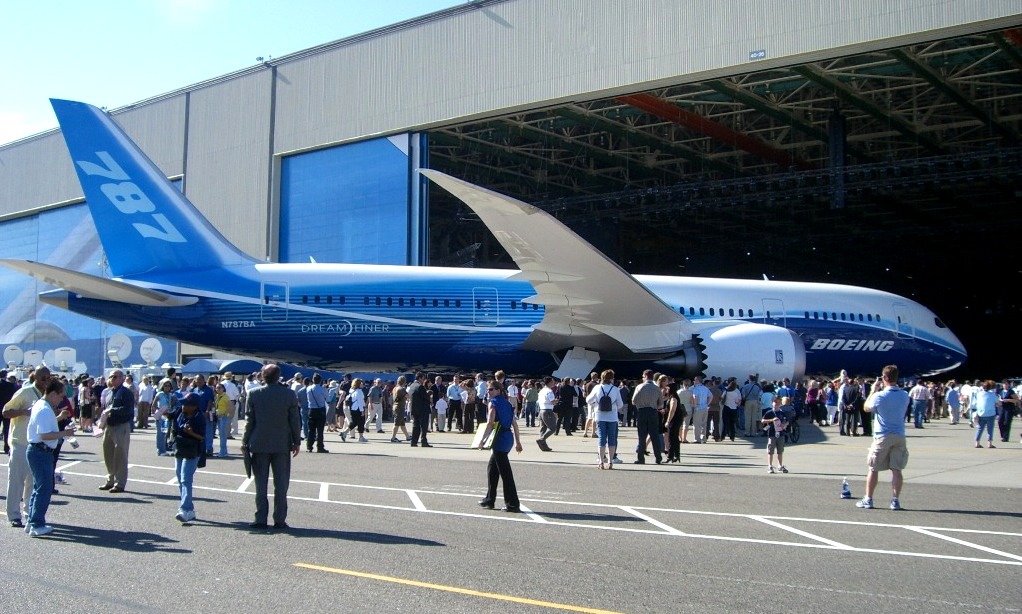
Boeing planned the first flight by the end of August 2007 and premiered the first 787 (registered N787BA) at a rollout ceremony on July 8, 2007. The 787 had 677 orders at this time, which is more orders from launch to roll-out than any previous wide-body airliner. The major systems were not installed at the time; many parts were attached with temporary non-aerospace fasteners requiring replacement with flight fasteners later.
In September 2007, Boeing announced a three-month delay, blaming a shortage of fasteners as well as incomplete software. On October 10, 2007, a second three-month delay to the first flight and a six-month delay to first deliveries were announced due to supply chain problems, a lack of documentation from overseas suppliers, and flight guidance software delays. Less than a week later, Mike Bair, the 787 program manager, was replaced. On January 16, 2008, Boeing announced a third three-month delay to the first flight of the 787, citing insufficient progress on "traveled work". On March 28, 2008, to gain more control over the supply chain, Boeing announced plans to buy Vought Aircraft Industries' interest in Global Aeronautica; a later agreement was also made to buy Vought's factory in North Charleston.
On April 9, 2008, a fourth delay was announced, shifting the maiden flight to the fourth quarter of 2008, and delaying initial deliveries by around 15 months to the third quarter of 2009. The 787-9 variant was postponed to 2012 and the 787-3 variant was to follow at a later date. On November 4, 2008, a fifth delay was announced due to incorrect fastener installation and the Boeing machinists strike, stating that the first test flight would not occur in the fourth quarter of 2008. After assessing the program schedule with suppliers, in December 2008, Boeing stated that the first flight was delayed until the second quarter of 2009. Airlines, such as United Airlines and Air India, stated their intentions to seek compensation from Boeing for the delays.
A secondary factor in the delays faced by the 787 program was the lack of detailed specifications provided to partners and suppliers. In previous programs Boeing had supplied high level design data, but for the 787, decided to provide broad level specifications only, on the assumption that relevant partners had the competencies to perform the design and integration work with the limited data. This decision created several delays as suppliers struggled to work with the limited design data.
Pre-flight ground testing
As Boeing worked with its suppliers toward production, the design proceeded through a series of test goals. On August 23, 2007, a crash test involving a vertical drop of a partial composite fuselage section from about 15 ft onto a 1 in-thick steel plate occurred in Mesa, Arizona; the results matched predictions, allowing modeling of various crash scenarios using computational analysis instead of further physical tests. While critics had expressed concerns that a composite fuselage could shatter and burn with toxic fumes during crash landings, test data indicated no greater toxicity than conventional metal airframes. The crash test was the third in a series of demonstrations conducted to match FAA requirements, including additional certification criteria due to the wide-scale use of composite materials.
On August 7, 2007, on-time certification of the Rolls-Royce Trent 1000 engine by European and US regulators was received. The alternative GE GEnx-1B engine achieved certification on March 31, 2008. On June 20, 2008, the first aircraft was powered up, for testing the electrical supply and distribution systems. A non-flightworthy static test airframe was built; on September 27, 2008, the fuselage was successfully tested to a differential pressure of 14.9 psi, which is 150 percent of the maximum pressure expected in commercial service. In December 2008, the 787's maintenance program was passed by the FAA.
On May 3, 2009, the first test 787 was moved to the flight line following extensive factory testing, including landing gear swings, systems integration verification, and a total run-through of the first flight. On May 4, 2009, a press report indicated a 10–15% range reduction, about 6900 nmi instead of the originally promised 7,700 to, for early aircraft that were about 8% overweight. Substantial redesign work was expected to correct this, which would complicate increases in production rates; Boeing stated the early 787-8s would have a range of almost 8000 nmi. As a result, some airlines reportedly delayed deliveries of 787s to take later planes that may be closer to the original estimates. Boeing expected to have the weight issues addressed by the 21st production model.
On June 15, 2009, during the Paris Air Show, Boeing said that the 787 would make its first flight within two weeks. On June 23, the first flight was postponed due to structural reasons. Boeing provided an updated 787 schedule on August 27, 2009, with the first flight planned to occur by the end of 2009 and deliveries to begin at the end of 2010. The company expected to write off US$2.5 billion because it considered the first three Dreamliners built unsellable and suitable only for flight tests. On October 28, 2009, Boeing selected Charleston, SC as the site for a second 787 production line, after soliciting bids from multiple states.
Flight testing

On December 15, 2009, Boeing conducted the 787-8 maiden flight from Paine Field in Everett, Washington, at 10:27 am PST and landed three hours later at 1:33 p.m. at Seattle's Boeing Field. During the flight the 787 reached a top speed of 180 knots and maximum altitude of 13,200 feet. Originally scheduled for hours, the test flight was shortened to three hours due to unfavorable weather conditions. The six-aircraft ground and flight test program was scheduled to be done in eight and a half months and 6800 hours, which was the fastest certification campaign for a new Boeing commercial design.
The flight test program comprised six aircraft, ZA001 through ZA006, four with Rolls-Royce Trent 1000 engines and two with GE GEnx-1B64 engines. The second 787, ZA002 in All Nippon Airways livery, flew to Boeing Field on December 22, 2009, to join the flight test program; the third 787, ZA004 made its first flight on February 24, 2010, followed by ZA003 on March 14, 2010. On March 24, 2010, flutter and ground effects testing was completed, clearing the aircraft to fly its entire flight envelope. On March 28, 2010, the 787 completed the ultimate wing load test, which requires that the wings of a fully assembled aircraft be loaded to 150% of the design limit load and held for 3 seconds. The wings were flexed approximately 25 ft upward during the test. Unlike past aircraft, the wings were not tested to failure. On April 7, data showed the test had been a success.
On April 23, 2010, the newest 787, ZA003, arrived at the McKinley Climatic Laboratory hangar at Eglin Air Force Base, Florida, for extreme weather testing in temperatures ranging from 115 to, including takeoff preparations at both temperature extremes. ZA005, the fifth 787 and the first with GEnx engines, began ground engine tests in May 2010, and made its first flight on June 16, 2010. In June 2010, gaps were discovered in the horizontal stabilizers of test aircraft due to improperly installed shims; all aircraft were inspected and repaired. That same month, a 787 experienced its first in-flight lightning strike; inspections found no damage. As composites can have as little as 1/1,000th the electrical conductivity of aluminum, conductive material is added to alleviate potential risks and to meet FAA requirements. The FAA also planned requirement changes to help the 787 show compliance. In December 2019, it was reported that Boeing had removed the copper foil that formed part of the protection against lightning strikes to the wings of the aircraft; it then worked with the FAA to override concerns raised.

The 787 made its first appearance at an international air show at the Farnborough Airshow, United Kingdom, on July 18, 2010.
On August 2, 2010, a Trent 1000 engine suffered an uncontained failure at Rolls-Royce's test facility during ground testing. The failure changed the schedule for installing Trent 1000 engines; on August 27, 2010, Boeing stated that the first delivery to launch customer ANA would be delayed until early 2011. That same month, Boeing faced compensation claims from airlines owing to ongoing delivery delays. In September 2010, it was reported that two additional 787s might join the test fleet for a total of eight flight test aircraft. On September 10, 2010, a partial engine surge occurred in a Trent engine on ZA001 at Roswell. On October 4, 2010, the sixth 787, ZA006 joined the test program with its first flight.
On November 9, 2010, the second 787, ZA002 made an emergency landing at Laredo International Airport, Texas, after smoke and flames were detected in the main cabin during a test flight. The electrical fire caused some systems to fail before landing. Following this incident, Boeing suspended flight testing on November 10, 2010; ground testing continued. After investigation, the in-flight fire was primarily attributed to foreign object debris (FOD) that was present in the electrical bay. After electrical system and software changes, the 787 resumed flight testing on December 23, 2010.
Test evaluation and certification
On November 5, 2010, it was reported that some 787 deliveries would be delayed to address problems found during flight testing. In January 2011, the first 787 delivery was rescheduled to the third quarter of 2011 due to software and electrical updates following the in-flight fire. By February 24, 2011, the 787 had completed 80% of the test conditions for the Rolls-Royce Trent 1000 engine and 60% of the conditions for the General Electric GEnx-1B engine. In July 2011, ANA performed a week of operations testing using a 787 in Japan. The test aircraft had flown 4,828 hours in 1,707 flights combined by August 15, 2011. During testing, the 787 visited 14 countries in Asia, Europe, North America, and South America to test in extreme climates and conditions and for route testing.
On August 13, 2011, certification testing of the Rolls-Royce powered 787-8 finished. The FAA and European Aviation Safety Agency certified the 787 on August 26, 2011, at a ceremony in Everett, Washington.
Entry into service
.jpg)
Certification cleared the way for deliveries and in 2011, Boeing prepared to increase 787 production rates from two to ten aircraft per month at assembly lines in Everett and Charleston over two years. In December 2011, the National Labor Relations Board dropped its lawsuit after the Machinists' union withdrew its complaint as part of a new contract with Boeing. The first 787 assembled in South Carolina was rolled out on April 27, 2012.
The first 787 was officially delivered to All Nippon Airways (ANA) on September 25, 2011, at the Boeing Everett factory. A ceremony to mark the occasion was also held the next day. On September 27, it flew to Tokyo Haneda Airport. The airline took delivery of the second 787 on October 13, 2011.
On October 26, 2011, an ANA 787 flew the first commercial flight from Tokyo's Narita International Airport to Hong Kong International Airport. The Dreamliner entered service some three years later than originally planned. Tickets for the flight were sold in an online auction; the highest bidder had paid $34,000 for a seat. An ANA 787 flew its first long-haul flight to Europe on January 21, 2012, from Haneda to Frankfurt Airport.
Proposed variants
Freighter version
Even after production of the 787 began, Boeing continued to produce the 767 as a freighter. More stringent emissions and noise limits will go into effect in 2028 and prevent 767 sales in its current form. To address this concern, Boeing has widely reported to be working on a freighter version of the 787, showing proposals to customers including FedEx Express. , production of the 787 Freighter is expected to begin between 2028 and 2033.
787-3

The 787-3 would have carried 290–330 passengers in two-class over 2,500 – range, limited by a 364000 lb MTOW. In April 2008, to keep the -8 on track for delivery, the -9 stretch was postponed from 2010 to at least 2012 and prioritized before the 787-3 and its 43 orders to follow without a firm delivery date.
It kept the -8 length but its 51.7 m wingspan would have fit in ICAO Aerodrome Reference Code D. It was designed to operate on Boeing 757-300/Boeing 767-200 sized regional routes from airports with restricted gate spacing. The wingspan was decreased by using blended winglets instead of raked wingtips.
By January 2010, all orders, from Japan Airlines and All Nippon Airways, had been converted to the 787-8. As it was designed specifically for the Japanese market, Boeing would likely scrap it after they switched orders. The -8's longer wingspan makes it more efficient on stages longer than 200 nmi. In December 2010, Boeing withdrew the short-haul model as it struggled to produce the 787-8 after program delays of three years.
Market and costs
The 787 Dreamliner program has reportedly cost Boeing $32 billion. In 2013, the 787 program was expected to be profitable after 1,100 aircraft have been sold. At the end of 2013, the cost of producing a 787 exceeded the purchase price. Boeing's accounting method books sales immediately and distributes estimated production costs over ten years for the 1,300 aircraft it expects to deliver during that time. JPMorgan Chase analyst Joseph Nadol estimated the program's cash loss to be $45 million per airplane, decreasing as the program moves forward. The actual cash flow reflects Boeing collecting most of the purchase price upon delivery; Boeing expects deferred costs to total $25 billion before the company begins to break even on production; the comparable number for the Boeing 777, adjusted for inflation, is $3.7 billion.
Boeing lost $30 million per 787 delivered in the first quarter of 2015, although Boeing planned to break even by the end of the year. The accumulated losses for the 787 totaled almost $27 billion (~$ in ) by May 2015. The cost of producing the fuselage may increase because of a tentative deal reached with Spirit Aerosystems of Wichita, Kansas, wherein severe price cuts demanded by Boeing would be eased, in return for a comprehensive agreement that lowers the cost of fuselages for other jetliners that Spirit helps Boeing manufacture.
In the second quarter of 2015, Boeing lost $25 million ($ in ) on each 787 delivered but was planning to break even per plane before the year-end. After that Boeing hoped to build 900 Dreamliners over six years at an average profit of more than $35 million each. But with deferred costs peaking in 2016 at $33 billion, ($ in ) Leeham analyst Bjorn Fehrm believes Boeing cannot make an overall profit on the program. Ted Piepenbrock, an academic affiliated with MIT and the University of Oxford, projects losses decreasing through the first 700 airliners and forecasts the cumulative deferred costs to peak beyond $34 billion. The model most favorable to Boeing projects a program loss of $5 billion after delivering 2,000 Dreamliners. Boeing's original development investment, estimated at least at a further $20 billion, is not included in these costs.
To recoup the deferred costs and earn its goal of a "low single-digit" overall profit margin, Boeing has to make an average profit of more than $50 million on the final 205 airplanes of the accounting block to be delivered from 2020: a profit margin of more than 30% while the mature Boeing 737 and 777 programs have 20% to 25% margins. Boeing is reaching it through a larger proportion of the 20% to 40% higher price -9/10s, costing only 5% to 10% more than the -8 with lower production costs from reliability and producibility investments and the expected experience curve. Former Douglas Aircraft chief economist Adam Pilarski notes that two assembly sites slow the experience curve. Boeing assumed a faster improvement than on previous programs which had not happened. Competition with the Airbus A350 and the launch of the A330neo put strong pressure on the 787 pricing.
On July 21, 2016, Boeing reported charges of $847 million against two flight-test 787s built in 2009. Boeing had planned to refurbish and sell them but instead wrote them off as research and development expense. In 2017, Boeing's Jim Albaugh said that the requested return on net assets (RONA) led to outsourcing systems reducing investment, but improving RONA had to be balanced against the risk of loss of control. From 2019, Boeing was to build 14 787s per month (168 per year), helping to offset the $28 billion in deferred production costs accumulated through 2015 and would add 100 aircraft to the current accounting block of 1,300 at the end of 2017 third quarter. In 2019, the list price for a 787-8 was US$248.3M, $292.5M for a 787-9, and $338.4M for a 787-10.
The valuation for a new 787-9 is $145 million in 2018, up from $135 million in 2014, but it may have been sold for $110–115 million to prevent A330neo sales while an A330-900 is worth $115 million. In February 2018, Boeing priced six 787-9s for less than $100–115m each to Hawaiian Airlines, close to their production cost of $80–90m, to overcome its A330-800 order. By late 2018, deferred production costs were reduced from a peak of $27.6 billion in early 2016 to $23.5 billion as assembly efficiency improved and the 800th production started.
Production rate
By 2014, Boeing planned to improve financial return by reorganizing the production line, renegotiating contracts with suppliers and labor unions, and increasing the 787 production rate, stepwise, to 12 airplanes per month by the end of 2016 and 14 airplanes per month by the end of the decade. By April 2015, the production rate was 10 per month.
From late 2020, the production rate is to be reduced from 14 to 12 airplanes per month due to the China-United States trade war. Production could be trimmed to 10 planes per month as demand for wide-body aircraft falters. On October 1, 2020, Boeing announced the 787 would be produced only in North Charleston from mid-2021 due to the impact of the COVID-19 pandemic on aviation, as the production rate fell to six per month. In December, the monthly rate was further reduced to five.
Quality-control issues (2019–2025)
2019
In 2019, reports began to emerge about quality-control issues at the North Charleston plant leading to questions about the jet's safety; and later that same year KLM, which had discovered loose seats, missing and incorrectly installed pins, nuts and bolts not fully tightened and a fuel-line clamp left unsecured on its jet, complained that the standard of manufacture was "way below acceptable standards."
2020
Early in 2020, Boeing engineers complained about depressions in the 787's vertical tail fin, affecting hundreds of planes or the vast majority of the fleet. Workers in Charleston and Everett had improperly discarded shims before the final installation of fasteners, which could lead to structural failure under limited loads. In late August 2020, Boeing grounded eight 787s due to such improper fuselage shimming and inner skin surfacing issues—issues which proved to have been discovered in August 2019 at Boeing South Carolina.
The following month, Boeing admitted that "nonconforming" sections of the rear fuselage did not meet engineering standards, and the FAA was investigating quality-control lapses dating back to the introduction of the 787 in 2011 and considering requiring additional inspections for up to 900 of the roughly 1,000 Dreamliners in service. The FAA then began to inquire into the company's Quality Management System (QMS), which Boeing had previously argued justified a reduction of 900 quality inspectors, but which had failed to detect either the shim or skin surface issues. A third quality-control issue then emerged, this time with the 787's horizontal stabilizers, and affecting as many as 893 Dreamliners: workers in Salt Lake City had clamped portions of the tail section too tightly, which could lead to premature material fatigue. At this point Boeing expected a one-time inspection during regularly scheduled maintenance to address the issues and expected merely to slow 787 deliveries "in the near term".
2021
By January 2021, Boeing had halted 787 deliveries to complete the inspection relating to poor quality control, then in March the FAA withdrew Boeing's delegated authority to inspect and sign off on four new 787s, saying that it would extend this withdrawal to further aircraft if needed. Boeing briefly resumed deliveries on March 26, 2021, handing over one 787-9 to United Airlines, but deliveries ceased again in May 2021; meaning that almost all deliveries had been paused for nearly a year. The delay generated $1 billion in abnormal costs and caused the company to cut production to around two planes a month.
On July 13, Boeing discovered gaps at joints in the forward pressure bulkhead and again reduced production; the company also investigated whether the issue affected 787s already in service. Questions were asked about the inspection process used to check the work, and Boeing worked with the FAA to fix the problem, which was said to pose "no immediate threat to flight safety" and did not require 787s already in service to be grounded.
On September 4, the Wall Street Journal reported that the FAA would not accept Boeing's proposed new inspection method, aiming to speed deliveries with targeted checks rather than nose-to-tail teardowns, until at least late October; and in late November it was reported that the FAA had discovered further problems, including additional out of tolerance gaps and contamination and associated weakening of fuselage composites. The rectification process for existing aircraft was made more complex by a lack of detailed configuration data on each aircraft. The new problems and the extension of the 13 month long disruption to 787 deliveries led to anger from buyers; a slide in the company's stock price; and demands by a subcommittee of the US House of Representatives for a review of the FAA's oversight of the plane.
2022
In January 2022, it was reported that deliveries were not anticipated to restart until April 2022. In February, the FAA announced that it would withdraw Boeing's delegated authority to issue airworthiness certificates for individual 787 aircraft until Boeing can demonstrate consistent quality, stable delivery processes, and a robust plan for the rework needed on the undelivered aircraft in storage. In late March Boeing began sounding out suppliers about their ability to support the production of up to seven aircraft a month by late 2023. Vistara, which had been expecting delivery of four Dreamliners in 2022, indicated a lack of confidence in Boeing meeting its delivery aims by arranging to lease aircraft instead. Later in April reports began to emerge of a further delay of at least two months, and it was only in late April that Boeing submitted the necessary certification package laying out the inspections and repairs to be undertaken on already constructed planes. The FAA rejected portions of the package as incomplete and returned it to Boeing, indicating a further delay before the resumption of deliveries. In late July, the FAA approved Boeing's revised certification package, leading the company to anticipate resuming deliveries "within days". Deliveries resumed on August 10, 2022, after the FAA granted clearance.
2023
In February 2023, a further problem, of an analysis error by a supplier related to the 787 forward pressure bulkhead, was identified, leading to a further temporary halt in deliveries (but not in production) and a 5% drop in the company's share price. On March 10, the FAA approved the resumption of the deliveries.
2024
In April 2024, Boeing engineer Sam Salehpour reported that the 787's (as well as the 777's) fuselage had been improperly assembled and that it could cause individual aircraft to break apart in mid-air. Salehpour also claimed that he tried to raise these concerns to Boeing but was reprimanded by the company. The FAA is investigating Salehpour's allegations. Boeing released a statement rejecting these claims.
2025
In early 2025, Italian authorities discovered a fraud scheme involving over 4,800 parts. The investigation indicated that Manufacturing Process Specification (MPS), an Italian supplier, and its subcontractors had falsified quality certifications for the components used in the Dreamliner. MPS, however, no longer exists as a company.
Design

The Boeing 787 Dreamliner is a long-haul, widebody, twin-engine jetliner, designed with lightweight structures that are 80% composite by volume; Boeing lists its materials by weight as 50% composite, 20% aluminum, 15% titanium, 10% steel, and 5% other materials. Aluminum has been used throughout the leading edges of wings and tailplanes, titanium is predominantly present within the elements of the engines and fasteners, while various individual components are composed of steel.
External features include a smooth nose contour, raked wingtips, and engine nacelles with noise-reducing serrated edges (chevrons). The longest-range 787 variant can fly up to 7565 nmi, The aircraft has a design life of 44,000 flight cycles.
Flight systems
Among 787 flight systems, a key change from traditional airliners is the electrical architecture. The architecture is bleedless and replaces bleed air with electrically powered compressors and four of six hydraulic power sources with electrically driven pumps while eliminating pneumatics and hydraulics from some subsystems, e.g. engine starters and brakes. Boeing says that this system extracts 35% less power from the engines, allowing increased thrust and improved fuel efficiency. Spoiler electromechanical actuators (SEMAs) control two of the seven spoiler pairs on each wing surface, providing roll control, air and ground speed brake, and droop capabilities similar to those provided by the hydraulic actuators used on the remaining spoiler surfaces. The SEMAs are controlled by electronic motor control units (EMCUs).
The total available onboard electrical power is 1.45 megawatts, which is five times the power available on conventional pneumatic airliners; electrically powered systems include engine start, cabin pressurization, horizontal-stabilizer trim, and wheel brakes. Wing ice protection is another new system; it uses electro-thermal heater mats on the wing slats instead of traditional hot bleed air. An active gust alleviation system, similar to the system used on the B-2 bomber, improves ride quality during turbulence.
The 787 has a "fly-by-wire" control system similar in architecture to that of the Boeing 777. The flight deck features multi-function LCDs, which use an industry-standard graphical user interface widget toolkit (Cockpit Display System Interfaces to User Systems / ARINC 661). The 787 flight deck includes two head-up displays (HUDs) as a standard feature. Like other Boeing airliners, the 787 uses a yoke (as opposed to a side-stick). Under consideration is the future integration of forward-looking infrared into the HUD for thermal sensing, allowing pilots to "see" through clouds. Lockheed Martin's Orion spacecraft will use a glass cockpit derived from Honeywell International's 787 flight deck systems.
Honeywell and Rockwell Collins provide flight control, guidance, and other avionics systems, including standard dual head-up guidance systems, Thales supplies the integrated standby flight display and power management, while Meggitt/Securaplane provides the auxiliary power unit (APU) starting system, electrical power-conversion system, and battery-control system with lithium cobalt oxide (LiCoO2) batteries by GS Yuasa. One of the two batteries weighs 28.5 kg and is rated 29.6 V, 76 Ah, giving 2.2 kWh. Battery charging is controlled by four independent systems to prevent overcharging, following early lab testing. The battery systems were the focus of a regulatory investigation due to multiple lithium battery fires, which led to the grounding of the 787 fleet starting in January 2013.
A version of Ethernet (Avionics Full-Duplex Switched Ethernet (AFDX) / ARINC 664) transmits data between the flight deck and aircraft systems. The control, navigation, and communication systems are networked with the passenger cabin's in-flight internet systems. In January 2008, FAA concerns were reported regarding possible passenger access to the 787's computer networks; Boeing has stated that various protective hardware and software solutions are employed, including air gaps to physically separate the networks, and firewalls for software separation. These measures prevent data transfer from the passenger internet system to the maintenance or navigation systems.
The -9/10 hybrid laminar flow control (HLFC) system delays the critical transition from laminar to turbulent flow as far back as possible on the vertical tail by passive suction from leading-edge holes to mid-fin low-pressure doors but was dropped from the tailplane due to lower benefits than the extra complexity and cost.
Airframe

The 787 is the first commercial aircraft to have an airframe majority made of carbon fiber reinforced polymer (CFRP), applied in: the empennage, fuselage, wings, doors, and in most other main components. Each 787 contains approximately 35 t of CFRP, made with 23 MT of pure carbon fiber. CFRP materials have a higher strength-to-weight ratio than conventional aluminum structural materials, which contributes significantly to the 787's weight savings, Historically, the first CFRP primary structure in Boeing commercial aircraft was put into service in 1984 on the horizontal tail of the Boeing 737 Classic, and in the mid-1990s on both vertical and horizontal tail (empennage) of the Boeing 777. In the early 2000s, while studying the proposed Sonic Cruiser, Boeing built and tested the first CFRP fuselage section for commercial aircraft, to evaluate materials and manufacturing techniques which later applied to the Dreamliner. Instead of designing one-piece composite fuselage barrels like the 787, the competing Airbus A350 uses a slightly more conventional approach with CFRP panels on CFRP frames, which is considered less risky in terms of assembly tolerance between fuselage sections.
Safety can be a concern due to lower impact energy absorption and poorer fire, smoke and toxicity capability of CFRP fuselages in the event of a crash landing, leading to whistleblower complaints at Boeing by Vince Weldon, who was fired in 2006. The Occupational Safety and Health Administration (OSHA) later denied Weldon whistleblower status "largely on the grounds that Boeing's 787 design does not violate any FAA regulations or standards". Boeing further argued that CFRP structures have been used on empennages and other parts of airliners for many years without incident, and special damage detection procedures will be instituted for the 787 to detect any potential hidden damage.
In the fall of 2004, 787 engineering program leader Walt Gillette made the final decision to use CFRP for the 787’s fuselage, a first for a commercial aircraft. Two distinct Boeing sub-groups with expertise in two different materials—CFRP and aluminum alloy—spent months researching how their material would perform for the 787. Therefore, a "fundamental philosophical dichotomy" existed in the group. This is why a single "collaborative" leader rather than the group needed to make the final call on the material.
In 2006, Boeing launched the 787 GoldCare program. This is an optional, comprehensive life-cycle management service, whereby aircraft in the program are routinely monitored and repaired, as needed. Although the first program of its kind from Boeing, post-sale protection programs are not new; such programs are usually offered by third party service centers. Boeing is also designing and testing composite hardware so inspections are mainly visual. This reduces the need for ultrasonic and other non-visual inspection methods, saving time and money.
The Boeing 787 is equipped with two flight recorders—a Forward Flight Recorder (FWD FR) and an Aft Flight Recorder (AFT FR)—each of which units provides the functions traditionally provided by the Flight Data Recorder and the Cockpit Voice Recorder.
Interior
.jpg)
The 787-8 is designed to typically seat 234 passengers in a three-class setup, 240 in two-class domestic configuration, and 296 passengers in a high-density economy arrangement. Seat rows can be arranged in four to seven abreast in first, business, or premium economy—e.g., 1–2–1, 2–2–2, or 2–3–2. Eight or nine abreast are options in economy—e.g., 2–4–2 or 3–3–3. Typical seat room ranges from 46 to pitch in first, 36 to in business, and 32 to in economy.
Cabin interior width is approximately 18 ft at armrest level. The Dreamliner's cabin width is 15 in more than that of the Airbus A330 and A340, 5 in less than the A350, and 16 in less than the 777. The 787's economy seats can be up to 17.5 in wide for nine-abreast seating and up to 19 in wide for eight-abreast seating arrangements. Most airlines are selecting the nine-abreast (3–3–3) configuration. The 787's nine-abreast seating for economy provides passengers less space, particularly across the hips and shoulders, than any other jet airliner. Some observers recommended passengers avoid flying 787s with nine-abreast seating, although others suggested that the 787 is more comfortable than other airliners.
The 787's cabin windows have dimensions of 10.7 by, and a high eye level so passengers can maintain a view of the horizon. The composite fuselage permits larger windows without the need for structural reinforcement. Instead of plastic window shades, the windows use electrochromism-based smart glass (supplied by PPG Industries) allowing flight attendants and passengers to adjust five levels of sunlight and visibility to their liking, reducing cabin glare while maintaining a view to the outside world, but the most opaque setting still has some transparency. While the lavatory window also uses smart glass, it was given a traditional sunshade.
The 787's cabin features light-emitting diodes (LEDs) as standard equipment, allowing the aircraft to be entirely "bulbless". LED lights have previously been an option on the Boeing 777 and Airbus aircraft fitted with standard fluorescent lights. The system has three-color LEDs plus a white LED. The 787 interior was designed to better accommodate persons with mobility, sensory, and cognitive disabilities. For example, a 56 by convertible lavatory includes a movable center wall that allows two separate lavatories to become one large wheelchair-accessible facility.
The 787's internal cabin pressure is the equivalent of a 6000 ft cabin altitude, which is a higher pressure than the 8000 ft cabin altitude of older conventional aircraft. According to Boeing, in a joint study with Oklahoma State University, this significantly improves passenger comfort. Cabin air pressurization is provided by electrically driven compressors, rather than traditional engine-bleed air, thereby eliminating the need to cool heated air before it enters the cabin. The cabin's humidity is programmable based on the number of passengers carried and allows 15% humidity settings instead of the 4% found in previous aircraft. The composite fuselage avoids metal fatigue issues associated with higher cabin pressure and eliminates the risk of corrosion from higher humidity levels. The cabin air-conditioning system improves air quality by removing ozone from outside air and, besides standard HEPA filters, which remove airborne particles, uses a gaseous filtration system to remove odors, irritants, and gaseous contaminants, as well as particulates like viruses, bacteria and allergens.
Engines
The Boeing 787 has two engine options: the General Electric GEnx-1B and the Rolls-Royce Trent 1000. As of early 2020, of the 1,484 total 787 orders, 905 (61%) had selected General Electric engines, 476 (32%) had chosen Rolls-Royce engines, and 103 (7%) remained undecided.
Both engines use a standardized electrical interface, enabling airlines to install either model with minimal modifications. This interchangeability reduces the time and cost typically associated with switching engine types and is particularly attractive to lessors, as it allows airlines to maintain a common engine type across their fleet when an aircraft changes ownership. While earlier aircraft could accommodate engines from different manufacturers, swaps were rarely performed due to their complexity and expense.
The 787's engines use an all-electric, bleedless system, adapted from the Sonic Cruiser, that eliminates the need for traditional superheated air conduits used for de-icing, cabin pressurization, and other functions. As part of its "Quiet Technology Demonstrator 2" program, Boeing integrated several noise-reduction features into the aircraft. These include an air inlet lined with sound-absorbing materials and an exhaust duct with a chevron-toothed pattern to promote quieter mixing of exhaust with ambient air. Boeing says these technologies make the 787 significantly quieter both inside the cabin and in surrounding areas, with sound levels kept below 85 decibels at airport boundaries.
In 2016, Rolls-Royce began flight testing the Trent 1000 TEN engine, an upgraded version of the Trent 1000 featuring a new compressor system derived from the Trent XWB and a new turbine design for extra thrust, up to 78000 lbf.
File:Boeing 787-8 Dreamliner, China Southern Airlines JP7647924.jpg|General Electric GEnx with composite fan blades File:Boeing 787 Dreamliner (6809458198).jpg|Rolls-Royce Trent 1000 with titanium fan blade
Operational history
On December 6, 2011, test aircraft ZA006 (sixth 787), powered by General Electric GEnx engines, flew 10710 nmi non-stop from Boeing Field eastward to Shahjalal International Airport in Dhaka, Bangladesh, setting a new world distance record for aircraft in the 787's weight class, which is between 440000 and. This flight surpassed the previous record of 9127 nmi, set in 2002 by an Airbus A330. The Dreamliner then continued eastbound from Dhaka to return to Boeing Field, setting a world-circling speed record of 42 hours, 27 minutes. In December 2011, Boeing started a six-month promotion 787 world tour, visiting various cities in China, Africa, the Middle East, Europe, United States, and others. In April 2012, an ANA 787 made a delivery flight from Boeing Field to Haneda Airport partially using biofuel from cooking oil.
ANA surveyed 800 passengers who flew the 787 from Tokyo to Frankfurt: expectations were surpassed for 90% of passengers; features that met or exceeded expectations included air quality and cabin pressure (90% of passengers), cabin ambiance (92% of passengers), higher cabin humidity levels (80% of passengers), headroom (40% of passengers) and the larger windows (90% of passengers). 25% said they would go out of their way to again fly on the 787.
After its first six months of service, Rolls-Royce powered ANA aircraft were burning around 21% less fuel than the replaced 767-300ER on international flights, slightly better than the 20% originally expected, and 15–20% on domestic routes, while GE-powered Japan Airlines aircraft were potentially slightly better. Other 787 operators have reported similar fuel savings, ranging from 20 to 22% compared with the 767-300ER. An analysis by consultant AirInsight concluded that United Airlines' 787s achieved an operating cost per seat that was 6% lower than the Airbus A330. In November 2017, International Airlines Group chief Willie Walsh said that for its budget carrier Level the lower cost of ownership of its two A330-200 more than offsets the 6 t higher fuel burn ($3,500 on a Barcelona-Los Angeles flight). It would introduce three more A330s as there were not enough 787 pilots.
Early operators discovered that if the APS5000 Auxiliary power unit was shut down with the inlet door closed, heat continued to build up in the tail compartment and cause the rotor shaft to bow. It could take up to two hours for the shaft to straighten again. This was particularly acute on short haul flights as there was insufficient time to allow the unit to cool before a restart was needed. Procedures were modified and the APU was later redesigned to address the issue.
On September 15, 2012, the NTSB requested the grounding of certain 787s due to GE engine failures; GE believed the production problem had been fixed by that time. In December 2012, responding to unhappiness within the airline industry at the continuing issues affecting the aircraft, Boeing CEO James McNerney stated that he regretted the impact on passengers: he went on to say that the 787's issues had been no greater than those experienced with the introduction of other Boeing models such as the 777.
In March 2014, Mitsubishi Heavy Industries informed Boeing of a new problem that was caused by a change in manufacturing processes. Employees did not fill gaps with shims to connect wing rib aluminum shear ties to the carbon composite wing panels; the tightened fasteners, without shims, cause excessive stress that creates hairline cracks in the wings, which could enlarge and cause further damage. Forty-two aircraft awaiting delivery were affected, and each required one to two weeks to inspect and repair. Boeing did not expect this problem to affect the overall delivery schedule, even if some airplanes were delivered late.
Dispatch reliability is an industry standard measure of the rate of departure from the gate with no more than 15 minutes delay due to technical issues. The 787-8 started out with a ~96% operational reliability, increasing to ~98.5% in April 2015. Daily utilization increased from five hours in 2013 to twelve hours in 2014. Dispatch reliability grew to 99.3% in 2017.
Airlines have often assigned the 787 to routes previously flown by larger aircraft that could not return a profit. For example, Air Canada offered a Toronto-Pearson to New Delhi route, first utilizing a Lockheed L1011, then a Boeing 747-400, then an Airbus A340-300, but none of these types were efficient enough to generate profit. The airline operated the route profitably with a 787-9, and credits the right number of seats and greater fuel efficiency for this success.
Up to June 30, 2017, after 565 units were delivered since 2011: 60% -8 (340) and 40% -9 (225), the airports with most 787 departures are Haneda Airport with 304 weekly, Narita Airport with 276 and Doha Airport with 265.
In 2023, the first 787s to be withdrawn from commercial service, two 10-year-old -8s, were torn down by Irish company EirTrade Aviation, as they would otherwise have shortly required 12-year checks and landing-gear overhauls.
Variants
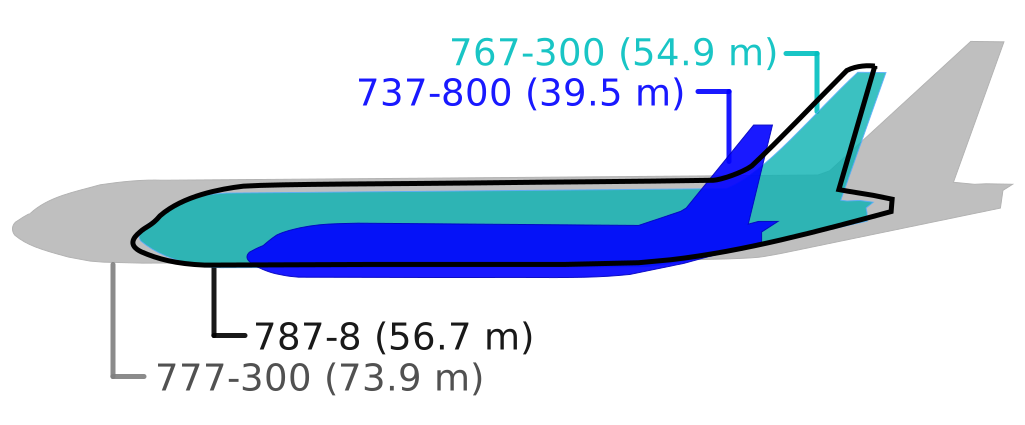
The shortest Dreamliner variant, the 787-8 was the first variant to fly in December 2009, then the longer 787-9 in September 2013, followed by the longest variant, the 787-10, in March 2017. These variants are called B788, B789, and B78X, respectively in the list of ICAO aircraft type designators. The short-range 787-3 was canceled in 2010.
787-8
With a typical capacity of 248 passengers and a range of 7305 nmi, the -8 is the base model of the 787 family and was the first to enter service in 2011. The 787-8 is targeted to replace the Boeing 767-200ER as well as expand into new non-stop markets where larger planes would not be economically viable. , approximately 26% of 787 orders are for the 787-8 with 386 delivered.
In 2018, Boeing said it would change the -8 manufacturing to raise its commonality with the -9 above the current 30% to be more like the 95% commonality between the -9 and -10, as it will benefit from learning from those. When it was launched, a new 787-8 was to cost only slightly more than the 767-300ER, valued new for $85 million at its 1990s peak, but it ended being 20% more costly. It competes with the Airbus A330-200 and Airbus A330-800.
787-9
Keeping the same wingspan as the 787-8, the 787-9 is a lengthened and strengthened variant with a {{#expr:206-186}} ft longer fuselage and a {{#expr:557000-502500}} lb higher maximum take-off weight (MTOW), seating 296 passengers in a typical two-class cabin configuration over a 7565 nmi range. It features active boundary-layer control on the tail surfaces, reducing drag. The 787-9 is targeted to replace the Boeing 767-300ER. It competes with the Airbus A330-300 and Airbus A330-900.
In 2005, the entry into service (EIS) was planned for 2010. The firm configuration was finalized on July 1, 2010. By October 2011, deliveries were scheduled to begin in 2014.
The prototype 787-9 made its maiden flight from Paine Field on September 17, 2013. By November 8, 2013, it had flown 141 hours. A 787-9 was on static display at the 2014 Farnborough Air Show prior to first delivery. On July 8, 2014, launch customer Air New Zealand took its first 787-9, in a distinctive black livery in a ceremony at Paine Field. The first revenue service was operated by All Nippon Airways on August 7, 2014. Air New Zealand operated its first commercial flight from Auckland to Sydney on August 9, 2014.
The 787-9 was to begin commercial service with All Nippon Airways on August 7, 2014. United Airlines was to start the longest nonstop scheduled 787 service between Los Angeles and Melbourne in October 2014. Air China started a 787-9 route between Beijing and Chengdu in May 2016. , 63% of all 787 orders are for the 787-9, with 580 deliveries. A 2014 787-9 leased for $1.05 million per month, and fell to $925,000 per month in 2018.
The 20 ft stretch was achieved by adding 10 ft (five-frame) extensions forward and aft of the wing. The 787-8 and 787-9 have 50% commonality: the wing, fuselage and systems of the 787-8 had required radical revision to achieve the payload-range goals of the 787-9. Following a major revamp of the original 787-8 wing, the latest configuration for the 787-9 and -10 is the fourth design evolution.
On March 25, 2018, a Qantas 787-9 completed the first scheduled non-stop flight between Australia and the UK flying seventeen hours from Perth to London Heathrow. On October 20, 2019, a Qantas 787-9 was flight tested from New York to Sydney with a restricted payload. A team of researchers monitored passengers and crew to investigate wellness and performance on long flights. On March 16, 2020, an Air Tahiti Nui 787-9 achieved the longest commercial flight of 8,485 nmi.
787-10
.jpg)
In December 2005, pushed by the interest of Emirates and Qantas, Boeing was studying the possibility of stretching the 787-9 further to seat 290 to 310 passengers. This variant would be similar to the capacity of the Boeing 777-200 and the Airbus A350-900, although with a shorter range. Customer discussions were continuing in early 2006. Mike Bair, Boeing's vice president and general manager for the 787 development program at the time, said it was easier to proceed with the 787-10 development after other customers followed Emirates' request. This variant is targeted to replace the Boeing 767-400ER and Airbus A330-300.
On May 30, 2013, Singapore Airlines became the launch customer by stating it would order 30 787-10s (provided Boeing launched the program), to be delivered in 2018–2019. On June 18, 2013, Boeing officially launched the 787-10 at the Paris Air Show, with orders or commitments for 102 aircraft from Air Lease Corporation (30), Singapore Airlines (30), United Airlines (20), British Airways (12), and GE Capital Aviation Services (10). As of January 2023, the aircraft has 189 orders out of which 115 have been delivered, 7 of which are stored.
This variant was envisioned as replacing Boeing 777-200 and Airbus A340-500 aircraft. It competes with the Airbus A350-900, and according to Boeing, it offers better economics than its Airbus competitor on shorter routes. Steven Udvar-Hazy said, "If it's identically configured, the -10 has a little bit of an edge on the -900", but smaller than Boeing's estimate of 10 percent. The 787-10 is 224 ft long, seats 336 passengers in a two-class cabin configuration, and has a range of 6330 nmi.
Boeing completed detailed design for the -10 on December 2, 2015. Major assembly began in March 2016. Designers targeted 90% commonality between the 787-9 and -10 and achieved 95%; the 18 ft stretch was reached by adding 10 ft forward of the wing and 8 ft aft, and by strengthening the fuselage for bending loads in the center wingbox. Because of the length and additional tail strike protection needed, a semilevered landing gear enables rotation over the aft wheels rather than at the bogie center, like the 777-300ER, and the cabin air conditioning system has 15% more capacity. The first and third -10 test-platforms incorporate Rolls-Royce's new Trent 1000 TEN engines, while the second is powered by the competing General Electric GEnx-1B engine.
Major fuselage parts were received for final assembly on November 30, 2016. The 787-10's mid-fuselage sections are too large for transport to Everett, Washington and it is built only in Charleston, South Carolina; it is the first Boeing airliner assembled exclusively there. The variant's first flight took place on March 31, 2017, and lasted 4 hours and 48 minutes.
The first test 787-10 aircraft is engaged in flight envelope expansion work and the second joined the program in early May 2017, while the third with a passenger cabin interior to test the uprated environmental control system and Trent fuel-burn performance was scheduled to join in June.
At the start of the November 2017 Dubai Air Show, the 787-10 had 171 orders; Emirates committed to 40 787-10s, in two- and three-class cabins for 240 to 330 passengers, to be delivered from 2022 and with conversion rights to the smaller 787-9. These aircraft are adapted for 7–8.5 hour missions, in a 280-seat three–class layout. Emirates' Tim Clark was doubtful it would meet its MTOW for the payload-range required with initial 70,000 - thrust engines, but with the current 76,000 lbf turbofans and the -9 early margins gave the -10 "stellar economics". By early 2019, Emirates was considering canceling its 787-10 order, due to engine margins being insufficient for the hot Dubai weather, in favor of the Airbus A350 (which would also replace its last Airbus A380 order). At the 2019 Dubai Air Show, Emirates placed an order for 30 787-9 aircraft rather than the 787-10.
In January 2018, the -10 was certified by the FAA after testing for 900 flight hours. Boeing received its production certificate on February 15. It was first delivered to launch customer Singapore Airlines on March 25, 2018. Fitted with 337 seats, 36 in business and 301 in economy, the -10 began commercial service on April 3, 2018.
The 8.7% fuselage stretch from the -9 to the -10 likely increased empty weight at a lower rate than the 7.4% growth from the -8 to the -9 due to the 10.7% stretch.
To replace Air New Zealand's 777-200 fleet, Boeing wants to increase the 787-10 MTOW by over 13,000 lb to 572,000 lb with some reinforcements and updated fuel systems. This would allow more range, such as the 5,600 nmi trip from Auckland to Los Angeles with no passenger restrictions and some cargo. The increased performance could trickle down to the 787-9, allowing Auckland to New York flights.
BBJ 787
The 787-8 and -9 are offered as Boeing Business Jets, the first offering 2,415 ft2 of floor space and a range of 9,945 nmi), the other 2,775 ft2 and 9,485 nmi, both with 25 passengers. Through June 2018, fifteen have been ordered, twelve delivered and four were in service.
Experimental
Main article: ecoDemonstrator
Two 787 aircraft have been used in Boeing's ecoDemonstrator program which aims to develop technology and techniques to reduce the environmental effects of aviation. The testing involves many partner organizations including engine and systems manufacturers, NASA, academic, research, and regulatory institutions. The program started in 2011 with a different airframe being used each year.
In 2014, the fourth prototype 787-8 was used for tests including use of sustainable aviation fuel, ceramic matrix composite engine exhaust nozzles, and systems for improved air traffic control (ATC) communications and closer landing approach spacing. In 2020, a new 787-10 took part in the program, including intensive noise reduction trials, and including text-based ATC communications and cabin hygiene and cleansing tests related to the COVID-19 pandemic. After removal of the test equipment, the aircraft was delivered to Etihad Airways.
In April 2023, Boeing announced the ecoDemonstrator Explorer program, which would run alongside the ecoDemonstrator program. The first Explorer program in 2023 tested international route planning (trajectory-based operations – a major aim of the FAA's NextGen project) and maximization of sustainable aviation fuel use for a planned 10% fuel efficiency gain, using a 787-10.
Operators
Main article: List of Boeing 787 operators
There are 1,006 Boeing 787 aircraft in airline service , comprising 377 Boeing 787-8s, 568 787-9s and 61 787-10s, with outstanding orders for further 481 aircraft.
Orders and deliveries
Main article: List of Boeing 787 orders and deliveries
In September 2011, the 787 was first officially delivered to launch customer All Nippon Airways. , the top five identified 787 customers are American Airlines with 89 orders (37 -8s and 52 -9s), All Nippon Airways with 83 orders (36 -8s, 44 -9s and three -10s), ILFC (an aircraft leasing company) with 74 orders (23 -8s and 51 -9s), and United Airlines (12 -8s, 38 -9s and 21 -10s) and Etihad Airways (41 -9s and 30 -10s), both with 71 orders.
On December 13, 2018, the 787th Boeing 787 was delivered to AerCap and leased to China Southern Airlines. By then the 787 had flown 300 million passengers on 1.5 million flights and opened 210 new nonstop routes. The 1000th Dreamliner, a 787-10 for Singapore Airlines, made its maiden flight on April 3, 2020.
Accidents and incidents
The Boeing 787 has been involved in eight accidents and incidents , including one fatal hull loss.
Accidents with fatalities
On June 12, 2025, Air India Flight 171, an 11-year-old Boeing 787-8 registered as VT-ANB operating from Ahmedabad Airport to London Gatwick Airport, crashed into the hostel building of B. J. Medical College shortly after takeoff. According to the preliminary Aircraft Accident Investigation Bureau report released on July 8, 2025, the crash was caused by both engines shutting down after their fuel control switches moved from the "RUN" to "CUTOFF" position. The cause of the switch movement remains under investigation. The report did not recommend any actions to Boeing, or 787 operators. All but one of the 242 people on board were killed, as well as 19 people on the ground. The sole survivor was a British national seated in 11A, next to an emergency exit. This marked the first fatal crash and hull loss of a 787.
Accidents and incidents without fatalities
A Japan Airlines (JAL) 787 experienced a fuel leak on January 8, 2013, and its flight from Boston was canceled. The next day, United Airlines reported a problem in one of its six 787s with the wiring near the main batteries. Soon, the US National Transportation Safety Board opened a safety probe. Fuel leaks also occurred on January 11, 2013 and on January 13, 2013, at Narita International Airport outside Tokyo. The aircraft reportedly was the same one that had a fuel leak on January 8. Japan's transport ministry also launched an investigation.
On January 11, 2013, the FAA completed a comprehensive review of the 787's critical systems including the design, manufacture, and assembly. The Department of Transportation secretary Ray LaHood stated the administration was "looking for the root causes" behind the recent issues. The head of the FAA, Michael Huerta, said that so far nothing found "suggests [the 787] is not safe."
On July 12, 2013, a fire started on an empty Ethiopian Airlines 787 parked at Heathrow Airport before it was extinguished by the airport fire and rescue service. No injuries were reported. The fire caused extensive heat damage to the aircraft. The FAA and NTSB sent representatives to assist in the investigation. The initial investigation found no direct link with the aircraft's main batteries. Further investigations indicated that the fire was due to lithium-manganese dioxide batteries powering an emergency locator transmitter (ELT). The UK Air Accidents Investigation Branch (AAIB) issued a special bulletin on July 18, 2013, requesting the US FAA ensure that the locator is removed or disconnected in Boeing 787s and to review the safety of lithium battery-powered ELT systems in other aircraft types. On August 19, 2015, the Associated Press reported that the fire was started by a short circuit caused by crossed wires located under the battery. The Air Accidents Investigation Branch's investigators recommended that "the US Federal Aviation Administration, together with similar bodies in Europe and Canada, should conduct a review of equipment powered by lithium metal batteries to ensure they have 'an acceptable level of circuit protection.'"
On July 26, 2013, ANA said it had found wiring damage on two 787 locator beacons. United Airlines also reported that it had found a pinched wire in one 787 locator beacon. On August 14, 2013, the media reported a fire extinguisher fault affecting three ANA airplanes, which caused the fire extinguishers to discharge into the opposite engine from the one requested. The fault was caused by a supplier assembly error.
On November 22, 2013, Boeing issued an advisory to airlines using General Electric GEnx engines on 787 and 747-8 aircraft to avoid flying near high-level thunderstorms due to an increased risk of icing on the engines. The problem was caused by a buildup of ice crystals just behind the main fan causing a brief loss of thrust on six occasions.
On January 21, 2014, a Norwegian Air Shuttle 787 experienced a fuel leak which caused a 19-hour delay to a flight from Bangkok to Oslo. The leak became known to pilots only after it was pointed out by concerned passengers. It was found later that a faulty valve was responsible. This fuel leak is one of numerous problems experienced by Norwegian Air Shuttle's 787 fleet. Mike Fleming, Boeing's vice president for 787 support and services, subsequently met with executives of Norwegian Air Shuttle and expressed Boeing's commitment to improving the 787's dispatch reliability, "we're not satisfied with where the airplane is today, flying at a fleet average of 98 percent...The 777 today flies at 99.4 percent...and that's the benchmark that the 787 needs to attain."
In March 2016, the FAA accelerated the release of an airworthiness directive in response to reports indicating that in certain weather conditions "erroneous low airspeed may be displayed..." There was concern "abrupt pilot control inputs in this condition could exceed the structural capability of the airplane." Pilots were told not to apply "large, abrupt control column inputs" in the event of an "unrealistic" drop in displayed airspeed.
On April 22, 2016, the FAA issued an airworthiness directive following a January 29, 2016 incident in which a General Electric GEnx-1B PIP2 engine suffered damage and non-restartable power loss while flying at an altitude of 20,000 feet. The damage is thought to have been caused by a fan imbalance resulting from fan ice shedding.
On March 11, 2024, LATAM Airlines Flight 800 experienced a sudden drop in altitude, resulting in 50 injuries to those aboard and 12 with serious injuries being hospitalized. As of March 13, 2024, the cause is still under investigation.
On January 24, 2025, United Airlines Flight 613, a Boeing 787‑8 registered N27903, operating from Lagos, Nigeria to Washington Dulles, US, experienced a sudden and unexpected altitude drop over Ivory Coast airspace. The autopilot disengaged following the failure of both inertial reference units (IRUs), prompting a rapid descent that injured 38 individuals (including four passengers and two crew members seriously). The aircraft returned safely to Lagos. The US National Transportation Safety Board (NTSB) launched a joint investigation with Nigerian authorities. A preliminary report released in March 2025 confirmed the IRU malfunction as the likely cause.
Lithium-ion battery problems
Main article: 2013 Boeing 787 Dreamliner grounding


On January 16, 2013, All Nippon Airways Flight 692, en route from Yamaguchi Ube Airport to Tokyo Haneda, had a battery problem warning followed by a burning smell while climbing from Ube about 35 nmi west of Takamatsu, Japan. The aircraft diverted to Takamatsu and was evacuated via the slides; three passengers received minor injuries during the evacuation. Inspection revealed a battery fire. A similar incident in a parked Japan Airlines 787 at Boston's Logan International Airport within the same week led the Federal Aviation Administration to ground all 787s. On January 16, 2013, both major Japanese airlines ANA and JAL voluntarily grounded their fleets of 787s after multiple incidents involving different 787s, including emergency landings. At the time, these two carriers operated 24 of the 50 787s delivered. The grounding reportedly cost ANA some 9 billion yen (US$93 million) in lost sales.
On January 16, 2013, the FAA issued an emergency airworthiness directive ordering all American-based airlines to ground their Boeing 787s until yet-to-be-determined modifications were made to the electrical system to reduce the risk of the battery overheating or catching fire. This was the first time that the FAA had grounded an airliner type since 1979. Industry experts disagreed on consequences of the grounding: Airbus was confident that Boeing would resolve the issue and that no airlines will switch plane type, while other experts saw the problem as "costly" and "could take upwards of a year".
The FAA also conducted an extensive review of the 787's critical systems. The focus of the review was on the safety of the lithium-ion batteries types (such as LiFePO4), which provide less reaction energy with virtually no cobalt content to avoid cobalt's thermal runaway characteristic, have become available. FAA approved a 787 battery in 2007 with nine "special conditions". A battery approved by FAA (through Mobile Power Solutions) was made by Rose Electronics using Kokam cells; the batteries installed in the 787 are made by Yuasa.
The first big hurdle for Boeing was that the ranks of commercial aircraft engineers lacked lithium-ion battery expertise in that lithium-ion batteries had never before been used on a Boeing commercial jet. Boeing chief technology officer John Tracy began canvassing the entire organization for lithium-ion battery experts. He also began calling his contacts outside the aerospace industry. Within a day, about a dozen Boeing engineers from across the United States assembled at Boeing's Everett, Washington engineering center.
The collaborators began ongoing collaborative group sessions—not just a series of meetings—that lasted weeks with breaks only for meals and sleep. Evan Rosen writes in The Culture of Collaboration (2024, expanded and updated edition) that for the Boeing 787 battery effort, hierarchy was out the window, because the collaborators were working outside of their usual reporting structure. There was no chain of command. Hidden agendas and internal competition were gone, because everybody had the same goal, Rosen writes.
On January 20, the NTSB declared that overvoltage was not the cause of the Boston incident, as voltage did not exceed the battery limit of 32 V, and the charging unit passed tests. The battery had signs of short circuiting and thermal runaway. Despite this, by January 24, the NTSB had not yet pinpointed the cause of the Boston fire; the FAA would not allow US-based 787s to fly again until the problem was found and corrected. In a press briefing that day, NTSB Chairwoman Deborah Hersman said that the NTSB had found evidence of failure of multiple safety systems designed to prevent these battery problems, and stated that fire must never happen on an airplane.
The Japan Transport Safety Board (JTSB) said on January 23 that the battery in ANA jets in Japan reached a maximum voltage of 31 V (below the 32 V limit like the Boston JAL 787), but had a sudden unexplained voltage drop to near zero. ANA and JAL had replaced several 787 batteries before the mishaps. , JTSB approved the Yuasa factory quality control while the NTSB examined the Boston battery for defects. The failure rate, with two major battery thermal runaway events in 100,000 flight hours, was much higher than the rate of one in 10 million flight hours predicted by Boeing.
The only American airline that operated the Dreamliner at the time was United Airlines, which had six. Chile's Directorate General of Civil Aviation (DGAC) grounded LAN Airlines' three 787s. The Indian Directorate General of Civil Aviation (DGCA) directed Air India to ground its six Dreamliners. The Japanese Transport Ministry made the ANA and JAL groundings official and indefinite following the FAA announcement. The European Aviation Safety Agency also followed the FAA's advice and grounded the only two European 787s operated by LOT Polish Airlines. Qatar Airways grounded their five Dreamliners. Ethiopian Airlines was the final operator to temporarily ground its four Dreamliners. On January 18, Boeing halted 787 deliveries until the battery problem was resolved.
On February 7, 2013, the FAA gave approval for Boeing to conduct 787 test flights to gather additional data. In February 2013, FAA oversight of the 787's 2007 safety approval and certification was under scrutiny. On March 7, 2013, the NTSB released an interim factual report about the Boston battery fire on January 7, 2013. The investigation stated that "heavy smoke and fire coming from the front of the APU battery case." Firefighters "tried fire extinguishing, but smoke and flame (flame size about 3 in) did not stop".
Boeing completed its final tests on a revised battery design on April 5, 2013. The FAA approved Boeing's revised battery design with three additional, overlapping protection methods on April 19, 2013. The FAA published a directive on April 25 to provide instructions for retrofitting battery hardware before the 787s could return to flight. Following the FAA approval in the U.S. effective April 26, Japan approved resumption of Boeing 787 flights in the country on April 26, 2013. On April 27, 2013, Ethiopian Airlines took a 787 on the model's first commercial flight after battery system modifications.
On January 14, 2014, a battery in a JAL 787 emitted smoke from the battery's protection exhaust while the aircraft was undergoing pre-flight maintenance at Tokyo Narita Airport. The battery partially melted in the incident; one of its eight lithium-ion cells had its relief port vent and fluid sprayed inside the battery's container. It was later reported that the battery may have reached a temperature as high as 660 C, and that Boeing did not understand the root cause of the failure.
The NTSB criticized the FAA, Boeing, and battery manufacturers for the faults in a 2014 report. It also criticized the GE-made flight data and cockpit voice recorder in the same report. The enclosure Boeing added is 185 lb heavier, negating the lighter battery potential.
Aircraft on display
All three prototype 787-8s are preserved in museums.
- N787BA (ZA001) – Chubu Centrair Airport in Nagoya, Japan—first prototype aircraft
- N787EX (ZA002) – Pima Air & Space Museum in Tucson, Arizona, United States—second prototype aircraft
- N787BX (ZA003) – Museum of Flight in Seattle, Washington, United States—third prototype aircraft
Specifications

| Model | 787-8 | 787-9 | 787-10 | Cockpit crew | Seating, 2-class | Seating, 1-class | Length | Wing | Wingspan | Height | Fuselage | Cargo capacity | Maximum takeoff weight | Maximum payload | Operating empty weight | Fuel capacity | Speed | Range | Takeoff | Ceiling | Engines (×2) | Thrust (×2) | ICAO designation |
|---|---|---|---|---|---|---|---|---|---|---|---|---|---|---|---|---|---|---|---|---|---|---|---|
| Two | |||||||||||||||||||||||
| 242: 24J @85" + 218Y @32" | 290: 28J @85" + 262Y @32" | 330: 32J @85" + 298Y @32" | |||||||||||||||||||||
| Max. 359, exit limit 381 | Max. 406, exit limit 420 | Max. 440, exit limit 440 | |||||||||||||||||||||
| 186 ft | 206 ft | 224 ft | |||||||||||||||||||||
| aspect ratio, {{#expr:197.25*246.9/12round0}} sqft area, 32.2° wing sweep | |||||||||||||||||||||||
| 197 ft span, 20.58 ft mean chord | |||||||||||||||||||||||
| 55 ft | 55 ft | ||||||||||||||||||||||
| Cabin width: 5.49 m; | |||||||||||||||||||||||
| External width: 18 ft Height: 19 ft | |||||||||||||||||||||||
| 4,826 ft3 | |||||||||||||||||||||||
| LD3 or (88×125) pallets | 6,090 ft3 | ||||||||||||||||||||||
| LD3 or (96×125) pallets | 6,722 ft3 | ||||||||||||||||||||||
| LD3 or (96×125) pallets | |||||||||||||||||||||||
| 502,500 lb | 571,500 lb | 574,000 lb | |||||||||||||||||||||
| 90,500 lb | 116,000 lb | lb / kg | |||||||||||||||||||||
| 264,500 lb | 284,000 lb | 298,700 lb | |||||||||||||||||||||
| 33,340 US gal / 126,206 L | |||||||||||||||||||||||
| 223,378 lb / 101,343 kg | 33,399 US gal / 126,429 L | ||||||||||||||||||||||
| 223,773 lb / 101,522 kg | |||||||||||||||||||||||
| Max: 0.90 Mach; | |||||||||||||||||||||||
| Cruise: 0.85 Mach | |||||||||||||||||||||||
| 7305 nmi | 7565 nmi | 6330 nmi | |||||||||||||||||||||
| 8500 ft | 9300 ft | 9100 ft | |||||||||||||||||||||
| 43,100 ft | 41,100 ft | ||||||||||||||||||||||
| General Electric GEnx-1B or Rolls-Royce Trent 1000 | |||||||||||||||||||||||
| 64000 lbf | 71000 lbf | 76000 lbf | |||||||||||||||||||||
| B788 | B789 | B78X |
References
- (December 31, 2025). "Boeing: Orders and Deliveries (updated monthly)". [[Boeing]].
- Gunter, Lori. (July 2002). "The Need for Speed, Boeing's Sonic Cruiser team focuses on the future". Boeing Frontier magazine.
- Banks, Howard. (May 28, 2001). "Paper plane: That Mach 0.95 Sonic Cruiser from Boeing will never fly. Here's why.". Forbes.
- (2005). "Boeing 787 Dreamliner – Flying Redefined". Aerospace Technical Publications International.
- (June 23, 2000). "History of the Boeing 787". The Seattle Times.
- Cannegieter, Roger. "Long Range vs. Ultra High Capacity". Aerlines.nl.
- (May 24, 2006). "Boeing Versus Airbus". Forbes.
- Randy Baseler. (May 20, 2005). "Kangaroo hop". The Boeing Company.
- Tkacik, Maureen. (September 18, 2019). "Crash Course".
- (March 2003). "Maximizing the Middle, Finding the sweet spot in the market". Boeing Frontier magazine.
- (June 20, 2008). "Boeing Achieves 787 Power On". Boeing.
- "Daydream believer: How different is the Boeing 787?". Flight International.
- (July 2003). "Name Your Plane sweepstakes". Boeing Frontiers Online.
- [http://boeing.mediaroom.com/2003-06-15-New-Boeing-7E7-Airplane-Gets-a-Name "New Boeing 7E7 Airplane Gets a Name"]. Boeing, June 15, 2003.
- (April 26, 2004). "Boeing Launches 7E7 Dreamliner". Boeing.
- (April 8, 2009). "ANA says Denver still in hunt for non-stop to Tokyo". Metro Denver.
- (October 5, 2012). "Air India takes delivery of first South Carolina-made Boeing 787". Reuters.
- (November 20, 2006). "The Dream of Composites". R&D Magazine.
- (November 20, 2006). "The Dream of Composites". RD mag.
- Norris, Guy. (January 9, 2009). "Boeing Rules Out 787 Window Change". [[Aviation Week]].
- Ogando, Joseph. (June 7, 2007). "Design News – Features – Boeing's 'More Electric' 787 Dreamliner Spurs Engine Evolution". designnews.com.
- Shifrin, Carole. (March 27, 2006). "Dream start". Flight International.
- (18 September 2007). "Boeing news – Fired engineer calls 787's plastic fuselage unsafe". [[The Seattle Times]].
- "Review – History of 787 Composites Project at Boeing". csmres.co.uk.
- Pandey, Mohan. (2010). "How Boeing Defied the Airbus Challenge". Createspace.
- http://787updates.newairplane.com/Boeing787Updates/media/Boeing787Updates/ETOPS-Presentation.pdf {{Bare URL PDF. (December 2025)
- "Boeing Receives 330-Minute ETOPS Certification for 787s".
- Marsh, George. (2009). "Boeing's 787: trials, tribulations, and restoring the dream". Reinforced Plastics.
- (June 26, 2007). "Boeing boosts aircraft prices 5.5% on rising cost of labor, materials". [[Air Transport World]].
- (2013-03-22). "Jet Prices".
- (18 May 2016). "How Much Does a Boeing 787 Really Cost?".
- "[https://web.archive.org/web/20071223183836/http://boeingmedia.com/imageDetail.cfm?id=14679&KeyWord=787&buID=0&caid=0&prid=0&sc=lrg&pn=1&clr=&CFID=2903355&CFTOKEN=34556541 Boeing Unveils 787 Final Assembly Factory Flow]." Boeing, December 6, 2006. Retrieved September 3, 2011.
- (May 5, 2008). "Boeing's Big Dream". Fortune.
- (July 9, 2007). "Boeing unveils 787 Dreamliner; Airbus sends congrats". USA Today.
- (May 5, 2008). "Boeing's Big Dream". Fortune.
- (April 9, 2008). "Boeing Revises 787 First Flight and Delivery Plans; Adds Schedule Margin to Reduce Risk of Further Delays". Boeing.
- "Boeing's Big Dream", ''Fortune'', May 5, 2008, p. 182.
- (October 30, 2010). "Boeing considers moving 787-9 tail build in-house". ATW Online.
- Thisdell, Dan. (February 4, 2013). "In focus: Debt dogs Finmeccanica". Flightglobal.
- "Boeing's Big Dream", ''Fortune'', May 5, 2008, p. 184.
- Seo, Sookyung. (September 29, 2010). "Boeing 787 Supplier Korea Aerospace Hires Share-Sale Arrangers". Bloomberg.
- (July 30, 2009). "Boeing Completes Acquisition of Vought Operations in South Carolina". Boeing.
- Gates, D.. (September 11, 2005). "Boeing 787: Parts from around world will be swiftly integrated". The Seattle Times.
- (July 12, 2007). "Korean Air to Buy 10 '787 Dreamliners'". The Korea Times.
- "Boeing". HCL Technologies.
- . (2008-02-06). ["India's Tata Group to Supply Parts for Boeing Dreamliner"](https://www.industryweek.com/leadership/companies-executives/article/21956362/indias-tata-group-to-supply-parts-for-boeing-dreamliner).
- (2019-08-27). "Boeing and TAL Manufacturing Solutions celebrate delivery of the 25,000th floor beam for the Boeing 787 Dreamliner". [[Boeing]].
- (September 30, 2010). "Korean Air ready for 787 ramp up". The Brisbane Times.
- (May 5, 2008). "Boeing's Big Dream". Fortune.
- Kennedy, Bill. "[https://archive.today/20130820070734/http://www.ctemag.com/aa_pages/2009/0903_Aerospace.html Wheels up]", ''Cutting Tool Engineering'', March 2009. Retrieved January 14, 2014.
- "787 Dreamliner International team facts". Boeing.
- Coulom, Dan. (August 20, 2007). "Hamilton Sundstrand delivers first cabin air conditioning packs for Boeing 787 Dreamliner". Hamilton Sundstrand.
- Gates, Dominic. (May 15, 2007). "Boeing shares work, but guards its secrets". The Seattle Times.
- Moores, Victoria. [http://www.flightglobal.com/news/articles/pictures-boeing-begins-787-final-assembly-214060/ "Pictures: Boeing begins 787 final assembly"]. ''Flight International'', May 22, 2007.
- Rosen, Evan (2024). ''[[The Culture of Collaboration]]'' (expanded and updated edition). Red Ape Publishing. ISBN 978-0-9774617-9-0 OCLC 1405190585
- (November 6, 2006). "Weight remains challenge for Boeing as 787 progresses". Flightglobal.
- (December 7, 2006). "Boeing Still Working On 787 Weight Issue, Carson Says".
- (July 6, 2007). "Boeing to deliver test 787s to its customers". Financial Times.
- Wallace, James. (December 7, 2006). "Virtual rollout of the 78". Hearst Communications Inc.
- Dominic Gates. (December 23, 2009). "Boeing's 787 Dreamliner is no lightweight". Los Angeles Times.
- Scott, Alwyn. (July 24, 2015). "Boeing looks at pricey titanium in bid to stem 787 losses". Reuters.
- (February 24, 2015). "Boeing Lining Up Buyers for Early Overweight Dreamliners". [[Bloomberg News.
- Gates, Dominic. (April 20, 2018). "Early 787 test plane is dismantled for reuse, recycling, or scrap".
- (August 28, 2014). "A Boeing 787-9 joins the Terrible Teens".
- (July 8, 2007). "Boeing Celebrates the Premiere of the 787 Dreamliner". Boeing.
- (July 8, 2007). "Boeing Celebrates the Premiere of the 787 Dreamliner". Boeing.
- Trimble, Stephen. (September 10, 2007). "Boeing 787 first flight suffers two-month delay". [[Flight International]].
- (September 5, 2007). "Boeing Delays 787's First Flight to November–December (Update4)". Bloomberg.
- Clark, Nicola. (October 10, 2007). "Boeing Delays Deliveries of 787". The New York Times.
- (October 10, 2007). "Boeing Reschedules Initial 787 Deliveries and First Flight". Boeing.
- (October 17, 2007). "787 Program Chief Replaced at Boeing". The New York Times.
- (January 16, 2008). "Boeing Shifts Schedule for 787 First Flight". Boeing.
- Sanders, Peter. (July 8, 2009). "Boeing Sets Deal to Buy a Dreamliner Plant". The Wall Street Journal.
- Gates, Dominic. (November 5, 2008). "Fasteners incorrectly installed". The Seattle Times.
- (November 4, 2008). "Boeing says 787 test flight delayed again". CNN.
- (December 4, 2008). "Boeing Reviews Dreamliner Schedule for More Delays (Update2)". Bloomberg.
- (December 11, 2008). "Boeing confirms 787 first flight pushed back to 2Q 2009". Flight International.
- (February 27, 2012). "United may seek damages for 787 delays". PSBJ.
- (July 25, 2012). "Govt approves Air India compensation package for Dreamliner delay".
- Kotha, Suresh. (2013). "Managing A Global Partnership Model: Lessons from the Boeing 787 'Dreamliner' Program". Blackwell Publishing.
- (August 23, 2007). "Boeing performs crash test on 787 fuselage section". Komo News.
- (August 29, 2007). "Boeing Performs Crash Test on 787 Dreamliner: Tests currently under analysis". Reed Elsevier.
- Gillespie, Elizabeth M. (September 6, 2007). "Boeing Says 787 Fuselage Test a Success". Forbes}} {{dead link.
- (September 6, 2007). "Announcement of Boeing Fuselage Crash Test Results". [[Design News]].
- Gates, Dominic. (September 18, 2007). "Fired engineer calls 787's plastic fuselage unsafe". The Seattle Times.
- Matlack, Carol. (June 26, 2009). "More Boeing 787 Woes as Qantas Drops Order". Bloomberg.
- The 787 meets the FAA's requirement that passengers have at least as good a chance of surviving a crash landing as they would with current metal airliners.Gates, Dominic. (September 18, 2007) "[http://seattletimes.com/html/boeingaerospace/2003889663_boeing180.html Boeing news. Fired engineer calls 787's plastic fuselage unsafe]". ''The Seattle Times''. Retrieved March 13, 2014.
- "European and US regulators certify Trent 1000 for Boeing 787". Flight International.
- (March 31, 2008). "GEnx-1B Engine Receives FAA Certification". GE Aviation.
- "PowerOn Interactive Site". TPN interactive.
- (September 27, 2008). "Boeing Completes 787 Dreamliner 'High Blow' Test". Boeing.
- (December 22, 2008). "FAA Approves Boeing 787 Dreamliner Maintenance Program". Boeing.
- (May 3, 2009). "Boeing 787 Dreamliner Moves to Flight Line for Testing". Boeing.
- (May 4, 2009). "Bernstein Research sees further 787 delays, bigger range shortfall". ATW Daily News.
- Ostrower, Jon. [http://www.flightglobal.com/articles/2009/05/07/326087/boeing-confirms-787-weight-issues.html "Boeing confirms 787 weight issues"]. ''Flight International'', May 7, 2009. Retrieved September 2, 2011.
- Ostrower, Jon. [http://www.flightglobal.com/articles/2009/03/09/323414/concerns-raised-over-expected-787-range-shortfall.html "Concerns raised over expected 787 range shortfall"]. ''Flight International'', March 9, 2009. Retrieved September 2, 2011.
- Ostrower, Jon. [http://www.flightglobal.com/articles/2009/03/14/323853/shanghai-casts-doubt-over-early-787-delivery-slots.html "Shanghai casts doubt over early 787 delivery slots"]. ''Flight International'', March 14, 2009. Retrieved September 2, 2011.
- (June 23, 2009). "Boeing Postpones 787 First Flight". Boeing.
- (September 10, 2009). "Dreamliner 787 Composites Approach Takes Another Big Hit". Design News.
- (August 27, 2009). "Boeing Announces New 787 Schedule and Third-Quarter Charge". Boeing.
- Gates, Dominic. (August 28, 2009). "Boeing still sure delayed 787 will be profitable". The Seattle Times.
- (December 12, 2009). "Boeing Completes 787 Dreamliner High-Speed Taxi Test". Boeing.
- (December 8, 2009). "787 approaches final gauntlet testing". Flight International.
- (December 15, 2009). "Boeing 787 Dreamliner Completes First Flight". Boeing.
- Dominic Gates. (December 16, 2009). "Rain shortens 787 first flight, fails to dampen optimism". [[The Seattle Times]].
- Jon Ostrower. (December 22, 2009). "787 first flight is just the start for gruelling programme". Flight International.
- (December 22, 2009). "Boeing Commercial Airplane Group No.2". FlightAware.
- [http://boeing.mediaroom.com/index.php?s=43&item=1010 "Second Boeing 787 Dreamliner Completes First Flight"]. Boeing, December 22, 2009. Retrieved September 2011.
- Ostrower, Jon. [http://www.flightglobal.com/articles/2010/03/24/339861/boeing-completes-787-flutter-and-ground-effects-testing.html "Boeing completes 787 flutter and ground effects testing"]. ''Flight International'', March 24, 2010. Retrieved September 3, 2011.
- (March 28, 2010). "Boeing Completes Ultimate-Load Wing Test on 787". Boeing.
- Sanders, Peter. (March 30, 2010). "Boeing's Dreamliner Lags Testing Schedule". The Wall Street Journal.
- Paur, Jason. (March 29, 2010). "Boeing 787 Passes Incredible Wing Flex Test".
- (April 7, 2010). "Boeing Confirms Success on 787 Wing, Fuselage Ultimate Load Test". Boeing.
- [http://www.upi.com/Business_News/Security-Industry/2010/04/23/Boeing-787-in-hotcold-testing-in-Florida/UPI-83021272046892/ "Boeing 787 in hot/cold testing in Florida"]. UPI, April 23, 2010. Retrieved September 3, 2011.
- [http://787flighttest.com/2010/05/ "First 787 GEnx Engine Runs Complete"]. Boeing, May 12, 2010.
- "VIDEO: GEnx powered 787 completes maiden flight". Flight International.
- (June 25, 2010). "Horizontal stabiliser gaps force 787 inspections and reduced flight envelope". Flight International.
- Jason Paur. (June 17, 2010). "Boeing 787 Withstands Lightning Strike".
- "FAA Probes American's Inspections". ''The Wall Street Journal'', May 16, 2008, p. B1.
- Gates, Dominic. [http://seattletimes.nwsource.com/html/businesstechnology/2002844619_boeing05.html "Building the 787, When lightning strikes"]. ''The Seattle Times'', March 5, 2006. Retrieved September 3, 2011.
- Gates, Dominic. (February 8, 2009). "FAA to loosen fuel-tank safety rules, benefiting Boeing's 787". The Seattle Times.
- (December 2019). "FAA engineers objected to Boeing's removal of some 787 lightning protection measures". The Seattle Times.
- (December 11, 2019). "Boeing discarded 787 lightning protection, despite FAA objections". Aerotime Hub.
- [https://www.bbc.co.uk/news/business-10676791 "Dreamliner lands at Farnborough"]. BBC News, July 18, 2010. Retrieved July 18, 2010.
- Mustoe, Howard. (August 24, 2010). "Rolls-Royce Blowout Shutters Boeing, Airbus Test Bed". [[Bloomberg L.P..
- (August 27, 2010). "Boeing delays delivery of 787 aircraft until next year". BBC.
- Ostrower, Jon. (August 28, 2010). "Lack of production engine for Airplane Nine drives 787 delay". Flight International.
- (August 16, 2010). "Boeing faces claim on 787 delays; sixth flight test aircraft won't fly until September". ATW Online.
- (September 10, 2010). "787 flight test fleet to expand". ATW Online.
- Norris, Guy. (September 16, 2010). "Boeing 787 Suffers Engine Surge During Tests; Deliveries May Slip Again". Aviation Week.
- [http://boeing.mediaroom.com/index.php?s=43&item=1455 "Sixth Boeing 787 Makes First Flight, Testing Program Making Good Progress"]. Boeing, October 4, 2010.
- Gates, Dominic. (November 9, 2010). "Electrical fire forces emergency landing of 787 test plane". The Seattle Times.
- (November 9, 2010). "Boeing 787 Makes Emergency Landing On Test Flight". NPR.
- (November 15, 2010). "787 electrical fire raises prospect of further delay". Flightglobal.
- Norris, Guy. "787s Grounded After Emergency Landing". ''Aviation Week'', November 10, 2010. Retrieved June 14, 2011.
- Norris, Guy. (November 11, 2010). "787s Remain Grounded As Investigation Continues". Aviation Week.
- Rothman, Andrea. [https://www.bloomberg.com/news/2010-11-22/boeing-787-fire-sparked-by-stray-tool-la-tribune-says.html "Boeing 787 Fire Sparked by Stray Tool"]. ''Bloomberg'', November 25, 2010.
- Ostrower, Jon. [http://www.flightglobal.com/articles/2010/12/23/351332/787-flight-tests-resume-final-schedule-unclear.html "787 flight tests resume, final schedule unclear"]. ''Air Transport Intelligence'', December 23, 2010. Retrieved September 2, 2011.
- [http://boeing.mediaroom.com/index.php?s=43&item=1571 "Boeing Resumes 787 Flight Testing"]. Boeing, December 23, 2010.
- (November 5, 2010). "Boeing faces prospect of further 787 delay". Flight International.
- (November 4, 2010). "JAL hit by further 787 delivery delay". Air Transport Intelligence.
- (January 18, 2011). "Boeing Sets 787 First Delivery for Third Quarter". Boeing.
- (January 18, 2011). "Boeing expects first 787 delivery in the third quarter". Flight International.
- Ostrower, Jon. (February 24, 2011). "Boeing passes 1,000 787 flights". Air Transport Intelligence.
- Koh, Quintella. (July 4, 2011). "All Nippon Airways starts week-long 787 validation". Air Transport Intelligence.
- "787 Dreamliner Flight Test site". Boeing.
- Ostrower, Jon. (August 15, 2011). "Certification flight testing complete, the 787 fleet is still busy". Flightblogger on Flightglobal.com.
- Ostrower, Jon. [http://www.flightglobal.com/articles/2011/08/17/360898/boeing-confirms-787-certification-flight-test-completion.html "Boeing confirms 787 certification flight test completion"]. ''Air Transport Intelligence'', August 17, 2011. Retrieved September 2, 2011.
- (August 26, 2011). "787 wins certification from FAA and EASA". Air Transport Intelligence.
- (August 26, 2011). "FAA Approves Production of Boeing 787 Dreamliner". FAA.
- Cohen, Aubrey. (April 20, 2011). "Boeing illegally put second 787 line in S.C., complaint says". Seattle Post-Intelligencer.
- Hananel, Sam. (December 9, 2011). "Labor board drops high-profile Boeing complaint". Boston Globe.
- Peterson, Kyle. (April 27, 2012). "Boeing Debuts First 787 Dreamliner in South Carolina". Reuters.
- Ostrower, Jon. (September 25, 2011). "Boeing formally delivers first 787 to ANA". Flight International.
- (September 25, 2011). "Boeing, ANA Complete Contractual Delivery of First 787 Dreamliner". Boeing.
- Tim Hepher. (September 27, 2011). "First delivered Boeing 787 takes off for Japan". Reuters.
- (September 26, 2011). "Boeing delivers first 787".
- (October 13, 2011). "Boeing delivers its second 787 and jumbo freighter". The Seattle Times.
- Tim Kelly. (October 26, 2011). "Dreamliner carries its first passengers and Boeing's hopes". Reuters.
- (October 26, 2011). "Boeing's Dreamliner completes first commercial flight". BBC News.
- (October 5, 2011). "ANA launches first long-haul service to Europe on 787 Dreamliner". ANA.
- Hamilton, Scott. (June 16, 2022). "FAA adopts ICAO 2027 emissions, noise rules; death knell for new production 767F, 777F".
- Hamilton, Scott. (September 20, 2022). "Boeing shows FedEx concepts for 787F and NMA-F". Leeham News and Analysis.
- Kulisch, Eric. (September 16, 2022). "Boeing CEO says 787 freighter is frontrunner to succeed 767F". Freight Waves.
- (May 7, 2024). "Congress poised to give Boeing five more years to build 767 freighters". The Air Current.
- "Boeing 787-3 Dreamliner Fact Sheet". Boeing.
- Trimble, Stephen. (April 11, 2008). "787 variants delayed to at least 2012". Flight International.
- Rich Breuhaus. (May 20, 2008). "787 Dreamliner: A New Airplane for a New World". Boeing.
- Jon Ostrower. (January 8, 2010). "ANA abandons 787-3". Flight International.
- (February 2, 2010). "Boeing will likely scrap 787-3". The Seattle Times.
- (February 3, 2010). "SINGAPORE 2010: 757 replacement gets new focus as 787-3 dwindles". Flightglobal.
- Susanna Ray. (December 13, 2010). "Boeing raises aircraft prices 5.2%, cancels short-haul 787". The Seattle Times.
- Gates, Dominic. (September 24, 2011). "Boeing celebrates 787 delivery as program's costs top $32 billion". The Seattle Times.
- (May 14, 2016). "The eye of the storm". The Economist.
- Jonathan R. Laing. (April 27, 2013). "Will Boeing's Battery Fix Fly?". [[Barron's (newspaper).
- Trimble, Stephen. (April 22, 2015). "Boeing 787 unit loss declines, but deferred costs rise". [[Flightglobal]].
- Jon Ostrower. (May 4, 2015). "Boeing Pursues Fresh Deal With Spirit AeroSystems". The Wall Street Journal.
- Dominic Gates. (October 17, 2015). "Will 787 program ever show an overall profit? Analysts grow more skeptical". Seattle Times.
- Walker, Karen. (July 21, 2016). "Boeing 787 financial hit underscores cost of launching a new airliner". [[Air Transport World]].
- [[James Albaugh]]. (December 4, 2017). "Opinion: Jim Albaugh's Lessons Of Aerospace Success". Aviation Week & Space Technology.
- Trimble, Stephen. (September 13, 2017). "Boeing commits to next production-rate increase for 787". Flightglobal.
- "About Boeing Commercial Airplanes: Prices". Boeing.
- Aircraft Value News. (June 11, 2018). "Intense A330/B787 Competition Could Impact Values".
- (February 20, 2018). "Boeing displaces Airbus at Hawaiian, wins 787-9 deal; airline cancels A330-800 order". Leeham.
- Guy Norris. (December 17, 2018). "Boeing And Airbus Hope To Leave Production Glitches Behind In 2019". Aviation Week & Space Technology.
- Ostrower, Jon. (June 10, 2014). "Boeing's Key Mission: Cut Dreamliner Cost". The Wall Street Journal.
- Bjorn Fehrm. (April 23, 2015). "Bjorn's Corner: Boeing's 787 and Airbus' 350 programs, a snapshot". Leeham News and Comment.
- (October 23, 2019). "Boeing to cut 787 production rate, cites global trade environment". Leeham News.
- Julie Johnsson and Siddharth Vikram Philip. (January 24, 2020). "Boeing Mulls Another Cut to 787 Output in New Threat to Cash".
- (October 1, 2020). "Boeing to Consolidate 787 Production in South Carolina in 2021". Boeing.
- Scott Hamilton. (December 4, 2020). "Boeing further trims 787 production; now sees 5/mo in 2021". Leeham News.
- (April 21, 2019). "'I never plan to fly on it': Workers reportedly recount poor practices at a Boeing factory in South Carolina that could spell trouble for Dreamliner plane". [[Axel Springer SE]].
- (April 20, 2019). "Claims of Shoddy Production Draw Scrutiny to a Second Boeing Jet". [[The New York Times]].
- (August 5, 2019). "Airlines flying Boeing's 787-10 Dreamliner are complaining about quality they say is 'way below acceptable standards'". [[Axel Springer SE]].
- (September 7, 2020). "Production Problems Spur Broad FAA Review of Boeing Dreamliner Lapses". [[Dow Jones & Company]].
- Ostrower, Jon. (August 27, 2020). "Boeing pulls eight 787s from service over structural issue".
- Ostrower, Jon. (September 8, 2020). "Scarce quality data on 787 skins as FAA peels back onion on Boeing".
- Shepardson, David. (September 10, 2020). "Boeing in talks with FAA about new reported 787 production issue". [[Reuters]].
- Harger, Charlie. (September 10, 2020). "Report raises new questions about structural integrity of Boeing 787 Dreamliner". KOMO News.
- (September 8, 2020). "Boeing Flags Additional 787 Production Problem". [[Dow Jones & Company]].
- Jon Hemmerdinger. (January 28, 2021). "Boeing to resume 787 deliveries no sooner than February". [[DVV Media Group]].
- Tangel, Andrew. (March 18, 2021). "Boeing Faces New Hurdle in Delivering Dreamliners". [[Dow Jones & Company]].
- (March 26, 2021). "Boeing Delivers First 787 in Months as Inspections Continue". [[Bloomberg L.P.]].
- Gates, Dominic. (October 12, 2021). "As orders trickle in, Boeing ramps up 737 MAX but 787 deliveries are still blocked". [[The Seattle Times]].
- (September 6, 2021). "Boeing's Delivery of New 787 Dreamliners Likely Delayed Until at Least Late October". [[Dow Jones & Company]].
- Josephs, Leslie. (October 27, 2021). "Boeing posts loss as Dreamliner flaws drive up costs, but airplane sales rise". [[NBCUniversal News Group]].
- (July 14, 2021). "Boeing cuts 787 production after structural fault found". [[The Times of London]].
- (July 13, 2021). "Boeing discloses a new problem with the 787 Dreamliner". [[Warner Bros. Discovery]].
- (September 4, 2021). "Boeing's Delivery of New 787 Dreamliners Likely Delayed Until at Least Late October". [[The Wall Street Journal]].
- Gates, Dominic. (November 19, 2021). "FAA memo reveals more Boeing 787 manufacturing defects, including contamination of carbon fiber composites". [[The Seattle Times]].
- (November 20, 2021). "Boeing Buyers' Ire Builds as 787 Disruptions Pass 13-Month Mark". [[Bloomberg L.P.]].
- (November 19, 2021). "U.S. House panel wants answers on Boeing 787". Yahoo News.
- Nall, Marissa. (December 13, 2021). "Region's Boeing 787 suppliers could see production delays into spring". [[American City Business Journals]].
- (February 15, 2022). "FAA to issue 787 airworthiness certificates, taking authority from Boeing". DVV Media GROUP.
- (March 11, 2022). "Exclusive-Boeing tests suppliers on 787 output hikes -sources". MarketScreener.com.
- (August 6, 2022). "Vistara takes Dreamliner aircraft on lease to boost international ops". [[Business Standard]].
- Tangel, Andrew. (April 27, 2022). "Boeing Looked for Flaws in Its Dreamliner and Couldn't Stop Finding Them". [[Dow Jones & Company]].
- (May 13, 2022). "Exclusive: U.S. FAA finds Boeing 787 certification documents incomplete -sources". Reuters.
- (July 30, 2022). "U.S. Approves Boeing inspection, rework plan to resume 787 deliveries". [[CNBC]].
- Josephs, Leslie. (August 10, 2022). "Boeing delivers first 787 Dreamliner since 2021 ending pause over manufacturing flaws". CNBC.
- (February 24, 2023). "Boeing shares fall after new Dreamliner delivery halt". Reuters.
- (March 13, 2023). "FAA Approves Resumption of B787 Dreamliner Deliveries".
- (April 9, 2024). "F.A.A. Investigates Claims by Boeing Whistle-Blower About Flaws in 787 Dreamliner". The New York Times.
- Senanayake, Natalia. (April 12, 2024). "Boeing Whistleblower Reportedly Claims 787 Planes Could Break Apart Mid-Air Due to Construction Flaws".
- Gates, Dominic. (April 9, 2024). "New Boeing whistleblower alleges serious structural flaws on 787 and 777 jets". The Seattle Times.
- Rose, Joel. (April 12, 2024). "Another Boeing whistleblower says he faced retaliation for reporting 'shortcuts'". National Public Radio.
- (March 17, 2025). "Boeing's Dreamliner Turning into Nightmares Due to Repeated Quality and Production Issues".
- (March 14, 2025). "More than 500 Boeing 787s with faulty parts cleared audits during Italian fraud".
- [https://www.industryweek.com/leadership/companies-executives/article/21942033/boeing-787-a-matter-of-materials-special-report-anatomy-of-a-supply-chain "Boeing 787: A Matter of Materials – Special Report: Anatomy of a Supply Chain"]. IndustryWeek.com, December 1, 2007.
- "787 Dreamliner Program Fact Sheet". The Boeing Company.
- Hawk, Jeff. (May 25, 2005). "The Boeing 787 Dreamliner: More Than an Airplane".
- "Evolution from 'Tabs' to 'Chevron Technology' – a Review". [[NASA Glenn Research Center]]. Cleveland, Ohio, US.
- "Boeing 787 program background".
- "FARNBOROUGH: Boeing presses on with 787 flight-testing (Jul 11, 2010)".
- [http://www.boeing.com/commercial/aeromagazine/articles/qtr_4_06/AERO_Q406_article4.pdf "Boeing 787 from the Ground Up"]. Boeing, Aero magazine, QTR_04/06.
- Sinnet, Mike. (2007). "Saving Fuel and enhancing operational efficiencies". Boeing.
- ((Boeing 787-8 Critical System Review Team)). (March 19, 2014). "Boeing 787-8 Design, Certification, and Manufacturing Systems Review". Federal Aviation Administration.
- Susanna Ray, Thomas Black & Mary Jane Credeur. "[https://www.bloomberg.com/news/2013-01-17/boeing-787-groundings-trace-to-one-of-a-kind-technology.html Boeing 787 Groundings Traced to One-of-a-Kind Technology]" [[Bloomberg L.P.. Bloomberg]], January 17, 2013. Retrieved January 17, 2013.
- "Taking to the skies", p. 47. ''[[Aviation Week & Space Technology]]'', December 10, 2012.
- [http://www.boeing.com/commercial/aeromagazine/articles/qtr_4_07/article_02_4.html "787 No Bleed Systems"]. Boeing Aero magazine, Quarter 4, 2007.
- [http://www.compositesworld.com/articles/787-integrates-new-composite-wing-deicing-system 787 integrates new composite wing deicing system]. Composites World, December 30, 2008.
- [http://www.freepatentsonline.com/4905934.html Universal-type gust alleviation system for aircraft, United States Patent 4905934]. Free patents online, original publication March 6, 1990. Retrieved December 9, 2009.
- (December 10, 2012). "Taking to the skies". Aviation Week & Space Technology.
- (June 1, 2005). "Boeing 787: Integration's Next Step".
- "[https://web.archive.org/web/20041023221505/http://www.engenuitytech.com/products/VAPS/XT_661/faq.shtml What is ARINC 661?]" Web archive of Engenuity Technologies page.
- "[http://www.boeing.com/news/releases/2005/q3/nr_050831g.html Boeing Unveils 787 Dreamliner Flight Deck] {{webarchive. link. (April 9, 2007 Boeing, August 31, 2005. Retrieved September 2, 2011.)
- Coppinger, Rob. (October 6, 2006). "NASA Orion crew vehicle will use voice controls in Boeing 787-style Honeywell smart cockpit". [[Flight International]].
- Brewin, Bob. (January 22, 2013). "A 2006 battery fire destroyed Boeing 787 supplier's facility". nextgov.com.
- "Power conversion". [[Meggitt]]/Securaplane.
- "Lithium Power". [[GS Yuasa]].
- "Thales selects GS Yuasa for Lithium ion battery system in Boeing's 787 Dreamliner". [[GS Yuasa]].
- "Development of Large-sized Lithium-ion Battery for Aviation Applications". GS Yuasa.
- (January 24, 2013). "Boeing: 787 battery blew up in '06 lab test, burned down building". [[Seattle Times]].
- (January 16, 2013). "FAA Statement". [[Federal Aviation Administration]].
- McHale, John. (April 2005). "AFDX technology to improve communications on Boeing 787". mae.pennnet.com.
- Zetter, Kim. (January 4, 2008). "FAA: Boeing's New 787 May Be Vulnerable to Hacker Attack".
- (January 3, 2008). "Special Conditions: Boeing Model 787-8 Airplane; Systems and Data Networks Security—Isolation or Protection From unauthorized Passenger Domain Systems Access". U.S. Government Printing Office (GPO).
- Marsh, George. (April 8, 2014). "Composites flying high (Part 1)". Materials Today.
- (April 12, 2005). "Market Research Report: Strategic Business Expansion of Carbon Fiber, Torayca". [[Toray Industries]].
- Wallace, James. (June 29, 2007). "How the 787 'Dream' was born". Seattle Post-Intelligencer.
- William G. Roeseler. (July 9, 2007 }}{{Dead link). "COMPOSITE STRUCTURES: THE FIRST 100 YEARS".
- (July 24, 2002). "Boeing Testing Sample Sonic Cruiser Fuselage". Boeing.
- (July 13, 2005). "Development Work on Boeing 787 Noses Ahead". Boeing.
- Haines, Lester. (September 19, 2007). "787 unsafe, claims former Boeing engineer". [[The Register]].
- Wallace, James. (January 9, 2006). "Airbus to use composites". Hearst Communications Inc..
- “Excerpts”-''The Culture of Collaboration''-Expanded and Updated Edition,” web site of ''[https://www.thecultureofcollaboration.com/excerpts-culture-of-collaboration-updated.php ''The Culture of Collaboration'']''.
- “Excerpts”-''The Culture of Collaboration''-Expanded and Updated Edition,” web site of ''[http://“Excerpts”-The%20Culture%20of%20Collaboration-Expanded%20and%20Updated%20Edition,”%20web%20site%20of%20The%20Culture%20of%20Collaboration. ''The Culture of Collaboration'']''.
- Bickers, Chaz. (July 2006). "Good as GoldCare: Revolutionary 787 fleet support program complements airplane's technical achievements". Boeing.
- Johnsson, Julie. (September 2, 2007). "Boeing coining plan for composite parts". Tribune Interactive.
- (June 21, 2025). "Inside the Black Box: How the Boeing 787 records flight data and what happens when power fails".
- (December 2015). "D6-58331, Boeing 787 Airplane Characteristics for Airport Planning". Boeing Commercial Aircraft.
- Flynn, David. (December 12, 2012). "BA reveals Airbus A380, Boeing 787 Dreamliner seatmaps". Australian Business Traveller.
- Wallace, James. (November 18, 2005). "Boeing details 787 improvements". Hearst Communications.
- "A330 and A340 family specifications". Airbus.
- "A350 XWB Xtra comfort". Airbus.
- (July 18, 2006). "Airbus unveils widebody, says A350 XWB will top 787 and 777". Seattle Post-Intelligencer.
- "British Airways 787-8 Seat Map".
- Wallace, James. (February 22, 2006). "Aerospace Notebook: More seats sought on 787". Seattle-PI.
- Verghese, Vijay. "A survey of the best airline economy seats". Smart travel Asia.
- (January 22, 2015). "Why I tell people to avoid flying on a 787".
- (August 23, 2015). "Negative feedback prompts British Airways to widen seats for 787-9".
- Morrison, Geoffrey. "15 hours on a Boeing 787 Dreamliner, in coach".
- Wallace, James. (June 5, 2007). "Aerospace Notebook: In Airbus, Boeing duel, jet windows a shut case". Seattle Post-Intelligencer.
- Wallace, James. (November 26, 2008). "Continental plans Dreamliner seats to be roomy, with a view". Seattle Post-Intelligencer.
- Norris, Guy. (December 20, 2005). "Qantas deal sees launch of 787-9". Reed Elsevier.
- Schofield, Adrian. (June 24, 2012). "The 787 windows issue (with pics)". [[Aviation Week]].
- Flynn, David. (October 26, 2011). "Light fantastic: Boeing 787 Dreamliner's digital window tinting". Australian Business Traveller.
- Parker Brown, David. (June 21, 2012). "ANA is NOT Looking to Install Sunshades on their Boeing 787s — No Complaints Were Received". Airline Reporter.
- "Interior Lighting Systems, Mood Lighting". [[Diehl Aerospace]].
- (2012). "Mood Lighting System". Diehl Aerospace.
- Gubisch, Michael. (December 20, 2005). "In Focus: Cabin interior advances beyond seats and IFE". Reed Elsevier.
- Cram, Jennifer. (March 26, 2007). "Boeing Unveils Improved Access Features on the 787". Boeing.
- Croft, John. (July 2006). "Airbus and Boeing spar for middleweight". [[American Institute of Aeronautics and Astronautics]].
- (July 19, 2004). "Boeing 7E7 Offers Preferred Cabin Environment, Study Finds". Boeing.
- (June 4, 2007). "Boeing's 'More Electric' 787 Dreamliner Spurs Engine Evolution: On the 787, Boeing eliminated bleed air and relied heavily on electric starter generators". [[Design News]].
- Dornheim, Michael. (March 27, 2005). "Massive 787 Electrical System Pressurizes Cabin". Aviation Week & Space Technology.
- Adams, Marilyn. (November 1, 2006). "Breathe easy, Boeing says". USA Today.
- Turner, Edgar. (2010). "The Birth of the 787 Dreamliner". Andrews McMeel.
- Kingsley-Jones, Max. (February 26, 2020). "Can Rolls-Royce win back confidence in 787 engine market?". Flight Global.
- (July 18, 2005). "787 Isn't Meeting 24-hour Engine Change Promo, lessor says". Leeham News and Analysis.
- (August 16, 2005). "GR & Boeing Demo. Quiet Technology". Goodrich.
- "Trent 1000".
- (December 8, 2011). "Boeing 787 Dreamliner Sets Speed, Distance Records". Boeing.
- (November 23, 2011). "Boeing Announces 787 Dream Tour". Boeing.
- (April 17, 2012). "Boeing, ANA Celebrate First 787 Biofuel Flight". Boeing.
- Steve Creedy. (June 12, 2012). "Rave reviews for Boeing's 787". The Australian.
- Guy Norris. (June 26, 2012). "Operators Reporting Positive 787 Fuel-Burn Results". Aviation Week.
- Guy Norris. (July 14, 2014). "Airlines Singing Praises of 787". Aviation Week and Space Technology.
- David Kaminski Morrow. (November 6, 2017). "IAG lauds ownership-cost benefit of Level A330s". Flightglobal.
- (May 27, 2013). "Boeing tackles 787 APU overheating issue". Aviation Week.
- (September 15, 2012). "NTSB urges grounding for certain GEnx-powered 787 and 747-8s". Flight International.
- (December 16, 2012). "Boeing: Problems with 787 Dreamliner "Normal"". frequentbusinesstraveler.com.
- (July 28, 2013). "Boeing 787 Dreamliner: a timeline of problems". The Telegraph.
- Ostrower, Jon. (March 8–9, 2014). "New Boeing woe: 787 wing defect". The Wall Street Journal.
- (October 1, 2012). "Aircraft Reliability". World Aviation Communication Ltd.
- Guy Norris. (November 24, 2015). "With Better Dispatch Reliability, Boeing 787 Deliveries Reach 350". Aviation Week & Space Technology.
- Bjorn Fehrm. (May 11, 2017). "ISTAT Asia 2017: The fight for the lead". Leeham.
- Brian Sumers. (January 22, 2016). "Air Canada's 787 Expansion Plans Still In Play". Aviation Week & Space Technology.
- (August 9, 2017). "787: Living the dream with amazing new routes? (Or just another great replacement aircraft?)". Airline Network News & Analysis.
- (March 25, 2018). "Jet makes history on flight from Australia". BBC News.
- Street, Francesca. (March 17, 2020). "Virus creates world's longest passenger flight". CNN.
- Howard Hardee. (June 1, 2023). "Advanced materials emerge as challenging new frontier for aircraft recycling". Flightglobal.
- "aircraft type designators". International Civil Aviation Organization.
- (October 6, 2020). "The ultimate guide to aircraft variants". [[Key Publishing]].
- (April 17, 2018). "Boeing to implement structural design change in 787-8 for production commonality". Leeham News.
- (October 29, 2018). "B767-300ER Historical Value Behavior Defy Expectations". Aircraft Value News.
- Kingsley-Jones, Max. (July 18, 2014). "Aero secrets of Boeing's new Dreamliner". [[FlightGlobal]].
- (July 1, 2010). "Boeing clears firm configuration hurdle for 787-9". Flight International.
- (October 27, 2011). "Boeing delays first 747-8I and 787-9 deliveries". FlightGlobal.
- (September 17, 2013). "Boeing 787-9 takes off for maiden flight". FlightGlobal.
- (November 8, 2013). "Boeing completes first flight of 2nd 787-9". FlightGlobal.
- Stake, Tim. (July 7, 2014). "Air NZ 787-9 To Be Showcased at Famous Airshow". Fairfax New Zealand.
- Durston, James. (July 9, 2014). "Air New Zealand shows off stunning, all-black Dreamliner". CNN.
- (August 9, 2014). "Air New Zealand operates first 787 service".
- "ANA sets date for first scheduled flights with Boeing 787-9". All Nippon Airways.
- (February 20, 2014). "United Airlines to Launch Nonstop Service Between Los Angeles and Melbourne, Australia". [[United Airlines]].
- "Air China Brings China's First Boeing 787-9 Home". China Aviation Daily.
- Aircraft Value News. (May 14, 2018). "A350-900 Lease Rentals Hold Steady".
- (March 25, 2018). "Australia-UK: First non-stop flight arrives in London from Perth". BBC News.
- (October 20, 2019). "Le plus long vol direct de l'histoire a duré plus de 19 heures". La Presse.
- (March 20, 2020). "New Record For World's Longest Flight".
- James Wallace. (December 21, 2005). "Everett work force for 787 pegged at 1,000". [[Seattle Post-Intelligencer]].
- Baseler, Randy. (February 8, 2006). "Dash 10". Boeing Blog.
- Lunsford, J. Lynn. (March 28, 2006). "Boeing to Offer Larger Version of 787 Dreamliner". The Wall Street Journal.
- Kaminski-Morrow, David. (May 30, 2013). "Singapore to launch 787-10X with order for 30". Flight International.
- Flynn, David. (May 30, 2013). "Singapore Airlines signs up for Boeing's 787-10X Dreamliner". Australian Business Traveller.
- (June 18, 2013). "Boeing Launches 787-10 Dreamliner". Boeing.
- "787 Model Summary Through June 2018".
- Trimble, Stephen. (June 18, 2013). "PARIS: Boeing launches 787-10 with five customers". Flight International.
- Metcalf, Eddy. (June 19, 2013). "Boeing To Launch 787-10 Dreamliner The Most Efficient Jetliner In History". Aviation Online Magazine.
- (June 18, 2013). "Air Lease's Hazy Says Boeing 787-10 Beats Airbus on Fuel". [[Bloomberg L.P..
- (February 2022). "Boeing 787 Dreamliner (Technical Specs)". Boeing.
- (December 2, 2015). "Boeing Completes Detailed Design for the 787-10 Dreamliner". [[Boeing]].
- (March 15, 2016). "Boeing 787-10 Dreamliner Begins Major Assembly". Boeing.
- Guy Norris. (December 19, 2016). "Simplicity Is Vital To Boeing 787-10 Execution". Aviation Week & Space Technology.
- David Wren. (November 30, 2016). "Boeing's first 787-10 Dreamliner moves into final assembly". Charleston Post and Courier.
- (February 17, 2017). "Boeing Debuts 787-10 Dreamliner". Boeing.
- Trimble, Stephen. (March 31, 2017). "Boeing achieves first flight of Charleston-built 787-10". FlightGlobal.
- Max Kingsley-Jones. (June 18, 2017). "Boeing completes a third of 787-10 testing". Flightglobal.
- Trimble, Stephen. (October 3, 2017). "Boeing rolls out first 787-10 built for customer". Flightglobal.
- Guy Norris. (November 22, 2017). "Boeing Targets 787-10 Test Completion In December". Aviation Week & Space Technology.
- David Kaminski Morrow. (November 12, 2017). "Emirates set to push 787-10 backlog over 200". Flightglobal.
- (November 12, 2017). "Emirates Airline Orders 40 Boeing 787 Dreamliners". [[The Wall Street Journal]].
- Jens Flottau. (November 14, 2017). "Emirates Dismisses A380plus Concept As Negotiations Continue". Aviation Week.
- David Kaminski Morrow. (November 14, 2017). "Emirates' faith in 787-10 closes window to A350". Flightglobal.
- Scott Hamilton. (February 4, 2019). "787-10 engines too small for Emirates". Leeham News.
- Kaminski-Morrow, David. (November 20, 2019). "DUBAI: Emirates to take 30 787-9s and trims 777X deal".
- Trimble, Stephen. (January 22, 2018). "FAA approves 787-10 for airworthiness". Flightglobal.
- (February 16, 2018). "Boeing receives 787-10 production certificate". Flightglobal.
- (March 25, 2018). "Boeing Delivers World's First 787-10 Dreamliner to Singapore Airlines". Boeing.
- Firdaus Hashim. (February 8, 2018). "SIA 787-10 will make May debut to Osaka". Flightglobal.
- (June 3, 2018). "Singapore Airlines takes delivery of its first Boeing 787-10". Australian Aviation.
- Trimble, Stephen. (March 28, 2018). "Boeing 787-10 technical description and cutaway". Flightglobal.
- Jon Ostrower. (May 30, 2019). "Boeing chases range frontier on 787 and 777X to win Air New Zealand, Qantas deals". The air current.
- (June 2018). "Boeing Business Jets". Boeing.
- "Backgrounder: The Boeing ecoDemonstrator Program (June 2022)".
- (November 17, 2014). "Boeing ecoDemonstrator 787 Tests Innovations for More Efficient Air Travel". Boeing.
- "Etihad ecoDemonstrator Programme".
- (April 28, 2023). "Boeing adds 787-10 to 2023 ecoDemonstrator technology programme". DVV Media.
- (June 15, 2023). "ANSPs demonstrate trajectory-based operations in Asia-Pacific". DVV Media.
- {{update inline. (August 2024 {{as of). 2019
- Michael. (August 26, 2011). "Boeing 787 Dreamliner – Date for First Delivery". Flight Story.
- (December 13, 2018). "Boeing Delivers the 787th 787 Dreamliner". Boeing.
- Gary Eaton. (April 3, 2020). "Maiden flight of the 1000th production Boeing 787 Dreamliner".
- "Boeing 787 Accident Statistics". Aviation Safety Network.
- "Boeing 787 occurrences". [[Aviation Safety Network]].
- "Flight history for aircraft - VT-ANB".
- (11 July 2025). "Preliminary Report Accident involving Air India's B787-8 aircraft bearing registration VT-ANB at Ahmedabad on 12 June 2025". [[Aircraft Accident Investigation Bureau (India).
- (2025-07-11). "Unexpected fuel cutoff preceded Air India plane crash, preliminary report says". The Washington Post.
- Khanna, Sumit. (2025-06-24). "Authorities identify all but one of 260 victims of Air India plane crash". Reuters.
- (June 12, 2025). "Fiery Air India crash kills 241 people aboard, leaving 1 survivor, airline says".
- (June 12, 2025). "Air India Ahmedabad-London flight crashes near airport in Meghani nagar area".
- (January 9, 2013). "Two Boeing 787 incidents raise concerns about jet". [[Reuters]].
- (January 9, 2013). "U.S. Opens Dreamliner Safety Probe". [[The Wall Street Journal]].
- (January 11, 2013). "U.S. to review Dreamliner amid two more mishaps in Japan". Chicago Tribune.
- (January 14, 2013). "Japan Airlines Reports New Fuel Leak in Boeing 787". Yahoo! News.
- (January 13, 2013). "JAL's grounded Dreamliner jet leaks fuel in tests". Reuters.
- Mukai, Anna. (January 15, 2013). "Japan to Investigate Boeing 787 Fuel Leak as FAA Reviews". Bloomberg.
- Topham, Gwyn. (January 11, 2013). "Boeing 787 Dreamliner to be investigated by US authorities". The Guardian.
- (July 12, 2013). "Heathrow shut after Boeing Dreamliner 787 fire". BBC News.
- (July 12, 2013). "Ethiopian 787 In Heathrow Fire Incident". Aviation Week.
- Goad, Ben. (July 13, 2013). "British investigators: No evidence Dreamliner fire related to batteries". The Hill.
- Martinez, Michael. (July 12, 2013). "Fire, 'technical issue' on two Dreamliners raise new worries". CNN.
- [https://www.theguardian.com/world/2013/jul/18/heathrow-fire-boeing-dreamliner-battery "Heathrow fire on Boeing Dreamliner 'started in battery component'"]. Guardian newspaper, July 18, 2013.
- (July 18, 2013). "Special Bulletin S5/2013 – Boeing 787, ET-AOP". [[Air Accidents Investigation Branch]].
- "UK: 2013 Dreamliner fire caused by crossed wires".
- [https://web.archive.org/web/20160307034228/http://uk.reuters.com/article/uk-boeing-dreamliner-qatar-idUKBRE96P12C20130727 "Qatar grounds a 787 as glitches pile up on Boeing jet"]. Reuters, July 27, 2013.
- (August 14, 2013). "Boeing 787 Hit by Setback With Fire-Extinguisher Wiring Flaw". Bloomberg.
- Ostrower, Jon. (August 16, 2013). "Boeing Traces Improperly Assembled Engine-Fire Extinguishers to Supplier's Bottles". The Wall Street Journal.
- "[https://finance.yahoo.com/news/boeing-ge-notify-airlines-engine-094401702.html Boeing warns of engine icing risk on 747-8s, Dreamliners]". Yahoo! Finance (October 15, 2013). Retrieved March 13, 2014.
- [http://www.businessweek.com/articles/2014-01-22/why-is-the-787-dreamliner-such-a-hassle-for-norwegian-air Boeing 787 Dreamliners Disrupt Norwegian Air Shuttle's Operations] {{webarchive. link. (January 24, 2014. Businessweek (January 22, 2014). Retrieved March 13, 2014.)
- [http://www.upi.com/Top_News/World-News/2014/01/21/Passengers-alert-planes-cabin-crew-to-fuel-leaking-from-wing/UPI-43731390321026/?spt=rln&or=1 Bangkok to Oslo flight halted after fuel seen leaking from wing]. UPI.com. Retrieved March 13, 2014.
- [https://www.reuters.com/article/boeing787-norwegian-idUSL2N0KW02320140122 UPDATE 1-Fuel leak on Boeing 787 delays Norwegian Air flight] {{Webarchive. link. (September 28, 2015. Reuters (January 21, 2014). Retrieved March 13, 2014.)
- Koranyi, Balazs. (January 24, 2014) [https://www.reuters.com/article/us-boeing-dreamliner-idUSBREA0N0F320140124 Boeing says Dreamliner reliability 'better, but not satisfactory'] {{Webarchive. link. (September 28, 2015. Reuters. Retrieved March 13, 2014.)
- Treloar, Stephen. (January 24, 2014) [http://seattletimes.com/html/businesstechnology/2022745412_boeingdreamlinerxml.html 787 Dreamliner's reliability needs to improve further, Boeing exec says. Business & Technology]. The Seattle Times. Retrieved March 13, 2014.
- Trimble, Stephen. (March 31, 2016). "Boeing, FAA warn 787 pilots of bad airspeed data".
- "Federal Aviation Administration,Airworthiness Directives; The Boeing Company Airplanes".
- Lorenzetti, Laura. "FAA Says Boeing 787 Dreamliners Have 'Urgent Safety Issue'".
- "Federal Aviation Administration-14 CFR Part 39".
- "Aircraft systems issue possible cause of LATAM incident – commentator".
- (January 25, 2025). "38 hurt as United flight from Nigeria to DC experiences unexpected aircraft movement". NBCUniversal.
- (March 19, 2025). "Navigation parts failure led to 'altitude excursions' on United flight: NTSB". AeroTime Hub.
- "Accident: ANA B788 near Takamatsu on January 16, 2013, battery problem and burning smell on board". Aviation Herald.
- (January 16, 2013). "Japanese airlines ground Boeing 787s after emergency landing". Reuters.
- McCurry, Justin. (January 16, 2013). "787 emergency landing: Japan grounds entire Boeing Dreamliner fleet". The Guardian.
- (May 1, 2013). "Boeing Dreamliner Grounding Hurts ANA, Japan Airlines Sales". [[Bloomberg L.P..
- (January 16, 2013). "Press Release". Federal Aviation Administration.
- (January 17, 2013). "Dreamliner: Boeing 787 planes grounded on safety fears". BBC.
- (January 17, 2013). "Airbus CEO 'Confident' Boeing Will Find Fix for 787". [[Bloomberg L.P..
- (January 17, 2013). "Airbus Says A350 Design Is 'Lower Risk' Than Troubled 787". [[Bloomberg L.P..
- (January 17, 2013). "Boeing 787 Dreamliner design riskier than our plane: Airbus | The Star". The Toronto Star.
- (January 17, 2013). "'Big Cost' Seen for Boeing Dreamliner Grounding". [[Bloomberg L.P..
- White, Martha C. (January 17, 2013). "Is the Dreamliner Becoming a Financial Nightmare for Boeing?". [[Time (magazine).
- Dudley, Brier. (January 17, 2013). "Lithium-ion batteries pack a lot of energy — and challenges". The Seattle Times.
- Dalløkken, Per Erlien. (January 17, 2013). "Her er Dreamliner-problemet".
- "Energy storage technologies – Lithium". [[Meggitt.
- (October 11, 2007). "Special Conditions: Boeing Model 787-8 Airplane; Lithium Ion Battery Installation". [[FAA]] / [[Federal Register]].
- "FAA approval of Boeing 787 battery under scrutiny". [[NBC News]].
- (2011). "Li battery UN test report applicability". nextgov.com.
- Nantel, Kelly. (January 20, 2013). "NTSB Provides Third Investigative Update on Boeing 787 Battery Fire in Boston". [[NTSB]].
- (January 26, 2013). "Press Release". [[NTSB]].
- (January 25, 2013). "Protracted Fire Inquiry Keeping 787 on Ground". The New York Times.
- Mitra-Thakur, Sofia. (January 23, 2013). "Japan says 787 battery was not overcharged". [[Engineering & Technology]].
- Hradecky, Simon. (February 5, 2013). "ANA B788 near Takamatsu on January 16, 2013, battery problem and burning smell on board". Aviation Herald.
- (January 29, 2013). "Boeing 787 Battery Was a Concern Before Failure". The New York Times.
- Tabuchi, Hiroko. (January 28, 2013). "No Quality Problems Found at Battery Maker for 787". The New York Times.
- (January 28, 2013). "GS Yuasa Shares Surge as Japan Ends Company Inspections". [[Bloomberg BusinessWeek]].
- Knudson, Peter. (January 29, 2013). "NTSB issues sixth update on JAL Boeing 787 battery fire investigation". [[NTSB]].
- "FAA grounding all Boeing 787s". KIRO TV.
- (January 16, 2013). "LAN suspende de forma temporal la operación de flota Boeing 787 Dreamliner". La Tercera.
- (January 17, 2013). "DGCA directs Air India to ground all six Boeing Dreamliners on safety concerns". The Economic Times.
- (January 16, 2013). "European safety agency to ground 787 in line with FAA". Reuters.
- (January 17, 2013). "Qatar Airways grounds Boeing Dreamliner fleet". Reuters.
- (January 16, 2013). "U.S., others ground Boeing Dreamliner indefinitely". Reuters.
- [https://www.bbc.co.uk/news/business-21041265 Boeing 787 Dreamliner: The impact of safety concerns]. BBC News. January 17, 2013. Retrieved January 17, 2013.
- (January 1, 1970). "Dreamliner crisis: Boeing halts 787 jet deliveries". BBC News.
- (February 7, 2013). "FAA approves test flights for Boeing 787". [[The Seattle Times]].
- Norris, Guy. (February 7, 2013). "FAA Gives All Clear For 787 Test Flights". Aviation Week.
- (February 22, 2013). "Boeing 787's battery woes put US approval under scrutiny". Business Standard.
- "Auxiliary Power Unit Battery Fire Japan Airlines Boeing 787-8, JA829J".
- (March 7, 2013). "Interim factual report".
- (March 7, 2013). "NTSB Report Details: Boeing 787 Battery Fire Was Difficult to Control". Time.
- "Airlines Prepare to Relaunch Their Dreamliners: ANA, Qatar, United Schedule First Flights". Frequent Business Traveler.
- Yeo, Ghim-Lay. (April 19, 2013). "FAA approves 787 battery changes". Flight International.
- (April 20, 2013). "Boeing Fix for Battery Is Approved by FAA". The New York Times.
- Gates, Dominic. "Grounding order formally lifted for Boeing 787". [[The Seattle Times]]/The Columbian.
- (April 26, 2013). "Japan OKs 787s to fly again". CNN.
- (April 27, 2013). "Boeing 787 Dreamliner returns to service in Ethiopia flight". BBC News.
- (January 14, 2014). "Boeing 787 aircraft grounded after battery problem in Japan". BBC News.
- (January 15, 2013). "No damage to JAL 787 in battery incident". Flight International.
- Thomson, Iain. (January 16, 2014). "Boeing bent over for new probe as 787 batteries vent fluid, start to MELT".
- Ostrower, John, "JAL reports malfunction in battery on Boeing 787", ''The Wall Street Journal'', January 15, 2014, p. B1.
- [https://www.telegraph.co.uk/finance/newsbysector/transport/10654333/Temperature-in-failed-Dreamliner-battery-hit-660-Celsius.html Temperature in failed Dreamliner battery hit 660 Celsius]. ''The Daily Telegraph''. Retrieved March 13, 2014.
- Knudson, Peter. "[https://www.ntsb.gov/news/2014/141201.html NTSB Recommends Process Improvements for Certifying Lithium-ion Batteries as it Concludes its Investigation of the 787 Boston Battery Fire Incident]" ''[[NTSB]]'', December 1, 2014. Retrieved December 2, 2014.
- Hemmerdinger, Jon. (December 1, 2014). "NTSB faults Boeing, FAA and contractors for 787 battery fire". [[Flightglobal]].
- Hemmerdinger, Jon. (December 1, 2014). "Temperature in 787 battery cells spikes in cold conditions: NTSB". [[Flightglobal]].
- Hemmerdinger, Jon. (December 1, 2014). "NTSB 787 battery report details quality concerns at GS Yuasa". [[Flightglobal]].
- Hemmerdinger, Jon. (December 2, 2014). "NTSB details issues with 787 flight and data recorder". [[Flightglobal]].
- Thierry Dubois. (June 27, 2017). "Lithium-ion Batteries Prove Value On A350". Aviation Week & Space Technology.
- (June 22, 2015). "Boeing donates the first 787-8 prototype (N787BA, ZA001) to Nagoya, Japan". World Airline News.
- "DREAMLINER". Pima Air & Space Museum.
- "Boeing 787 Dreamliner". The Museum of Flight.
- (November 3, 2014). "Museum Opens World's First Boeing 787 Dreamliner Exhibit Nov 8". The Museum of Flight.
- (February 2023). "787 Airplane Characteristics for Airport Planning". Boeing Commercial Aircraft.
- (2006). "Boeing 787 -8 (Dreamliner) sample analysis". Lissys Ltd.
- (July 7, 2007). "Everything about the Boeing 787 Dreamliner". [[Flightglobal]].
- https://www.boeing.com/content/dam/boeing/boeingdotcom/commercial/airports/acaps/787_ACAP_Rev_Q.pdf {{Bare URL PDF. (December 2025)
- (November 16, 2017). "Type certificate data sheet for Boeing 787". EASA.
- "787 Technical Specifications". Boeing.
- (October 28, 2019). "Updated EASA Type certificate data sheet for Boeing 787". EASA.
This article was imported from Wikipedia and is available under the Creative Commons Attribution-ShareAlike 4.0 License. Content has been adapted to SurfDoc format. Original contributors can be found on the article history page.
Ask Mako anything about Boeing 787 Dreamliner — get instant answers, deeper analysis, and related topics.
Research with MakoFree with your Surf account
Create a free account to save articles, ask Mako questions, and organize your research.
Sign up freeThis content may have been generated or modified by AI. CloudSurf Software LLC is not responsible for the accuracy, completeness, or reliability of AI-generated content. Always verify important information from primary sources.
Report