From Surf Wiki (app.surf) — the open knowledge base
Body height (typography)
Height of the space in which a type element is defined

Height of the space in which a type element is defined
In typography, the body height or point size refers to the height of the space in which a glyph is defined.
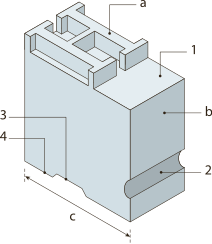
Originally, in metal typesetting, the body height or the font (or point) size was defined by the height of the lead cuboid (metal sort) on which the actual font face is moulded. The body height of a metal sort defined the point size, and was usually slightly larger than the distance between the ascender and descender to allow additional space between the lines of text. More space might be achieved by inserting thin long pieces of lead between the lines of text (that is leading).
In digital fonts, the body is now a virtual, imaginary area, whose height still equals the point size as it did in metal type.
The distance between one baseline and the next is the sum of the body height and the leading, often expressed as "characters per inch vertically" (as in ) or lines of text per inch (not to be confused with lines per inch, a measure of printed photograph resolution).
Footnotes
References
- (22 January 2020). "Typography terms and definitions".
This article was imported from Wikipedia and is available under the Creative Commons Attribution-ShareAlike 4.0 License. Content has been adapted to SurfDoc format. Original contributors can be found on the article history page.
Ask Mako anything about Body height (typography) — get instant answers, deeper analysis, and related topics.
Research with MakoFree with your Surf account
Create a free account to save articles, ask Mako questions, and organize your research.
Sign up freeThis content may have been generated or modified by AI. CloudSurf Software LLC is not responsible for the accuracy, completeness, or reliability of AI-generated content. Always verify important information from primary sources.
Report